GS3 Environment & Bio-diversity
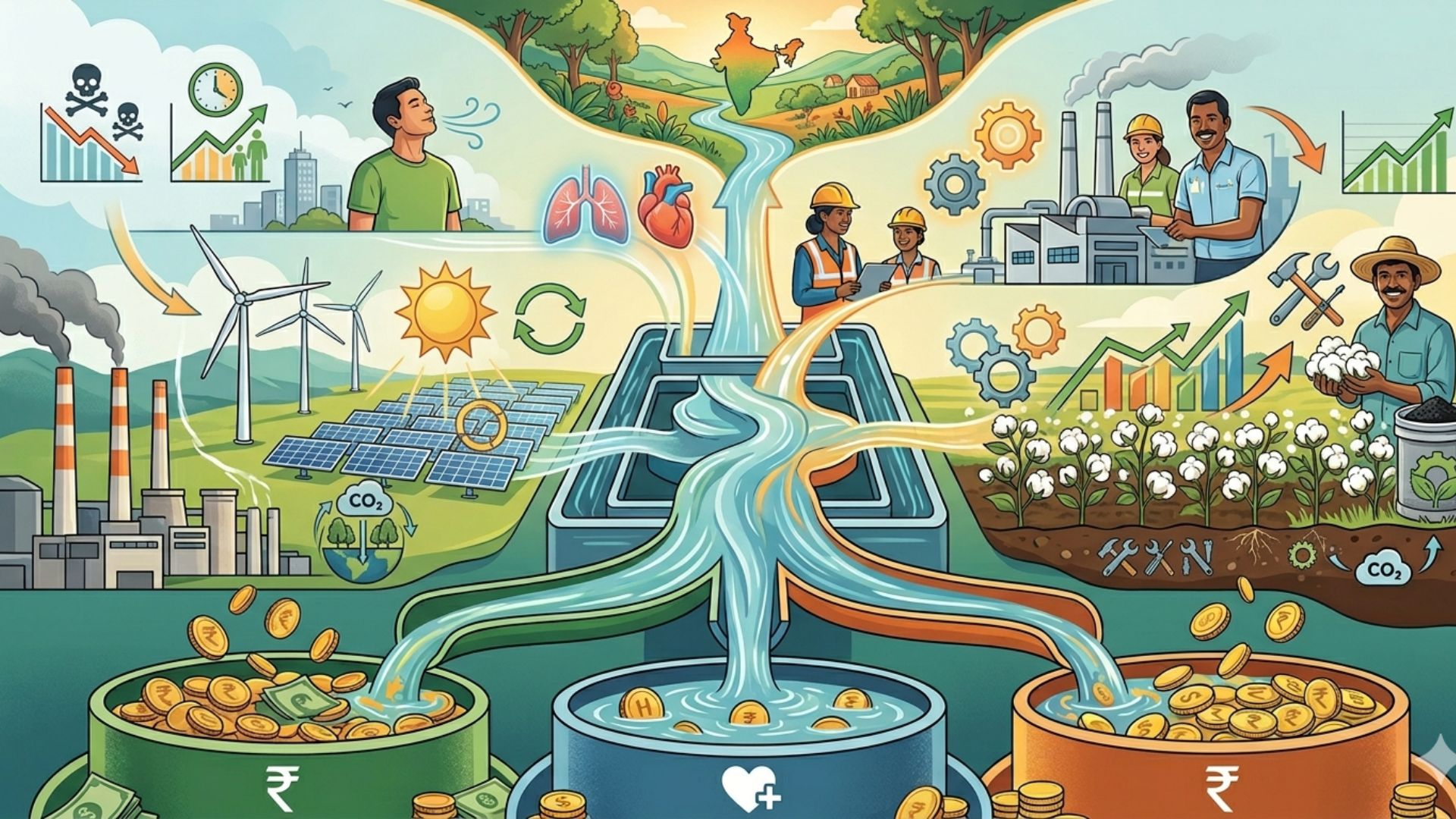
Integrating Climate and Development Finance for Greater Impact

Climate Finance and Development Finance: Two Sides of the Same Coin

Understanding the interconnectedness of climate action and development investment to maximize positive outcomes for society and environment.
Gopi Gopi
4 mins read

Asia possesses substantial pools of capital dedicated to climate action, health, poverty reduction, and sustainable development. However, these investments are often evaluated separately, despite the fact that a single intervention can simultaneously generate environmental, economic, and social benefits. Bridging this disconnect is critical for achieving both climate goals and the Sustainable Development Goals (SDGs).

The Scale of the Financing Challenge

Global and national estimates highlight the urgency of integrated financing.

IndicatorEstimate
Global SDG Financing Gap$4 trillion annually
Share linked to Energy Transition~50%
India's additional investment requirement for SDGs~6% of GDP annually

Notably, sectors contributing most to the SDG financing gap—energy, infrastructure, and health—are also those requiring large-scale climate investments.

Climate Investment
        +
Development Investment
        ↓
Energy + Health + Livelihoods + Resilience

The challenge is therefore not merely a shortage of capital, but the absence of frameworks that recognise multiple returns from the same investment.

"The same investment can simultaneously deliver climate, health, productivity and poverty-reduction outcomes."

Why Current Investment Frameworks Fall Short

Many climate investments are assessed only through their carbon reduction benefits.

However, their actual impact extends much further.

Example: Clean Energy Transition

Benefit TypeOutcome
Climate ReturnLower emissions
Health ReturnReduced air pollution
Productivity ReturnFewer workdays lost
Social ReturnBetter quality of life

India faces significant costs from fossil fuel dependence:

  • Nearly 0.95 million premature deaths annually from fossil fuel combustion.
  • Extreme heat resulted in 247 billion lost working hours in 2024.

Thus, a renewable energy investment creates multiple gains, even though investors often account only for carbon reduction.

Renewable Energy as a Development Multiplier

India's renewable energy sector is projected to create approximately 3.4 million jobs by 2030.

These jobs generate:

  • Employment opportunities
  • Income security
  • Poverty reduction
  • Improved health outcomes
  • Regional economic development
Renewable Energy Project
          ↓
Jobs Created
          ↓
Higher Income
          ↓
Better Health & Lower Poverty

This demonstrates that climate finance can also function as development finance.

Case Study: Kolhapur Foundry Cluster

The Kolhapur foundry cluster represents one of India's largest concentrations of small manufacturing units.

FeatureDetails
Share of India's Cast-Iron Exports~5%
Jobs Supported~27,700

Challenges faced:

  • High electricity consumption
  • Rising carbon compliance costs
  • Impact of EU Carbon Border Adjustment Mechanism (CBAM)
  • Export disruptions from global trade barriers

A shift to renewable power would simultaneously:

  • Reduce emissions
  • Improve export competitiveness
  • Lower energy costs
  • Protect employment

"The energy cost problem, trade competitiveness problem and climate problem are often the same problem."

Case Study: Biochar in Maharashtra's Cotton Belt

A proposed biochar initiative demonstrates how agriculture can generate both climate and development gains.

ImpactOutcome
Farmers Covered10 lakh
Additional Annual Income₹85,000 per farmer
CO₂ Removal1.45 million tonnes annually

Benefits include:

  • Improved soil fertility
  • Higher crop yields
  • Reduced fertilizer dependence
  • Lower pest pressure
  • Carbon sequestration
Biochar Application
         ↓
Healthier Soil
         ↓
Higher Farm Income
         +
Carbon Removal

The farmer's income gain and carbon reduction are simply two different outcomes of the same intervention.

The Role of Philanthropy and Technical Assistance

Many promising projects fail to attract investment because they lack preparation and aggregation.

Important enabling functions include:

  • Aggregating demand from multiple stakeholders
  • Mapping energy requirements
  • Assessing regulatory risks
  • Designing payment security systems
  • Developing investment-ready project pipelines

Commercial investors often avoid funding these early-stage activities but readily invest once projects become financially viable.

Unlocking Capital Through Integrated Frameworks

To mobilise greater investment, financing frameworks must recognise the complete spectrum of returns.

Key outcomes that should be measured include:

  • Financial returns
  • Carbon reduction
  • Employment generation
  • Health improvements
  • Productivity gains
  • Poverty reduction
  • Economic resilience

When these benefits remain invisible, capital allocation is based on an incomplete understanding of value creation.

Way Forward

  • Develop integrated climate-development financing frameworks.
  • Create metrics that capture both financial and social returns.
  • Expand blended finance mechanisms involving governments, philanthropy, and private capital.
  • Strengthen project preparation facilities for climate-resilient investments.
  • Promote carbon markets that also reward livelihood and ecosystem benefits.
  • Encourage investments in renewable energy, sustainable agriculture, and resilient infrastructure.
  • Improve disclosure standards for measuring developmental co-benefits.

Conclusion

The distinction between climate finance and development finance is increasingly artificial. Investments in clean energy, resilient agriculture, and sustainable infrastructure simultaneously generate environmental, economic, health, and social gains. By recognising and valuing these multiple returns, India and Asia can unlock larger pools of capital, accelerate SDG achievement, and build a more resilient and inclusive development pathway.

Attribution

Original content sources and authors

Aravindan Srinivasan Author Aravindan Srinivasan The Hindu Source The Hindu

Syllabus classification

How this article maps to GS papers

Main syllabus

GS3Environment & Bio-diversity

Quick Q&A

What is the concept of integrated climate-development financing and why is it gaining importance in contemporary policymaking?
Integrated climate-development financing refers to an approach that treats investments in climate action, health, poverty reduction and economic development as interconnected rather than separate objectives. Traditionally, climate finance and development finance have been evaluated independently. However, contemporary thinking increasingly recognises that a single investment can simultaneously generate environmental, social and economic benefits. Globally, nearly half of the estimated $4 trillion Sustainable Development Goal (SDG) financing gap is associated with the energy transition. In India, achieving the SDGs is estimated to require additional investments equivalent to around 6% of GDP annually. Sectors such as energy, infrastructure and health constitute both the largest development financing gaps and the most pressing areas for climate investment. For example, replacing coal-based electricity with renewable energy reduces greenhouse gas emissions, improves public health and enhances labour productivity. Fossil fuel combustion causes nearly 0.95 million premature deaths annually in India, while extreme heat led to the loss of 247 billion working hours in 2024. Therefore, climate investments create multiple returns beyond carbon reduction. From the UPSC perspective, the concept connects GS-III themes relating to climate change, sustainable development, infrastructure and economic growth. It also links with GS-II issues concerning welfare and governance. Internationally, frameworks such as the Paris Agreement and the SDGs encourage integrated approaches. The emerging debate focuses on how to quantify social and environmental returns alongside financial returns, thereby ensuring more efficient allocation of capital and promoting inclusive and sustainable development.
Why is recognising multiple returns from climate investments essential for achieving sustainable development goals in India?
Recognising multiple returns from climate investments is crucial because environmental, economic and social outcomes are often inseparable. Conventional investment frameworks focus primarily on financial returns or carbon mitigation benefits, thereby underestimating the overall value generated by climate-related interventions. A clean energy investment, for instance, simultaneously reduces carbon emissions, improves air quality, decreases healthcare burdens and enhances worker productivity. According to estimates, fossil fuel combustion contributes to approximately 0.95 million premature deaths annually in India. Similarly, extreme heat caused the loss of 247 billion working hours in 2024, indicating the productivity costs associated with climate change. India's renewable energy sector is expected to generate nearly 3.4 million jobs by 2030. These jobs contribute not only to economic growth but also to poverty reduction and regional development. Consequently, investments in renewable energy should be viewed through the lens of livelihood creation and social welfare in addition to climate mitigation. The issue is highly relevant for UPSC GS-III topics such as environment, infrastructure, energy security and inclusive growth. It also relates to GS-II themes concerning social justice and public welfare. Different schools of thought exist regarding the valuation of social returns. While economists advocate market-based instruments, development experts stress equity and distributive justice. Ultimately, recognising multiple returns enables governments and investors to design policies that maximise overall societal benefits, accelerate SDG achievement and strengthen India's transition towards a low-carbon and resilient economy.
How can climate investments enhance economic competitiveness, employment generation and resilience in industrial sectors of India?
Climate investments can improve industrial competitiveness and employment by reducing energy costs, ensuring regulatory compliance and promoting sustainable production systems. In the modern global economy, environmental sustainability and economic competitiveness increasingly reinforce each other rather than being opposing objectives. The Kolhapur foundry cluster in Maharashtra provides a useful example. The cluster accounts for nearly 5% of India's cast-iron exports and supports around 27,700 jobs. However, industries in the region face rising carbon compliance costs due to mechanisms such as the European Union's Carbon Border Adjustment Mechanism (CBAM). Simultaneously, they face disruptions arising from global trade barriers and tariff uncertainties. Transitioning these industries to open-access renewable energy can reduce emissions and lower production costs. More importantly, it helps maintain export competitiveness in markets where carbon pricing is becoming increasingly important. Thus, investment in renewable infrastructure strengthens industrial resilience and protects employment. The renewable energy sector itself is projected to create around 3.4 million jobs by 2030, contributing to income generation and poverty reduction. Such investments also diversify local economies and reduce dependence on carbon-intensive industries. From the UPSC perspective, the topic intersects with GS-III themes such as environment, industrial policy, employment and international trade. It also connects with global developments relating to carbon taxation and green protectionism. Critics argue that stringent environmental standards may disadvantage developing countries, whereas proponents view them as opportunities for technological transformation. Therefore, climate investments should be seen as instruments for achieving economic resilience, sustainable industrialisation and long-term competitiveness.
What practical examples demonstrate the synergy between climate action, agricultural sustainability and rural income enhancement in India?
Several practical examples illustrate how climate interventions can simultaneously promote environmental sustainability and rural prosperity. One important example is the proposed biochar programme in Maharashtra's cotton-growing regions. Biochar is a carbon-rich material produced through the thermal decomposition of biomass under limited oxygen conditions. When incorporated into soil, it improves soil fertility, enhances moisture retention and reduces dependence on chemical fertilisers. The programme targeting around 10 lakh farmers is projected to increase annual farm incomes by approximately ₹85,000 per farmer through improved yields and lower input costs. Apart from income enhancement, the intervention is estimated to remove around 1.45 million tonnes of carbon dioxide annually. Thus, the same physical process delivers two outcomes—climate mitigation and agricultural development. Carbon credits generated through such interventions provide additional opportunities for financing and market participation. This example reflects the broader principle that climate action and poverty reduction are complementary rather than contradictory. Similar examples include solar irrigation pumps, micro-irrigation systems and agroforestry practices that improve productivity while reducing environmental degradation. For UPSC aspirants, these case studies are relevant to GS-III topics including agriculture, environment, climate change and food security. They also illustrate the importance of sustainable land management and natural resource conservation. Debates persist regarding access to carbon markets and equitable benefit-sharing mechanisms for small farmers. Nevertheless, such examples demonstrate how climate-smart agriculture can support income growth, ecological restoration and resilience against climate-related shocks.
Critically analyse the challenges involved in mobilising and deploying climate finance effectively in Asia and India.
Although substantial pools of capital exist globally for climate action and sustainable development, effective deployment remains a major challenge. The issue is not merely the availability of resources but the absence of institutional frameworks that recognise the interconnected benefits of investments. Globally, the SDG financing gap is estimated at approximately $4 trillion, with nearly half linked to the energy transition. In India, additional annual investments amounting to around 6% of GDP are required to achieve SDG targets. Despite these needs, climate finance flows remain inadequate. One major challenge is the fragmentation of investment frameworks. Climate, health and poverty reduction are often financed separately, leading to inefficient allocation of resources. Another challenge involves project preparation. Rural water boards, urban local bodies and farmer cooperatives frequently lack the technical capacity needed to attract commercial investment. Regulatory uncertainty, inadequate risk assessment and weak financial instruments also hinder investment. Carbon markets and blended finance mechanisms are still evolving. Moreover, measuring social returns such as health improvements or productivity gains remains difficult. Critics argue that excessive reliance on private capital may neglect issues of equity and public welfare. Others contend that stronger market mechanisms and carbon pricing are essential for accelerating investment. From the UPSC perspective, this issue relates to GS-III topics on environment, infrastructure, economics and disaster resilience, as well as GS-II themes of governance and institutional capacity. Effective climate finance requires coordination among governments, philanthropic institutions and private investors. Building comprehensive frameworks that capture both financial and social returns will be essential for achieving sustainable and inclusive growth.
What role can philanthropy and technical assistance play in unlocking climate finance and strengthening sustainable development initiatives?
Philanthropy and technical assistance have emerged as important catalysts for mobilising climate finance and preparing projects for large-scale investment. Their significance lies not primarily in the volume of funds provided but in their ability to reduce risks and improve project readiness. Commercial investors often hesitate to finance projects during the early stages because of uncertainties relating to demand aggregation, regulatory frameworks and repayment mechanisms. Philanthropic institutions can bridge this gap by supporting feasibility studies, data collection, risk assessments and institutional capacity building. For instance, aggregating energy demand across rural cooperatives, urban local bodies and industrial clusters requires extensive technical expertise and coordination. Once load patterns are mapped, payment security mechanisms are established and regulatory risks are addressed, commercial investors become more willing to participate. Thus, philanthropy acts as a catalyst that unlocks larger pools of private capital. Globally, blended finance models promoted by organisations such as the World Bank and multilateral development banks follow similar principles. Such approaches combine concessional finance with private investment to maximise developmental outcomes. From the UPSC perspective, the issue is relevant to GS-II governance, GS-III environment and economic development, and international institutions. It highlights the importance of public-private partnerships and collaborative governance. However, concerns exist regarding accountability, transparency and excessive dependence on external funding sources. Nevertheless, technical assistance remains indispensable for creating investment pipelines that are analytically robust and financially viable. By making social and environmental benefits visible, philanthropy can help channel resources towards projects that deliver maximum impact in terms of climate mitigation, health improvement, livelihood generation and economic resilience.

Practice questions

1 question for mains preparation

Climate action and economic development are increasingly interlinked in contemporary India. Examine how investments in clean energy and sustainable agriculture can simultaneously contribute to environmental sustainability, employment generation, poverty reduction, and inclusive growth.

10 marks · 150 words · 8 mins
