GS3 Environment & Bio-diversity
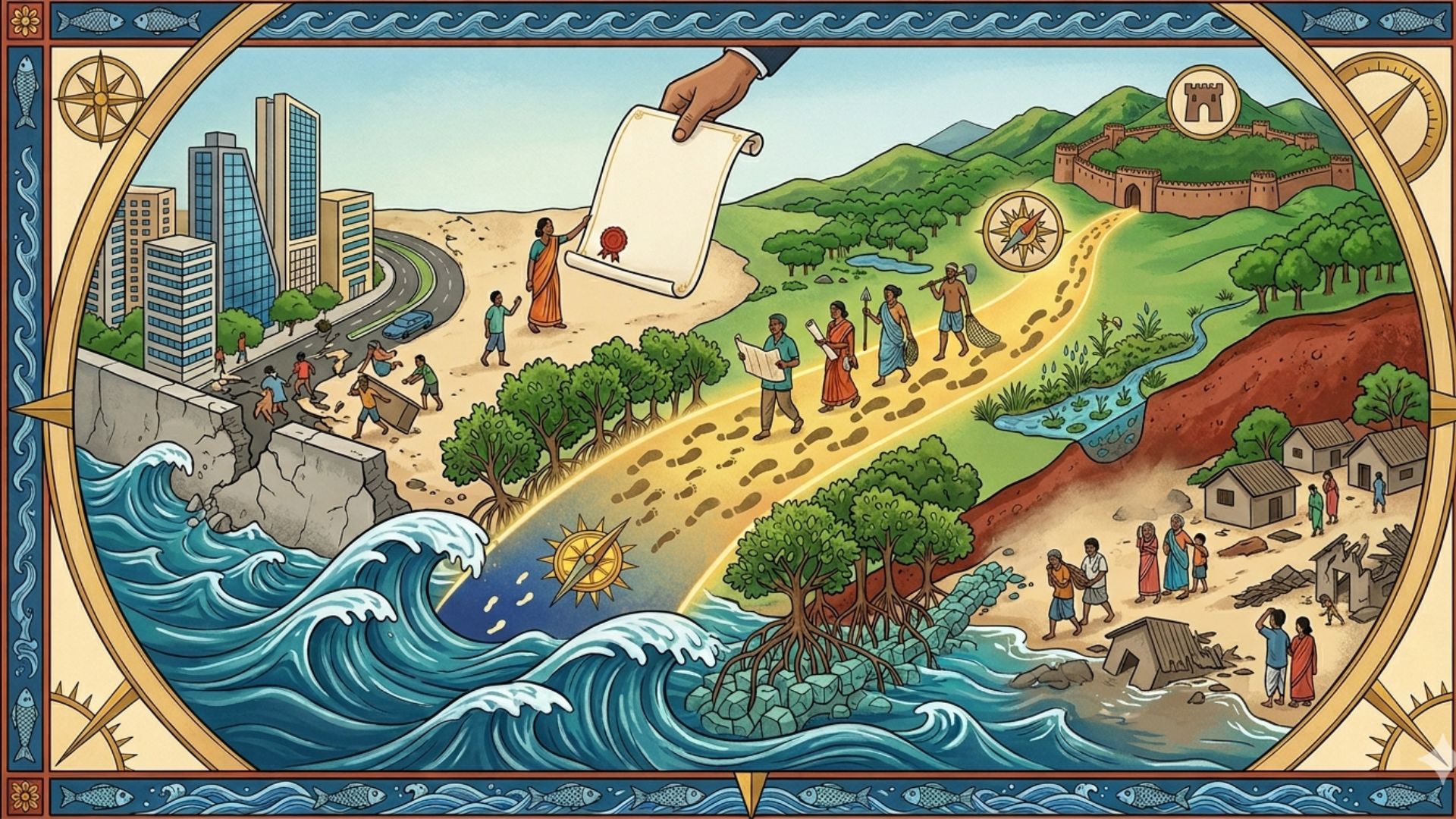
Coastal Climate Adaptation in India: Beyond Seawalls and Retreat

With more than 7,500 km of coastline and millions living in vulnerable coastal regions, India faces a growing challenge of adapting to sea-level rise, coastal erosion, storm surges, and extreme weather events. The debate often revolves around two choices: building hard infrastructure such as seawalls or relocating communities inland. However, a more balanced and equitable third approach is emerging.
India's Coastal Adaptation Dilemma
Climate change is increasing risks across coastal regions:
- Sea-level rise
- Coastal erosion
- Storm surges
- Cyclones
- Saline intrusion
Traditional responses generally fall into two categories:
| Approach | Description |
|---|---|
| Engineering Solutions | Seawalls, embankments, reclamation projects |
| Managed Retreat | Relocation of people and infrastructure away from risk zones |
The challenge is to balance climate protection with social equity and long-term sustainability.
Engineering as a Developmental Off-Ramp
India has consistently argued in global climate negotiations that developing countries require time and flexibility during the transition away from fossil fuels.
A similar argument is sometimes applied to coastal adaptation:
"Using engineering to buy time can be viewed as a developmental right."
Engineering measures can:
- Protect critical infrastructure
- Reduce immediate disaster risks
- Support economic activity
- Provide adaptation time
However, this approach carries risks if not carefully designed.
The Maladaptation Trap
Maladaptation occurs when adaptation measures increase long-term vulnerability or transfer risks elsewhere.
Example: Great Wall of Lagos (Nigeria)
Protection of Financial District
            ↓
Redirection of Tidal Energy
            ↓
Increased Erosion at Alpha Beach
The project protects valuable coastal assets while increasing risks for neighbouring low-income communities.
Example: Mekong Delta (Vietnam)
High dikes were constructed to protect rice-producing regions.
Consequences:
- Reduced sediment deposition
- Faster sinking of the delta
- Increased long-term vulnerability
Example: Kosi River Embankments (India-Nepal)
Under the 1954 Kosi Agreement:
- Large embankments confined the river.
- Sediments accumulated within the channel.
- Riverbed levels rose over time.
River Confinement
        ↓
Sediment Build-up
        ↓
Raised Riverbed
        ↓
Catastrophic Flood Risk
These examples demonstrate how engineering solutions can unintentionally create future risks.
Managed Retreat: The Global Approach
The IPCC identifies Managed Retreat as one of the major coastal adaptation strategies.
"Managed retreat refers to the planned movement of people, infrastructure and assets away from hazard-prone areas."
International Examples
| Country | Strategy |
|---|---|
| United States | Hazard Mitigation Buyouts |
| United Kingdom | Managed Realignment |
| New Zealand | Red-Zoning |
Common features include:
- Government-supported relocation
- Land-use regulations
- Risk-sensitive planning
However, managed retreat often faces:
- Property rights disputes
- Political resistance
- Social inequality concerns
India's Unique Challenges
In India, relocation has often been reactive rather than planned.
Satabhaya, Odisha (2018)
More than 500 families from seven villages were relocated after severe coastal erosion.
While housing was provided:
- Traditional livelihoods were disrupted.
- Families lost access to ancestral lands.
- Many became daily wage labourers.
Similar Challenges
- Sundarbans delta communities
- Coastal fishing settlements
- Informal shoreline habitations
These experiences show that relocation without livelihood planning can deepen vulnerability.
Lessons from Panama
In 2024, Panama relocated the Guna Indigenous community from a sinking island.
Although economically organised, the relocation created:
- Loss of cultural identity
- Reduced access to traditional fishing grounds
- Social dislocation
This highlights that adaptation is not merely physical relocation but also a social and cultural process.
A Third Way: Hybrid Coastal Adaptation
Rather than choosing between seawalls and retreat, a hybrid approach combines:
- Engineering
- Legal reforms
- Planned migration
- Nature-based solutions
Example: Mongla, Bangladesh
The government is transforming Mongla into a climate-resilient town through:
- New schools
- Industrial development
- Raised infrastructure
- Economic opportunities
Climate Risk
       ↓
Planned Economic Centres
       ↓
Voluntary Migration
       ↓
Resilient Communities
Key Components of India's Hybrid Strategy
1. Develop Receiver Cities
- Identify inland growth centres.
- Expand infrastructure and employment opportunities.
- Make migration a choice rather than a compulsion.
2. Reform Coastal Land Laws
Many coastal residents lack formal land titles.
Needed reforms:
- Recognition of informal settlements.
- Legal security for vulnerable communities.
- State-supported relocation rights.
Climate-displaced citizens should be treated as "pioneers" of a new geography, not as refugees or encroachers.
3. Promote Nature-Based Solutions
Natural systems provide adaptive and flexible protection.
Examples include:
- Mangroves
- Bioswales
- Artificial reefs
- Wetland restoration
Lessons from China
Cities such as Shanghai and Ningbo are increasingly adopting:
- Permeable pavements
- Rain gardens
- Wetland restoration
These measures help absorb water rather than merely blocking it.
Way Forward
- Integrate climate adaptation into urban and regional planning.
- Develop climate-resilient receiver cities.
- Strengthen legal protections for coastal communities.
- Expand investment in nature-based solutions.
- Combine grey and green infrastructure approaches.
- Establish buffer zones and sacrificial floodplains.
- Ensure adaptation policies prioritise social equity and livelihoods.
Conclusion
India cannot afford to rely solely on concrete barriers, nor can it depend entirely on retreat. The challenge is to create a balanced adaptation strategy that protects vulnerable populations, preserves livelihoods, and respects social equity. By combining engineering, planned migration, legal reforms, and nature-based solutions, India can build a resilient coastal future while ensuring that climate adaptation remains both effective and just.
Attribution
Original content sources and authors
.jpeg)

Syllabus classification
How this article maps to GS papers
Main syllabus
GS3Environment & Bio-diversityQuick Q&A
What is the concept of managed retreat in climate adaptation, and why is it significant for India's vulnerable coastal regions?
Why is the debate between coastal engineering and managed retreat becoming increasingly important in the context of climate change and social equity?
How can India adopt a hybrid climate adaptation strategy that balances engineering interventions, migration, and ecological sustainability?
What international and Indian examples illustrate the opportunities and limitations of managed retreat and hard engineering approaches?
What are the major criticisms and risks associated with excessive dependence on hard engineering solutions for climate adaptation?
What lessons can India learn from the experiences of Odisha, Bangladesh, and other countries in ensuring equitable climate-induced relocation?
What are the reasons for emphasizing nature-based solutions and legal reforms as essential components of India's long-term climate adaptation strategy?
Practice questions
2 questions for mains preparation