GS3 Environment & Bio-diversity
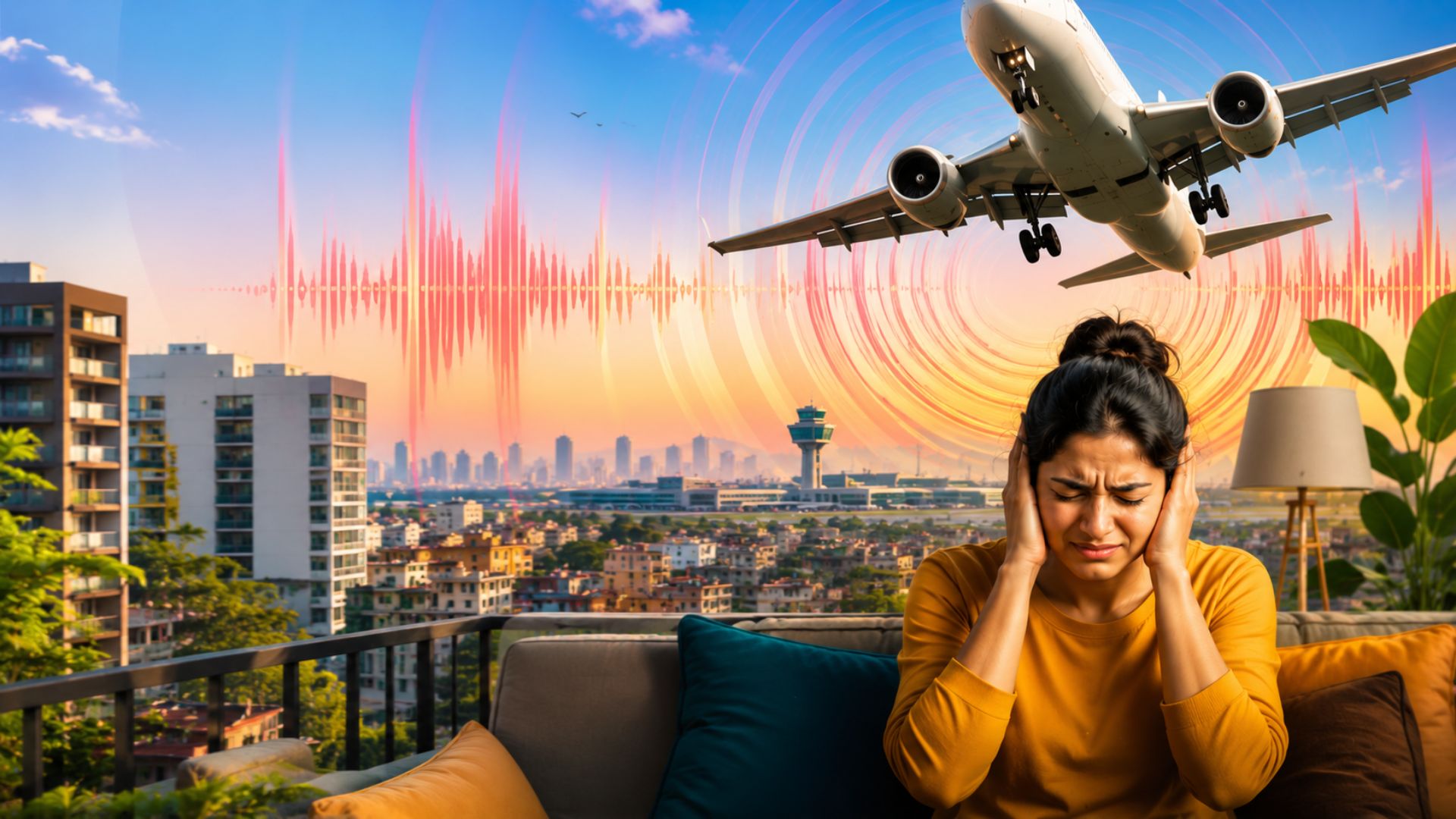
Aircraft Noise Raises Long Term Health Concerns

Environmental Noise Pollution: The Growing Public Health Challenge Around Airports

Chronic exposure to aircraft noise is emerging as a significant environmental health concern, with implications extending beyond hearing loss to broader physiological and psychological well-being.
Dhinesh Balasubramanian Dhinesh Balasubramanian
4 mins read

As India's aviation sector expands, aircraft noise has become a persistent feature of life around major airports. Residents living under flight paths experience repeated noise exposure throughout the day and often during the night. While airports increasingly monitor noise through sophisticated acoustic measurements, concerns are growing that existing regulatory approaches may not adequately capture the long-term health effects of chronic aircraft noise.

The debate is gradually shifting from how much noise exists to what that noise does to human health over time.

Aircraft Noise: More Than a Nuisance

Indian aviation and environmental regulations require airports to map noise exposure using decibel contours.

These assessments:

  • Measure sound intensity around airports.
  • Identify high-noise zones.
  • Track regulatory compliance.

However, researchers argue that monitoring noise levels alone does not fully explain the biological effects of long-term exposure.

"Current aircraft noise assessment frameworks may underestimate broader public health risks because they remain largely centered on hearing damage and decibel thresholds." — Manish Shukla, DRDO Scientist

Emerging Evidence of Biological Stress

Research on aircraft noise in India remains limited.

A 2025 study led by DRDO scientist Manish Shukla examined 621 Air Force personnel chronically exposed to aircraft noise.

Key findings included:

  • Elevated systemic inflammation.
  • Increased oxidative stress.
  • Reduced heart-rate variability.
  • Subclinical cochlear damage.
  • Auditory nerve dysfunction despite normal hearing-test results.

These findings suggest that aircraft noise may function as a chronic biological stressor, affecting multiple body systems beyond hearing.

Chronic Aircraft Noise
           ↓
 Stress Response
           ↓
 Inflammation & Oxidative Stress
           ↓
 Cardiovascular Effects
           ↓
 Long-Term Health Risks

Why Long-Term Exposure Matters

Researchers emphasise that health impacts depend on several factors:

  • Noise intensity.
  • Frequency of exposure.
  • Duration of exposure.
  • Recovery time between events.
  • Night-time disturbances.
  • Lifetime cumulative exposure.

Insufficient recovery, particularly during sleep, can amplify physiological stress responses.

Both the World Health Organization (WHO) and the International Civil Aviation Organization (ICAO) acknowledge the significance of these factors.

The Challenge of Unequal Risk

The burden of aircraft noise is not equally distributed.

Many residents living near airports:

  • Cannot easily relocate.
  • Cannot afford expensive soundproofing measures.
  • Experience daily disruptions to sleep and quality of life.

Rajeev Kariya, a long-time resident near Delhi airport, reported that aircraft noise has intensified over time due to increasing flight frequency and larger aircraft.

Even costly double-glazed windows provided limited relief.

"The continuous noise regularly disrupts sleep and irritates throughout the day."

This highlights how environmental exposure often intersects with socioeconomic constraints.

Limitations of Current Monitoring Systems

Most existing monitoring relies on averaged acoustic indicators.

Common metrics include:

Leq

  • Average acoustic energy over a period.

LDN

  • 24-hour average noise level.
  • Adds 10 dB penalty for nighttime noise.

However, experts argue that aircraft noise differs from steady industrial noise because it occurs as sudden bursts.

Why Averaging Can Be Misleading

Aircraft Take-off
       ↓
 Sudden Noise Peak
       ↓
 Psychological Stress Response

(Average values may fail to capture
these repeated peak events)

Professor Markandeya Tiwari argues that additional metrics are required:

  • L10 (noise exceeded 10% of the time)
  • L50 (median noise level)
  • L90 (background noise level)

These indicators better capture fluctuations and peak exposure periods.

Regulatory and Governance Concerns

Activist Anil Sood has questioned whether current monitoring methods adequately assess:

  • Repeated noise peaks.
  • Night-time disturbances.
  • Long-term health impacts.

According to him:

  • The Central Pollution Control Board (CPCB) is formally responsible.
  • Much compliance monitoring is conducted by airport operators and the Directorate General of Civil Aviation (DGCA).

Former CPCB Regional Director D.K. Soni noted that cumulative exposure assessment remains a low regulatory priority.

Towards Health-Based Monitoring

Experts increasingly advocate moving beyond compliance-focused monitoring.

Recommendations include:

  • Real-time noise monitoring networks.
  • Monitoring around residential and hospital zones.
  • Publicly accessible dashboards.
  • Integration of health data with acoustic assessments.

According to CSIR-NEERI expert Satish K. Lokhande, India's aircraft noise monitoring system requires substantial improvements to address long-term health concerns.

Way Forward

  • Integrate public health considerations into aviation noise regulations.
  • Expand research on long-term biological effects of aircraft noise.
  • Establish real-time monitoring networks around vulnerable zones.
  • Incorporate peak-noise and cumulative-exposure indicators.
  • Improve transparency through public data dashboards.
  • Promote noise-sensitive urban planning near airports.
  • Develop health-based exposure standards alongside acoustic standards.

Conclusion

India possesses increasingly sophisticated tools to measure aircraft noise, but understanding its long-term health implications remains a significant gap. Emerging evidence suggests that chronic exposure may contribute to biological stress, inflammation, cardiovascular effects, and cognitive impacts. As aviation expands, regulatory frameworks must evolve from merely measuring decibels to assessing and mitigating their cumulative effects on human health.

Attribution

Original content sources and authors

Author Kushagra Rajendra, The Hindu Source The Hindu

Syllabus classification

How this article maps to GS papers

Main syllabus

GS3Environment & Bio-diversity

Also covers

GS3Infrastructure

Quick Q&A

What is chronic aircraft noise exposure and why has it emerged as a significant public health and environmental concern in India?
Chronic aircraft noise exposure refers to the repeated and prolonged exposure of individuals and communities to noise generated by aircraft takeoffs, landings, and associated airport operations. Traditionally, aviation noise regulation in India has focused on decibel thresholds and hearing loss. However, emerging scientific evidence suggests that aircraft noise should be viewed as a broader biological and public health issue rather than merely an acoustic problem. India's major airports such as Delhi, Mumbai, Bengaluru, Hyderabad, and Chennai are surrounded by densely populated residential areas. According to aviation regulations, airports are required to map noise exposure using decibel contours, but these measurements often fail to capture the cumulative physiological impacts of repeated sound peaks. A 2025 study led by Manish Shukla of DRDO's Defence Institute of Physiology and Allied Sciences examined 621 Air Force personnel exposed to chronic aircraft noise. The study found elevated systemic inflammation, oxidative stress, reduced heart-rate variability, and evidence of subclinical cochlear and neural damage despite normal hearing tests. These findings suggest that chronic noise may affect cardiovascular and auditory systems. The World Health Organization (WHO) and the International Civil Aviation Organization (ICAO) have increasingly recognized links between environmental noise, stress, sleep disruption, and cardiovascular diseases. The issue therefore intersects with GS Paper III topics such as Environment, Science and Technology, and Public Health, while also touching upon urban planning and sustainable development. It highlights the need to move beyond decibel-centric regulation towards health-based environmental governance.
Why is the issue of aircraft noise and its health implications important for UPSC aspirants and contemporary policy debates?
The issue of aircraft noise is important for UPSC aspirants because it represents the intersection of public health, environmental governance, urbanization, science and technology, and social justice. Such multidimensional issues frequently appear in UPSC Mains and personality tests, where candidates are expected to demonstrate analytical and interdisciplinary understanding. India is experiencing rapid growth in aviation infrastructure under schemes such as UDAN and expanding airport capacity. As aircraft traffic increases, millions of people living near airports may be exposed to chronic noise. Yet regulatory frameworks remain focused primarily on compliance with acoustic standards rather than on long-term biological consequences. The issue has gained significance because scientific studies worldwide and emerging Indian evidence indicate links between chronic noise exposure, stress-related inflammation, cardiovascular diseases, sleep disturbances, and cognitive effects. WHO guidelines acknowledge these risks, thereby making the issue part of global health and sustainable development discussions. From a policy perspective, the debate raises questions about environmental justice. Wealthier citizens may afford soundproofing measures or relocation, whereas economically weaker sections often bear disproportionate exposure. Activists such as Anil Sood have highlighted these concerns through RTI applications and legal proceedings. For UPSC preparation, the topic relates to GS Paper II (governance and regulatory institutions), GS Paper III (environment, infrastructure, health, and technology), and Essay papers. It also illustrates the need for evidence-based policymaking and balancing economic development with citizens' right to health under Article 21 of the Constitution. Therefore, aircraft noise serves as an important case study in sustainable and inclusive development.
How are aircraft noise levels currently monitored in India and what are the limitations of existing assessment methodologies?
Aircraft noise monitoring in India primarily relies on acoustic indicators and regulatory compliance mechanisms. Airports prepare decibel contour maps that represent variations in sound pressure around airports. Monitoring responsibilities formally lie with the Central Pollution Control Board (CPCB), while airport operators and the Directorate General of Civil Aviation (DGCA) play major roles in compliance and implementation. Commonly used metrics include Leq and LDN. Leq represents average acoustic energy over a period, whereas LDN incorporates a 10-decibel penalty for nighttime noise. These indicators have traditionally been effective for measuring continuous industrial noise. However, experts such as Markandeya Tiwari, former faculty member at IIT-BHU, argue that aircraft noise is fundamentally different because it is intermittent and characterized by sudden peaks. Average indicators fail to capture the psychological and physiological impacts of repeated bursts of sound. Additional metrics such as L10, L50, and L90 are required to assess peak exposure and fluctuations. Former CPCB regional director D.K. Soni has observed that cumulative exposure assessment remains a low regulatory priority. Likewise, CSIR-NEERI expert Satish K. Lokhande has emphasized the need for real-time monitoring networks and public dashboards, particularly around hospitals and residential areas. The existing framework is criticized for emphasizing decibel thresholds while ignoring sleep disturbances, recovery periods, and cumulative biological stress. This creates a widening gap between technical monitoring and actual health outcomes. For UPSC, this issue demonstrates the challenges of environmental regulation, institutional coordination, and evidence-based governance. It also highlights the limitations of traditional metrics when dealing with emerging public health concerns and technological externalities.
What are the major reasons behind the widening gap between aircraft noise regulation and understanding of biological health risks in India?
The widening gap between aircraft noise regulation and biological risk assessment in India is attributable to scientific, institutional, and socio-economic factors. Historically, environmental regulations focused primarily on preventing hearing loss and ensuring compliance with prescribed noise levels. Consequently, broader health implications received limited attention. One major reason is the scarcity of long-term epidemiological studies in India. Most available research has been conducted in occupational settings such as among Air Force personnel rather than among civilian populations residing near airports. This limits the availability of evidence for public-health policymaking. Second, existing regulatory metrics such as Leq and LDN are based on average sound exposure and do not adequately capture intermittent noise peaks, sleep disturbances, or cumulative stress effects. Experts have argued that these indicators underestimate the true burden of aircraft noise. Third, institutional fragmentation creates challenges. Although the CPCB is formally responsible for monitoring, airport authorities and the DGCA undertake much of the compliance process. Coordination between health agencies, environmental institutions, and aviation regulators remains inadequate. Fourth, economic priorities often overshadow health considerations. India's rapidly expanding aviation sector contributes significantly to connectivity and economic growth, making policymakers reluctant to impose stringent regulations that may increase operational costs. Social inequalities further aggravate the problem. Residents living near airports may lack resources to relocate or install effective soundproofing systems. Activists such as Anil Sood have raised concerns through litigation and RTI mechanisms. From a UPSC perspective, this issue reflects governance deficits, regulatory challenges, and environmental justice concerns. It underscores the need for integrated policymaking, a recurring theme in GS Paper II and GS Paper III.
Critically analyse the adequacy of India's present aircraft noise governance framework from the perspectives of public health and environmental justice.
India's existing aircraft noise governance framework has strengths in terms of technical monitoring and regulatory compliance, but it exhibits significant shortcomings from public health and environmental justice perspectives. On the positive side, airports are required to prepare noise contour maps and comply with prescribed standards. The framework demonstrates increasing technical sophistication and aligns with international practices recommended by organizations such as ICAO. These measures contribute to aviation safety and environmental management. However, critics argue that the framework remains excessively decibel-centric. It largely measures sound intensity without adequately assessing biological consequences such as inflammation, cardiovascular stress, sleep deprivation, and cognitive effects. Emerging scientific evidence, including the 2025 DRDO study involving 621 Air Force personnel, suggests that the health impacts of chronic aircraft noise extend beyond hearing impairment. Another limitation concerns environmental justice. Individuals living near airports often belong to middle- and lower-income groups who may lack the financial capacity to relocate or undertake effective soundproofing. Consequently, the burden of exposure is distributed unequally. Transparency and accountability are also subjects of debate. Activists have questioned official methodologies and highlighted the need for independent assessments. Experts advocate real-time monitoring systems and publicly accessible dashboards. A balanced approach would require integrating acoustic data with epidemiological evidence, strengthening inter-agency coordination, and incorporating health-based standards into aviation regulations. Compensation mechanisms and better urban planning should also be considered. The issue embodies the broader challenge of reconciling economic development with citizens' right to health and a clean environment under Article 21. It is relevant to GS Paper II, GS Paper III, ethics, and essay writing, where balanced critical analysis is highly valued.
What lessons can be drawn from the experiences of residents, researchers, and activists regarding aircraft noise exposure in India?
The experiences of affected residents, scientific researchers, and civil society activists provide an important case study in environmental governance and participatory policymaking. These stakeholders collectively reveal that aircraft noise is not merely a technical issue but a socio-economic and public-health challenge. Residents living near major airports have reported increasing disturbances due to larger aircraft, increased flight frequencies, and extended runway operations. For example, Rajeev Kariya, who has lived near Delhi airport for decades, has described persistent sleep disruption and daily irritation. Despite investing in expensive double-glazed windows, he found that noise and vibrations continued to affect his quality of life. Scientific research has added another dimension. The 2025 DRDO study led by Manish Shukla demonstrated elevated inflammation, oxidative stress, and neural damage among chronically exposed Air Force personnel. These findings indicate that long-term exposure may produce hidden biological effects even when hearing tests appear normal. Civil society interventions have also played a crucial role. Activist Anil Sood has spent nearly 17 years pursuing RTI applications and legal remedies to question monitoring methodologies and demand greater accountability. Such efforts illustrate the importance of citizen participation in democratic governance. Experts from IIT-BHU, CSIR-NEERI, and former CPCB officials have recommended adopting advanced metrics, real-time monitoring systems, and health-oriented standards. This case study highlights the significance of evidence-based policymaking, transparency, and environmental justice. For UPSC candidates, it demonstrates how scientific findings, citizen activism, and institutional responses interact to shape public policy. It also offers valuable insights for GS Paper II, GS Paper III, and Ethics, particularly regarding responsiveness and accountability in governance.

Practice questions

1 question for mains preparation

Rapid expansion of airports and air traffic has increased concerns regarding aircraft-induced noise pollution. Discuss the impact of chronic aircraft noise exposure on public health and suggest measures for sustainable airport planning and noise management.

15 marks · 250 words · 8 mins