GS3 Environment & Bio-diversity
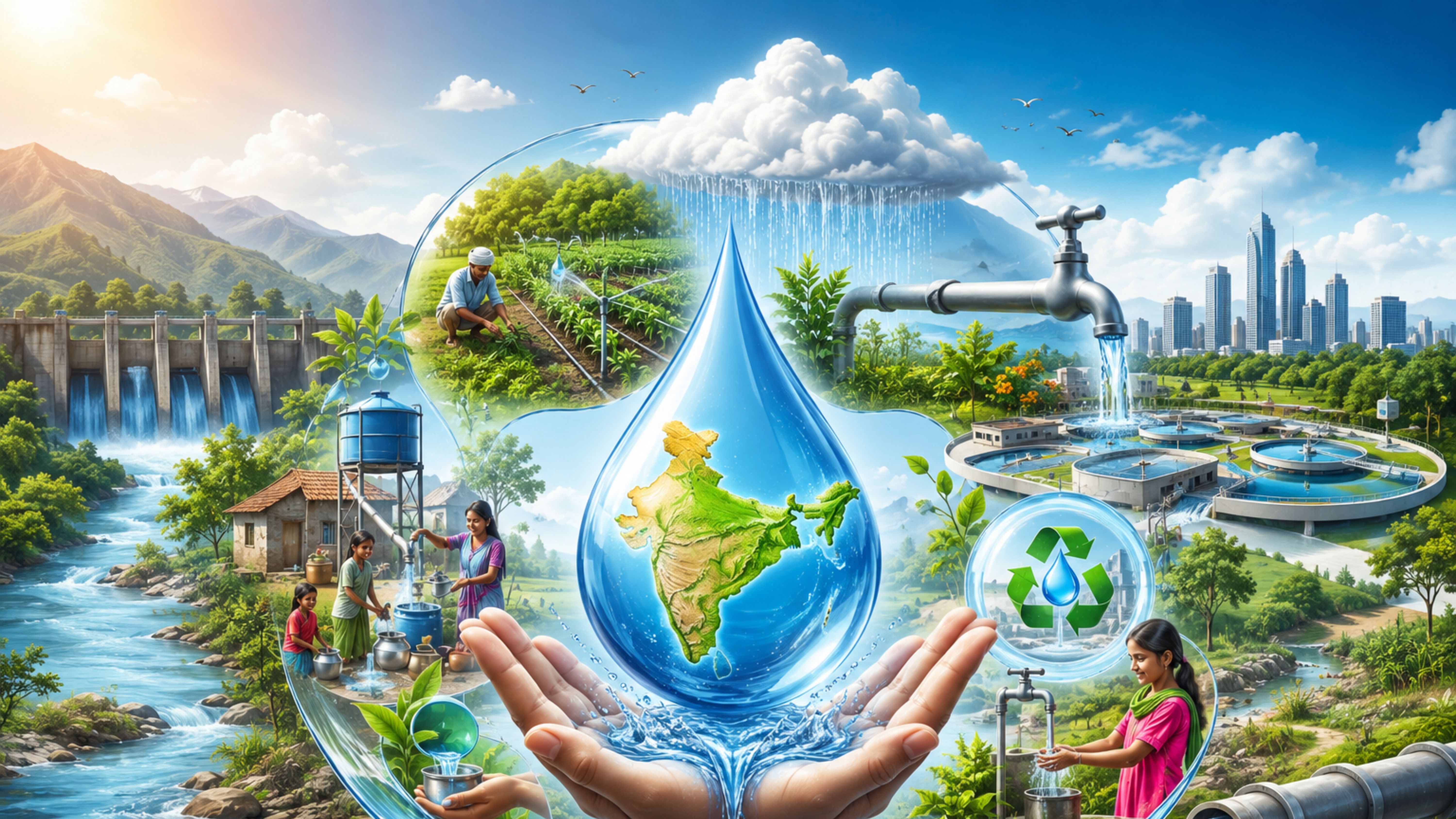
How India is Transforming Water Governance for Sustainability

India's water crisis is routinely framed as a problem of scarcity. The deeper reality is a paradox — the country receives nearly 4,000 billion cubic metres of annual rainfall, yet only a fraction is captured, stored, or used efficiently. The central question for policymakers is not how much water India has, but how that water is governed.
The Numbers Behind the Paradox
India's hydrological arithmetic is striking in its contradictions:
- Supports nearly one-fifth of the world's population
- Access to only 4% of global freshwater resources
- Around 600 million people face high to extreme water stress (NITI Aayog Composite Water Management Index)
- Of total annual precipitation, only about 1,100 billion cubic metres are considered usable — due to storage limitations, uneven rainfall distribution, and ecological constraints
The decline in per-capita availability tells the story most sharply:
Post-Independence   →   5,000 cubic metres per person annually
Present day         →   ~1,400 cubic metres per person annually
The principal coping mechanism has been groundwater extraction. India is now the world's largest groundwater user, accounting for roughly a quarter of global extraction. While this has enabled agricultural expansion and rural livelihoods, it has caused declining water tables across several regions. The conclusion is unavoidable — India's water crisis is as much institutional as it is hydrological.
How Water Governance Works in India
India's water governance operates through a complex, multi-level structure:
- Ministry of Jal Shakti — nodal authority for water resources, drinking water, and sanitation
- Central Water Commission — surface water planning, river basin development, flood control
- Central Ground Water Board — scientific assessment of groundwater resources and aquifer management
- NITI Aayog — evaluates State-level water governance performance through the Composite Water Management Index, introducing accountability and evidence-based policymaking
However, India's federal structure places most water responsibilities with State governments — irrigation, water supply, and groundwater regulation fall within State jurisdiction. State irrigation departments, urban water boards, and local bodies are the primary implementers. This multi-layered design reflects federal logic but also creates coordination challenges and institutional fragmentation.
National Missions: Bridging the Gap
To address fragmentation, the Union government has aligned central funding with State implementation through targeted missions:
- Jal Jeevan Mission (2019) — functional tap connections to every rural household; extended to 2028 for universal coverage
- Atal Bhujal Yojana — participatory aquifer management in water-stressed regions; promotes community-based groundwater budgeting and monitoring
- Pradhan Mantri Krishi Sinchayee Yojana — micro-irrigation technologies to improve agricultural water efficiency; critical given that agriculture consumes the majority of India's freshwater
- Atal Mission for Rejuvenation and Urban Transformation (AMRUT) — expands urban water supply networks, sewage treatment, and wastewater reuse
- Namami Gange Programme — combines pollution control, sewage treatment, and ecological restoration in the Ganga basin
Toward a Circular Water Economy
Global best practices point toward an integrated, circular approach to water management:
- Wastewater recycling in cities to ease pressure on freshwater sources
- Improved crop choices and irrigation methods to raise agricultural water productivity
- Technological innovation combined with participatory community governance
- Scientific knowledge integration into policy planning at all levels
India's water future will depend less on how much rain it receives and more on how effectively it is governed.
Conclusion
India's water challenge sits at the intersection of hydrology, federalism, and institutional capacity. The country has the rainfall — what it lacks is the governance architecture to capture, distribute, and conserve it equitably. As India works toward SDG Goal 6 (clean water and sanitation) and its Viksit Bharat 2047 aspirations, transforming water governance from fragmented administration to integrated, data-driven, and participatory management is not optional — it is foundational to sustained economic growth and social well-being.
Attribution
Original content sources and authors

Syllabus classification
How this article maps to GS papers
Main syllabus
GS3Environment & Bio-diversityQuick Q&A
What explains the paradox that India receives abundant rainfall yet faces a severe water crisis?
The crisis is worsened by declining per capita availability. After independence, annual per capita water availability exceeded 5,000 cubic metres; today it has fallen to nearly 1,400 cubic metres. This decline reflects population growth, urbanisation, industrial demand, and agricultural overuse. Groundwater has become the default coping mechanism, making India the largest extractor of groundwater globally, accounting for nearly 25% of world extraction.
Key dimensions of the paradox:
- High annual rainfall but low capture efficiency
- Dependence on monsoon-driven storage
- Excessive groundwater exploitation
- Fragmented governance across institutions
Why is India’s water crisis increasingly seen as an institutional challenge rather than merely a hydrological one?
Institutional failures include weak groundwater regulation, fragmented river basin management, and lack of integrated planning between drinking water, irrigation, sanitation, and urban supply. Water is often managed in silos rather than as a shared ecological system. The article highlights that governance determines whether water becomes scarce or sufficient.
Why this matters:
- Policy fragmentation reduces efficiency
- State-level capacity varies widely
- Data-sharing between agencies remains weak
- Local participation is limited in planning
How does India’s federal structure shape water governance and create both opportunities and challenges?
However, this decentralisation also creates coordination problems. Inter-state river disputes, fragmented aquifer management, and uneven administrative capacity often weaken outcomes. Central agencies such as the Central Water Commission and Central Ground Water Board provide technical guidance, but implementation depends heavily on States and local bodies.
Advantages:
- Regional flexibility
- Local adaptation to ecological conditions
- Scope for innovation by States
- Inter-state disputes (e.g., Cauvery)
- Weak local institutional capacity
- Policy duplication
What are the major reasons behind unsustainable groundwater extraction in India?
The lack of effective groundwater regulation is another major reason. Since groundwater is often linked to land ownership, private extraction remains difficult to regulate. Scientific aquifer mapping has improved, but enforcement remains weak. Community participation in groundwater budgeting is still limited.
Main causes:
- Water-intensive crops like paddy and sugarcane
- Subsidised electricity encouraging over-pumping
- Weak groundwater laws
- Monsoon uncertainty
Critically analyse the effectiveness of major government initiatives such as Jal Jeevan Mission and Atal Bhujal Yojana.
However, effectiveness depends on sustainability beyond physical infrastructure. In some regions, household taps exist but water supply remains intermittent. Similarly, groundwater budgeting under Atal Bhujal is innovative, but community adoption varies and local capacity constraints remain significant.
Strengths:
- Mission-mode implementation
- Data-driven monitoring
- Community participation
- Uneven implementation
- Long-term maintenance issues
- Source sustainability concerns
What role can a circular water economy play in addressing India’s water challenges?
In urban India, wastewater treatment offers significant opportunities. Treated wastewater can be reused for industrial purposes, landscaping, and agriculture, reducing dependence on freshwater. In rural areas, micro-irrigation and crop diversification can improve productivity per unit of water.
Key measures:
- Wastewater recycling in cities
- Drip irrigation
- Rainwater harvesting
- Crop pattern rationalisation
How can India align its water governance with Sustainable Development Goal 6 and Vision 2047?
A long-term strategy should combine scientific data, digital monitoring, community participation, and institutional coordination. Strengthening local water bodies, restoring wetlands, and creating basin-level governance authorities are essential. Public awareness and demand-side management must complement infrastructure expansion.
Way forward:
- Integrated river basin management
- Water-efficient agriculture
- Smart metering and digital monitoring
- Decentralised community institutions
Practice questions
1 question for mains preparation