GS3 Environment & Bio-diversity
India's Coastal Plastic Crisis

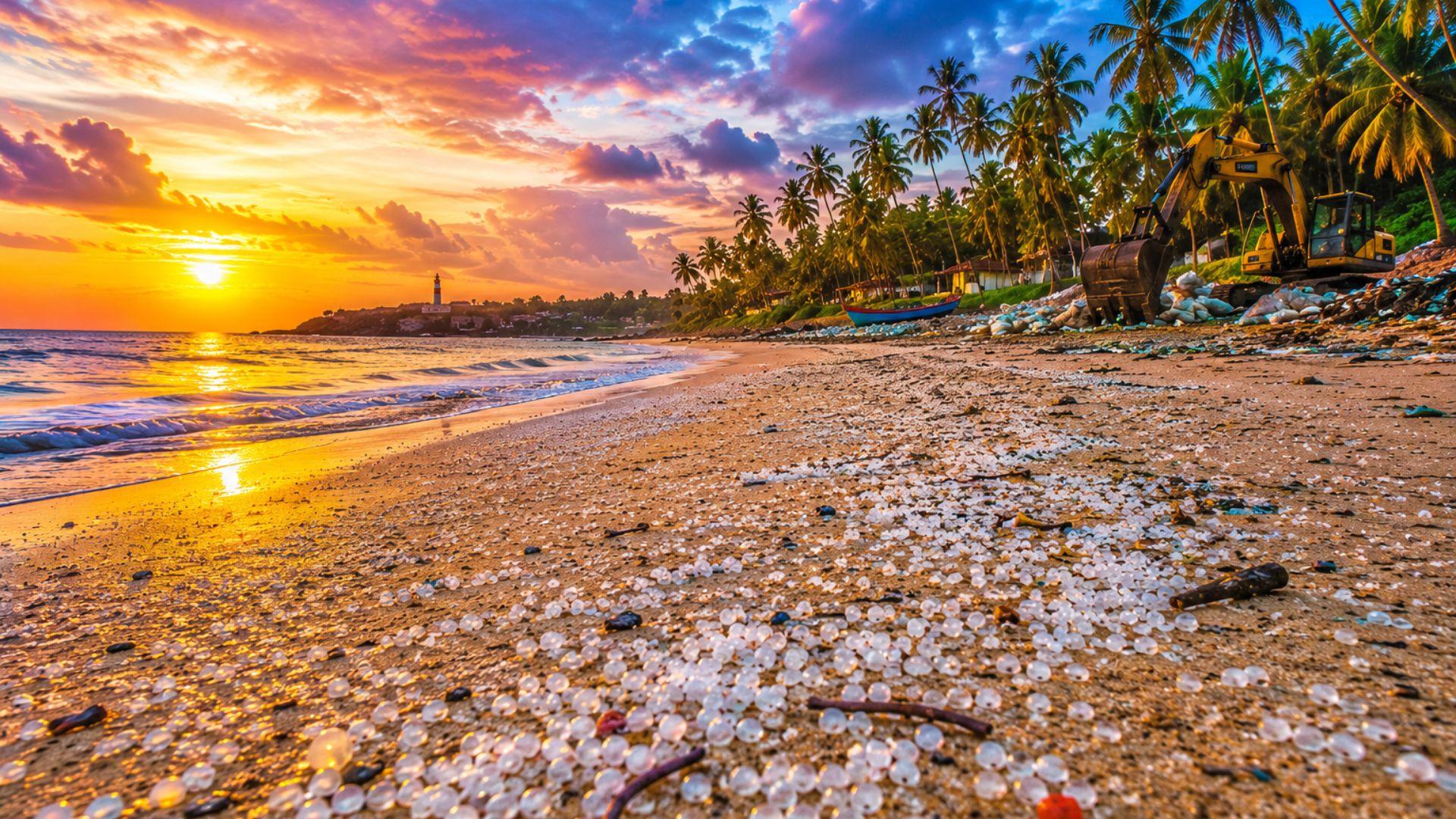
A year after the Liberian-flagged vessel MSC Elsa 3 sank off Kerala's coast, the beaches of coastal Thiruvananthapuram continue to bear the scars — not of oil, but of millions of tiny plastic pellets called nurdles. The disaster has exposed India's unpreparedness for a class of marine pollution that is silent, persistent, and deeply dangerous.
The Incident
The MSC Elsa 3 listed to one side and sank approximately 14.6 nautical miles off the Kerala coast over May 24–25, 2025. The ship carried 643 containers, several of which washed ashore across Kerala's coastal districts in the days that followed. Recognising its scale, the Kerala government on May 29, 2025 declared the wreckage a 'State-specific disaster' citing its "potentially serious environmental, social and economic impact."
What Are Nurdles?
Nurdles are pre-production plastic pellets — the raw material from which most plastic products are manufactured.
- Size: 1 mm to 5 mm in diameter — classified as primary microplastics
- Material: Made from polyethylene or polyvinyl chloride (PVC)
- Nature: Non-toxic in themselves, but non-biodegradable — can persist for years
- Buoyancy: Float easily, making them highly mobile across ocean currents
- Danger: Their minuscule size allows them to be ingested by fish and marine organisms, eventually entering the human food chain
Unlike oil spills, nurdles leave no visible slick. They blend into sand, drift with currents, and resist conventional clean-up methods — making them one of the most insidious forms of marine pollution.
Ground Reality: One Year Later
Despite initial clean-up efforts, nurdles remain visibly present on beaches including Kannanthura (north of Shanghumughom) and Hawa Beach (Eve's Beach) near Kovalam. The firm tasked with onshore salvage has ceased beach clean-up operations.
A Directorate General of Shipping situation report from August 2025 captured the plateau:
"Clean-up efforts remain active, with 600 volunteers currently engaged. However, the daily collection of nurdles has plateaued, with the cumulative recovery estimated to be in the range of 629–639 metric tons."
The numbers sound significant, but with monsoon-driven rough seas regularly pushing fresh pellets ashore, the problem is cyclical rather than contained.
The Deeper Threat
Two expert voices frame the long-term risk clearly.
FML (Friends of Marine Life) convener Robert Panipilla warned:
"The sea here has turned rough now, so there is always a possibility of pellets floating about in the sea getting washed ashore."
He also pointedly noted Kerala's relative inexperience in handling such disasters, calling for heightened alertness.
Dr. A. Biju Kumar, Vice-Chancellor of KUFOS, stressed the permanence of the threat:
"Being non-biodegradable, the pellets could last for years, and depending on the patterns of ocean currents they could move about and wash ashore."
The approaching southwest monsoon adds further uncertainty — rough seas could mobilise pellets still lying on the seabed or in shallow coastal waters.
Way Forward
- Establish a dedicated coastal disaster response protocol for microplastic and nurdle spills, distinct from oil spill frameworks.
- Make salvage firms legally accountable for sustained, long-term clean-up — not just the immediate aftermath — with performance benchmarks and penalties for early cessation.
- Deploy ocean current modelling to predict nurdle washup patterns ahead of monsoon seasons and pre-position clean-up resources.
- Invest in specialised nurdle collection technology — standard beach clean-up equipment is ill-suited for pellets mixed with sand.
- Strengthen marine biodiversity monitoring in affected zones to track bioaccumulation in fish and other organisms.
- Push for international regulation of nurdle transport — the IMO's existing MARPOL framework needs a specific provision for pre-production plastic pellet spills.
Conclusion
The MSC Elsa 3 disaster is a case study in how a single maritime accident can trigger a slow-burning ecological crisis. Nurdles do not make headlines the way oil spills do, but their persistence, mobility, and entry into the food chain make them equally — if not more — dangerous over time. India's coastal states, particularly Kerala, must treat this not as a localised clean-up exercise but as a long-term environmental governance challenge demanding institutional capacity, legal accountability, and scientific monitoring.
Attribution
Original content sources and authors

Syllabus classification
How this article maps to GS papers
Main syllabus
GS3Environment & Bio-diversityAlso covers
Practice questions
1 question for mains preparation