GS3 Environment & Bio-diversity
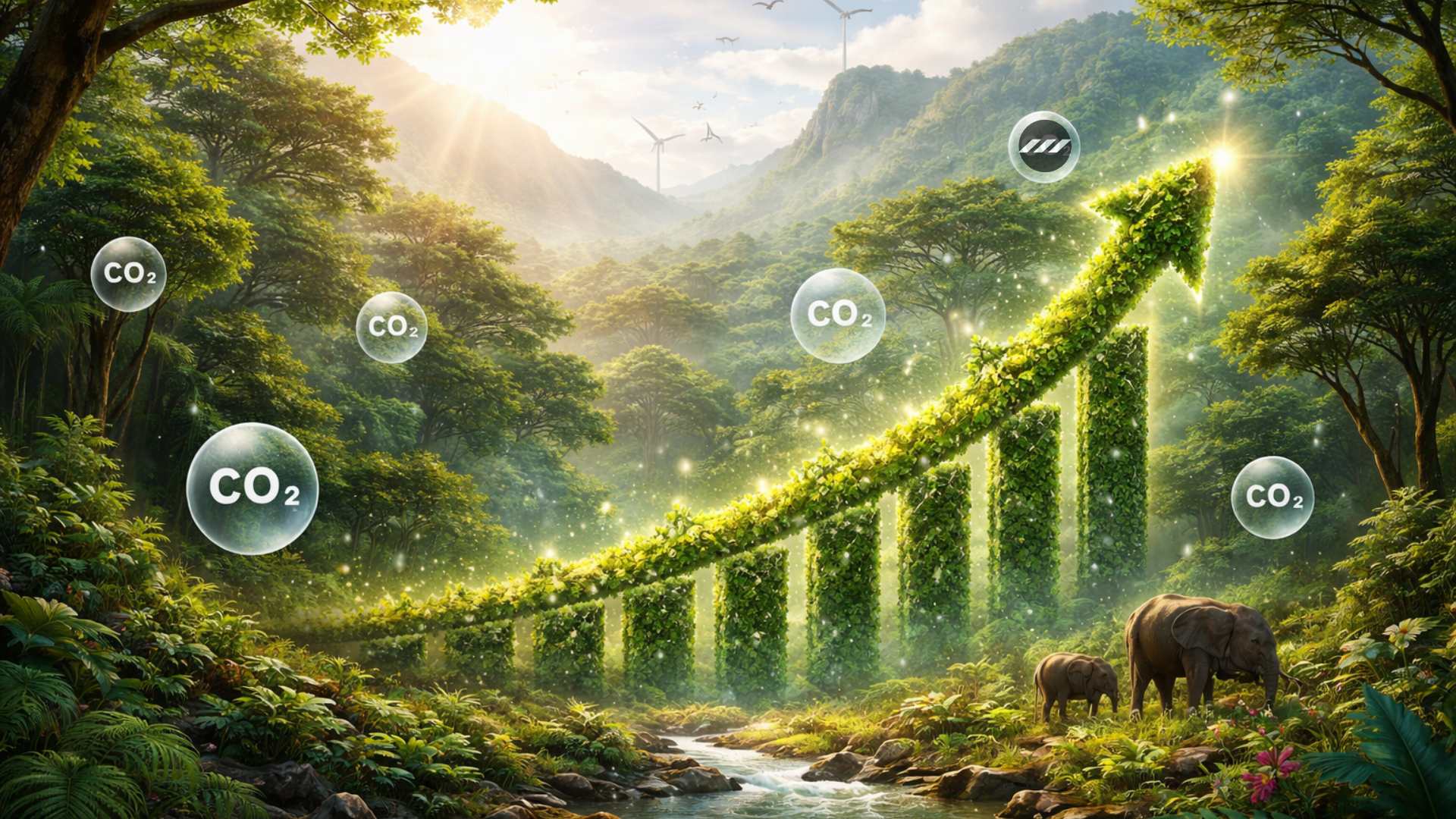
India's Forests: A Key Player in Carbon Storage by 2100

Introduction
"Climate change is not just about rising temperatures — it is silently rewriting every sector, including our forests. If we undermine our forests today, we risk amplifying emissions tomorrow." — Fathima Fitha, Lead Author, Environmental Research: Climate (2025)
A new multi-institute Indian modelling study projects that India's forest vegetation carbon biomass could rise by up to 97% by 2100 under high-emissions scenarios — nearly double current levels. Yet this apparent gain masks deeper ecological risks, diverges from FSI ground data, and raises critical questions about India's carbon sink targets under its updated NDC.
| Scenario | Carbon Biomass Increase by 2100 |
|---|---|
| Low emissions | +35% |
| Medium emissions | +62% |
| High emissions (fossil-fuel intensive) | +97% |
| FSI documented stock (2013) | 6.94 billion tonnes |
| FSI documented stock (2023) | 7.29 billion tonnes |
| FSI projection (2030) | 8.65 billion tonnes |
| India's NDC forest sink target (2035) | 3.5–4 billion tonnes CO₂ eq. |
Background & Context
India's forests cover approximately 21.7% of total geographical area (FSI 2023) and are a critical component of the country's Nationally Determined Contribution (NDC) under the Paris Agreement. India's updated NDC (approved by Union Cabinet, 2025) raises the forest carbon sink target to 3.5–4 billion tonnes of CO₂ equivalent by 2035.
This study is significant as it is among India's first forest dynamics modelling efforts using a second-generation dynamic global vegetation model (DGVM) — moving beyond static field measurements to simulate future forest trajectories under climate scenarios.
Key Concepts
1. VEGETATION CARBON BIOMASS
   ┌─────────────────────────────────────────────────────────┐
   │ Carbon stored in LIVING plant matter                    │
   │ (above ground: trunk, branches + below ground: roots)  │
   │ Rising biomass = more CO₂ pulled from atmosphere        │
   └─────────────────────────────────────────────────────────┘
   More biomass → more sequestration → climate mitigation ✓

2. DYNAMIC GLOBAL VEGETATION MODEL (DGVM)

   FSI Approach          vs.        DGVM (This Study)
   ──────────────────────────────────────────────────
   Field measurement              2nd-gen simulation
   + Remote sensing               of future scenarios
   Observed conditions            Climate variables:
   Historical + near-term    →    temp + rainfall + CO₂
   (till 2030)                    Long-term (till 2100)

   DGVM = more sophisticated | simulates FUTURE trajectories

3. CO₂ FERTILISATION EFFECT

   Atmospheric CO₂ ↑
          ↓
   Photosynthesis rate ↑ ──→ faster biomass growth
   Water-use efficiency ↑ ──→ trees need less water
          ↓
   KEY DRIVER of projected carbon increase
   ⚠ But: does not mean forests are ecologically healthier

4. CARBON SINK vs. CARBON STOCK

   STOCK  =  Total carbon stored AT A POINT IN TIME
             (like a bank balance)

   SINK   =  NET absorption of CO₂ OVER TIME
             (like monthly savings rate)

   India's NDC target → SINK enhancement
   (3.5–4 billion tonnes CO₂ eq. by 2035)
   NOT just maintaining existing stock

5. RAINFALL LAG EFFECT

   Heavy rainfall year
          ↓
   Forests do NOT respond instantly
          ↓
   Woody biomass accumulates SLOWLY over time

   Low / Medium emissions  →  ~2 year lag
   High emissions          →  ~4 year lag

   Why longer lag under high emissions?
   → More extreme events + greater climate variability
   → Forests need more time to stabilise and respond

═══════════════════════════════════════════════════════════════
CONNECT ALL 5:
  CO₂ ↑ + Rainfall ↑ → Biomass ↑ (via DGVM projection)
  But Rainfall Lag + Ecosystem stress = delayed/uncertain gains
  Stock ↑ ≠ Sink target met ≠ Ecological health assured
  FSI measures reality | DGVM models risk — BOTH needed
═══════════════════════════════════════════════════════════════
Regional Projections — Where Carbon Will Rise
Highest relative increase (>60% under high emissions):
┌─────────────────────────────────────────────┐
│ Rajasthan, Gujarat, W. Madhya Pradesh       │
│ (Desert & Semi-Arid zones)                  │
│ Trans-Himalayas + Gangetic forest belt      │
│ Deccan Peninsula                            │
└─────────────────────────────────────────────┘
        ↓
Paradox: DRIEST margins gain most relatively

Smallest relative increase:
┌─────────────────────────────────────────────┐
│ Western Ghats + Himalayas                   │
│ (Most biodiverse + ecologically significant)│
│ Constrained by ecological saturation +      │
│ specific climatic pressures                 │
└─────────────────────────────────────────────┘
Critical implication: India's most ecologically valuable forests gain the least — while dry margins gain the most. Biodiversity and carbon gains do not overlap.
The Apparent Paradox — More Carbon ≠ Healthier Forests
This is the most analytically important insight for UPSC:
| What the model shows | What the model misses |
|---|---|
| Rising vegetation carbon biomass | Deforestation & land conversion |
| CO₂ fertilisation driving growth | Wildfires intensified by warming |
| Higher rainfall → more tree growth | Pest outbreaks under climate stress |
| Dry margins greening | Nutrient limitation constraints |
| Carbon stock increase | Ecological stability of dense forests |
Key Warning (Roxy Mathew Koll, IITM): "Some regions may store more carbon in living biomass, but that does not mean climate change is helping forests."
Divergence from FSI Data — Why It Matters
| Parameter | FSI Approach | Modelling Study |
|---|---|---|
| Method | Field measurement + remote sensing | Second-gen DGVM simulation |
| Timeframe | Historical + near-term (to 2030) | Long-term (to 2100) |
| Scope | Actual observed conditions | Future scenario projections |
| Limitations | Cannot project future | Excludes nutrient limits, disturbances |
| Policy use | NDC baseline + tracking | Strategic planning + risk assessment |
Both are valid but serve different policy purposes. The divergence highlights the need for integrated forest monitoring combining ground truth with climate modelling.
Implications for India's Climate Policy
NDC & Paris Agreement
- India's updated NDC targets 3.5–4 billion tonnes CO₂ eq. forest sink by 2035.
- If models are correct, natural climate-driven biomass increase may partially inflate sink numbers without active conservation — creating false comfort in policy circles.
Forest Governance Risk
- Projected gains in dry margins may reduce urgency to protect existing dense forests.
- Dense forests of Western Ghats and Himalayas — storing the most carbon per hectare — show smallest relative gains and face the most ecological stress.
Biodiversity-Carbon Nexus
- Carbon gain ≠ biodiversity gain. Dry-zone greening may involve invasive species or monocultures, not ecologically rich forest systems.
Way Forward
| Measure | Purpose |
|---|---|
| Regional, climate-aware forest planning | One-size policy fails diverse forest types |
| Integrate DGVM modelling with FSI data | Combine ground truth + future projections |
| Protect dense forests of W. Ghats + Himalayas | Highest biodiversity + per-hectare carbon value |
| Include nutrient limitation in future models | Current models overestimate gains |
| Wildfire + pest outbreak preparedness | Address disturbances models currently miss |
| Strict land-use change regulation | Prevent deforestation offsetting modelled gains |
Conclusion
India's forests may absorb more carbon by 2100 — but this is not a climate success story. Rising biomass under high-emissions scenarios is a symptom of unchecked warming, not a solution to it. The real risk lies in mistaking projected carbon gains for ecological health, while India's most biodiverse forests face saturation and stress. Sound forest policy must be regional, risk-aware, and ecologically grounded — treating carbon sequestration and biodiversity conservation as complementary, not interchangeable, goals.
Attribution
Original content sources and authors


Syllabus classification
How this article maps to GS papers
Main syllabus
GS3Environment & Bio-diversityQuick Q&A
What are the key findings of the recent study on India’s forest carbon storage under different climate scenarios?
The drivers behind this increase are primarily climatic factors:
- Rising precipitation: Increased rainfall enhances soil moisture, facilitating plant growth.
- Elevated CO₂ levels: Higher carbon dioxide improves photosynthesis and water-use efficiency in plants.
Regionally, the study reveals uneven impacts. Dry regions such as Rajasthan and Gujarat are projected to experience the highest relative increases, while ecologically saturated areas like the Western Ghats and Himalayas show limited growth. This suggests that climate change may redistribute ecological productivity rather than uniformly enhance it.
Overall, while the findings indicate a potential increase in carbon sequestration, they must be interpreted cautiously, as they do not account for disruptive factors like deforestation or wildfires.
Why does an increase in forest carbon stock under climate change not necessarily indicate a positive environmental outcome?
Key concerns include:
- Ecological instability: Increased biomass may not be sustainable if driven by short-term climatic changes.
- Extreme events: Climate change intensifies risks such as wildfires, droughts, and pest outbreaks, which can rapidly release stored carbon.
- Human pressures: Deforestation, land-use change, and urbanisation can negate gains in carbon storage.
For example, forests in semi-arid regions may temporarily flourish due to increased rainfall, but they remain vulnerable to future climatic variability and anthropogenic disturbances.
Moreover, models used in the study do not account for nutrient limitations or ecosystem degradation. This means that projected growth may not materialise in real-world conditions where soil fertility and biodiversity constraints exist.
Thus, the apparent ‘greening’ effect of climate change should not be equated with ecological health. Instead, it underscores the need for cautious interpretation and highlights the importance of sustainable forest management and climate mitigation strategies.
How do climatic factors like precipitation and CO₂ concentration influence forest carbon dynamics in India?
Firstly, increased precipitation enhances vegetation growth. Higher rainfall improves soil moisture availability, which supports photosynthesis and biomass accumulation. This is particularly significant in water-limited regions such as semi-arid zones, where even modest increases in rainfall can lead to substantial vegetation growth.
Secondly, elevated CO₂ levels contribute to the ‘CO₂ fertilisation effect’.
- Enhanced photosynthesis: Plants absorb more carbon dioxide, increasing growth rates.
- Improved water-use efficiency: Plants lose less water during gas exchange, making them more resilient in dry conditions.
The interaction of these factors is complex and time-dependent. Forests do not respond instantly; instead, there is a lag of 2–4 years due to the gradual accumulation of woody biomass. For example, a series of wet years may lead to sustained growth, whereas a single wet year may not have a lasting impact.
Importantly, these processes vary regionally, with dry regions showing stronger responses compared to already dense forests like the Western Ghats. This highlights the need for region-specific forest management strategies.
Critically analyse the differences between modelling-based projections and Forest Survey of India (FSI) estimates of forest carbon stocks.
Advantages of modelling approaches include:
- Forward-looking insights: They help anticipate long-term trends under various emission pathways.
- Scenario analysis: Policymakers can assess potential outcomes under different climate futures.
On the other hand, FSI estimates are grounded in empirical data and provide a more accurate snapshot of existing conditions. For instance, FSI data shows a steady increase in carbon stock from 6.94 billion tonnes in 2013 to 7.29 billion tonnes in 2023. However, it lacks predictive capacity.
The divergence between the two highlights a critical policy challenge. Over-reliance on optimistic models may lead to complacency, while ignoring future projections can hinder long-term planning.
Therefore, an integrated approach is essential, combining empirical monitoring with advanced modelling to ensure realistic and adaptive forest management strategies aligned with India’s climate commitments.
As a policymaker, how would you design a region-specific forest management strategy based on the study’s findings?
Key elements of such a strategy would include:
- Dry and semi-arid regions (e.g., Rajasthan, गुजरात): Promote afforestation and agroforestry, leveraging increased rainfall potential while ensuring drought resilience.
- Biodiversity hotspots (Western Ghats, Himalayas): Focus on conservation, preventing ecological saturation and protecting endemic species.
- Climate-sensitive zones (Trans-Himalayas): Monitor ecological thresholds and prevent over-exploitation.
For example, in Rajasthan, increased vegetation growth could be harnessed through community-led afforestation programmes like Joint Forest Management, while ensuring sustainable water use.
Additionally, risk mitigation must be central to the strategy:
- Fire management systems: Early warning and rapid response mechanisms.
- Monitoring land-use change: Prevent deforestation and illegal encroachments.
- Integration of climate data: Use real-time data for adaptive management.
Finally, aligning with India’s NDC targets—such as achieving 3.5–4 billion tonnes of CO₂ equivalent carbon sink—requires integrating local actions with national goals. Thus, a decentralised, climate-aware, and risk-sensitive approach is essential for sustainable forest governance.
Provide examples of how climate change may differently impact various forest regions in India.
For instance, dry and semi-arid regions such as Rajasthan and Gujarat are projected to experience significant increases in vegetation carbon, potentially exceeding 60% under high-emission scenarios. This is primarily due to increased rainfall and improved water-use efficiency of plants. However, these gains may be fragile and susceptible to future climatic variability.
In contrast, biodiversity-rich regions like the Western Ghats and the Himalayas show relatively smaller increases.
- Ecological saturation: These regions already have dense vegetation, limiting further growth.
- Climate stress: Rising temperatures and changing precipitation patterns may disrupt existing ecosystems.
The Gangetic plains and Deccan Plateau represent intermediate cases, where moderate increases in carbon storage are expected. However, these regions are also vulnerable to human pressures such as agriculture expansion and urbanisation.
These examples highlight the need for differentiated policy responses. A one-size-fits-all approach would be ineffective, as each region requires tailored strategies that balance growth potential with ecological sustainability and risk management.
Practice questions
1 question for mains preparation