GS3 Environment & Bio-diversity
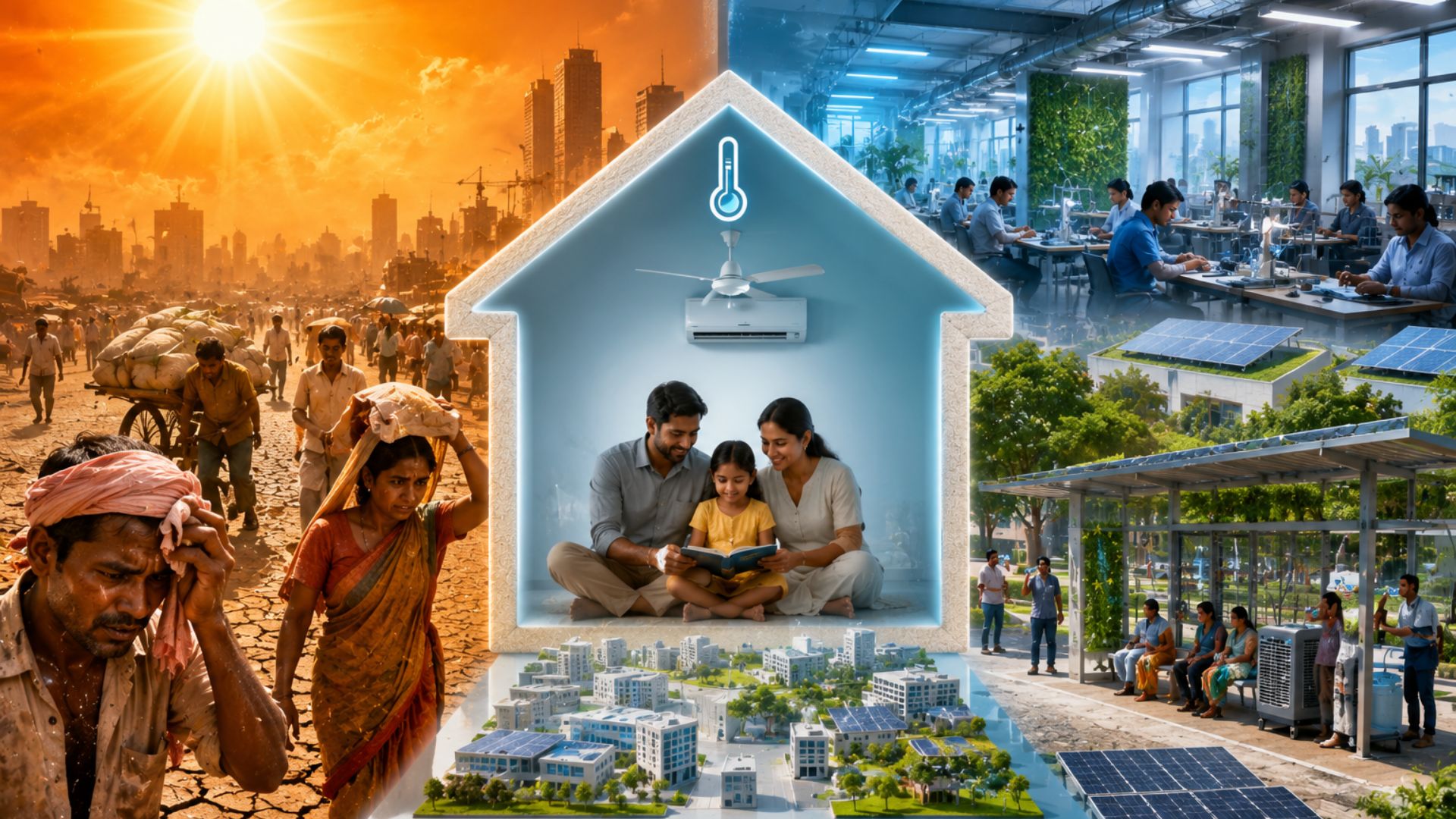
India's Heat Crisis: From Action Plans to a National Cooling Doctrine
 Surya
Surya
"To keep printing heat action plans while indoor temperatures climb is no longer a serious answer — it is theatre."
The Current Response: Well-Intentioned but Insufficient
Every summer, India's heat response follows a predictable pattern:
- NDMA releases updated preparedness tallies
- Heat Action Plans (HAPs) are circulated across states
- 16th Finance Commission has recommended heatwaves be notified as a national disaster — unlocking dedicated central funding
But the NDMA itself concedes the problem:
✗ Quality of HAPs is uneven across states
✗ Several plans are direct imitations of plans drafted elsewhere
✗ Implementation leans on short-term palliatives:
     → Water kiosks
     → Public advisories
     → Shaded bus stop waiting areas
These measures save lives at the margins. They do not address the underlying reality — tens of millions of Indians work, commute, and sleep in conditions that are becoming, in the most clinical sense, biologically untenable.
What Is Actually Needed: A National Cooling Doctrine
India needs to move beyond emergency response toward a scalable, rights-based framework — one that treats sustained access to safe indoor temperatures as a public health entitlement.
Where to Begin: Workplaces
The most acute harm happens indoors, not outdoors. The doctrine must start with:
- Mandatory minimum cooling standards for indoor workplaces:
→ Factories and warehouses
→ Commercial kitchens
→ Call centres
→ Delivery hubs
- Backed by an honest, functional inspection regime — not compliance on paper
The Technology Pathway
Mechanical air conditioning alone cannot solve this. India needs a layered technology approach:
| Solution | Application |
|---|---|
| Passive cooling materials | Building construction standards |
| Reflective roofing | Deployed at scale across urban and peri-urban zones |
| District cooling systems | Dense urban zones — shared infrastructure model |
| Efficient, affordable AC | Calibrated for Indian grid realities |
Why Importing Western Solutions Will Not Work
This is a critical and often overlooked point:
Western cooling literature assumes:
→ Dry heat (European summers)
→ Wealthy households absorbing energy bills
→ Reliable grid supply

India's reality:
→ Wet, humid, longer heat seasons
→ Most households cannot afford western-style cooling bills
→ Grid supplies at most 60% of installed capacity even on best days
Solutions designed for temperate, wealthy economies of the global North are structurally mismatched to India's conditions. India needs indigenous cooling architecture — built around its grid constraints, climate profile, and economic realities.
Way Forward
- Notify heatwaves as national disasters — implement the 16th Finance Commission recommendation to unlock dedicated funding
- Draft a National Cooling Doctrine — a statutory, scalable framework treating cooling access as a public health entitlement
- Mandate workplace cooling standards with credible enforcement — starting with the highest-risk indoor occupational settings
- Invest in passive and district cooling infrastructure — reduce dependence on individual mechanical cooling
- Develop India-specific cooling research — stop borrowing from a literature built on different climates and grid assumptions
- Grid expansion must run parallel — cooling infrastructure is only as good as the power supply backing it
Conclusion
India has built a robust choreography of heat response — advisories, kiosks, action plans, committees. What it has not built is a serious answer to the structural question: how do hundreds of millions of people who cannot afford air conditioning survive increasingly lethal summers in a country whose grid cannot reliably power it anyway? A National Cooling Doctrine is not a luxury policy aspiration. It is the minimum serious response to a public health emergency that arrives, without fail, every year — and grows worse each time.
Attribution
Original content sources and authors

Syllabus classification
How this article maps to GS papers
Main syllabus
GS3Environment & Bio-diversityQuick Q&A
What is meant by a national cooling doctrine, and why is it being proposed for India?
The doctrine expands the focus from emergency response to climate adaptation. It would require setting mandatory indoor cooling standards in factories, offices, warehouses, and public institutions. This includes regulatory norms for thermal comfort, worker safety, and building design. Such a doctrine recognizes heat not merely as a weather event but as a chronic developmental challenge linked to urbanization, housing inequality, and energy access.
For India, this is critical because its heat conditions differ from developed countries. High humidity, longer summers, and unreliable electricity supply make imported cooling models inadequate. A national doctrine would integrate public health, energy policy, labour regulation, and urban planning, similar to how the National Clean Air Programme addresses pollution as a systemic issue.
Why are existing heat action plans considered insufficient to tackle India’s heatwave crisis?
The article criticizes these plans for being repetitive and uneven in implementation. Many state-level plans are copied from templates designed elsewhere, without adaptation to local climatic or socio-economic conditions. The NDMA itself acknowledges these gaps. This means the policy often remains administrative compliance rather than meaningful adaptation.
For example, a shaded bus stop does not protect a factory worker exposed to 10-hour indoor heat. Similarly, water kiosks do little for slum residents sleeping in tin-roofed homes. Therefore, heat action plans save lives at the margins but fail to transform structural vulnerability. Long-term infrastructure changes are required.
How can technology contribute to building climate-resilient cooling systems in India?
District cooling is particularly relevant in dense cities. It involves centralized cooling networks supplying multiple buildings efficiently, reducing energy demand compared to individual systems. Additionally, research into low-power cooling devices suited to Indian voltage fluctuations can expand affordability.
Case studies from Ahmedabad show success. Cool-roof initiatives using white reflective paint reduced indoor temperatures by 2–5°C in low-income housing. Scaling such solutions through Smart Cities Mission and PM Awas Yojana could make cooling infrastructure more equitable while reducing heat-related illnesses.
Why is extreme heat increasingly being viewed as a public health issue rather than merely a climatic event?
The public health dimension also arises from unequal exposure. Low-income workers, elderly people, children, and those in informal settlements face disproportionate risks. This makes heat not just environmental but also a question of social justice and health equity.
For instance, the 2015 heatwave in India caused over 2,500 deaths. Most victims were outdoor labourers and urban poor. As climate change intensifies, such events may become normal. Therefore, public health systems must integrate heat preparedness alongside disease prevention.
Critically analyse the challenges in implementing a national cooling doctrine in India.
Second, India’s electricity constraints are serious. The article notes that the grid can supply only about 60% of installed capacity on peak days. Expanding conventional air-conditioning without renewable integration may worsen emissions and power shortages.
Third, regulatory enforcement is weak. Labour inspections are inconsistent, and informal workplaces dominate employment. A doctrine must therefore combine standards with incentives, subsidies, and local innovation. Without social equity considerations, cooling could remain accessible only to affluent households.
What examples from India demonstrate successful adaptation to extreme heat?
Another example is Telangana’s cool roofing initiatives. Public buildings and schools used reflective coatings to reduce indoor temperatures. This lowered dependence on mechanical cooling and improved comfort in educational institutions.
These examples show both possibilities and limitations. They are successful in pilot areas but remain fragmented. Scaling them nationally requires institutional integration with housing, labour, and urban policies. This supports the article’s argument that isolated heat plans are insufficient without a larger doctrine.
How would a national cooling doctrine impact workers in the informal and industrial sectors? Explain with a case study.
Consider a garment factory in Tiruppur. Workers often spend long shifts in enclosed environments with poor airflow. During summer, heat stress lowers productivity and increases health risks. Mandatory cooling norms could improve worker safety, reduce absenteeism, and enhance industrial efficiency.
The wider impact is economic and social. Healthier workers mean better labour productivity and lower medical expenditure. Such policies also align with constitutional principles under Article 21, ensuring dignity and safe living conditions as part of the right to life.
Practice questions
1 question for mains preparation