GS3 Environment & Bio-diversity
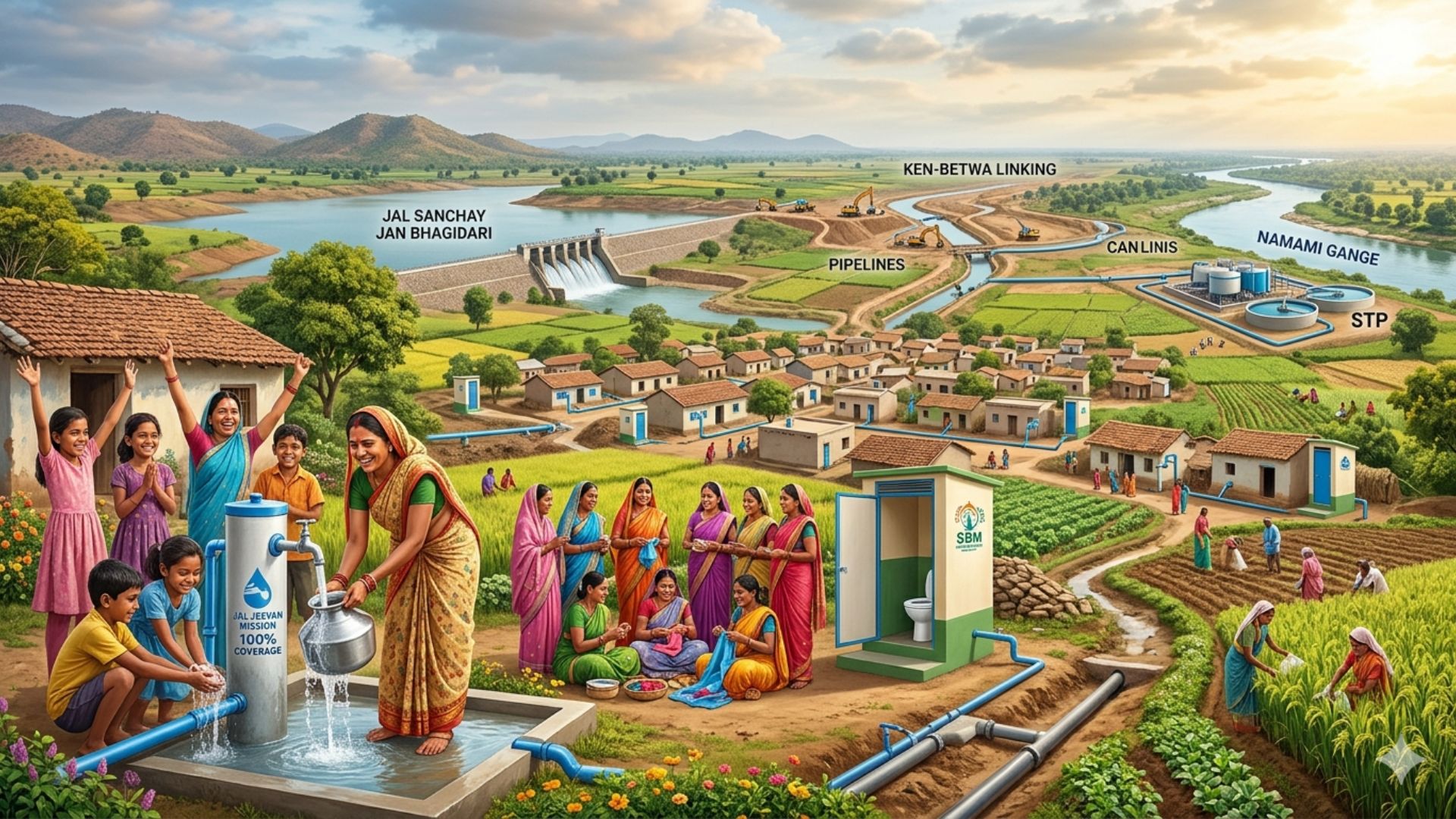
India's Integrated Water Governance Model: From Access to Sustainability

“Water security is not merely about supplying water; it is about ensuring health, dignity, livelihoods, environmental sustainability and climate resilience.”
India's water sector has witnessed a significant transformation over the last decade through an integrated approach that combines drinking water supply, sanitation, water conservation, groundwater recharge, river rejuvenation and climate resilience. Programmes such as the Jal Jeevan Mission (JJM), Swachh Bharat Mission (SBM), Namami Gange and water conservation initiatives reflect a shift from fragmented interventions to holistic water governance.
Why Water Matters
Water influences:
- Public health
- Human dignity
- Agriculture
- Economic productivity
- Environmental sustainability
- Climate resilience
India faces a unique challenge:
| Indicator | Status |
|---|---|
| Share of World Population | ~18% |
| Share of Global Freshwater Resources | ~4% |
This makes efficient water management essential for sustainable development.
Jal Jeevan Mission: Expanding Household Water Access
Launched to provide Functional Household Tap Connections (FHTCs), JJM has become the world's largest rural drinking water supply programme.
Progress Achieved
| Indicator | At Launch | Present Status |
|---|---|---|
| Rural households with tap water | 3.23 crore (~17%) | 15.8+ crore (~81%) |
Target: 100% rural household coverage by 2028
Social Impact
Before JJM:
Women spent significant time fetching water

After JJM:
• 5.5 crore person-hours saved daily
• More time for education
• Improved livelihoods
• Better childcare
• Reduced health expenditure
Access to safe drinking water has also lowered the incidence of water-borne diseases and associated medical costs.
Swachh Bharat Mission: Linking Sanitation and Health
The Swachh Bharat Mission demonstrated the power of behavioural change, community participation and political commitment.
Key Achievements
- Expansion of household toilets.
- Improved dignity and privacy, especially for women.
- Reduction in open defecation.
- Promotion of sustainable waste management through SBM-Grameen 2.0.
WHO Assessment:
SBM-Grameen helped avert
more than 3 lakh diarrhoeal deaths
between 2014 and October 2019.
The programme highlights the close relationship between sanitation, public health and water security.
Water Conservation and Groundwater Recharge
India has undertaken one of the world's largest water conservation efforts.
Jal Sanchay Jan Bhagidari Initiative
| Achievement | Status |
|---|---|
| Rainwater harvesting & recharge structures | 1.55 crore+ |
Outcomes
- Improved groundwater recharge.
- Reduction in over-exploited groundwater assessment units.
- Increased community participation in conservation efforts.
“Sustained conservation efforts combined with community participation can reverse environmental stress.”
Advancing National Water Infrastructure
Ken-Betwa River Linking Project
The project represents:
- India's first major river interlinking initiative.
- An attempt to address water scarcity in Bundelkhand.
- A strategy for regional water redistribution.
The project reflects efforts to improve water availability in drought-prone regions.
Namami Gange: River Rejuvenation and Development
The Namami Gange programme seeks to combine ecological restoration with economic development.
Key Outcomes
| Indicator | Progress |
|---|---|
| Sewage Treatment Capacity Created | 4,260 MLD |
| Biochemical Oxygen Demand (BOD) | 26 TPD (2017) → 10.75 TPD (2024) |
| Effluent Discharge | 349 MLD → 265.56 MLD |
Ecological Improvement
- Improved water quality.
- pH and dissolved oxygen levels now meet bathing standards at monitored locations.
- Enhanced river ecosystem health.
Integrated River Rejuvenation:
Sewage Treatment
          +
Pollution Control
          +
Monitoring
          ↓
Improved Ganga Water Quality
The Need for an Integrated Water Approach
India's experience demonstrates that water challenges cannot be addressed through isolated schemes.
Interconnected Components
- Drinking water supply
- Sanitation
- River conservation
- Groundwater recharge
- Irrigation efficiency
- Wastewater reuse
- Climate adaptation
These elements function as part of a single water ecosystem.
Emerging Challenges
Despite progress, future pressures remain significant.
Key Concerns
- Climate change
- Rapid urbanisation
- Rising water demand
- Groundwater stress
- Extreme weather events
The sustainability of water resources will increasingly determine India's developmental resilience.
Way Forward
- Achieve universal household tap water coverage.
- Improve water-use efficiency across sectors.
- Promote wastewater treatment and recycling.
- Strengthen groundwater governance.
- Expand community-led water conservation.
- Enhance climate-resilient water infrastructure.
- Encourage citizen participation in water management.
- Foster convergence among water, sanitation and environmental programmes.
Conclusion
India's recent water initiatives mark a shift from fragmented service delivery to integrated water governance. Programmes such as Jal Jeevan Mission, Swachh Bharat Mission, Namami Gange and groundwater recharge efforts illustrate how access, conservation and sustainability can be pursued simultaneously. As climate change and resource pressures intensify, strengthening this integrated and participatory model will be critical to ensuring long-term water security and national resilience.
Attribution
Original content sources and authors

Syllabus classification
How this article maps to GS papers
Main syllabus
GS3Environment & Bio-diversityQuick Q&A
What is the significance of India's integrated water management approach and how has it evolved in recent years?
Why are the Jal Jeevan Mission and Swachh Bharat Mission considered transformative initiatives for rural India and public health?
How have community participation and behavioural change contributed to the success of India's water and sanitation programmes?
What are the major examples and case studies that illustrate India's progress in water conservation and river rejuvenation?
What is a critical analysis of India's recent water governance reforms and their long-term sustainability challenges?
What are the major reasons that make water security a critical issue for India's future development and climate resilience?
How does India's water sector transformation provide important lessons and case studies for global sustainable development?
Practice questions
3 questions for mains preparation