GS3 Environment & Bio-diversity
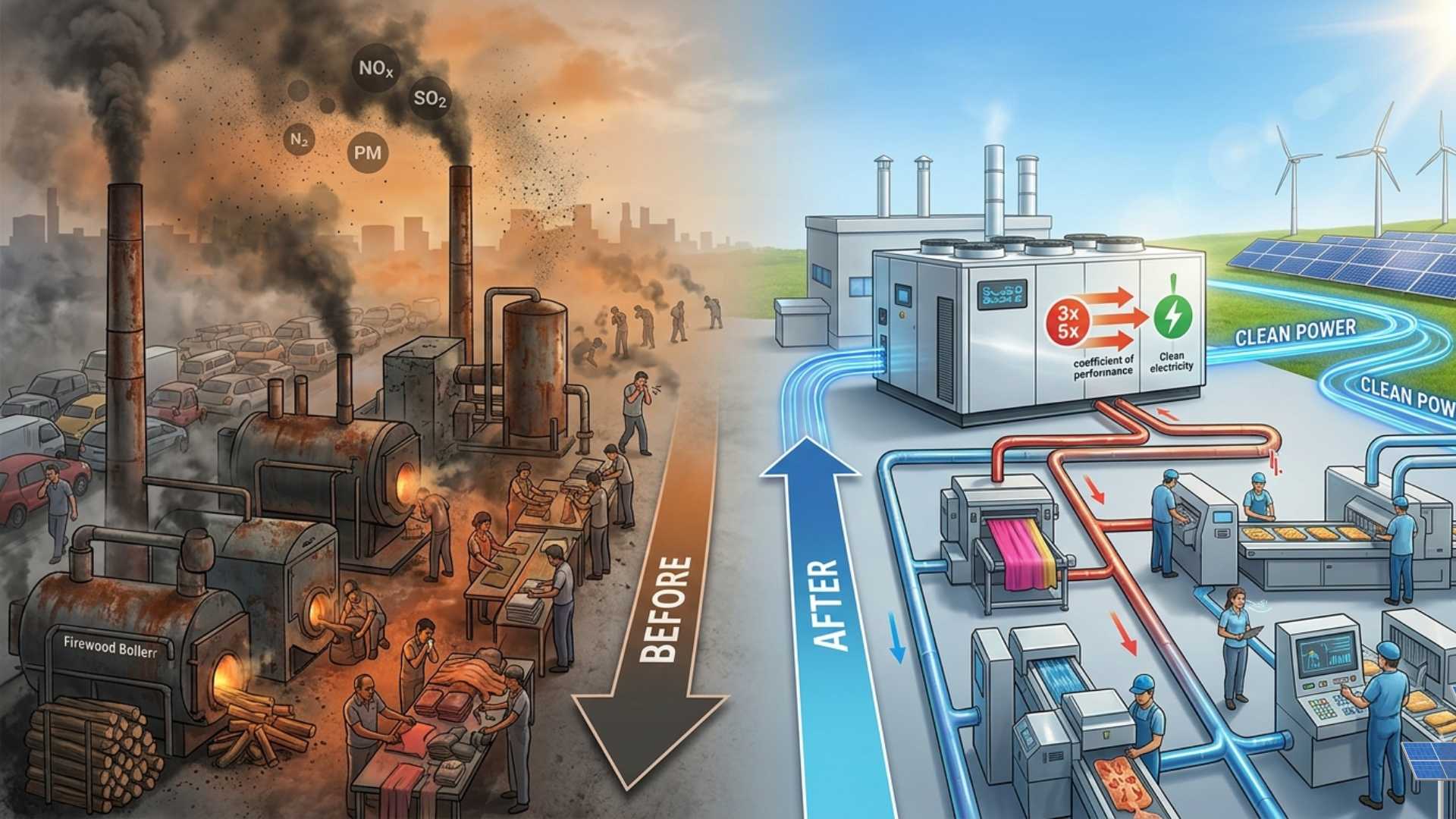
Industrial Heat Pumps: Key to Greener Manufacturing in India

Introduction
"Cleaning up industrial heat is not just a climate question — it is an air quality, competitiveness, energy security, and worker-health question."
-
Industry accounts for nearly half of India's final energy consumption (2025), with process steam alone generating 182 million metric tonnes of CO₂, 595 kt of SO₂, and 520 kt of particulate matter annually.
-
While green hydrogen and carbon capture dominate decarbonisation discourse, low-to-medium temperature industrial process heat — the quiet backbone of textiles, food processing, chemicals, and pharmaceuticals — remains almost entirely fossil-fuel dependent. Industrial heat pumps offer a practical, near-term solution to this overlooked frontier.
| Pollutant | Annual Industrial Steam Emissions (India) |
|---|---|
| CO₂ | 182 million metric tonnes |
| SO₂ | 595 kilotonnes |
| Particulate Matter | 520 kilotonnes |
| NOx | 516 kilotonnes |
Background & Context
The Hard-to-Abate Gap
Decarbonisation pathways like green hydrogen and carbon capture are essential for extreme-heat industrial processes (steel, cement) but remain years from large-scale commercial deployment. Meanwhile, a large share of manufacturing requires only low-to-medium temperature process heat — and continues to meet this need through coal, biomass, furnace oil, and gas combustion.
MSMEs — The Fragmented Emission Source
MSMEs contribute ~17% of total industrial emissions — smaller in share but dispersed across millions of units in textiles, food processing, and paper. Their boilers are typically old, oversized, manually operated, and run below optimal capacity — making them simultaneously inefficient and difficult to replace wholesale.
Key Concepts
1. How Industrial Heat Pumps Work
Unlike boilers, heat pumps do not generate heat by combustion — they move and upgrade heat from one stream to another using electricity.
| Parameter | Conventional Boiler | Industrial Heat Pump |
|---|---|---|
| Heat source | Fuel combustion | Electricity (heat transfer) |
| Coefficient of Performance | ~0.8–0.9 | 3–5 (3–5 units heat per unit electricity) |
| Emissions | Direct CO₂, SO₂, NOx | Zero on-site combustion |
| Modularity | Fixed, peak-sized | Modular, load-specific |
| Energy saving potential | Baseline | 40–60% reduction in suitable applications |
2. The Right-Sizing Logic
Conventional boilers are designed around peak heat demand — generating high-temperature steam that is then reduced for lower-temperature applications. This is inherently wasteful.
Heat pumps invert this logic: start with the lowest-temperature requirement, boost only where needed. This right-sizing approach can reduce overall energy use by 40–60% in suitable brownfield MSME applications.
3. Dual-Function Advantage
Industrial heat pumps can simultaneously supply heat and produce cooling — making them especially valuable in food processing and textile printing, where process heat and controlled cooling are both required. This displaces both boiler and chiller loads in a single system.
Implications & Challenges
1. Air Quality and Public Health
Fossil-fuel-driven air pollution caused an estimated 1.72 million premature deaths in India in 2022, with industrial heat systems as a key source. Electrifying process heat directly reduces on-site SO₂, NOx, and particulate emissions — with immediate co-benefits for surrounding communities.
2. Occupational Health
Over 2.4 billion workers globally face excessive workplace heat exposure — highest in Asia-Pacific. In labour-intensive MSME factories, internal process heat compounds rising ambient temperatures, increasing risks of heat exhaustion, cardiovascular strain, and reduced cognitive performance. Heat pumps reduce on-site combustion heat, improving factory floor thermal conditions.
3. Energy Security Dimension
Electrifying industrial heat reduces dependence on imported coal, furnace oil, and gas — directly addressing India's fossil fuel import vulnerability. When paired with renewable electricity, heat pumps convert an import-dependent thermal process into a domestically sourced one.
4. MSME Financing Wall
The primary barrier is not technical but financial — MSMEs lack capital for upfront equipment replacement. Modular deployment (pre-heating feedwater, hot water supply, waste heat recovery) allows phased adoption without full boiler replacement, but financing models tailored to MSME cash flows remain underdeveloped.
Way Forward
→ Production-linked or capital subsidy for industrial heat pump adoption in MSME clusters — prioritise textiles, food processing, and paper
→ Cluster-based deployment — target existing MSME industrial clusters (Surat textiles, Ludhiana manufacturing) for aggregated procurement and shared grid connections
→ Renewable electricity access — heat pump economics become compelling only when low-cost renewable power is reliably available; industrial tariff reform is essential
→ BEE (Bureau of Energy Efficiency) standards — mandate heat pump feasibility assessments in MSME energy audits under the Perform Achieve Trade (PAT) scheme
Conclusion
-
Industrial heat pumps represent a rare policy opportunity: a single technology intervention that simultaneously addresses climate, air quality, energy security, occupational health, and MSME competitiveness.
-
India's decarbonisation discourse has rightly focused on solar, EVs, and green hydrogen — but the millions of boilers running in textile sheds and food processing units represent an equally urgent, and far more tractable, transition.
-
The technology exists, the economics are improving, and the co-benefits are immediate. What remains is the policy architecture to make it accessible to the MSMEs that need it most.
Attribution
Original content sources and authors


Syllabus classification
How this article maps to GS papers
Main syllabus
GS3Environment & Bio-diversityQuick Q&A
What is industrial decarbonisation in the context of process heat, and why is it a critical frontier in India’s energy transition?
Why it is critical:
- Industry accounts for nearly half of India’s final energy consumption, making it a major emissions source.
- Process steam alone contributes 182 million metric tonnes of CO2 annually, along with harmful pollutants like SO2, NOx, and particulate matter.
- These emissions have implications beyond climate change, affecting air quality, public health, and industrial competitiveness.
Broader Implications: Decarbonising industrial heat is not just an environmental necessity but also a developmental imperative. Cleaner heat systems can reduce India's import dependence on fossil fuels, improve worker productivity, and align with global climate commitments. Thus, targeting process heat offers a high-impact, near-term opportunity in India’s energy transition.
How do industrial heat pumps work, and what makes them an efficient alternative to conventional thermal systems?
Efficiency Advantage:
- Heat pumps have a coefficient of performance (COP) of 3 to 5, meaning they deliver 3–5 units of heat for every unit of electricity consumed.
- This makes them significantly more efficient than electric resistance heating and often competitive with fossil fuels.
- They reduce overall energy demand, particularly when integrated with renewable electricity sources.
Application Example: In sectors like textiles and food processing, heat pumps can supply hot water, preheat boiler feedwater, and recover waste heat. Unlike conventional boilers that operate at high temperatures and pressures, heat pumps right-size energy use by matching heat supply to actual demand. This leads to energy savings of up to 40–60% in suitable applications, making them both economically and environmentally viable.
Why are MSMEs particularly important in the transition towards cleaner industrial heat systems in India?
Challenges Faced:
- Dependence on outdated and inefficient thermal systems such as coal-fired boilers and thermic fluid heaters.
- Limited access to capital for technology upgrades.
- Lack of awareness and technical expertise for adopting cleaner technologies.
Why Transition Matters: Targeting MSMEs offers a scalable opportunity for emissions reduction due to their sheer number. Technologies like modular heat pumps are particularly suitable for MSMEs as they can be deployed incrementally without requiring large capital investments. Additionally, improving energy efficiency in MSMEs enhances their competitiveness, reduces operational costs, and improves compliance with environmental standards, making them crucial actors in India’s decarbonisation journey.
What are the key inefficiencies in conventional industrial heat systems, and how do they affect energy use?
Operational Issues:
- Steam is often used indirectly for applications like heating water or maintaining vessel temperatures, which do not require high-grade heat.
- Energy losses occur during pressure reduction, heat transfer, and distribution.
- Manual operation and poor maintenance in MSMEs further reduce efficiency.
Illustrative Example: A textile unit in Surat consumed 0.42 kg of coal per meter of fabric, highlighting the material intensity of conventional systems. Much of this energy is wasted due to mismatched heat supply and demand.
Impact: These inefficiencies lead to higher fuel consumption, increased emissions, and elevated operational costs. Transitioning to systems like heat pumps, which start from low-temperature demand and scale up, can significantly optimise energy use and reduce wastage.
Critically analyse the potential and limitations of industrial heat pumps as a solution for decarbonising India’s industrial sector.
Additional Advantages:
- Integration of heating and cooling functions, improving overall system efficiency.
- Enhanced worker safety and comfort by reducing heat exposure.
- Reduction in local air pollution, addressing public health concerns.
Limitations and Challenges:
- Dependence on reliable and affordable electricity supply.
- High upfront costs, especially for MSMEs.
- Limited applicability in high-temperature industrial processes.
- Need for redesigning existing industrial systems and processes.
Conclusion: While heat pumps are a promising solution, they are not a universal substitute for all industrial heat needs. Their success depends on policy support, financing mechanisms, and integration with renewable energy systems. A hybrid approach combining multiple technologies will be essential for comprehensive industrial decarbonisation.
Using the example of a textile unit in Surat, explain how process redesign and heat pump adoption can improve efficiency and reduce emissions.
Identified Issues:
- Over-reliance on high-temperature steam for low-temperature applications.
- Oversized boilers designed for peak demand.
- Lack of waste heat recovery and inefficient energy use.
Heat Pump Intervention: By adopting industrial heat pumps, the unit can:
- Preheat boiler feedwater and supply hot water for dyeing and washing.
- Recover waste heat from effluents.
- Reduce dependence on coal-fired steam systems.
Outcomes: Such interventions can lead to 40–60% energy savings, lower emissions, and reduced operational costs. Additionally, integrating heating and cooling functions can improve process stability and worker comfort. This case highlights the importance of process redesign and technology adoption in achieving sustainable industrial growth.
Practice questions
2 questions for mains preparation