GS3 Environment & Bio-diversity
Kerala's Strategy to Combat Oil Spill Hazards

-
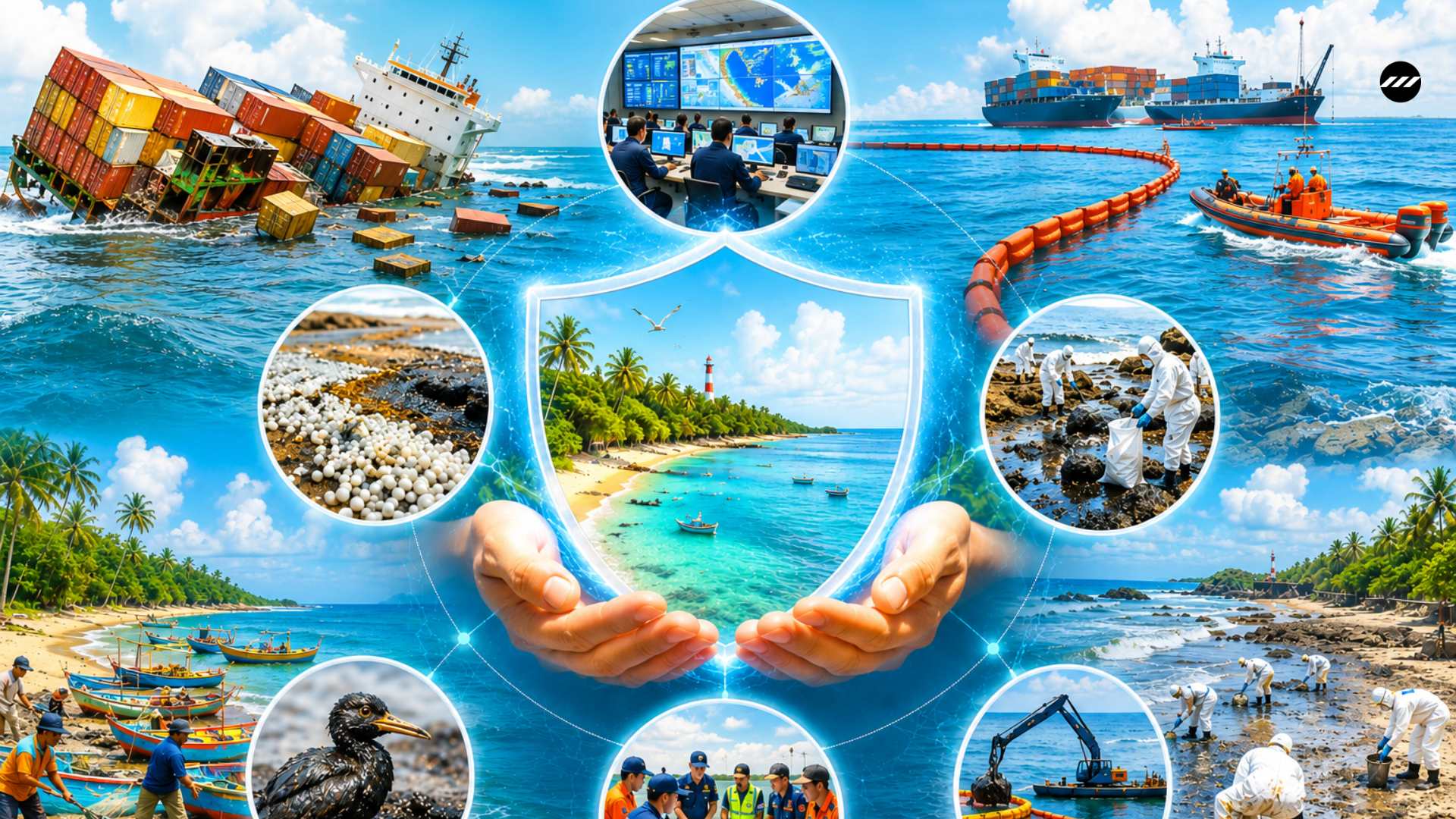
When the container ship MSC Elsa 3 sank off Kerala's coast on May 25, 2025, it took down 640 containers — including 13 with hazardous cargo and 12 with calcium carbide.
-
A second vessel, MV Wan Hai 503, followed on June 9, 2025. Together, these incidents exposed a critical gap in India's coastal disaster preparedness and forced Kerala to accelerate a plan that had been pending since 2016.
Why Kerala Needs a State-Specific OSCP
Kerala is uniquely vulnerable among Indian coastal states:
- 590 km coastline — one of the longest among Indian states
- 9 of 14 districts classified as oil spill-prone
- A major international oil transportation route runs adjacent to the coast
- Oil tankers and cargo ships visiting Kerala's ports pose direct risk to coastal communities, fishing livelihoods, and marine biodiversity
MSC Elsa 3 sinking — May 25, 2025:
→ 640 containers submerged
→ 13 containers: hazardous cargo
→ 12 containers: calcium carbide (reacts violently with seawater)
→ Large quantities of nurdles (plastic pellets) washed ashore
→ Threat: marine ecosystem contamination, fisheries disruption
The proposal for an Oil Spill Contingency Plan (OSCP) was first initiated in 2016 as part of a review of major accident hazard units. It was delayed by technical and financial hurdles for nearly a decade — the shipwrecks finally forced action.
What the OSCP Covers
The Plan operates within a defined geographic scope:
- Marine zone: Within 12 nautical miles (24 km) of Kerala's coastline
- Riverine zone: Up to 40 km inland or till tidal effect is evident, whichever is greater
Its key components include:
- Environmental Sensitivity Index (ESI) mapping — identifying ecologically fragile stretches of coast
- Wildlife response plans — protecting marine fauna during spill events
- Ship-board Pollution Emergency Plans
- Tactical oil spill booming and site response plans
- Crisis management and marine emergency response guidelines
- Mapping of fishing boat operation zones and environmentally vulnerable areas
The OSCP will be prepared in accordance with the National Oil Disaster Contingency Plan (NOS-DCP) guidelines of 2015, 2018, and 2024 — ensuring state-level planning aligns with national standards.
Shoreline Response: The Operational Core
The most critical element of any spill response is the shoreline clean-up chain — and the OSCP addresses this systematically:
- Establishes a clear chain of command with defined duties for each agency
- Maintains a contact directory and equipment database — machinery, control equipment available at ports and harbours
- Prescribes pre-clean-up assessment covering:
Before shoreline clean-up begins:
→ Assess oil characteristics on shore
→ Evaluate on-site conditions
→ Select appropriate methods
→ Determine scope of work by priority zones
→ Deploy correct equipment for spill type
- Specifies administrative responsibilities of departments involved
- Identifies protection priorities — which zones get resources first
Institutional Process Before Finalisation
The OSCP follows a structured vetting pathway:
- Kerala State Pollution Control Board (KSPCB) — nodal agency, awarded work to a Bengaluru-based firm
- Draft submitted to the National Green Tribunal (NGT took suo motu cognisance of MSC Elsa 3's environmental impact)
- Draft includes hydrodynamic modelling, oil spill modelling, and net environmental benefit analysis
- Will be vetted by a committee of experts
- Final submission to the Indian Coast Guard — the central coordinating authority for marine oil pollution response
- Published only after receiving all required clearances
Conclusion
-
The Kerala OSCP, born out of crisis, represents the kind of proactive environmental governance that India's coastline urgently needs.
-
With over 7,500 km of national coastline exposed to shipping traffic, the Kerala model — integrating scientific mapping, multi-agency coordination, and national standards — offers a replicable framework. The deeper lesson: disaster preparedness cannot wait for disaster.
Attribution
Original content sources and authors

Syllabus classification
How this article maps to GS papers
Main syllabus
GS3Environment & Bio-diversityQuick Q&A
What is an Oil Spill Contingency Plan (OSCP), and why is Kerala preparing a State-specific framework?
Kerala requires a State-specific OSCP because of its unique geographical and economic characteristics. The State has a coastline of nearly 590 km, and one of the major international oil transportation routes lies close to its coast. Out of Kerala’s 14 districts, nine are considered oil-spill prone. The plan therefore seeks to create a coordinated mechanism involving ports, fisheries, pollution control authorities, coastal police, disaster management agencies, and local administrations.
Key features of the proposed OSCP include:
- Environmental Sensitive Index (ESI) mapping of coastal regions
- Guidelines for wildlife rescue and shoreline clean-up
- Identification of vulnerable fishing and biodiversity zones
- Emergency communication and command structures
- Inventory of response equipment and machinery
The OSCP also reflects the broader principle of cooperative environmental governance, where State authorities align with the National Oil Spill Disaster Contingency Plan (NOS-DCP). From a UPSC interview perspective, the issue demonstrates the growing importance of climate resilience, marine governance, and disaster preparedness in India’s coastal policy framework.
Why are oil spills considered a major environmental and socio-economic threat for coastal States like Kerala?
From an environmental perspective, oil spills damage marine biodiversity, coral ecosystems, mangroves, plankton populations, and fish breeding grounds. Hazardous materials such as calcium carbide or chemical cargo can further intensify toxicity levels in seawater. The washing ashore of plastic nurdles after the MSC Elsa 3 incident revealed another dimension of marine pollution, as these pellets are difficult to remove and can enter the marine food chain through fish and seabirds.
The socio-economic impacts are equally severe:
- Fishing communities suffer loss of livelihood due to contaminated waters
- Tourism declines because polluted beaches affect public perception
- Ports and maritime trade may face operational disruptions
- Public health risks emerge due to toxic exposure and contaminated seafood
The Kerala case also highlights the challenge of balancing economic growth with environmental sustainability. India’s expanding maritime trade and port-led development under initiatives like Sagarmala increase marine traffic and accident risks. Therefore, preparedness mechanisms such as OSCPs become essential components of sustainable coastal governance.
In a broader policy context, oil spills are linked to issues of climate vulnerability, marine conservation, and blue economy governance. Effective management requires scientific modelling, inter-agency coordination, community participation, and international cooperation. Thus, oil spills are not merely environmental accidents; they are multidimensional governance challenges requiring integrated policy responses.
How will Kerala’s proposed OSCP improve shoreline response and disaster management capacity?
The plan proposes a response-focused contingency framework that integrates environmental assessment, operational logistics, and administrative coordination. Before initiating clean-up operations, the OSCP recommends detailed assessments of shoreline oil characteristics, site conditions, and environmental vulnerability. This ensures that clean-up techniques are selected scientifically rather than through ad hoc measures.
The shoreline response strategy includes:
- Preparation of resource inventories and equipment databases
- Deployment protocols for booms, skimmers, and containment systems
- Mapping of environmentally sensitive coastal zones
- Coordination with ports, harbours, and fisheries departments
- Wildlife rescue and rehabilitation procedures
Another important feature is the inclusion of hydrodynamic and oil-spill modelling, which can predict the spread of pollutants depending on ocean currents, tides, and weather conditions. Such predictive capacity is crucial for minimising ecological damage and prioritising response zones.
The OSCP also strengthens India’s disaster management architecture by aligning with the National Oil Spill Disaster Contingency Plan (NOS-DCP) and involving the Indian Coast Guard as the nodal coordinating agency. This creates vertical integration between State and Central authorities.
From a governance perspective, the plan reflects the shift toward evidence-based environmental management. It demonstrates how technological tools, institutional coordination, and ecological mapping can improve resilience against marine disasters. For UPSC interviews, this issue can be linked to disaster management reforms, coastal security, and environmental federalism.
Critically analyse the challenges involved in implementing an effective Oil Spill Contingency Plan in India.
One major challenge is institutional fragmentation. Oil spill management involves multiple stakeholders including pollution control boards, port authorities, fisheries departments, disaster management agencies, local governments, and the Indian Coast Guard. In the absence of seamless coordination, response measures may become delayed or ineffective. Bureaucratic overlap can also dilute accountability during emergencies.
Additional implementation challenges include:
- Limited availability of specialised clean-up equipment and trained personnel
- High financial costs associated with marine surveillance and response infrastructure
- Inadequate real-time monitoring systems and scientific modelling capabilities
- Lack of awareness among coastal communities regarding emergency protocols
- Difficulties in enforcing liability and compensation from shipping companies
Another concern is the growing complexity of maritime trade. Modern ships transport hazardous chemicals, plastics, and fuels in massive quantities. Accidents involving such cargo can create long-term ecological damage extending beyond oil pollution alone. The MSC Elsa 3 incident, involving nurdles and hazardous substances, demonstrated this multidimensional risk.
However, OSCPs also present significant opportunities. They can improve inter-agency coordination, strengthen coastal governance, and promote scientific decision-making. The integration of environmental sensitivity mapping and predictive modelling reflects a proactive approach rather than a purely reactive one.
The way forward should include:
- Capacity building of coastal authorities and local communities
- Regular mock drills and simulation exercises
- Creation of dedicated marine environmental emergency funds
- Use of satellite surveillance and AI-based monitoring systems
- Strengthening international maritime cooperation
Thus, the success of OSCPs ultimately depends on political commitment, institutional coordination, technological preparedness, and public participation.
What lessons can India learn from the MSC Elsa 3 incident for improving marine environmental governance?
One key lesson is the importance of early preparedness and preventive regulation. Kerala had proposed an Oil Spill Contingency Plan as early as 2016, but implementation was delayed due to technical and financial hurdles. The incident shows that delays in environmental preparedness can significantly increase disaster impacts and clean-up costs.
The incident offers several broader lessons:
- Need for regular risk assessments of maritime routes and ports
- Importance of rapid-response infrastructure and trained personnel
- Necessity of scientific tools such as oil-spill modelling and ESI mapping
- Role of judicial oversight, as seen in the NGT’s suo motu intervention
- Need for stronger liability mechanisms for shipping operators
Another important takeaway is the growing relevance of the Blue Economy framework. India seeks to expand maritime trade, fisheries, tourism, and offshore energy activities. However, such expansion must be accompanied by robust environmental safeguards. Sustainable ocean governance requires balancing economic objectives with ecological protection.
The role played by institutions like the National Green Tribunal also demonstrates the increasing importance of environmental accountability in governance. Judicial interventions can compel authorities to adopt long-term remedial measures rather than temporary responses.
For UPSC preparation, this case can be linked to topics such as environmental governance, disaster management, maritime security, climate resilience, and sustainable development. It exemplifies how local environmental incidents can raise larger questions about regulatory capacity and policy implementation in India.
Suppose a major oil tanker accident occurs near Kerala’s coast during the monsoon season. As a district administrator, how would you coordinate response measures under the proposed OSCP framework?
Immediate measures would focus on containment and risk assessment. Rapid shoreline assessments would be conducted to identify vulnerable ecosystems, fishing zones, and densely populated coastal areas. Simultaneously, containment booms and skimmers would be deployed to minimise the spread of oil, especially because monsoon currents can accelerate coastal contamination.
The operational response would include:
- Issuing advisories to fishing communities and restricting access to affected waters
- Coordinating evacuation if toxic exposure risks emerge
- Mobilising trained clean-up teams and specialised equipment
- Monitoring marine biodiversity impacts with expert agencies
- Establishing temporary relief and compensation mechanisms for affected fishermen
Public communication would be extremely important. Accurate and transparent dissemination of information through local media and community networks can prevent panic and misinformation. Coordination with health departments would also be necessary to monitor seafood contamination and public health risks.
From a governance perspective, the response must reflect the principles of incident command systems, decentralised administration, and scientific disaster management. Post-disaster actions should include environmental restoration, compensation assessment, and a review of response effectiveness.
This scenario demonstrates how the OSCP can transform disaster response from a fragmented approach into a structured and evidence-based framework. It also underlines the importance of administrative leadership, community participation, and institutional preparedness in handling environmental emergencies effectively.
Practice questions
1 question for mains preparation