GS3 Environment & Bio-diversity
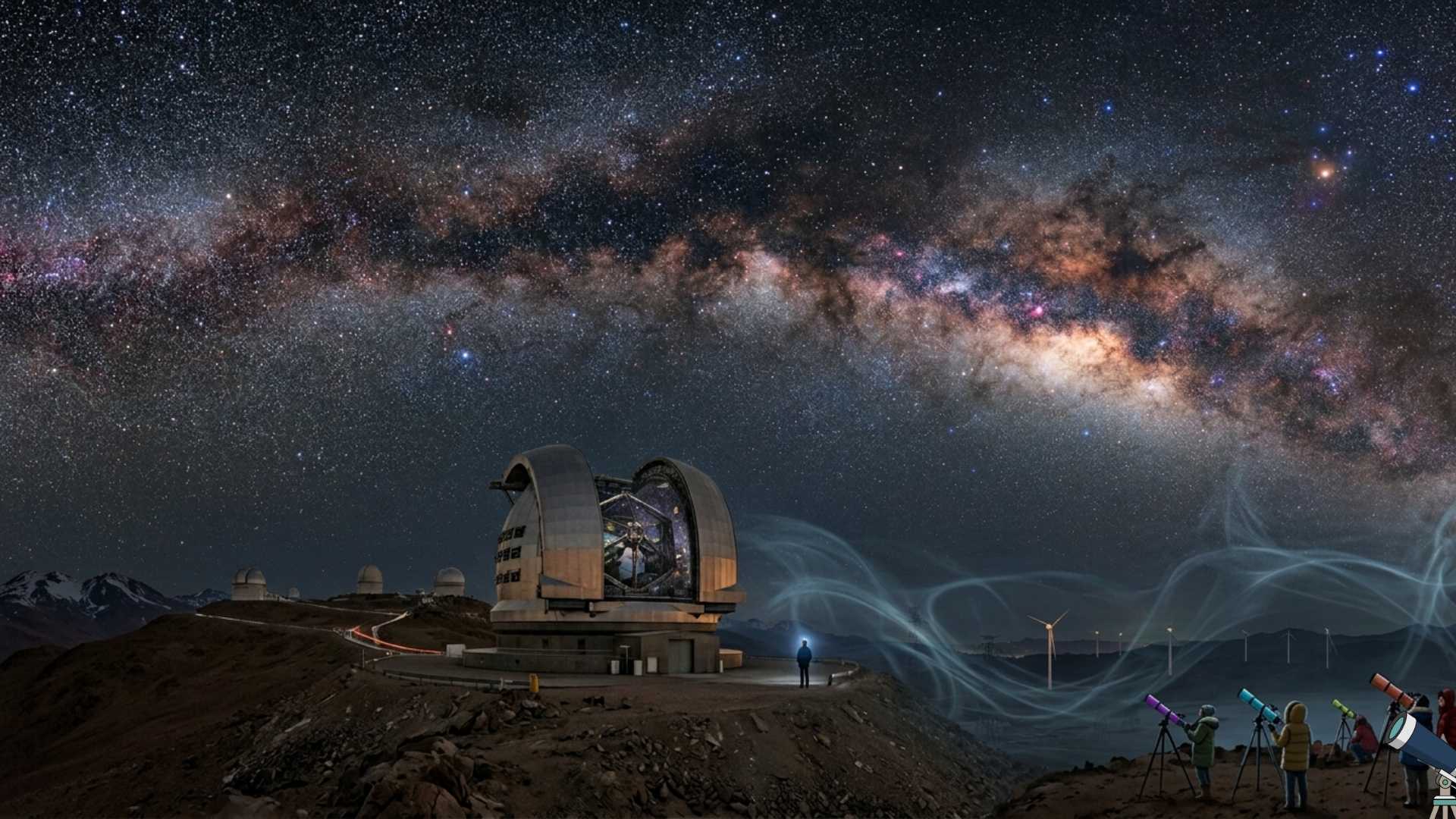
Light Pollution: A Threat to the Atacama's Stellar Skies

Introduction
- The Atacama Desert hosts 300+ clear nights/year, making it one of the best astronomical sites globally.
- Globally, over 80% of people live under light-polluted skies, while India is also witnessing rising light pollution due to urbanisation.
“Dark skies are a natural resource as valuable as clean air and water.” — International Dark-Sky Association
Background / Context
-
The Atacama Desert in Chile is:
- One of the driest places on Earth
- Located at high altitude (>3000 m)
- Free from light pollution and atmospheric disturbance
-
It has become a global hub for astronomy, hosting:
- Multiple observatories
- Advanced telescopes
- International scientific collaborations
Key Concept: Why Atacama is Ideal for Astronomy
| Factor | Significance |
|---|---|
| Dry Climate | Minimal water vapour → clearer signals |
| High Altitude | Reduced atmospheric distortion |
| Low Light Pollution | Better visibility of celestial objects |
| Isolation | Limited human interference |
Major Astronomical Infrastructure
- Managed by European Southern Observatory
- Includes cutting-edge projects like:
Extremely Large Telescope (ELT)
-
Cost: ~$1.5 billion
-
Features:
- 798 mirrors
- Light-gathering area ~1,000 sq. m
-
Capability:
- 20× more powerful than current telescopes
- 15× sharper than Hubble Space Telescope
Emerging Issue: Threats to Dark Skies
1. Industrial & Energy Development
-
Proposed green energy project near Paranal Observatory
-
Risk:
- Light pollution
- Atmospheric disturbances
2. Urbanisation & Mining Expansion
-
Growth of:
- Cities
- Wind farms
- Mining activities
👉 Result:
- Loss of pristine “dark sky” conditions
3. Regulatory Gaps
-
Existing laws:
- Outdated
- Ambiguous
👉 Raises concerns about:
- Environmental governance
- Scientific preservation
Case Study: Chile’s “Photon Valley”
-
High-altitude corridor hosting:
- Multiple observatories
- Advanced astronomical instruments
👉 Significance:
-
Attracts global scientists
-
Supports research on:
- Origins of universe
- Deep space exploration
Implications
1. Scientific Impact
- Reduced observation quality
- Loss of long-term research investments
2. Environmental Concerns
-
Light pollution affects:
- Ecosystems
- Nocturnal biodiversity
3. Economic vs Scientific Trade-off
- Renewable energy vs astronomy
- Development vs conservation
Comparative Insight (India)
| Aspect | Chile (Atacama) | India |
|---|---|---|
| Dark Sky Quality | Excellent | Declining |
| Observatories | Global hub | Hanle (Ladakh) |
| Threats | Mining, energy | Urbanisation, light pollution |
👉 Example:
- Indian Astronomical Observatory faces similar risks from development.
Key Challenges
- Balancing development vs scientific heritage
- Lack of clear regulatory framework
- Increasing light pollution globally
- Weak enforcement of environmental safeguards
Way Forward
1. Strengthen Dark Sky Laws
- Clear zoning regulations
- Buffer zones around observatories
2. Sustainable Development Planning
- Environmental Impact Assessments (EIA)
- Science-sensitive infrastructure
3. Promote Dark Sky Reserves
- International recognition (like UNESCO-type protection)
4. Technological Solutions
- Shielded lighting
- Low-impact energy infrastructure
Value Addition (Quote)
- “We are not only protecting science, but humanity’s view of the universe.” — Astronomical community perspective
Conclusion
The Atacama Desert exemplifies the global challenge of balancing development with scientific and environmental preservation. As technological expansion accelerates, safeguarding dark skies as a shared human heritage becomes essential—not just for astronomy, but for sustaining ecological balance and advancing knowledge of the universe.
Attribution
Original content sources and authors


Syllabus classification
How this article maps to GS papers
Main syllabus
GS3Environment & Bio-diversityQuick Q&A
What makes the Atacama Desert an ideal location for astronomical observations?
Key enabling factors include:
- Low light pollution: Its remote location ensures minimal interference from artificial lighting
- Stable atmosphere: Reduced turbulence improves image clarity
- Dry climate: Absence of water vapour enhances infrared and radio observations
These conditions have led to the development of major astronomical facilities such as the Paranal Observatory and the upcoming Extremely Large Telescope (ELT). The ELT, with its massive mirror array and advanced optics, is expected to revolutionise our understanding of the universe.
Conclusion: The Atacama represents a rare natural laboratory where environmental conditions align perfectly for cutting-edge scientific research, making it a global hub for astronomy.
Why is the preservation of dark skies important for astronomy and scientific advancement?
Scientific importance:
- Precision research: Observing distant galaxies and exoplanets requires extremely dark conditions
- Data integrity: Light interference can distort readings and affect long-term studies
- Technological investments: Projects like the ELT involve billions of dollars and depend on pristine conditions
Broader implications: Dark skies are not only important for science but also for ecological and cultural reasons. Many species rely on natural light cycles, and indigenous communities often associate the night sky with cultural heritage.
Conclusion: Preserving dark skies is essential for sustaining scientific discovery, protecting ecosystems, and maintaining humanity’s connection with the cosmos, making it a global environmental priority.
How do large-scale astronomical projects like the Extremely Large Telescope (ELT) contribute to our understanding of the universe?
Key contributions include:
- Study of exoplanets: Detecting Earth-like planets and analysing their atmospheres for signs of life
- Understanding cosmic origins: Observing the formation of galaxies and stars in the early universe
- Dark matter and dark energy research: Providing insights into fundamental cosmic forces
Technological innovation: The ELT incorporates advanced adaptive optics to correct atmospheric distortions in real time, ensuring high-resolution imaging. Its capabilities surpass those of the Hubble Space Telescope in terms of sharpness and sensitivity.
Example: Similar projects like the James Webb Space Telescope have already transformed our understanding of the early universe. The ELT is expected to complement such space-based missions with detailed ground-based observations.
Conclusion: The ELT exemplifies how cutting-edge technology, combined with optimal natural conditions, can unlock deeper insights into the universe’s mysteries.
What are the major threats to the Atacama Desert’s suitability for astronomy?
Key threats include:
- Light pollution: Increased urbanisation introduces artificial lighting that disrupts dark skies
- Industrial activity: Mining and infrastructure projects generate dust and atmospheric disturbances
- Energy projects: Large-scale installations may interfere with observational equipment
Case in point: The proposed green power complex near the Paranal Observatory sparked significant concern among scientists, as it could have compromised the observational quality of one of the world’s most advanced telescopes. Although the project was eventually cancelled, it highlighted gaps in regulatory frameworks.
Conclusion: These threats underscore the need for stronger environmental governance and updated policies to balance development with the preservation of critical scientific infrastructure.
Critically analyse the conflict between sustainable development and astronomical preservation in regions like the Atacama Desert.
Arguments in favour of development:
- Energy transition: Renewable energy projects reduce dependence on fossil fuels
- Economic growth: Infrastructure projects generate employment and regional development
Arguments for preservation:
- Irreplaceable resource: Dark skies and ideal atmospheric conditions cannot be replicated elsewhere
- Scientific value: Observatories contribute to global knowledge and technological advancement
Critical perspective: The issue is not a binary choice but requires a nuanced approach. Poorly planned development can undermine long-term scientific and ecological benefits, while excessive restrictions may hinder economic progress.
Conclusion: A balanced framework involving zoning regulations, technological mitigation measures, and stakeholder consultation is essential to reconcile these competing priorities and ensure sustainable coexistence.
As a policymaker, how would you design regulations to protect astronomical sites like the Atacama Desert while allowing sustainable development?
Second, environmental impact assessments (EIAs) must be strengthened to include specific criteria for astronomical impact. Projects such as mining or energy installations should be evaluated not only for ecological effects but also for their impact on sky quality and atmospheric conditions.
Third, promoting the use of technology-based solutions can mitigate conflicts. For example, shielded lighting systems and low-impact infrastructure designs can reduce light pollution.
Case example: Countries like Chile have already initiated regulatory reviews following conflicts such as the Paranal Observatory case. Lessons can also be drawn from international dark sky reserves, which combine conservation with sustainable tourism.
Conclusion: A multi-stakeholder approach involving scientists, industry, and local communities is essential. By integrating scientific priorities into development planning, policymakers can ensure that progress does not come at the cost of irreplaceable global assets.
Practice questions
1 question for mains preparation