GS3 Environment & Bio-diversity
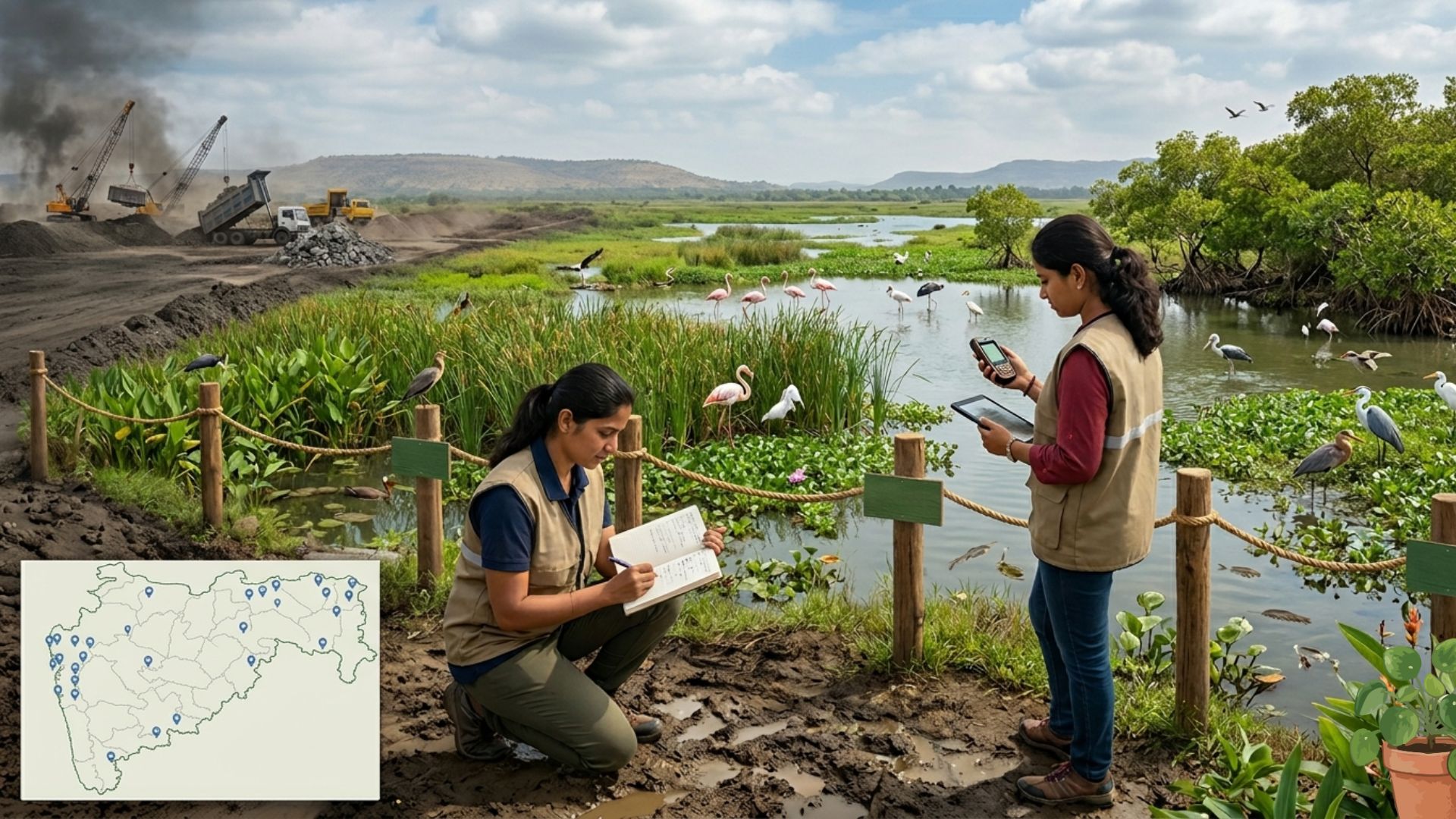
Maharashtra Achieves Milestone in Wetlands Documentation

What Has Happened?
- The National Centre for Sustainable Coastal Management (NCSCM) — functioning under MoEFCC — has completed satellite mapping, documentation, and ground-truthing of Maharashtra's wetlands
- Total wetlands documented: 23,415 — with only 11 in Pune district remaining for ground-truthing
- This clears the path to formally notify these wetlands under the Wetlands (Conservation and Management) Rules, bringing them under legal protection for the first time
What Is Ground-Truthing and Why Does It Matter?
Ground-truthing = physical, on-site verification of wetlands to confirm their existence, boundaries, ecological condition, and present land use against satellite imagery
- It is the crucial last step before a wetland can be officially notified under environmental law
- Without notification, a wetland has zero legal protection — it can be filled, encroached upon, or destroyed in the name of development
Where Are Maharashtra's Wetlands? — The Numbers
Division / District          Wetlands Count
────────────────────────────────────────────
Chhatrapati Sambhaji Nagar   5,196  (highest division)
Nagpur Division              5,086
Ahmednagar District          1,596  (highest district)
Nashik District              1,236
Chandrapur District          1,231
Raigad                       1,093
Thane                          247
Mumbai Suburban                210
Mumbai City                     37
Why Wetlands Matter — The Ecological Case
- Flood buffering: Act as natural sponges during extreme rainfall, absorbing and slowing floodwaters
- Groundwater recharge: Replenish underground aquifers that millions depend on
- Carbon sequestration: Store carbon in waterlogged soils, making them critical for climate mitigation
- Biodiversity conservation: Support unique plant, bird, and aquatic ecosystems
- Their role has become increasingly critical amid changing climate patterns and recurring urban floods across Maharashtra
The Backstory: 16 Years of Delay
- The National Wetlands Inventory and Assessment was launched by the Centre nearly two decades ago
- The National Wetland Atlas (decadal-change version) was updated in 2020 to track changes over time
- Despite this, Maharashtra's ground-truthing lagged for years — gathering momentum only after:
- Legal interventions by environmental group Vanashakti
- Subsequent Supreme Court directions asking all states and UTs to complete wetland demarcation in a time-bound manner
"This process should not have taken 16 years after the National Wetland Atlas was launched." — B.N. Kumar, Director, NatConnect Foundation
The Cost of Delay — Real Consequences Already Visible
- Un-notified wetlands across Maharashtra have been treated as:
- Reclamation land
- Debris dumping grounds
- Encroachment sites
- Infrastructure development zones
- Uran and the Mumbai Metropolitan Region have suffered particularly severe damage to biodiversity-rich wetland ecosystems
"The burial of wetlands in Uran has already triggered unseasonal flooding and compensation payouts worth crores from taxpayers' money. This could have been avoided had the authorities acted in time to preserve these natural drainage systems." — Nandakumar Pawar, Director, Sagarshakti
- The Uran case is a direct example of how wetland destruction converts a free ecological service (natural flood drainage) into a costly taxpayer liability
Way Forward
- Complete the remaining 11 Pune wetlands for ground-truthing without further delay — the documentation exercise must reach 100%
- Fast-track formal notification under Wetlands (Conservation and Management) Rules for all 23,415 documented wetlands — mapping without notification offers no real protection
- Strengthen the Maharashtra Wetlands Dashboard (maintained by NCSCM) as a real-time public monitoring tool — transparency deters encroachment
- Integrate wetland boundaries into urban master plans for Mumbai, Thane, Raigad and other rapidly urbanising districts where development pressure is highest
- Accountability mechanism for the 16-year delay must be built into future environmental governance frameworks — court-driven compliance cannot remain the only trigger for state action
Conclusion
- Maharashtra's wetland mapping is a critical environmental milestone — but it is only the beginning, not the destination
- The real test lies in converting documentation into enforceable legal protection before encroachment and development pressures consume what satellite imagery has now counted
- The Uran flooding story is a warning in plain numbers: destroying a free natural service always creates a far more expensive man-made problem
- India has the tools — the atlas, the rules, the courts — what has historically been missing is timely institutional will
Attribution
Original content sources and authors


Syllabus classification
How this article maps to GS papers
Main syllabus
GS3Environment & Bio-diversityQuick Q&A
What is the significance of wetland mapping and ground-truthing in environmental governance?
The recent documentation and verification of Maharashtra’s 23,415 wetlands by the National Centre for Sustainable Coastal Management (NCSCM) represents an important step toward legal protection of vulnerable ecosystems. Official notification ensures that wetlands receive regulatory safeguards against encroachment, debris dumping, reclamation, and unscientific infrastructure development. Environmental groups have highlighted that unnotified wetlands are often treated as wastelands despite their ecological significance.
The significance of wetland mapping includes:
- Flood mitigation: Wetlands act as natural sponges during heavy rainfall events.
- Groundwater recharge: They help maintain hydrological balance and water availability.
- Biodiversity conservation: Wetlands provide habitats for migratory birds, fish, and aquatic species.
- Climate regulation: Wetlands store carbon and help reduce climate-related risks.
- Legal protection: Mapping and notification enable enforcement under environmental laws.
The Maharashtra case also demonstrates the growing role of technology and judicial intervention in conservation governance. Delays in wetland demarcation had already contributed to ecological degradation and urban flooding in regions like Uran and the Mumbai Metropolitan Region. Therefore, wetland mapping is not merely a technical exercise but a crucial policy instrument for climate resilience, sustainable urban planning, and ecological security.
Why are wetlands increasingly important in the context of climate change and urban flooding?
In Maharashtra, environmental experts have linked the destruction and burial of wetlands in areas like Uran and Mumbai Metropolitan Region to recurring unseasonal flooding. Wetlands naturally store and slowly release rainwater, thereby reducing pressure on drainage systems. When wetlands are reclaimed for infrastructure projects or filled with debris, this natural drainage mechanism collapses, resulting in waterlogging and flood-related economic losses.
The importance of wetlands in climate adaptation includes:
- Flood buffering: Wetlands absorb excess rainfall and reduce urban flooding risks.
- Carbon sequestration: Wetlands capture and store significant amounts of carbon.
- Drought resilience: They help maintain groundwater recharge and water availability.
- Biodiversity support: Wetlands sustain aquatic ecosystems and migratory species.
- Temperature regulation: Wetland ecosystems help moderate local climatic conditions.
Globally, countries are increasingly integrating wetland conservation into climate adaptation strategies. International frameworks such as the Ramsar Convention emphasize the role of wetlands in sustainable development and disaster risk reduction. In India, the growing frequency of urban floods in cities like Chennai, Mumbai, and Bengaluru demonstrates the consequences of encroaching upon lakes, marshes, and floodplains.
Therefore, protecting wetlands is not only an environmental necessity but also an economic and social imperative. Effective conservation can reduce disaster-related expenditure, improve water security, and enhance long-term urban resilience against climate-induced risks.
How do legal and institutional mechanisms contribute to wetland conservation in India?
Institutions such as the Ministry of Environment, Forest and Climate Change (MoEFCC), State Wetland Authorities, and scientific bodies like the National Centre for Sustainable Coastal Management (NCSCM) play key roles in wetland identification, mapping, monitoring, and restoration. Satellite mapping under the National Wetland Inventory and Assessment programme has significantly improved data collection and ecological monitoring across India.
Important legal and institutional mechanisms include:
- Wetlands Rules: Provide guidelines for notification and protection of wetlands.
- National Wetland Atlas: Tracks spatial and ecological changes in wetlands.
- State Wetland Authorities: Responsible for conservation planning and implementation.
- Judicial oversight: Supreme Court interventions have accelerated wetland demarcation.
- Community participation: Civil society organizations often monitor encroachments and advocate conservation.
The Maharashtra case illustrates how judicial activism and environmental litigation can strengthen governance. Legal interventions by organizations like Vanashakti prompted the Supreme Court to direct states to complete wetland demarcation in a time-bound manner. This demonstrates the judiciary’s role in enforcing environmental accountability where administrative delays persist.
However, challenges remain, including weak enforcement, urban development pressures, and overlapping institutional responsibilities. Effective wetland conservation requires coordination between scientific agencies, urban planners, local governments, and communities. Strengthening ecological governance and ensuring timely notification of wetlands are essential for balancing development with environmental sustainability.
Critically analyze the challenges faced in wetland conservation and management in rapidly urbanizing states like Maharashtra.
One major challenge is the delay in official notification and demarcation of wetlands. Maharashtra’s wetland verification process reportedly took nearly 16 years after the launch of the National Wetland Atlas. During this period, several wetlands in regions such as Uran and Mumbai Metropolitan Region suffered irreversible ecological damage. Environmental activists have linked such destruction to recurring floods and public financial losses caused by compensation payouts and disaster management expenditures.
Major challenges include:
- Urban encroachment: Wetlands are frequently reclaimed for roads, housing, and commercial projects.
- Pollution: Dumping of sewage, industrial waste, and construction debris degrades ecosystems.
- Weak enforcement: Environmental regulations are often poorly implemented.
- Institutional fragmentation: Multiple agencies create coordination gaps.
- Lack of public awareness: Communities often underestimate the ecological importance of wetlands.
Another critical issue is balancing developmental needs with ecological sustainability. Urban governments face pressure to expand infrastructure and housing, particularly in metropolitan regions. In the absence of integrated urban planning, wetlands are sacrificed for short-term economic gains.
A sustainable solution requires adopting ecosystem-based urban planning, strengthening legal enforcement, and integrating wetlands into climate adaptation policies. Scientific mapping, community participation, and transparent environmental impact assessments are also essential. Wetland conservation should be viewed not as an obstacle to development but as a foundational requirement for resilient and sustainable urbanization.
Why do environmental groups consider the notification of wetlands essential for preventing ecological degradation?
In Maharashtra, environmental organizations have highlighted that many wetlands faced debris dumping, encroachments, and reclamation because they lacked official protection. Areas such as Uran experienced severe ecological damage due to unchecked urbanization, leading to flooding and disruption of natural drainage systems. These incidents illustrate how delays in legal notification can have long-term environmental and economic consequences.
Notification becomes essential because it:
- Provides legal safeguards against encroachment and land conversion.
- Enables scientific management and ecological restoration measures.
- Supports biodiversity conservation by protecting habitats.
- Improves disaster resilience by preserving natural floodplains.
- Ensures accountability among urban planning and development authorities.
Environmental groups also emphasize that wetlands contribute directly to public welfare through water purification, groundwater recharge, and climate regulation. Their destruction imposes hidden economic costs such as flood damage, infrastructure repair, and loss of ecosystem services.
Globally, conservation frameworks increasingly recognize wetlands as critical natural infrastructure. In India, timely notification and monitoring are necessary to ensure that development projects align with ecological sustainability principles. Therefore, wetland notification is not merely a bureaucratic formality but a foundational step toward environmental security and sustainable development.
As a district administrator in a flood-prone urban area, how would you balance infrastructure development with wetland conservation?
The first step would involve preparing a comprehensive wetland inventory using GIS mapping and scientific ground-truthing. Official notification of ecologically sensitive wetlands should be prioritized to ensure legal protection. Urban master plans must clearly demarcate floodplains, marshlands, and drainage channels to prevent encroachments. Infrastructure projects should undergo rigorous environmental impact assessments before approval.
Key administrative measures would include:
- Strict enforcement against illegal reclamation and debris dumping.
- Creation of buffer zones around major wetlands and water bodies.
- Promotion of nature-based solutions such as urban wetlands and green drainage systems.
- Community participation in monitoring and conservation activities.
- Inter-agency coordination among urban planning, irrigation, and environmental departments.
Public awareness campaigns would also be essential because local communities often view wetlands as wastelands. Demonstrating the role of wetlands in reducing floods, improving groundwater recharge, and enhancing biodiversity can strengthen citizen participation.
The experiences of Mumbai, Chennai, and Bengaluru show that ignoring natural drainage systems results in severe urban flooding and economic losses. Therefore, sustainable urban governance requires integrating ecological conservation into development planning. By protecting wetlands while pursuing infrastructure growth, administrators can promote resilient, climate-adaptive, and environmentally sustainable urbanization.
Practice questions
1 question for mains preparation