GS3 Environment & Bio-diversity
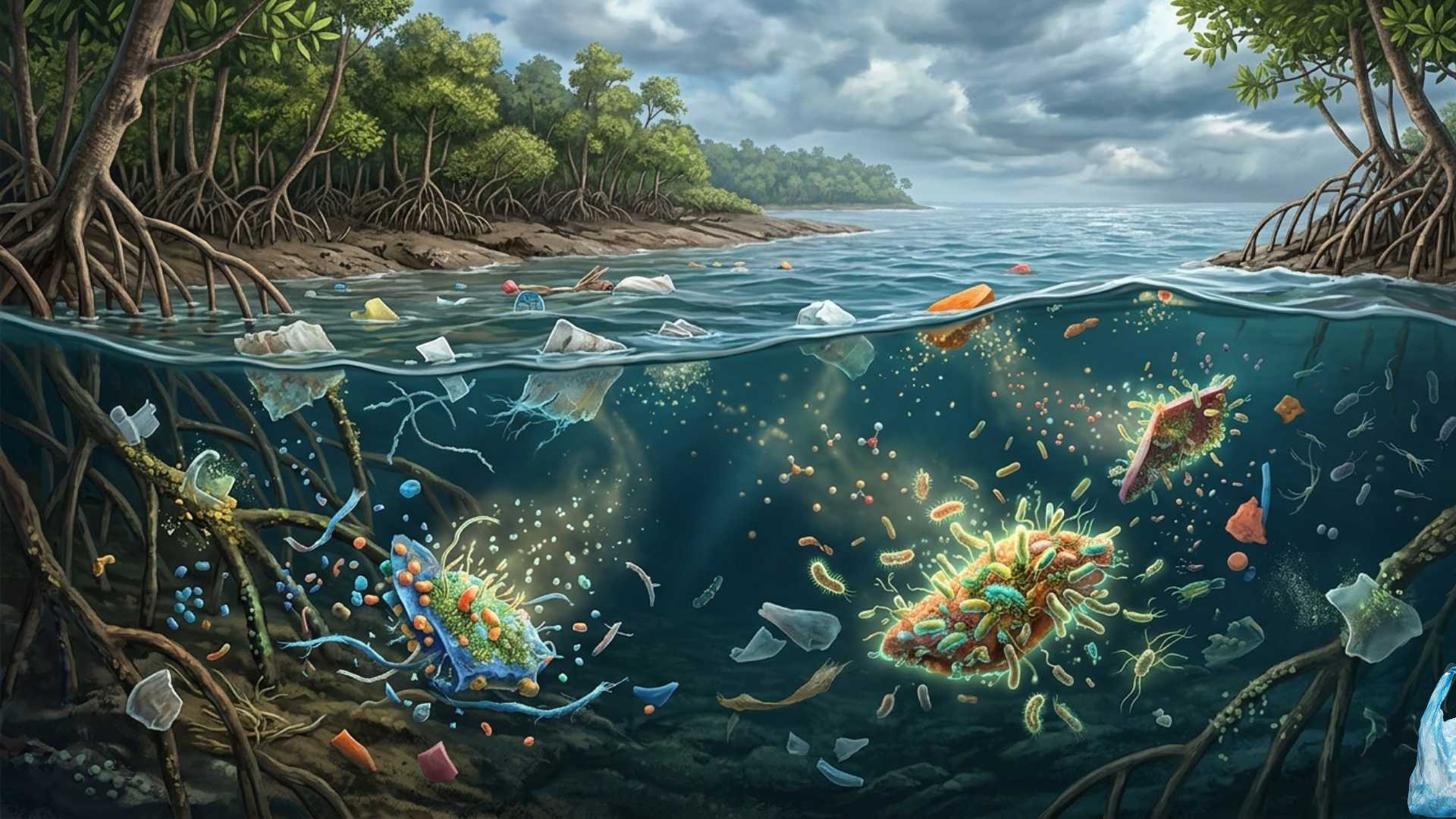
Sundarbans: The Hidden Threat of Microplastics

Introduction
"Microplastics in the Sundarbans are now a significant part of the ecosystem's carbon cycle." — IISER Kolkata, Journal of Hazardous Materials Advances (May 2026)
The Sundarbans — world's largest contiguous mangrove forest and a critical blue carbon ecosystem — is under a novel threat. IISER Kolkata's year-long study reveals that microplastics are not merely pollutants but active carbon cycle disruptors, threatening the Bay of Bengal's ecological balance.
| Key Data | Figure |
|---|---|
| Study period | Oct 2021 – Oct 2022 |
| Microplastic concentration | 5–58 particles per litre |
| Monsoon surge | ~40% higher than non-monsoon |
| Dominant plastic types | Polypropylene + PET (water bottles) |
| Carbon composition of plastics | ~90% carbon |
| Study location | Mooriganga estuary, Sagar Island |
Background & Context
The Sundarbans sits at the confluence of the Ganga and Brahmaputra, making it a sink for upstream waste. While pollution in the region is documented, the seasonal behaviour of microplastics and their carbon contribution were poorly understood — until this study.
Microplastics are plastic particles under 5mm. They enter water bodies through textile fibres, packaging waste, urban runoff, and river transport. In this study, ~50% were fibres (textiles), followed by fragments.
Key Concepts
Plastisphere — Complex microbial communities (bacteria, microbes) that colonise plastic surfaces. They are ecologically distinct from natural marine microbial communities and produce biogenic carbon of their own.
Dissolved Organic Carbon (DOC) — As microplastics weather and break down, they leach DOC into water. This fuels bacterial growth at unnaturally accelerated rates, distorting the natural food web.
Blue Carbon Ecosystems — Coastal ecosystems (mangroves, seagrasses, salt marshes) that efficiently capture and store atmospheric CO₂. The Sundarbans is among the most carbon-dense blue carbon systems globally.
Novel Carbon Reservoir — Microplastics (~90% carbon) are now functioning as an artificial carbon source in the Sundarbans, introducing carbon that was never part of the natural cycle.
Nanoplastics — High-resolution imaging found cracks, pits, and grooves on microplastics — evidence of further breakdown into nanoplastics, which are even harder to detect and remove.
How Microplastics Disrupt the Carbon Cycle
Plastic waste → Rivers (Ganga/Brahmaputra) → Sundarbans estuary
        ↓
Weathering → releases Dissolved Organic Carbon (DOC)
        ↓
Bacteria feed on DOC → grow unnaturally fast → disrupt food web
        ↓
Plastisphere microbes → produce Biogenic Carbon
        ↓
Mangroves receive excess carbon input → carbon sequestration efficiency ↓
        ↓
Blue carbon sink weakened → net CO₂ absorption reduced
Implications & Challenges
Ecological
- Natural food web disrupted by bacterial overgrowth fed by plastic-derived DOC.
- Plastisphere communities compete with or replace native microbial ecosystems.
- Nanoplastic formation makes remediation increasingly difficult.
Climate
- Sundarbans' role as a carbon sink is being undermined — directly relevant to India's climate commitments (Net Zero by 2070, NDC targets).
- Blue carbon accounting must now factor in plastic-derived carbon inputs.
Seasonal Vulnerability
- Monsoon season = 40% surge in microplastics due to surface runoff from urban drains — linking urban solid waste mismanagement directly to marine ecosystem health.
Governance Gap
- No dedicated regulatory framework for microplastic monitoring in Indian coastal waters.
- Plastic Waste Management Rules 2016 (amended 2022) address land-based plastic — marine microplastic monitoring remains weak.
Policy & Regulatory Framework
| Policy | Relevance |
|---|---|
| Plastic Waste Management Rules, 2022 | Single-use plastic ban; upstream reduction |
| National Action Plan for Marine Litter | Addresses coastal and marine plastic |
| Wetlands (Conservation & Management) Rules, 2017 | Sundarbans protection framework |
| India's NDC & Net Zero 2070 | Blue carbon ecosystems are carbon offset assets |
| MARPOL Convention | International marine pollution framework |
Conclusion
The IISER Kolkata study reframes microplastic pollution from a visibility problem to a carbon cycle crisis. The Sundarbans — a globally significant blue carbon sink and biodiversity hotspot — is now being compromised by plastic-derived carbon inputs that accelerate bacterial growth, disrupt food webs, and reduce carbon sequestration efficiency. Addressing this requires convergence of upstream waste management, coastal monitoring frameworks, and integration of blue carbon into India's climate accounting. The ocean's ability to absorb our carbon emissions depends, in part, on our ability to stop sending our plastic waste into it.
Attribution
Original content sources and authors
.jpeg)

Syllabus classification
How this article maps to GS papers
Main syllabus
GS3Environment & Bio-diversityQuick Q&A
What is the relationship between microplastics and the carbon cycle in marine ecosystems like the Sundarbans?
Biological interactions: This DOC becomes a substrate for microbial communities, enabling bacteria to grow and reproduce at accelerated rates. Additionally, microbes colonizing the plastic surface—forming plastispheres—produce biogenic carbon, further contributing to the carbon pool. This alters the natural balance between organic and inorganic carbon in the ecosystem.
Implications for carbon dynamics: In ecosystems like the Sundarbans, which are blue carbon ecosystems known for efficient carbon sequestration, the introduction of plastic-derived carbon can disrupt natural processes. It may lead to altered carbon storage efficiency, changes in microbial respiration rates, and potential feedback effects on climate regulation.
Why is the presence of microplastics in the Sundarbans particularly significant for environmental sustainability?
Pollution dynamics: Due to its location at the confluence of major rivers like the Ganga and Brahmaputra, the Sundarbans acts as a sink for upstream waste. The study highlights that microplastic concentrations increase by nearly 40% during monsoons, indicating seasonal amplification of pollution due to runoff. This makes the region highly vulnerable to anthropogenic pressures.
Long-term sustainability concerns: The accumulation of microplastics and their integration into the food web can lead to bioaccumulation and biomagnification. Over time, this may affect fish populations, bird species, and even human communities dependent on these ecosystems. Thus, microplastic pollution is not just an environmental issue but also a socio-economic concern.
How do microplastics influence microbial activity and food webs in aquatic ecosystems?
Formation of plastispheres: Microplastics provide surfaces for microbial colonization, forming complex ecosystems known as plastispheres. These communities differ significantly from free-living microbes and can include pathogenic species. This alters species composition and ecological interactions within the aquatic environment.
Impact on food webs: Changes at the microbial level cascade through the food web. Increased bacterial activity can affect nutrient cycling and oxygen levels, influencing phytoplankton and higher trophic levels. For instance, excessive microbial respiration may lead to localized hypoxia, affecting fish and other aquatic organisms.
What are the primary reasons for the seasonal variation in microplastic concentration observed in the Bay of Bengal region?
Surface runoff and river discharge: Rivers like the Ganga and Brahmaputra carry large volumes of water and waste during monsoons. This leads to the influx of both fresh and weathered microplastics, including colourless fragments that indicate prolonged environmental exposure.
Human and infrastructural factors: Poor waste management systems, especially in densely populated upstream regions, exacerbate the problem. Seasonal flooding and inadequate drainage infrastructure further contribute to the flushing of plastics into water bodies, making the issue cyclical and persistent.
Can you illustrate with examples how human activities contribute to microplastic pollution in marine ecosystems?
Packaging and consumer waste: Materials like polypropylene and polyethylene terephthalate (PET), commonly used in packaging and water bottles, were prevalent. Improper disposal and lack of recycling infrastructure lead to their fragmentation into microplastics over time.
Case study – Sundarbans: The Sundarbans exemplifies how upstream urbanization impacts downstream ecosystems. Waste generated in cities along the Ganga basin eventually accumulates in the delta, demonstrating the interconnectedness of human activities and environmental degradation.
Critically analyze the implications of microplastics acting as a ‘novel carbon reservoir’ in marine ecosystems.
Negative implications: As microplastics degrade, they release dissolved organic carbon, which fuels microbial activity and alters natural carbon cycles. This can reduce the efficiency of blue carbon ecosystems like mangroves in sequestering atmospheric CO2. Additionally, the formation of plastispheres introduces new microbial dynamics, including harmful pathogens.
Broader environmental concerns: The integration of plastic-derived carbon into natural systems represents a form of anthropogenic interference with biogeochemical cycles. It complicates climate models and challenges existing conservation strategies. Therefore, while the idea of carbon storage may seem beneficial, the overall impact is largely detrimental and calls for urgent policy intervention.
Based on the Sundarbans study, what policy measures would you recommend to mitigate microplastic pollution and its ecological impacts?
Monitoring and research: Establishing continuous monitoring systems for microplastics, especially in sensitive ecosystems like mangroves, is essential. Encouraging interdisciplinary research can help understand long-term impacts on carbon cycles and biodiversity.
Community and policy integration: Engaging local communities in conservation efforts and raising awareness about plastic pollution can create grassroots-level change. Policies should integrate environmental, economic, and social dimensions, ensuring sustainable livelihoods while protecting ecosystems. For example, incentivizing eco-friendly practices in industries and urban centers along river basins can have downstream benefits.
Practice questions
1 question for mains preparation