GS3 Environment & Bio-diversity
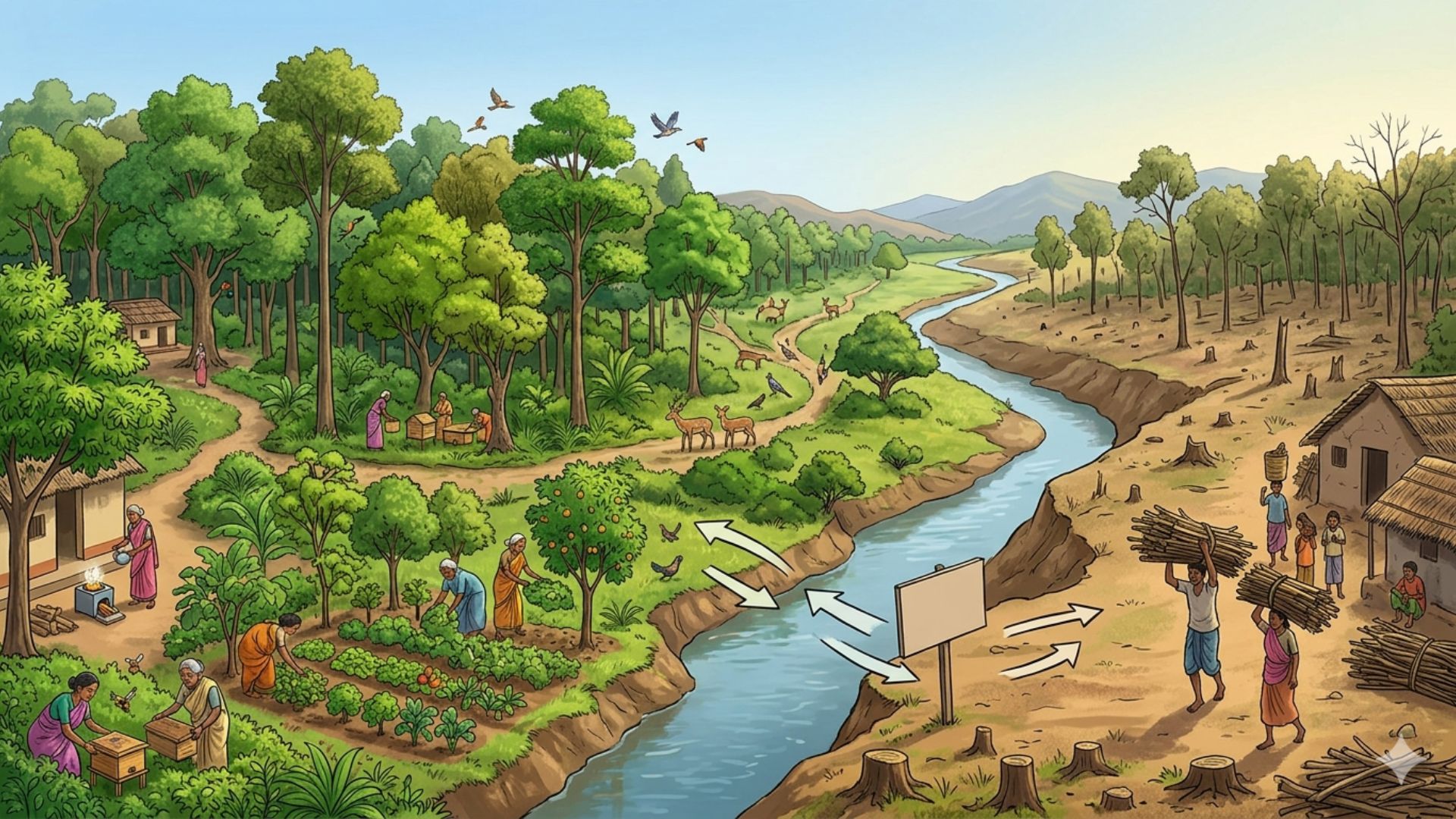
The Intersection of Forest Conservation and Poverty Alleviation

“Conservation cannot succeed without the support of local communities.”
For decades, biodiversity conservation and human development were often viewed as competing objectives. Forest protection was treated separately from poverty alleviation, with conservation policies frequently restricting human access to natural resources. However, a recent international study challenges this assumption and highlights the deep connection between community welfare and biodiversity conservation.
What Does the New Study Reveal?
A study published in Nature Sustainability analysed data from 322 community-managed tropical forests across 15 countries between 1993 and 2017.
Research Institutions Involved
- University of Notre Dame
- University of Michigan
- Yale University
- University of Colorado Boulder
- Swedish University of Agricultural Sciences
- University of Manchester
- University of Victoria
- Indian School of Business
Key Finding
There exists a strong relationship between:
- Livelihood opportunities
- Forest dependence
- Biodiversity outcomes
Link Between Poverty and Biodiversity
The study found important patterns.
| Socio-economic Condition | Biodiversity Outcome |
|---|---|
| High dependence on fuelwood | Lower tree diversity |
| Greater poverty levels | Lower species richness |
| Dense population pressure | Reduced biodiversity |
| Alternative livelihoods available | Higher tree diversity |
Important Clarification
The researchers emphasise:
Poverty itself does not cause biodiversity loss.
Rather:
Limited livelihood options
          ↓
Greater dependence on forests
          ↓
Higher resource extraction
          ↓
Decline in species diversity
Thus, improving livelihood opportunities can reduce ecological pressure.
Why Tree Species Diversity Matters
Tree species diversity refers to the number of different tree species present in a forest.
Ecological Significance
- Supports greater wildlife diversity
- Improves ecosystem stability
- Enhances resilience to environmental change
- Strengthens ecosystem services
Forests with richer species diversity are generally healthier and more resilient.
The Fortress Model of Conservation
India's forest management has historically followed the fortress conservation model.
Main Features
- Restricted human access
- Minimised resource extraction
- Strictly protected areas
- State-led management
Achievements
- Recovery of several flagship species
- Improved protection in national parks and reserves
Emerging Limitations
| Challenge | Impact |
|---|---|
| Protected area isolation | Ecological fragmentation |
| Human-dominated landscapes | Increased pressure on surrounding forests |
| Restricted community participation | Reduced local ownership |
Today, many protected areas function as ecological islands surrounded by human settlements.
Importance of Wildlife Corridors
The study highlights the conservation value of forests located between protected areas.
Functions of Wildlife Corridors
- Enable movement of large mammals
- Improve genetic exchange
- Enhance ecosystem resilience
- Connect fragmented habitats
Protected Area A
       ↔
Wildlife Corridor
       ↔
Protected Area B

Result:
• Species movement
• Better biodiversity
• Stronger resilience
Strengthening biodiversity in these corridors can directly support long-term conservation goals.
Reducing Pressure on Forests
Several State Forest Departments have introduced interventions to reduce dependence on forest resources.
Existing Measures
- Subsidised LPG connections
- Efficient cooking stoves
- Cleaner heating alternatives
These initiatives help reduce:
- Fuelwood collection
- Human entry into forests
- Resource extraction pressure
However, implementation challenges remain.
Common Constraints
- Irregular funding
- Variable community participation
- Weak long-term support systems
Communities as Conservation Partners
A growing conservation approach views local communities as stakeholders rather than threats.
Community-Based Conservation Models
• Community-run homestays
• Livestock insurance
• Reduced human-wildlife conflict
• Mangrove protection
• Sustainable fisheries
• Ecotourism promotion
• Aquaculture support
• Nest adoption programmes
• Former hunters as nest protectors
• Community forest patrolling
Madhav Gadgil's Inclusive Vision
The late ecologist Madhav Gadgil advocated:
- Community participation in conservation
- Recognition of traditional ecological knowledge
- Rights-based natural resource management
- Incentive-driven conservation
His approach viewed local communities as custodians rather than adversaries of nature.
Sharing Conservation Benefits
Wildlife tourism generates substantial revenue.
Yet:
- Only a small share reaches forest-dependent communities.
- Benefits often remain concentrated elsewhere.
Greater revenue sharing can:
- Improve livelihoods
- Strengthen conservation incentives
- Increase local stewardship
Way Forward
- Expand livelihood diversification programmes.
- Strengthen community forest governance.
- Invest in wildlife corridor restoration.
- Scale up clean energy alternatives in forest regions.
- Ensure greater revenue sharing from ecotourism.
- Integrate traditional knowledge into conservation planning.
- Promote community-led conservation initiatives.
Conclusion
The study challenges the traditional belief that conservation and development are conflicting goals. Evidence from community-managed forests shows that biodiversity conservation and poverty alleviation can reinforce one another. By moving beyond the fortress model and empowering local communities as conservation partners, policymakers can create more inclusive and sustainable approaches that benefit both people and nature.
Attribution
Original content sources and authors


Syllabus classification
How this article maps to GS papers
Main syllabus
GS3Environment & Bio-diversityAlso covers
Quick Q&A
What is the relationship between biodiversity conservation and livelihood security, and why is this linkage significant?
Why is the traditional fortress model of conservation increasingly being questioned in biodiversity management debates?
How can community participation and alternative livelihoods contribute to sustainable biodiversity conservation in India?
What are the major reasons behind biodiversity decline in community forests and human-dominated landscapes?
What lessons can be learned from Indian community-based conservation initiatives for achieving ecological sustainability and social inclusion?
What is the critical analysis of inclusive conservation approaches compared to exclusionary wildlife protection strategies?
Practice questions
1 question for mains preparation