GS3 Environment & Bio-diversity
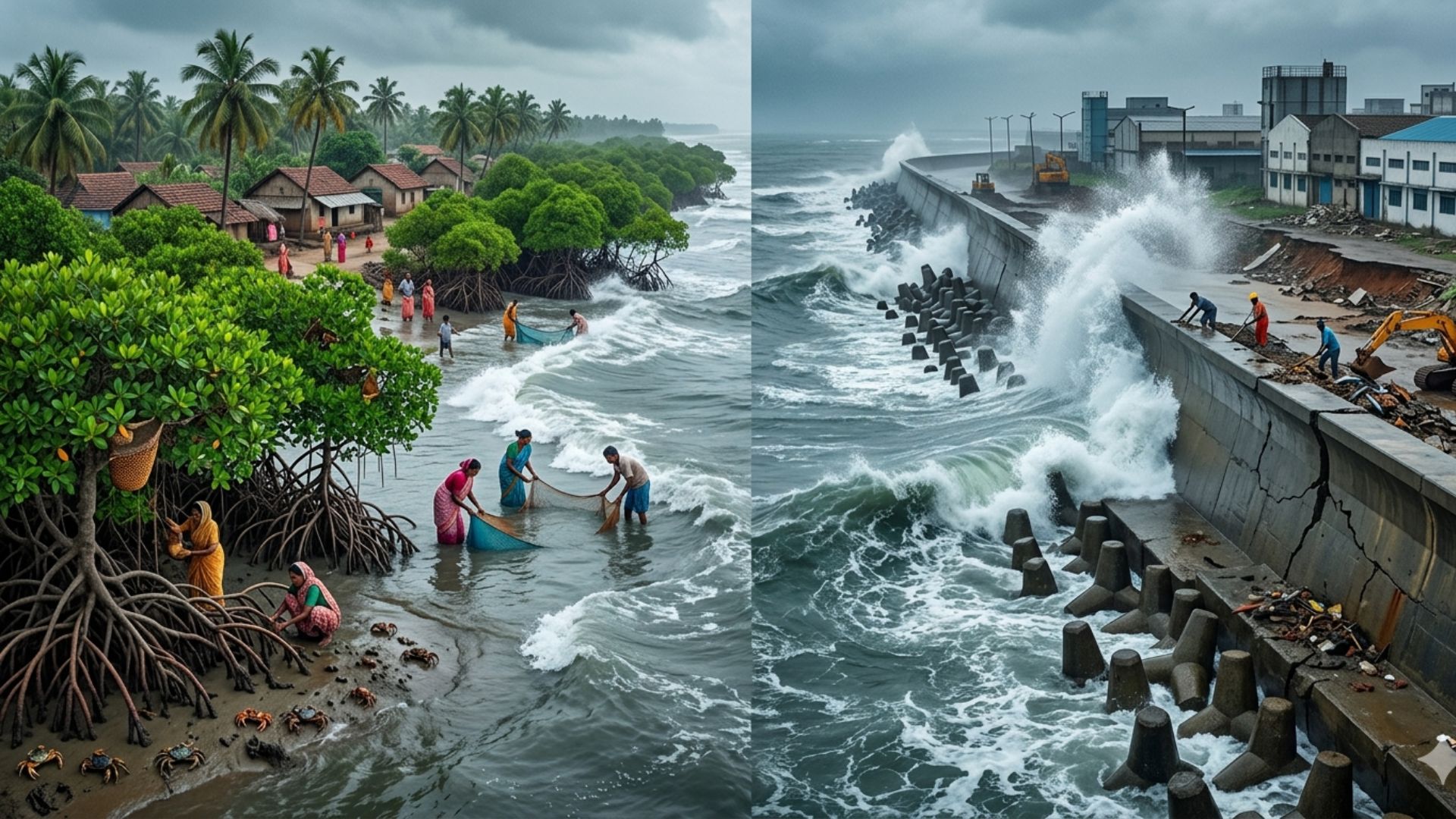
The Vital Role of Mangroves in Climate Adaptation

When Cyclone Dana made landfall near Bhitarkanika in Odisha, coastal mangroves provided a natural shield against climate impacts. This highlighted the growing importance of Ecosystem-Based Adaptation (EbA)—an approach that uses ecosystems and biodiversity to help communities adapt to climate change while supporting livelihoods and ecological health.
Why Coastal Adaptation Matters
India's coastline stretches over 11,000 km and supports nearly 250 million people.
Major climate threats include:
- Sea-level rise
- Saline intrusion
- Stronger cyclones
- Storm surges
- Coastal erosion
These hazards threaten:
- Human settlements
- Fisheries
- Agriculture
- Tourism
- Coastal ecosystems
Climate Change
      ↓
Sea-Level Rise + Cyclones
      ↓
Coastal Vulnerability
      ↓
Need for Adaptation
In this context, EbA offers a sustainable pathway to climate resilience.
What is Ecosystem-Based Adaptation?
"EbA uses biodiversity and ecosystem services to help people adapt to climate change."
Natural ecosystems function as protective barriers while generating ecological and economic benefits.
Key Coastal EbA Ecosystems
| Ecosystem | Adaptation Function |
|---|---|
| Mangroves | Reduce storm surge impacts |
| Seagrass Meadows | Stabilise sediments and store carbon |
| Coral Reefs | Dissipate wave energy |
| Coastal Wetlands | Absorb floodwaters |
These ecosystems help reduce climate risks while sustaining local livelihoods.
India's Preference for Grey Infrastructure
Despite the benefits of EbA, adaptation efforts continue to favour engineered structures.
Common Grey Infrastructure
- Seawalls
- Groynes
- Embankments
- Tetrapods
| Adaptation Approach | Characteristics |
|---|---|
| Grey Infrastructure | Visible, engineered, expensive |
| EbA | Natural, multifunctional, sustainable |
Over the last decade:
| Indicator | Amount |
|---|---|
| Spending on Hard Protection Measures | ₹2,641 crore |
| National Coastal Mission Budget (2022-23) | ₹195 crore |
| National Coastal Mission Budget (2024-25) | ₹50 crore |
This demonstrates a strong policy preference for engineered solutions.
Limitations of Hard Infrastructure
Grey measures remain useful, particularly in densely populated urban areas.
However, challenges include:
- High maintenance costs
- Ecological disruption
- Transfer of risks to nearby areas
Example: Kerala Coast
Seawall Construction
          ↓
Protection of One Stretch
          ↓
Increased Erosion Nearby
In several locations, coastal armouring has protected specific sites while accelerating erosion in adjacent regions.
India's Untapped Natural Asset
Research identifies India as a global hotspot for coastal EbA.
A notable advantage:
"India's mangroves protect more people per hectare than almost any other country."
Yet these ecosystems remain underutilised within adaptation planning.
Success Story: Sundarbans Mangrove Restoration
The Sundarbans demonstrate the practical benefits of EbA.
Outcomes
| Indicator | Achievement |
|---|---|
| Women Involved | 18,000+ |
| Mangroves Restored | 4,600 hectares |
| Cyclones Mitigated | Amphan and Yaas |
Additional livelihood benefits included:
- Honey collection
- Crab farming
- Community income generation
Mangrove Restoration
          ↓
Cyclone Protection
          +
Livelihood Generation
          +
Ecosystem Recovery
This illustrates the multiple co-benefits of EbA.
Why Does EbA Remain Marginal?
Several barriers limit its recognition.
Institutional Challenges
- Fragmented governance mandates
- Weak monitoring systems
- Preference for visible infrastructure projects
- Limited adaptation-specific assessment
Conceptual Challenges
The policy landscape includes multiple overlapping terms:
- Ecosystem-Based Adaptation (EbA)
- Nature-Based Solutions (NbS)
- Ecosystem-Based Coastal Adaptation (EbCA)
- Ecosystem-Based Disaster Risk Reduction (Eco-DRR)
This creates confusion regarding classification and reporting.
As a result, many adaptation interventions remain hidden within broader development or conservation programmes.
Why Classification Matters
The Mangrove Initiative for Shoreline Habitats & Tangible Incomes (MISHTI) illustrates this challenge.
MISHTI Programme
| Objective | Target |
|---|---|
| Mangrove Restoration | 540 sq km |
| States Covered | 9 |
Although designed to protect communities from climate impacts, MISHTI is primarily classified as a restoration initiative rather than an adaptation programme.
Without clear recognition:
- Adaptation outcomes remain undercounted.
- Financing opportunities are missed.
- Monitoring becomes difficult.
- Policy prioritisation weakens.
Way Forward
- Integrate EbA into national and state coastal adaptation plans.
- Develop clear definitions and classification frameworks for EbA.
- Strengthen monitoring and evaluation systems.
- Expand mangrove, seagrass, coral reef, and wetland restoration.
- Promote community-led ecosystem management.
- Increase dedicated funding for ecosystem-based adaptation.
- Align adaptation reporting with Global Goal on Adaptation frameworks.
- Combine grey and green infrastructure where appropriate.
Conclusion
India's coastal ecosystems are already functioning as powerful climate adaptation assets. Mangroves, wetlands, coral reefs, and seagrass meadows not only reduce disaster risks but also strengthen livelihoods and ecological resilience. The challenge today is not proving that ecosystem-based adaptation works, but ensuring that policy frameworks recognise, measure, finance, and scale these interventions. By placing natural capital at the centre of adaptation planning, India can build a more resilient, equitable, and sustainable coastal future.
Attribution
Original content sources and authors


Syllabus classification
How this article maps to GS papers
Main syllabus
GS3Environment & Bio-diversityQuick Q&A
What is Ecosystem-based Adaptation and why is it emerging as a significant strategy for climate resilience along India's coastline?
Why is ecosystem-based adaptation considered important for India's climate policy and for UPSC aspirants studying environmental governance?
How do ecosystem-based adaptation measures function differently from conventional hard infrastructure in managing coastal risks?
What are the major reasons behind the underutilisation and limited recognition of ecosystem-based adaptation in India?
What lessons do the Sundarbans and MISHTI programme provide regarding ecosystem-based adaptation and biodiversity conservation in India?
Critically analyse the debate between grey infrastructure and ecosystem-based adaptation in achieving coastal resilience in India.
Why does proper classification and measurement of ecosystem-based adaptation matter for India's climate governance and adaptation finance framework?
Practice questions
1 question for mains preparation