GS3 Environment & Bio-diversity
Understanding Wildfires in the Nilgiris: A Growing Concern

Introduction
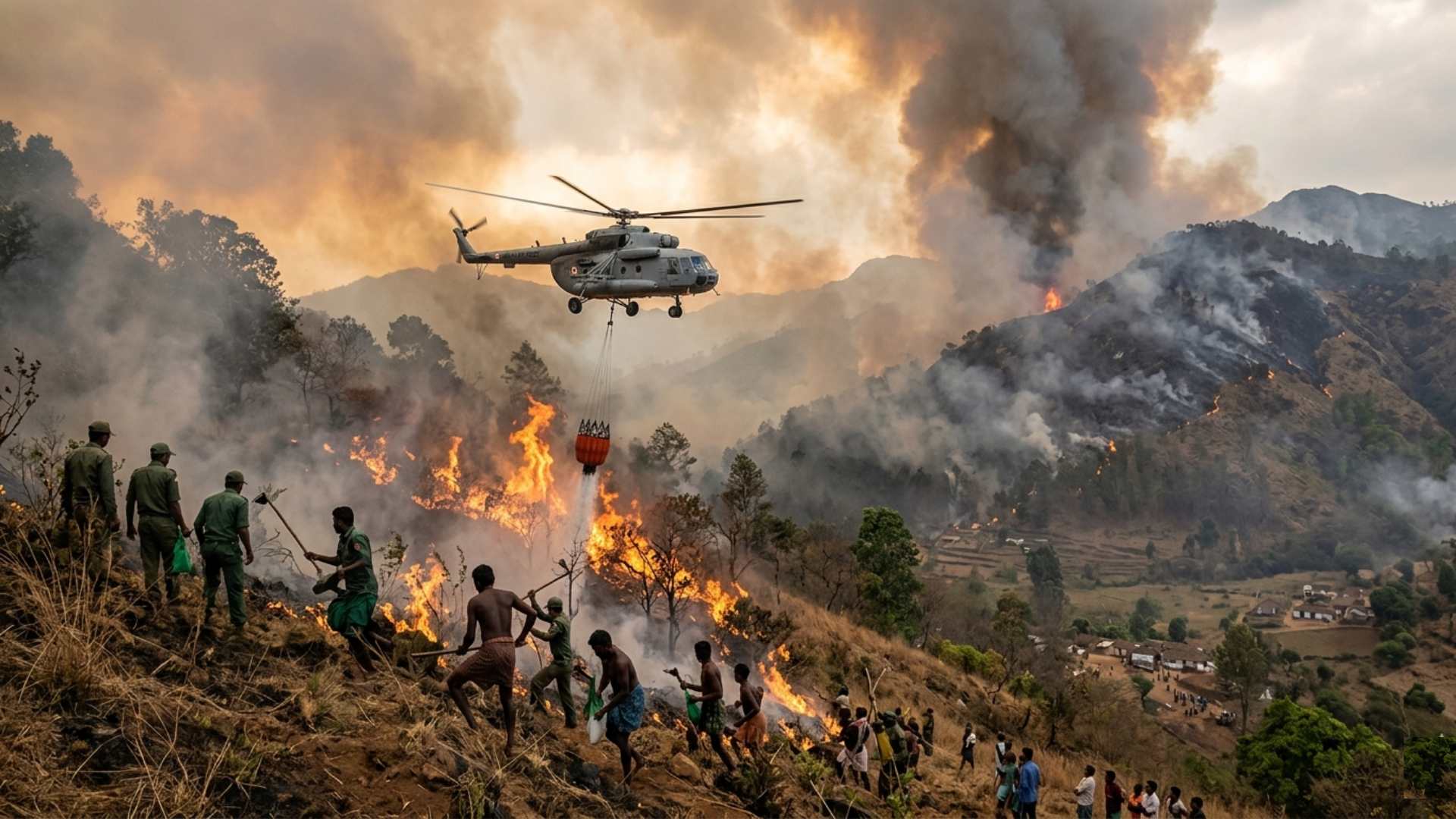
- The Nilgiris-Mudumalai-Coimbatore-Erode forest belt witnessed severe wildfires in 2025, requiring Indian Air Force assistance — marking a crisis-level escalation of an otherwise seasonal phenomenon.
- India loses an estimated 1.5–2 lakh hectares of forest cover annually to fires; the Western Ghats, a UNESCO World Heritage biodiversity hotspot, remains particularly vulnerable.
"Wildfires are no longer rare disasters but recurring crises — globally, over 4 million sq. km burn annually (WWF), while India recorded forest fire alerts in 36,000+ locations in a single year (FSI, 2021), signalling a systemic, not seasonal, emergency."
Key Concepts
| Term | Meaning |
|---|---|
| Firelines | Cleared strips of land to prevent fire spread |
| Controlled Burn | Deliberate, managed burning to reduce accumulated biomass |
| Invasive Undergrowth | Non-native species accumulating as fuel load |
| Climate Variability | Short-term fluctuations in climate increasing fire baseline risk |
Causes of Nilgiris Wildfires
Natural/Climatic:
- Feb–May is the established fire season; 2025 saw high heat + strong winds carrying embers across pre-existing firelines.
- Accumulated biomass and invasive undergrowth in Pykara caused fires to burn hotter and longer.
- Climate variability (hotter, drier summers) raises the baseline risk independent of other factors.
- El Niño effects suppress monsoon moisture, extending dry seasons — a pattern linked to fire surges in Australia (2019–20 Black Summer) and Canada (2023 record fires).
Human/Anthropogenic:
- Tribal wood-gathering (broom-making) and herder-initiated grassland burns for fodder regrowth.
- Discarded smoking paraphernalia as accidental ignition source.
- Alleged deliberate arson over unresolved tiger-related human deaths.
- Inter-state coordination failure — Kerala forest staff conducted a controlled burn allegedly without informing Tamil Nadu.
- Encroachment and land conversion — globally, Amazon fires are largely arson-driven to clear land for agriculture.
- Shifting cultivation (Jhum) in Northeast India — uncontrolled burns frequently escape into adjoining forests.
- Power line sparks and infrastructure — leading cause in California wildfires (PG&E liability cases).
Structural/Systemic:
- Forest fragmentation reduces natural firebreaks, allowing faster lateral spread.
- Understaffed forest departments — India has ~1 forest guard per 800 hectares against the recommended 1 per 500 (CAG).
- Absence of a dedicated National Wildfire Management Policy in India, unlike the US (National Interagency Fire Center) or Australia (Australasian Fire Authorities Council).
Challenges in Fire Management
Geographical:
- Steep terrain and limited road access slow crew and equipment deployment to fire sites.
Socio-economic:
- Fire-risk activities (grassland burning, wood gathering) are tied to tribal and pastoral livelihoods — cannot be eliminated without viable alternatives.
Institutional:
- Poor inter-state forest department coordination (Kerala–Tamil Nadu incident).
- Reactive rather than anticipatory management culture.
Ecological:
- Invasive species accumulation increases fuel load year-on-year.
- Loss of biodiversity in one of India's most ecologically sensitive zones.
Government Response (2025)
- Control rooms and firelines set up from March.
- Ensured animal access to water outside human-settled areas.
- Weed clearance and community awareness campaigns mounted.
- IAF deployed for aerial firefighting — indicating scale beyond routine capacity.
Note: Local tribal communities were among the first-responders — underscoring the importance of community-based forest governance.
Relevant Policy & Legal Framework:
| Policy/Act | Relevance |
|---|---|
| Forest Conservation Act, 1980 | Regulates diversion of forest land; limits encroachment-driven fire risk |
| Wildlife Protection Act, 1972 | Governs protected area management including fire response in reserves |
| Forest Rights Act, 2006 | Recognises tribal rights; key to integrating communities in fire management |
| National Action Plan on Forest Fires (NAPFF), 2018 | India's primary framework — emphasises prevention, early detection, and community involvement |
| Disaster Management Act, 2005 | Enables NDMA/SDMA coordination for large-scale fire response |
| ISFR (India State of Forest Report) | FSI monitors fire-prone areas via satellite; informs annual preparedness |
Gaps in Policy Implementation:
- NAPFF remains largely unimplemented at state level due to funding and capacity deficits.
- No dedicated National Wildfire Management Authority unlike the US or Australia.
- Forest Rights Act's community empowerment potential remains underutilised in fire management.
Way Forward
- Long-term land use planning integrating fire risk into forest management cycles.
- Livelihood alternatives for communities dependent on fire-risk practices.
- Inter-state coordination protocols for controlled burns in border forest divisions.
- Early Warning Systems using satellite data (ISRO's VIIRS/MODIS fire alerts) for real-time detection.
- Invasive species management to reduce accumulated fuel loads.
- Strengthen Joint Forest Management (JFM) committees with trained tribal first-responders.
Conclusion
- Nilgiris fires reveal that forest fire management is no longer a short-term operational problem but a long-term governance and climate adaptation challenge.
- The confluence of climate variability, ecological degradation, livelihood dependencies, and institutional gaps demands an integrated, community-centred approach — moving from crisis response to anticipatory resilience.
Attribution
Original content sources and authors


Syllabus classification
How this article maps to GS papers
Main syllabus
GS3Environment & Bio-diversityQuick Q&A
What are the key factors contributing to seasonal wildfires in the Nilgiris region?
Another important factor is the accumulation of biomass and invasive undergrowth, especially in areas like Pykara. This acts as fuel, causing fires to burn hotter and longer. The region’s steep terrain and limited accessibility further complicate firefighting efforts, delaying response times and restricting the movement of personnel and equipment.
Human activities also significantly contribute to these fires. Practices such as burning grasslands for fodder regeneration, collection of forest produce, and accidental causes like discarded cigarettes are common triggers. Occasionally, administrative lapses—such as uncoordinated controlled burns across state boundaries—also exacerbate the situation. Thus, wildfires in the Nilgiris are the result of a complex interplay between natural conditions and human interventions.
Why are the recent wildfires in the Nilgiris considered more intense and concerning than usual?
Additionally, the presence of excess biomass and invasive species has amplified fire intensity. In areas such as Parsons Valley and Pykara, accumulated vegetation acted as a continuous fuel source, leading to prolonged burning. The inability to quickly access affected regions due to rugged terrain further delayed containment efforts, allowing fires to escalate.
Another critical factor is climate variability, which is increasing baseline risks. Even if traditional causes remain constant, a hotter and drier environment magnifies their impact. This highlights a shift from predictable seasonal patterns to more unpredictable and severe fire events, raising concerns about long-term ecological stability and disaster preparedness.
How do human activities and livelihood practices influence wildfire risks in the Nilgiris?
Accidental causes are also common. For instance, discarded smoking materials can ignite dry vegetation, especially during peak summer months. Additionally, poorly coordinated administrative actions—such as controlled burns conducted without inter-state communication—can lead to unintended fire spread, as seen in the recent incident involving Kerala and Tamil Nadu forest divisions.
While these activities are integral to local livelihoods, they pose a challenge for forest management. Completely banning them is neither practical nor equitable. Instead, there is a need for community-based fire management strategies, awareness campaigns, and provision of alternative livelihood options. This approach ensures that ecological conservation is balanced with socio-economic realities.
What role does climate variability play in exacerbating wildfire risks in forest ecosystems like the Nilgiris?
Unlike long-term climate change, which refers to gradual shifts, climate variability involves short-term fluctuations that can create extreme conditions in a given season. For example, an unusually dry spell combined with high winds can transform routine fire incidents into large-scale disasters. This variability makes it difficult for authorities to rely solely on historical patterns for planning and preparedness.
The implications are significant for forest management. Traditional fire prevention strategies may no longer suffice, as they are based on predictable seasonal cycles. There is a growing need for adaptive management approaches, including real-time monitoring, early warning systems, and flexible response strategies. Recognising the role of climate variability is essential for building resilience against increasingly unpredictable wildfire events.
Provide a case-based explanation of how geographical and administrative factors complicate wildfire management in the Nilgiris.
Administratively, coordination challenges further exacerbate the situation. The recent incident where a fire spread from Kerala into Tamil Nadu highlights the risks associated with lack of inter-state coordination during controlled burns. Such lapses can transform routine management practices into large-scale emergencies.
Despite these challenges, local communities often act as first responders, demonstrating the importance of community involvement in disaster management. This case underscores the need for integrated approaches that combine geographical awareness, administrative coordination, and community participation to effectively manage wildfires.
Critically analyse the effectiveness of current wildfire management strategies in the Nilgiris.
However, their effectiveness is increasingly being challenged by changing environmental and socio-economic conditions. Climate variability has made fires more unpredictable and intense, reducing the efficacy of traditional approaches. Additionally, many fire-inducing activities are linked to local livelihoods, making it difficult to enforce strict regulations without causing socio-economic disruptions.
Another limitation is the lack of long-term, integrated planning. Current strategies often focus on short-term containment rather than addressing root causes such as invasive species, land-use changes, and climate risks. To improve effectiveness, there is a need for a holistic approach that includes technological interventions (like satellite monitoring), community engagement, and policy coordination across sectors and states.
As a district administrator, how would you design a long-term wildfire management strategy for regions like the Nilgiris?
Second, integrating community participation is crucial. Local tribes and residents, who are often the first responders, should be trained in fire management techniques and incentivised to adopt safer practices. Providing alternative livelihoods can reduce dependence on activities that increase fire risk, such as intentional grassland burning.
Third, ensuring inter-agency and inter-state coordination is essential to prevent administrative lapses. Policies should emphasise long-term ecological restoration, including controlling invasive species and promoting sustainable land use. By combining technology, community engagement, and policy integration, such a strategy can enhance resilience and reduce the impact of wildfires in the Nilgiris.
Practice questions
1 question for mains preparation