GS3 Indian-Economy

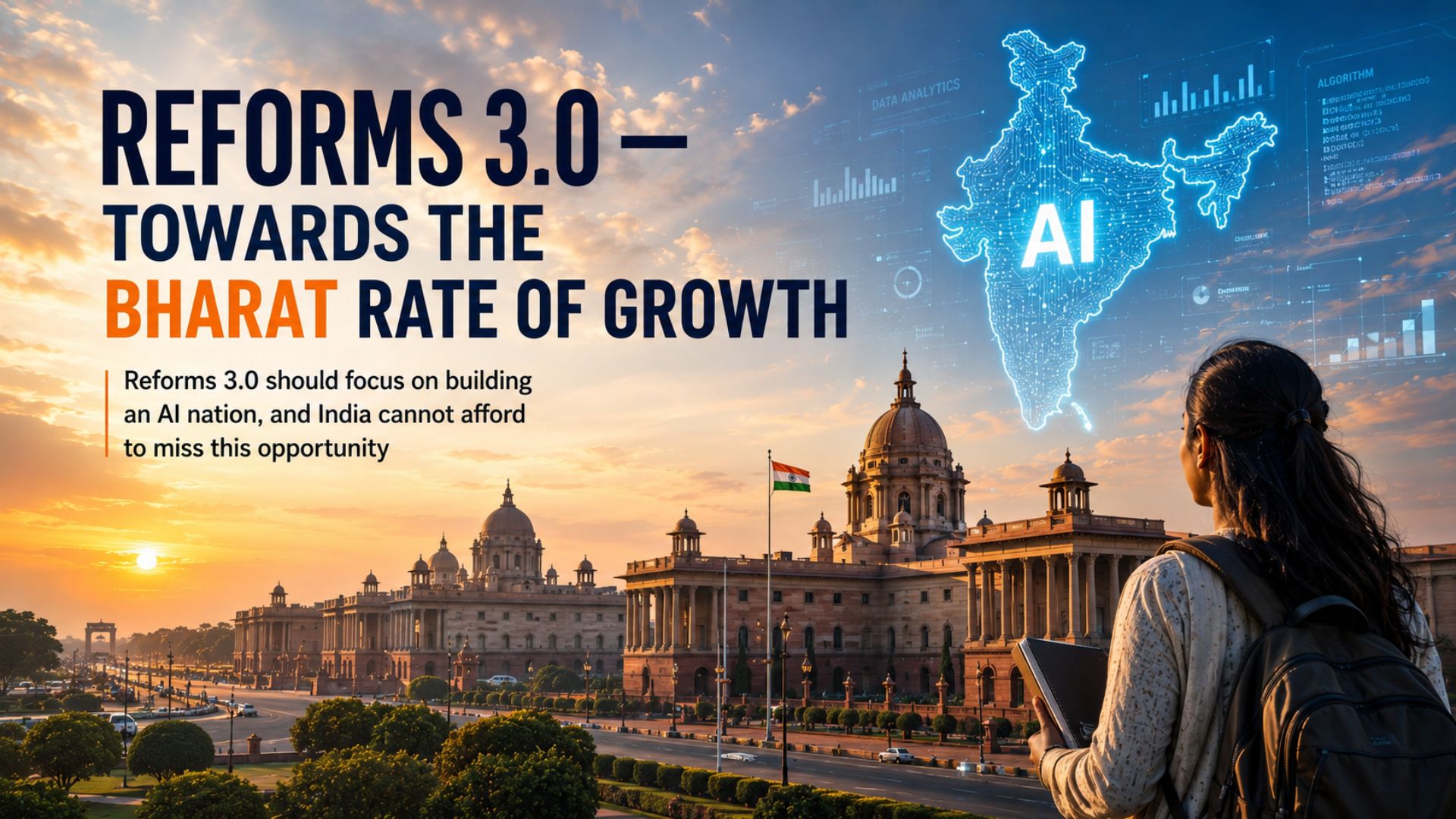
AI-Powered Reforms, Bharat's Next Growth Leap

AI as India's Next Growth Engine: From Digital Public Infrastructure to AI Public Infrastructure

India stands on the brink of an AI revolution; embracing innovations can redefine growth trajectories.
Gopi Gopi
4 mins read

"Technology is best when it brings people together and expands human capability." — Matt Mullenweg

Artificial Intelligence (AI) is increasingly being viewed as the next transformational force for India's economic growth, much like the 1991 economic liberalisation that accelerated GDP growth. The central proposition is that India should replicate the success of its Digital Public Infrastructure (DPI) by making AI tokens as affordable and accessible as mobile data, thereby democratising AI for research, education and innovation.


Why is AI a Strategic Opportunity?

The article argues that India has repeatedly demonstrated its ability to leapfrog technological stages.

Digital TransformationAchievement
AadhaarWorld's largest biometric identity system (1.38 billion people)
UPIAround 250 billion annual transactions worth $3.4 trillion; nearly 50% of global real-time payments
Jio RevolutionMobile data prices fell dramatically, making internet access affordable

These examples suggest that policy-led digital infrastructure can create large-scale economic transformation.


Why invest in AI now?

India spends only 0.65% of GDP on Research & Development (R&D), considerably lower than many major economies.

CountryR&D Expenditure (% of GDP)
Israel5.4%
South Korea4.9%
United States3.5%
China2.4%
India0.65%

The proposal is to subsidise AI tokens for universities, research institutions and schools, enabling AI-assisted learning and scientific research.


What are AI Tokens?

AI tokens represent the computational units consumed while interacting with Large Language Models (LLMs).

Example

Student asks AI to solve a physics problem
↓

LLM processes the request

↓

AI Tokens consumed

↓

Response generated

Free AI tokens
↓

Affordable AI access for education and research

The proposal seeks to make these tokens freely available for selected educational and research institutions.


Is such a subsidy affordable?

The estimated annual AI token subsidy is about $2 billion (0.06% of GDP).

Compared with existing subsidies:

ComparisonObservation
Food subsidyAI subsidy ≈ one-fourteenth
Fertilizer subsidyAI subsidy ≈ one-tenth
LPG compensationLower than one quarter's compensation

The article argues that the challenge is not financial capacity but policy prioritisation.


Proposed Funding Strategy

Instead of large direct government expenditure, the proposal recommends a combination of public investment and market incentives.

Major suggestions include:

  • Freeze growth in existing subsidies for one year.
  • Develop Public-Private Partnerships (PPPs) with AWS, Google and Microsoft.
  • Exchange land, power incentives and data sovereignty assurances for AI inference capacity.
  • Cross-subsidise schools through enterprise AI services.

The underlying principle mirrors India's telecom revolution:

Create enabling regulations rather than permanent subsidies.


Why should India host its own AI models?

The article argues that India should become both a producer and operator of AI infrastructure rather than merely a consumer.

Potential models include:

  • Sarvam
  • Llama
  • Qwen
  • DeepSeek
  • Kimi

Advantages of sovereign AI hosting

  • Reduced dependence on foreign APIs.
  • Lower inference costs.
  • Better adaptation for Indic languages.
  • Greater transparency and security for government applications.

Requirements for Sovereign AI Infrastructure

Hosting national-scale AI requires capabilities beyond model deployment.

Essential components include:

  • Multi-region availability and redundancy.
  • Low-latency nationwide access.
  • Efficient compute utilisation.
  • Data residency compliance.
  • Cybersecurity and prompt injection protection.
  • Auditability for public sector applications.

Thus, AI infrastructure is viewed as a strategic national capability, similar to India's space and nuclear programmes.


Diversifying AI Hardware

Heavy dependence on a single hardware vendor creates technological vulnerability.

The proposed hardware mix is:

PlatformProposed Share
AWS Trainium & AMD40%
Google TPUs30%
NVIDIA GPUs30%

This diversified approach aims to reduce costs while strengthening technological resilience.


Proposed Two-Year Roadmap

24-Month Implementation

↓

National AI Token Policy

↓

PPP with hyperscalers

↓

Free AI tokens for IITs & IISc

↓

API sandbox for 500 startups

↓

100 Universities

↓

500 High Schools

↓

Indic AI Benchmarks

↓

Deployment in Healthcare,
Agriculture, Judiciary &
Education

↓

5,000 Schools
22 Indian Languages

Expected outcomes include:

  • Top-five global AI token consumption.
  • Competitive India-trained AI models.
  • Growth of over 10,000 AI-native startups.
  • Higher long-term GDP growth.

Key Challenges

  • Low public investment in R&D.
  • High cost of AI infrastructure.
  • Dependence on foreign AI ecosystems.
  • Need for secure sovereign compute infrastructure.
  • Balancing affordability with technological self-reliance.
  • Building skilled AI talent across sectors.

Way Forward

  • Formulate a National AI Token Policy.
  • Expand public-private partnerships for AI infrastructure.
  • Increase R&D investment and AI funding.
  • Promote open-source and sovereign AI ecosystems.
  • Develop multilingual AI models for all Indian languages.
  • Diversify AI hardware supply chains to reduce strategic dependence.
  • Integrate AI across education, healthcare, agriculture, governance and judiciary while ensuring responsible AI practices.

Conclusion

Artificial Intelligence presents India with an opportunity comparable to the transformational impact of 1991 economic reforms and the success of Digital Public Infrastructure. By combining affordable AI access, sovereign infrastructure, diversified technology ecosystems and strong public-private collaboration, India can transform AI into a public digital utility that accelerates innovation, enhances productivity and strengthens inclusive economic growth. The challenge is no longer technological feasibility, but making timely policy choices that position India as a global leader in the AI era.

Attribution

Original content sources and authors

Srivatsa Krishna Author Srivatsa Krishna The Hindu Source The Hindu

Syllabus classification

How this article maps to GS papers

Main syllabus

GS3Indian-Economy

Also covers

GS3Science & Technology

Quick Q&A

What is the concept of a National AI Token Policy, and why is making AI tokens widely accessible considered a transformative strategy for India's economic and technological development?
A National AI Token Policy refers to a government-led framework aimed at providing affordable or free access to AI inference tokens—the computational units consumed when users interact with large language models (LLMs). The proposal draws parallels with India's Digital Public Infrastructure (DPI) success stories such as Aadhaar, Unified Payments Interface (UPI), and affordable internet enabled by Reliance Jio. Just as inexpensive mobile data democratized internet access, AI token accessibility seeks to democratize access to artificial intelligence. The article argues that India currently spends only about 0.65% of GDP on research and development, significantly below China (2.4%), the United States (3.5%), South Korea (4.9%), and Israel (5.4%). It proposes an annual AI token subsidy of approximately $2 billion, or around 0.06% of GDP, for leading research institutions, universities, and schools. Such an investment is relatively small compared to India's annual subsidies on food, fertilizers, and energy. The objective is to treat AI as a public productivity infrastructure that enhances education, scientific research, healthcare, agriculture, governance, and entrepreneurship. The proposal also recommends public-private partnerships with cloud providers such as AWS, Google, and Microsoft to reduce infrastructure costs. For UPSC, this topic is relevant to GS Paper III (Science and Technology, Economic Development), GS Paper II (Governance and Public Policy), and Essay. It raises broader debates about digital inclusion, human capital formation, technological sovereignty, innovation-led growth, and the role of the State in enabling frontier technologies while ensuring equitable access.
Why is sovereign AI infrastructure increasingly viewed as a strategic national capability for India in the era of artificial intelligence and geopolitical competition?
Sovereign AI infrastructure refers to a country's ability to independently host, train, deploy, and govern artificial intelligence models using domestic computational infrastructure while maintaining control over data, security, and policy decisions. The article argues that India should move beyond merely consuming AI services through foreign APIs and instead develop indigenous capabilities for hosting large language models such as Sarvam, Llama, Qwen, DeepSeek, Kimi, and other open-source models on Indian infrastructure. This approach is strategically important because dependence on foreign AI platforms exposes countries to risks arising from export controls, geopolitical tensions, licensing restrictions, data privacy concerns, and technological monopolies. AI systems increasingly influence governance, defence, healthcare, education, finance, and judicial administration, making digital sovereignty as important as energy or food security. Open-source models offer several advantages, including lower costs, transparency through auditable model weights, customization for Indic languages, and reduced reliance on proprietary vendors. However, hosting AI models at scale requires expertise in cybersecurity, low-latency computing, multi-region redundancy, energy-efficient computing, data residency compliance, and prompt injection defence. These capabilities have significant implications for national resilience. The proposal also recommends diversifying hardware through a 40:30:30 mix involving AWS Trainium and AMD, Google TPUs, and NVIDIA GPUs to avoid excessive vendor lock-in. For UPSC, this topic connects to GS Paper III (Science & Technology, Internal Security), GS Paper II (Data Governance), and International Relations. It illustrates how technological self-reliance complements initiatives such as Digital India, Atmanirbhar Bharat, Semiconductor Mission, and the IndiaAI Mission while strengthening national competitiveness in an increasingly AI-driven global economy.
How can India replicate the success of Aadhaar, UPI, and affordable mobile data to build an inclusive and globally competitive artificial intelligence ecosystem?
India's Digital Public Infrastructure demonstrates that enabling policies and open technological ecosystems can generate transformational outcomes. Aadhaar created the world's largest biometric identity system covering more than 1.38 billion people. UPI now processes nearly 250 billion annual transactions worth approximately $3.4 trillion and accounts for nearly half of the world's real-time digital payments. Similarly, affordable internet expanded rapidly after regulatory reforms and competitive market conditions reduced mobile data prices dramatically. The article argues that India should replicate this model for AI by making inference tokens affordable through ecosystem development rather than relying solely on government subsidies. The strategy involves announcing a National AI Token Policy, establishing public-private partnerships with hyperscalers such as AWS, Google, and Microsoft, and leveraging India's large digital market to negotiate favorable infrastructure arrangements. The roadmap proposes an initial rollout covering premier IITs, IISc, 100 universities, national research institutions, startups, and thousands of schools before expanding to sectors such as healthcare, agriculture, judiciary, and education in all 22 scheduled languages. Cross-subsidization through enterprise users, open-source AI models, sovereign hosting infrastructure, and diversified compute hardware can reduce costs sustainably. The approach emphasizes market creation instead of permanent fiscal dependence. Such a framework would improve innovation capacity, AI literacy, startup ecosystems, and research productivity while strengthening India's global competitiveness. From a UPSC perspective, the proposal links science and technology with governance, digital economy, education policy, public-private partnerships, startup ecosystems, and inclusive growth. It demonstrates how institutional reforms, regulatory innovation, and strategic investments can create long-term multiplier effects similar to previous digital transformations.
Critically analyse the proposal to subsidise AI tokens for education and research instead of significantly increasing traditional welfare expenditure in India.
The proposal to subsidise AI tokens represents a shift in public policy from subsidising consumption toward enhancing productivity and knowledge creation. Supporters argue that India's long-term economic competitiveness depends increasingly on investments in human capital, innovation, and frontier technologies. According to the article, an annual investment of approximately $2 billion—around 0.06% of GDP—would be sufficient to provide AI access to leading universities, research institutions, and thousands of schools. Compared with annual expenditures on food, fertilizer, and fuel subsidies, this amount is relatively modest and could generate substantial productivity gains through improved scientific research, education, entrepreneurship, and public service delivery. AI-enabled researchers, students, doctors, and innovators could accelerate discoveries across agriculture, healthcare, climate science, manufacturing, and governance. However, critics may argue that India continues to face pressing developmental challenges, including poverty, malnutrition, unemployment, healthcare deficits, and educational inequalities. They may contend that AI investments should complement rather than substitute essential social welfare programmes. Additional concerns include digital divides, unequal internet access, cybersecurity risks, algorithmic bias, misinformation, and dependence on foreign technology firms. There are also fiscal considerations regarding opportunity costs and implementation capacity. Therefore, policymakers must ensure that AI investments remain inclusive, transparent, and accompanied by digital literacy, regulatory safeguards, and robust data protection mechanisms. A balanced approach would involve gradually reallocating resources without undermining existing welfare commitments while encouraging private sector participation through public-private partnerships. For UPSC, this debate illustrates the broader challenge of balancing equity with efficiency, welfare with innovation, and immediate social needs with long-term national competitiveness. It is relevant to GS Papers II and III, public finance, social justice, technology policy, and governance reforms.
What lessons can policymakers derive from India's digital public infrastructure experience while designing a national artificial intelligence ecosystem for inclusive development and global leadership?
India's Digital Public Infrastructure (DPI) provides an important case study in how coordinated policy reforms, technological innovation, and institutional capacity can create large-scale developmental impact. Aadhaar established universal digital identity, enabling efficient welfare delivery and financial inclusion. UPI revolutionized digital payments by creating an interoperable, low-cost platform that now handles around 250 billion annual transactions worth nearly $3.4 trillion. Affordable mobile internet following the entry of Reliance Jio dramatically expanded digital participation, reducing data prices from roughly $3 per GB to nearly $0.10 within a few years. These examples demonstrate that governments need not directly finance every technological service; instead, they can establish regulatory frameworks that promote competition, interoperability, and innovation. Applying similar principles to AI, policymakers should prioritize open standards, public-private partnerships, interoperable APIs, sovereign infrastructure, diversified compute hardware, and support for open-source models. Investments should focus on universities, research institutions, startups, and schools to build long-term human capital rather than only subsidizing consumption. The ecosystem must also address cybersecurity, data protection, multilingual AI, energy efficiency, transparency, and ethical AI governance. Inclusive access across rural and urban India is essential to prevent widening digital inequalities. Furthermore, India should integrate AI into governance sectors such as healthcare, agriculture, judiciary, education, and public administration while maintaining accountability through appropriate regulatory institutions. For UPSC aspirants, this case study highlights the importance of institutional innovation, digital governance, cooperative federalism, public-private partnerships, and strategic technology policy. It demonstrates how carefully designed public infrastructure can generate multiplier effects across economic growth, social inclusion, administrative efficiency, and global competitiveness, making it highly relevant to GS Papers II, III, Essay, and Ethics.

Practice questions

1 question for mains preparation

Investment in knowledge and technology is increasingly becoming the foundation of economic growth in the 21st century. Analyse the role of Artificial Intelligence (AI) and research & development (R&D) in transforming India into a knowledge-based economy.

10 marks · 150 words · 8 mins
