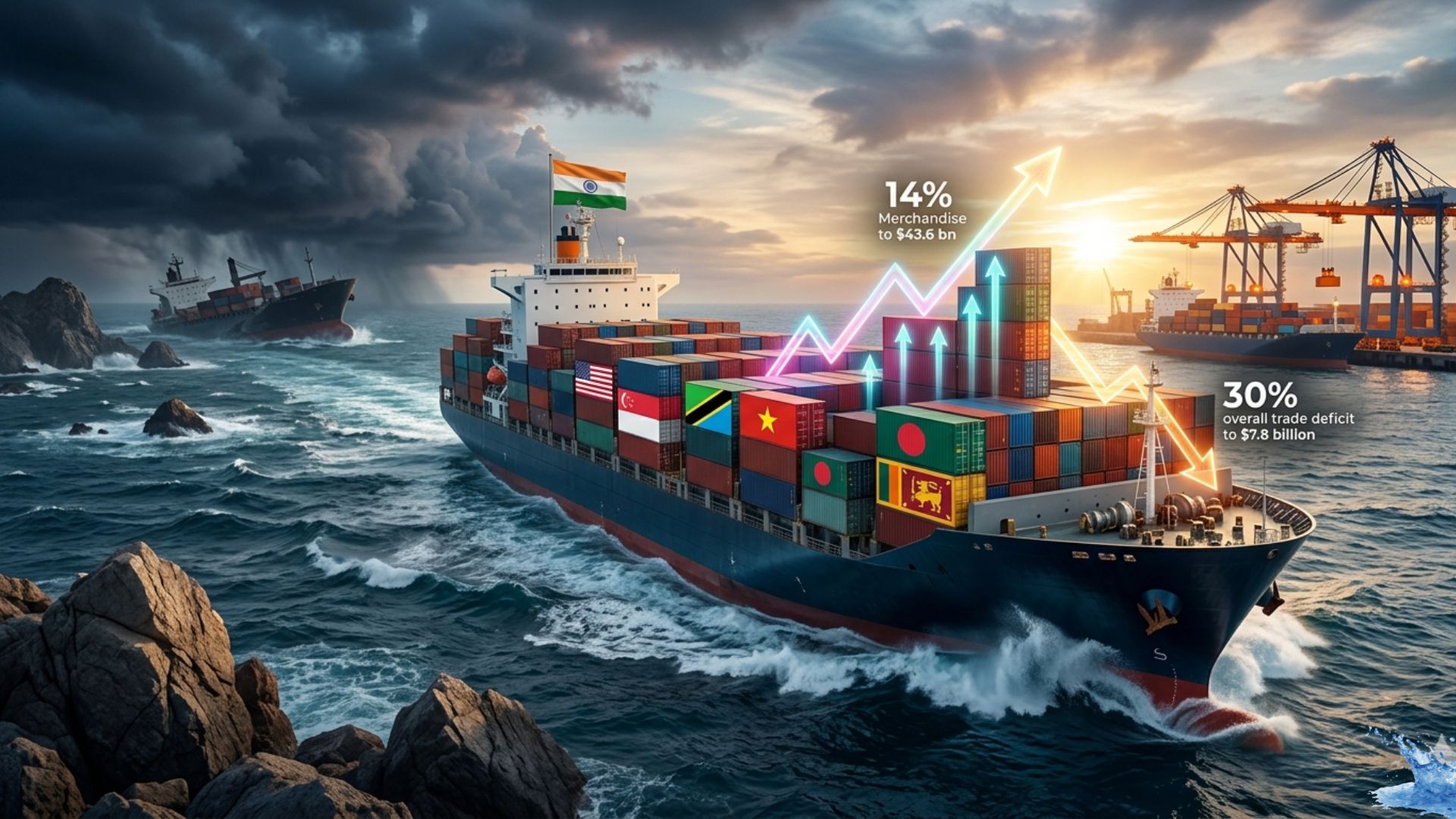
India’s Exports Grow 14% Despite West Asia Crises

India's Merchandise Exports Surge 14% in April 2026 Despite West Asia Headwinds
Despite the ongoing West Asia crisis disrupting regional trade flows, India's merchandise exports recorded a robust 14% growth in April 2026, reaching $43.6 billion — a figure that signals both resilience and strategic adaptability in India's export ecosystem.
What Drove the Growth?
Commerce Secretary Rajesh Agrawal attributed the performance to two key factors:
- Rising global prices across commodities and manufactured goods
- Market diversification by Indian exporters into newer geographies
"The positive growth in value can have some contribution from prices because prices of many things are going up. It is also to the credit of our industry which has been able to maintain the supply chains and look at new markets and diversify their exports." — Commerce Secretary Rajesh Agrawal, May 15, 2026
This is significant because value-driven export growth — even partly inflation-led — still reflects India's capacity to fulfil global demand at scale and maintain supply chain continuity under stress.
The Diversification Story
Perhaps the most structurally important takeaway from April 2026 data is the geographic spread of export growth. India registered high growth rates to markets that have historically not been major export destinations:
| Destination | Export Growth (April 2026) | Export Value |
|---|---|---|
| Sri Lanka | +215% | — |
| Singapore | +179% | — |
| Tanzania | +158% | $1.2 billion |
| Vietnam | +53% | — |
| Bangladesh | +64% | — |
| USA | +1.1% | $8.5 billion |
Tanzania alone received $1.2 billion worth of Indian exports — a 158% jump. This reflects India's push into African and Southeast Asian markets, reducing over-dependence on any single corridor.
The West Asia Drag
The crisis in West Asia — involving disrupted shipping lanes, reduced demand, and geopolitical uncertainty — left a visible dent on India's export basket to the region.
- Exports to **West Asia fell to 5.78 billion in April 2025
- Exports to the UAE, one of India's largest trade partners, dropped 36.4% to $2.2 billion
- Imports from West Asia fell even sharper — from 10.5 billion (down 31.6%), largely due to reduced energy imports
"Exports to West Asia dived in March and declined in April as well, but now the decline is only 28%." — Commerce Secretary Agrawal
The narrowing of the decline — from a sharper dip in March to 28% in April — suggests the shock may be bottoming out.
The Full Trade Picture
Merchandise Exports (Apr 2026):     $43.6 billion   ↑ 14%
Merchandise Imports (Apr 2026):     $71.9 billion   ↑ 10%
Merchandise Trade Deficit:          $28.4 billion   (vs $27.1B last year)

Services Exports (Apr 2026):        $37.2 billion   ↑ 13.4%
Services Imports (Apr 2026):        $16.7 billion   ↓ 1.5%
Services Surplus:                   $20.5 billion

Overall Trade Deficit (Apr 2026):   $7.8 billion    ↓ 30% (vs $11.2B last year)
The headline number here is the 30% reduction in the overall trade deficit to $7.8 billion — driven substantially by a strong services surplus (IT, business services, remittances) and the fall in West Asia energy imports.
Way Forward
- India must institutionalise its market diversification beyond price-driven gains — especially deepening trade ties with Africa and ASEAN, where April 2026 numbers showed early promise.
- The West Asia exposure remains a structural vulnerability. Reducing dependence on the Gulf for both exports and energy imports requires accelerated FTA negotiations and domestic energy transition.
- The services surplus is India's most reliable buffer. Continued investment in digital infrastructure, skilling, and IT capacity will keep this engine running.
- Price-led export growth, while welcome, needs to be complemented by volume and value-chain upgradation — moving up the manufacturing ladder to reduce raw material export dependency.
Conclusion
April 2026's export data is a cautiously optimistic story — India held its ground under genuine external pressure. The West Asia crisis exposed a real vulnerability, but the simultaneous pivot to Tanzania, Sri Lanka, Singapore, and Vietnam demonstrates that Indian exporters are not merely reactive. The overall trade deficit shrinking by 30% despite the merchandise gap widening slightly shows the growing counterweight of India's services economy. The challenge now is to convert this diversification from an opportunistic response into a durable, policy-backed export architecture.
Attribution
Original content sources and authors


Syllabus classification
How this article maps to GS papers
Main syllabus
GS3Indian-EconomyQuick Q&A
What does India’s rise in merchandise exports in April 2026 indicate about the resilience of its external trade sector despite geopolitical disruptions?
The rise is partly nominal, driven by global price increases, but structural factors are equally significant. The Commerce Ministry noted that exporters entered new markets such as Tanzania, Sri Lanka, and Vietnam, reducing dependence on traditional destinations. This demonstrates a transition from concentration risk to distributed trade engagement.
From a policy perspective:
- It reflects the success of India’s trade diplomacy and FTAs.
- It shows domestic industries’ ability to sustain production despite global uncertainty.
- It underscores the role of services exports in balancing trade deficits.
Why is export market diversification becoming a strategic necessity for India in the current global trade environment?
India’s strategy of increasing exports to countries such as Sri Lanka (215%), Singapore (179%), and Bangladesh (64%) reduces vulnerability. By broadening market access, India can maintain export momentum even when key corridors are disrupted. This aligns with the broader objective of economic security.
Strategic benefits include:
- Risk mitigation during regional conflicts or sanctions.
- Greater bargaining power in trade negotiations.
- Creation of stable demand for Indian products across continents.
For UPSC, this demonstrates how trade policy is not merely economic but deeply linked to foreign policy, supply-chain security, and strategic autonomy.
How do services exports help offset India’s merchandise trade deficit, and why is this significant for macroeconomic stability?
India’s services exports rose by 13.4% to $37.2 billion, while imports declined by 1.5%. This created a substantial cushion against the merchandise imbalance. The significance lies in the fact that services are less dependent on shipping routes and are more resilient to physical disruptions.
Macroeconomic importance:
- Supports current account stability.
- Strengthens foreign exchange reserves.
- Reduces pressure on the rupee.
This shows why India’s long-term economic strategy increasingly emphasizes high-value services. The combination of manufacturing and services creates a balanced trade ecosystem, essential for sustaining growth and minimizing external vulnerability.
What explains the decline in India’s trade with West Asia despite overall export growth?
Exports to West Asia fell 28%, while imports dropped 31.6%. This reflects both reduced demand and logistical challenges. West Asia is a key source of crude oil and an important export destination, so disruptions directly affect India’s trade volumes.
Reasons include:
- Conflict-related disruption of shipping routes.
- Higher freight and insurance costs.
- Reduced economic activity in importing countries.
This demonstrates the interconnected nature of global trade and geopolitics. For India, the lesson is to strengthen strategic reserves, diversify logistics corridors like INSTC, and expand partnerships beyond conflict-prone regions.
Critically analyze whether India’s April 2026 export growth reflects genuine structural strength or temporary nominal gains due to rising global prices.
However, structural factors are visible. Export growth in new destinations such as Tanzania and Vietnam indicates successful diversification. Such expansion suggests that Indian firms are not merely benefiting from price effects but are securing new markets.
Critical assessment:
- Positive: Broader market reach and stronger supply-chain adaptation.
- Concern: Higher prices may mask stagnant export quantities.
- Risk: Global slowdown could reverse gains if demand weakens.
Thus, policymakers must track both value and volume indicators. Sustainable growth requires strengthening manufacturing competitiveness, reducing logistics costs, and moving toward high-value exports instead of relying solely on favorable price trends.
As a policymaker, how would you strengthen India’s trade resilience in the face of recurring geopolitical crises such as the West Asia conflict?
As a policymaker, I would prioritize three interventions. First, expand export destinations through focused trade diplomacy in Africa, Latin America, and ASEAN. Second, improve logistics infrastructure including ports, multimodal corridors, and digital customs systems. Third, strengthen domestic manufacturing under PLI to ensure export competitiveness.
Specific measures:
- Create strategic shipping partnerships to bypass vulnerable routes.
- Promote rupee trade settlements to reduce currency risks.
- Build stronger export insurance mechanisms for MSMEs.
In the long term, resilience requires integrating trade policy with foreign policy, industrial policy, and energy security. This ensures India can sustain external sector growth even amid global instability.
Practice questions
1 question for mains preparation