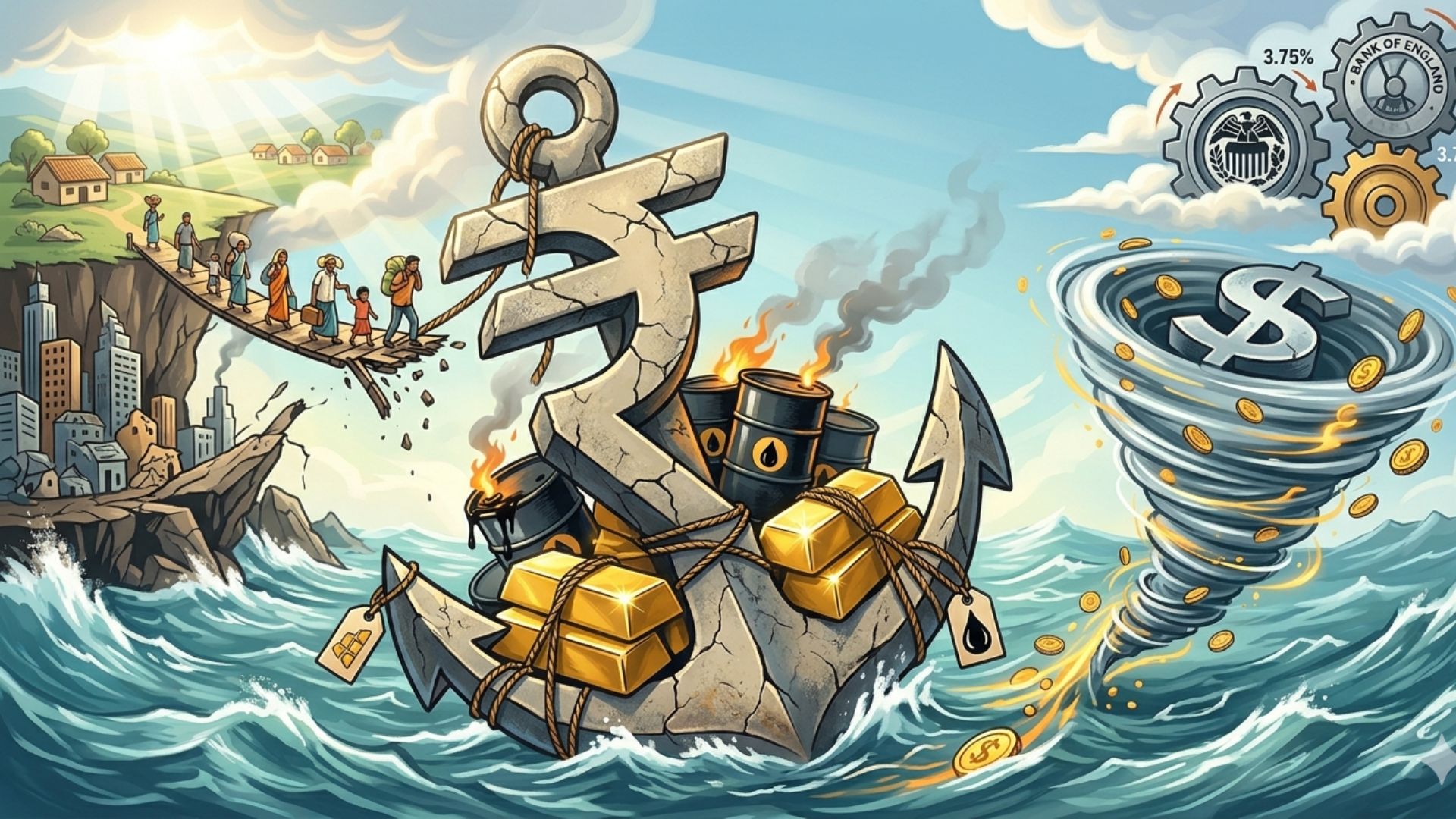
Understanding Capital Flight and Its Impact on the Rupee

"The Prime Minister's announcement diagnoses the problem the economy currently faces. But moral suasion cannot be a policy response."
The Immediate Trigger
PM Modi's public appeal to reduce consumption of gold and petrol signalled something deeper — India's external sector is under serious stress. The proximate cause: hostilities in the Persian Gulf and closure of the Strait of Hormuz, which have:
- Triggered foreign capital outflows
- Caused significant rupee depreciation
- Pushed LPG prices up — causing hardship for working classes and reverse migration of workers back to villages
- Widened the current account deficit through rising oil import bills
What Makes This Especially Worrying
Normally, capital flight from emerging markets is triggered by rising interest rates in developed economies. What is alarming about the current situation:
Normal scenario:
→ U.S./U.K. raise interest rates
→ Returns on foreign assets rise
→ Capital exits emerging markets
→ Rupee depreciates

Current scenario:
→ U.S. Fed and Bank of England holding rates at 3.75% (since Dec 2025)
→ No definitive signal of future hikes given
→ Capital is STILL fleeing India
→ Rupee is STILL depreciating
Capital has exited in anticipation of future rate hikes — not because they have occurred. This makes the situation harder to manage and harder to predict.
Understanding the Mechanism: How Capital Flows Work
Emerging markets like India offer higher returns than developed economies — but with attached risks:
- Currency risk — rupee depreciation erodes net returns for foreign investors
- Inflation risk — rising Indian inflation reduces real returns
The decision to hold Indian assets depends on the interest rate differential — the gap between Indian and foreign interest rates.
If foreign rates rise (or are expected to rise):
→ Differential narrows
→ Indian assets less attractive
→ Capital exits
→ Rupee sold for dollars → depreciation
→ RBI forced to consider raising domestic rates
→ But higher domestic rates hurt investment
This is the monetary policy trap for emerging economies — their policy space is constrained by U.S. Federal Reserve decisions.
The Taper Tantrum: A Historical Parallel
The current situation echoes 2013's taper tantrum:
- Post-2008 Great Recession, U.S. Fed had driven rates to zero lower bound
- In 2013, Fed merely announced a possible end to quantitative easing
- No actual rate hike occurred — only an expectation of future tightening
- Result: Massive capital withdrawal from emerging market economies including India
The lesson: in a globalised capital environment, expectations are as powerful as actions. Markets price in future rate hikes and act immediately — long before central banks move.
The Current Uncertainty in Developed Economy Monetary Policy
Central banks face a genuine dilemma:
| Scenario | Central Bank Logic |
|---|---|
| War is short, oil prices temporary | Don't raise rates — hiking would be deflationary |
| War drags on, inflation entrenches | Must raise rates to anchor inflationary expectations |
The U.S. Fed and Bank of England initially held rates — forecasting the oil price spike as temporary. But:
- The longer the war continues, the more inflationary expectations entrench
- Rising wages and prices as economic agents defend purchasing power → wage-price spiral risk
- Interest rate futures already pricing in elevated inflation — even as energy futures anticipated eventual price decline
This contradiction — between central bank forecasts and market pricing — is itself a source of profound uncertainty.
India's Policy Response: Necessary but Insufficient
| Measure | Assessment |
|---|---|
| RBI restrictions on foreign exchange derivative contracts | Addresses symptoms, not causes |
| Import duties on gold | Reduces one channel of current account pressure |
| PM's appeal to reduce gold and petrol consumption | Moral suasion — cannot substitute for structural policy |
The underlying vulnerabilities remain intact. If developed economy interest rates do rise, India's external account will come under further, compounded stress.
Way Forward
- Build foreign exchange reserves as a buffer against future capital flight episodes
- Reduce structural oil import dependence — accelerate domestic renewable energy transition to insulate the current account from Gulf price shocks
- Monetary policy coordination — RBI must maintain adequate interest rate differential while balancing domestic growth imperatives
- Capital account management — revisit the toolkit for managing volatile short-term capital flows without full capital controls
- Diversify energy sourcing — reduce single-corridor dependence (Strait of Hormuz vulnerability is a structural risk, not a one-time event)
- Strengthen domestic demand fundamentals — reverse migration signals working class distress that needs direct policy attention beyond price management
Conclusion
India's external sector stress is not a temporary blip caused by a distant war. It is the surfacing of structural vulnerabilities — oil import dependence, sensitivity to global capital flows, and a currency exposed to decisions made in Washington and London. The taper tantrum of 2013 offered a warning. The current episode confirms that warning was not acted upon with sufficient seriousness. Moral suasion and marginal tariff adjustments are not answers. A comprehensive external sector strategy — built around energy security, reserve adequacy, and calibrated capital flow management — is the only credible response to a world where the next shock is always closer than it appears.
Attribution
Original content sources and authors


Syllabus classification
How this article maps to GS papers
Main syllabus
GS3Indian-EconomyQuick Q&A
What are the key external sector vulnerabilities currently affecting the Indian economy, and how do they interact?
Capital flight compounds this problem. Foreign investors have withdrawn funds from Indian financial markets due to uncertainty in global conditions. This reduces dollar inflows and creates downward pressure on the rupee. A depreciating rupee further increases the cost of imports, especially petroleum, creating a vicious cycle.
Key channels of stress include:
- Higher oil import bill leading to CAD expansion
- Foreign portfolio outflows weakening the rupee
- Imported inflation through costlier fuel and energy
- Pressure on foreign exchange reserves and policy autonomy
Example: Similar dynamics were observed during the 2013 taper tantrum, when India’s rupee sharply depreciated as capital exited emerging markets. The present situation is particularly concerning because capital outflows are occurring even without an actual rise in U.S. or U.K. interest rates, indicating deeper structural concerns.
How do global interest rate movements in advanced economies affect capital flows and exchange rates in emerging economies like India?
Even expectations of future interest rate hikes can trigger outflows. Investors may sell Indian assets pre-emptively, converting rupees into dollars, causing rupee depreciation. This creates pressure on the Reserve Bank of India (RBI), which may have to raise domestic interest rates or use forex reserves to stabilise the currency.
Policy transmission occurs through:
- Interest rate differential changes
- Investor risk perception
- Exchange rate volatility
- Imported inflation
Case study: During the 2013 taper tantrum, the U.S. Federal Reserve merely hinted at reducing quantitative easing. That expectation caused major outflows from India and other emerging markets, demonstrating how even anticipated monetary shifts can disrupt domestic macroeconomic stability.
Why is the current capital outflow from India considered more alarming than previous episodes such as the taper tantrum?
This suggests that markets may be reacting not only to expected future rate hikes but also to India’s own structural vulnerabilities. The rupee had already shown weakness, and geopolitical shocks simply accelerated the trend. This raises questions about confidence in India’s macroeconomic fundamentals.
Key reasons for concern:
- Outflows without formal rate hikes
- Persistent rupee depreciation
- High dependence on imported energy
- Fragility of investor confidence
Implication: It indicates that external shocks are amplifying pre-existing weaknesses. If advanced economies eventually raise rates, India may face an even stronger outflow, making current conditions a precursor to a deeper external sector crisis.
Critically analyse the limitations of moral suasion and import restrictions as tools to manage external sector stress.
Similarly, imposing import duties on gold may reduce some discretionary imports but does not address structural causes such as high oil imports or capital volatility. Restrictions on forex derivatives may slow speculation temporarily but cannot resolve investor concerns about future returns.
Limitations include:
- Temporary behavioural impact
- No effect on global crude prices
- Cannot stop capital flight driven by global sentiment
- May create informal market distortions
Evaluation: Sustainable solutions require stronger export competitiveness, diversified energy sourcing, and stable macroeconomic fundamentals. Administrative measures can buy time but cannot replace structural policy responses.
What explains the link between geopolitical conflicts and macroeconomic instability in import-dependent economies like India?
At the same time, global uncertainty drives investors toward safer assets such as U.S. treasury bonds. This leads to outflows from emerging markets, including India. Thus, geopolitical events simultaneously affect both the current account and capital account.
Transmission channels:
- Higher oil prices raising import costs
- Inflationary pressures on domestic prices
- Capital shifting to safe havens
- Currency depreciation and reserve depletion
Example: The Russia-Ukraine war and Gulf conflicts both caused global energy shocks. For India, such events highlight the need for energy security, strategic petroleum reserves, and diversification toward renewable energy.
What lessons can India draw from the 2013 taper tantrum to address present external account pressures?
Today, India can apply those lessons by strengthening buffers before conditions worsen. This includes maintaining adequate forex reserves, reducing dependence on short-term portfolio inflows, and enhancing domestic manufacturing to reduce import dependence.
Key lessons:
- Build resilient forex reserves
- Reduce oil import dependence
- Promote stable long-term FDI over volatile portfolio flows
- Maintain credible macroeconomic communication
Way forward: India must focus on structural resilience rather than reactive firefighting. Strong domestic production, energy diversification, and prudent fiscal management are critical for insulating the economy from recurring global financial shocks.
Practice questions
2 questions for mains preparation