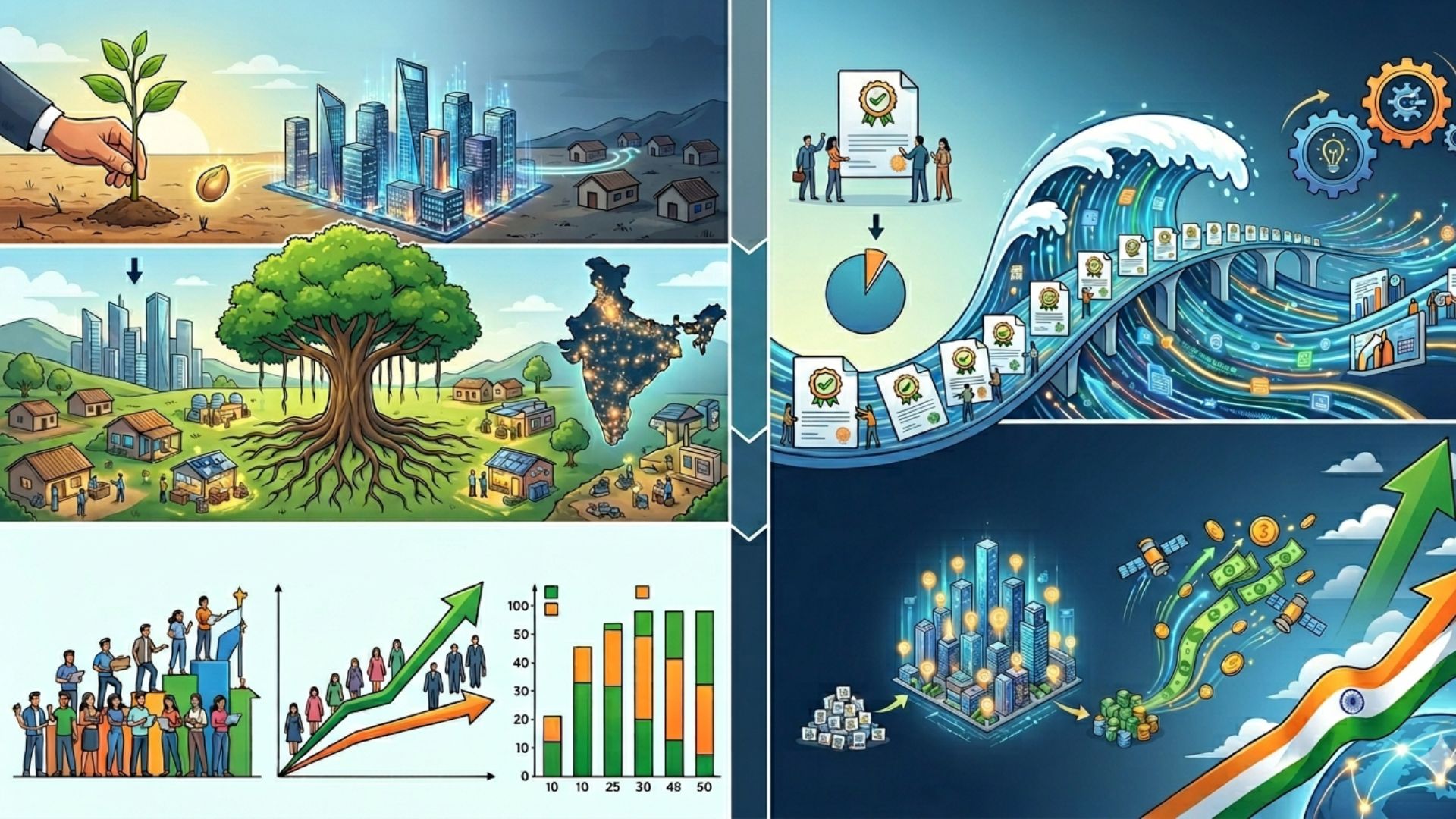
From Metros to Small Towns: The Decade That Transformed India’s Startup Story

Why in News?
Ten years after the launch of the Startup India initiative in 2015, India has emerged as one of the world's leading startup ecosystems. The journey reflects not only a rise in the number of startups but also a transformation in entrepreneurship, innovation, investment, and regional participation.
"Innovation is the key to economic growth, job creation and global competitiveness."
The Startup India Vision
In his Independence Day address on August 15, 2015, Prime Minister Narendra Modi envisioned making India the "Number 1" startup nation.
The initiative sought to promote:
- Innovation-driven enterprises.
- Technology-based solutions.
- Market-oriented business opportunities.
- Job creation and economic dynamism.
What Makes a Startup Different?
According to the Startup India framework, startups are distinguished by:
- Innovation in products or services.
- Use of technology.
- Scalability and market potential.
To formalise the ecosystem, the Department for Promotion of Industry and Internal Trade (DPIIT) began recognising eligible enterprises as startups.
Rise of Formalisation
Although DPIIT recognition is not mandatory, increasing participation indicates growing trust in the formal ecosystem.
Growth in DPIIT Recognition
| Year | DPIIT Recognised Startups | Share of Total Startups |
|---|---|---|
| 2016 | 288 | 3% |
| 2025 | Massive increase | 77% |
Significance
- Greater regulatory participation.
- Improved access to government support.
- Enhanced credibility among investors.
- Better integration with the formal economy.
2016:
Most startups operated outside the formal ecosystem.

2025:
More than three-fourths voluntarily joined the
recognised startup framework.
Democratisation of Entrepreneurship
One of the most remarkable developments has been the geographical spread of startups.
Shift from Tier-1 Cities to Tier-3 Towns
| Year | Tier-1 Cities | Tier-3 Towns |
|---|---|---|
| 2016 | 65% | 15% |
| 2020 | 49% | 27% |
| 2025 | 18% | 71% |
What Does This Indicate?
- Innovation is no longer confined to metropolitan centres.
- Smaller towns are emerging as entrepreneurial hubs.
- Digital infrastructure and policy support have broadened opportunities.
- Regional economic participation has increased significantly.
This trend reflects the growing inclusiveness of India's innovation ecosystem.
Youth-Led Entrepreneurial Growth
The startup movement has been strongly driven by younger entrepreneurs.
Founder Demographics
- Around 66% of male founders are below 40 years.
- Around 59% of female founders are below 40 years.
Implications
- Early adoption of entrepreneurship as a career choice.
- Greater risk-taking and innovation.
- Strong confidence in the startup ecosystem.
Traditional Career Path:
Education → Job → Business

Emerging Startup Path:
Education → Innovation → Startup
Growing Participation of Women
Women entrepreneurs have become an increasingly important pillar of India's startup ecosystem.
Key Trends
- Women constitute about 21% of founders under 30 years.
- Their share rises to 33% among founders aged above 50 years.
- Women often enter entrepreneurship later in life.
Strong Growth Momentum
| Category | CAGR (2016-2025) |
|---|---|
| Women Founders | 20% |
| Male Founders | 14% |
The higher growth rate indicates increasing participation of women in entrepreneurship.
Expanding Funding Landscape
Investor confidence has grown substantially during the decade.
Startup and Funding Growth
| Indicator | 2016 | 2025 |
|---|---|---|
| Total Startups | 10,000 | 2,50,000 |
| Funded Startups | 2,000 | 75,000 |
Growth Achieved
- Total startups increased 25-fold.
- Funded startups increased 38-fold.
This expansion reflects:
- Improved investor confidence.
- Availability of venture capital.
- Strong policy support.
- Growing market opportunities.
Factors Behind Success
Several factors contributed to India's startup rise:
- Supportive government policies.
- Formal startup recognition mechanisms.
- Expanding digital infrastructure.
- Growing investment ecosystem.
- Increasing entrepreneurial culture.
- Wider regional participation.
- Greater inclusion of women and youth.
Together, these factors have created a vibrant innovation-driven economy.
Way Forward
- Strengthen access to early-stage funding in smaller towns.
- Improve startup mentoring and incubation networks.
- Encourage deep-tech and research-driven innovation.
- Expand women's participation through targeted support mechanisms.
- Simplify regulatory compliance for emerging enterprises.
- Enhance industry-academia collaboration.
- Promote global market access for Indian startups.
Conclusion
The first decade of Startup India marks a significant transformation in India's entrepreneurial landscape. From a largely urban phenomenon, startups have evolved into a nationwide movement driven by innovation, technology, youth participation, and growing investor confidence. The expansion of startups into Tier-3 towns, rising participation of women entrepreneurs, and dramatic growth in funding have firmly established India among the world's leading startup ecosystems, laying the foundation for innovation-led economic growth in the years ahead.
Attribution
Original content sources and authors

Syllabus classification
How this article maps to GS papers
Main syllabus
GS3Indian-EconomyQuick Q&A
What is the Startup India initiative and how has it transformed India's digital economy and innovation ecosystem over the last decade?
Why is the growth of India's startup ecosystem considered strategically important for economic development and UPSC preparation?
How has the geographical distribution of startups shifted from metropolitan centres to Tier-3 towns, and what are its implications?
What is a critical analysis of women's participation and demographic trends among startup founders in India?
What are the major reasons behind the rapid expansion and increasing formalization of India's startup ecosystem between 2016 and 2025?
What practical examples and indicators demonstrate the success of India's startup ecosystem during the first decade of Startup India?
Practice questions
3 questions for mains preparation