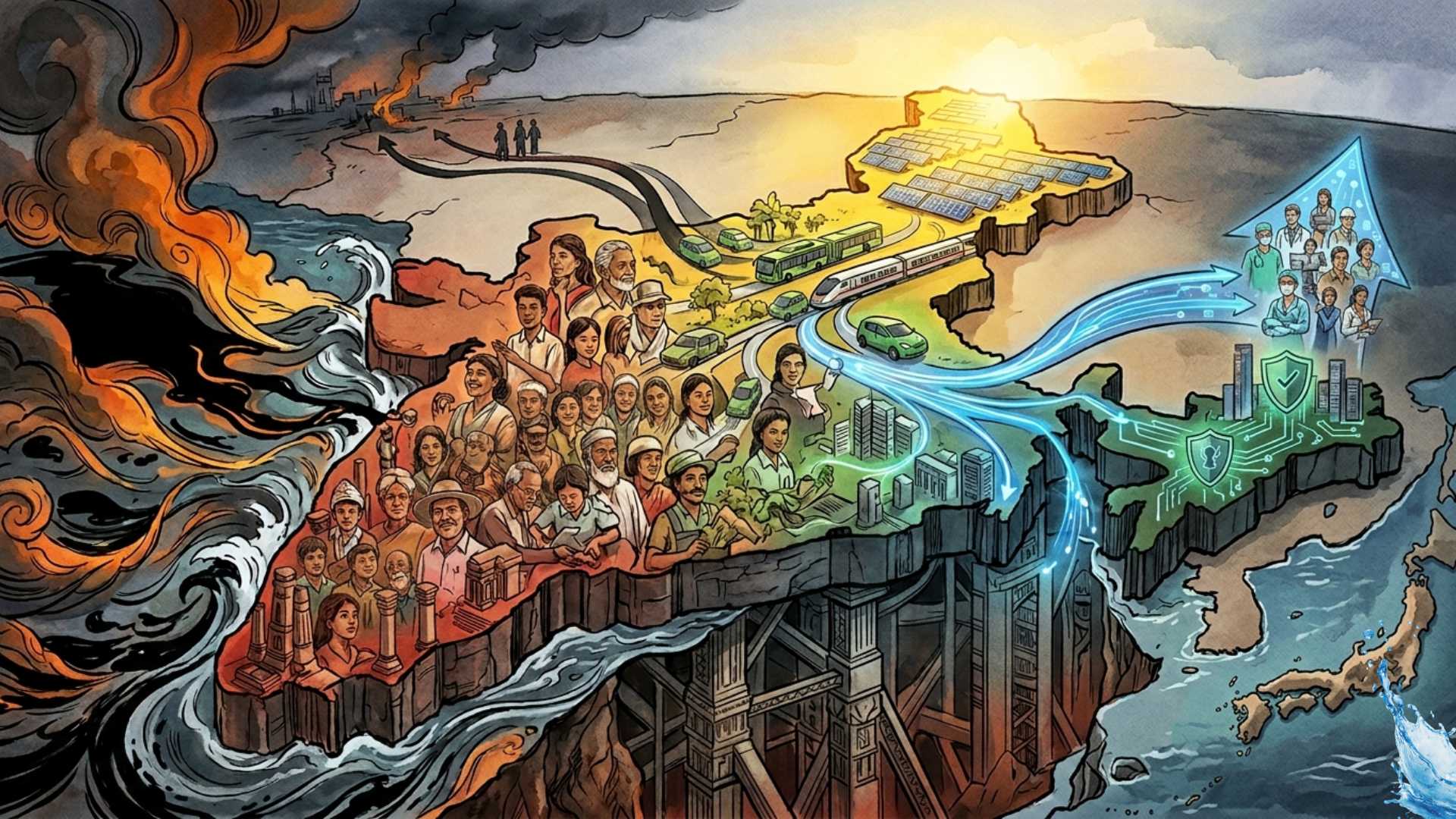
India's Economic Resilience Amid West Asia Conflict

West Asia accounts for nearly 60% of India's crude oil imports and hosts over 8 million Indian workers remitting $40+ billion annually. As the ongoing conflict disrupts global energy markets and growth forecasts, India's structural advantages — demographic depth, solar potential, and geopolitical positioning — offer a differentiated buffer unavailable to most emerging economies.
"India will be better than many others even if this war continues — it has structural advantages that are often underappreciated even within India itself." — Keiko Honda, Former CEO, MIGA (World Bank Group)
| Vulnerability | Structural Advantage |
|---|---|
| 60% crude imports from West Asia | Solar irradiance 300+ days/year → renewable transition |
| PSU oil companies absorbing daily losses | EV push + urban public transport reducing hydrocarbon dependence |
| Remittance corridor at risk | Skill mix shifting → data scientists, cybersecurity professionals |
| Energy price inflation → growth disruption | Diversified economic base ≠ hydrocarbon-dependent Gulf states |
Background and Context
The West Asia conflict has triggered a cascading effect across global energy markets, supply chains, and remittance flows. For India, the exposure is real but asymmetric — while import costs rise and remittance corridors face pressure, India's demographic scale, renewable energy potential, and geopolitical positioning create structural buffers that hydrocarbon-dependent economies cannot replicate.
Key Concepts
Cascading Shock Absorption Unlike Gulf states whose social compacts rest on hydrocarbon wealth, India's economic foundation is diversified across agriculture, services, manufacturing, and a growing digital economy — making it more resilient to energy price volatility.
Demographic Dividend as Buffer A predominantly young population of 1.4 billion creates domestic consumption depth, labour market flexibility, and internal cohesion that insulates India from external shocks in ways smaller, resource-dependent economies cannot manage.
Remittance Corridor Risk India is the world's largest remittance recipient (~$125 billion in 2023). A significant share originates from West Asia's hydrocarbons sector. Conflict-driven disruption could compress household incomes and consumption, particularly in Kerala, UP, Bihar, and Rajasthan.
India's Structural Advantages: An Assessment
| Dimension | Current Status | Long-term Potential |
|---|---|---|
| Solar Energy | 4th largest solar capacity globally | Reduce hydrocarbon import dependence structurally |
| EV Transition | FAME scheme + PLI for batteries | Compress urban fossil fuel demand |
| Skilled Diaspora | High-skilled worker ratio rising | Higher remittances + global professional mobility |
| Cybersecurity | Emerging hub | "Probably the biggest area" of future employment — Honda |
| Geopolitical Position | Indo-Pacific pivot point | Cornerstone of stable global order |
Vulnerabilities That Cannot Be Ignored
- PSU losses: State-owned oil companies absorbing daily losses as global energy prices remain elevated — disrupts even conservative GDP growth projections
- Remittance dependence: Low-skilled West Asia corridor remains dominant in volume; structural shift to high-skilled is underway but incomplete
- Import substitution gap: Renewable transition takes decades; short-term hydrocarbon exposure is unavoidable
- Inflation pass-through: Elevated energy prices feed into transport, manufacturing, and food costs — disproportionately affecting lower-income households
Governance and Policy Implications
- Energy security: Accelerate renewable capacity addition under National Solar Mission + Green Hydrogen Mission as strategic import substitution
- Remittance resilience: Skilling programmes (Skill India, PM Kaushal Vikas) must explicitly target West Asia-bound workers for upward mobility
- Diaspora policy: Formal bilateral labour agreements with Gulf states to protect workers during conflict-driven disruptions
- Cybersecurity investment: Position India as a global cybersecurity hub through dedicated policy, talent pipelines, and CERT-In upgradation
- Strategic autonomy: India's geopolitical positioning demands active engagement — not just passive beneficiary status — in West Asia peace processes
Conclusion
India's resilience to the West Asia conflict is neither accidental nor guaranteed — it is the product of structural advantages that must be actively leveraged through policy. The transition from a low-skilled remittance economy to a high-skilled global professional hub, the acceleration of the renewable energy shift, and the deepening of India's geopolitical role are not merely economic imperatives — they are strategic necessities. As Keiko Honda observed, India is not just a large nation managing a crisis; it is a cornerstone of global stability whose moment demands proportionate ambition.
Attribution
Original content sources and authors


Syllabus classification
How this article maps to GS papers
Main syllabus
GS3Indian-EconomyQuick Q&A
What structural advantages make India relatively resilient to global shocks such as the West Asia conflict?
Demographic advantage is another critical pillar. With a population of over 1.4 billion, predominantly young, India benefits from a large workforce and expanding domestic market. This internal demand acts as a stabilizing force even when external conditions deteriorate. Additionally, India’s strong internal cohesion and democratic institutions contribute to political stability, which enhances investor confidence and economic continuity.
Further, India’s proactive policy measures, such as investments in renewable energy, digital infrastructure, and skill development, position it better than many countries. For instance, initiatives like Digital India and Make in India have strengthened economic resilience. Thus, India’s structural advantages go beyond geography and reflect long-term strategic planning.
Why is the West Asia conflict particularly significant for global energy markets and India’s economy?
For India, which imports a substantial portion of its crude oil, rising prices increase the current account deficit and put pressure on government finances. State-owned oil companies often absorb part of the cost to shield consumers, which impacts their profitability and fiscal sustainability. Additionally, higher fuel prices can trigger inflationary pressures across sectors, affecting overall economic stability.
However, India’s relative resilience comes from its diversified economy and policy responses. For example, India has been expanding its strategic petroleum reserves and investing in renewable energy. Thus, while the conflict poses challenges, India is better positioned than many nations to manage these shocks.
How can renewable energy, particularly solar power, reduce India’s vulnerability to external energy shocks?
By investing in large-scale solar projects such as the National Solar Mission and promoting rooftop solar installations, India can gradually decrease its reliance on volatile global oil markets. Additionally, the integration of renewable energy with electric vehicles (EVs) and improved public transportation systems further reduces fossil fuel consumption in the transport sector.
For example, India’s commitment to achieving 500 GW of non-fossil fuel capacity by 2030 reflects its long-term strategy. This transition not only enhances energy security but also aligns with climate goals. However, challenges such as storage technology, grid integration, and financing must be addressed to fully realize this potential.
What are the potential risks to India from prolonged instability in West Asia despite its structural strengths?
Another risk is the sustained increase in energy prices, which can strain India’s fiscal balance and increase inflation. Industries dependent on energy inputs, such as manufacturing and transportation, may experience reduced competitiveness. Additionally, geopolitical tensions could disrupt trade routes, increasing logistical costs.
However, India is gradually mitigating these risks through a shift toward high-skilled migration. Professionals in sectors like IT, cybersecurity, and data science are increasingly contributing to remittances. This diversification of income sources enhances resilience, but the transition is still ongoing and requires continued policy support.
Can you illustrate with examples how India is transitioning from a hydrocarbon-dependent economy to a more diversified energy and economic model?
Another example is the push for electric mobility under schemes like FAME (Faster Adoption and Manufacturing of Electric Vehicles). By incentivizing EV adoption and improving charging infrastructure, India is reducing its dependence on imported oil in the transport sector. Similarly, investments in metro rail and public transport systems in cities like Delhi and Mumbai contribute to energy efficiency.
On the economic front, India is shifting toward a knowledge-based economy, with growth in IT, cybersecurity, and digital services. This reduces reliance on traditional sectors and enhances resilience. These examples collectively demonstrate India’s strategic move toward sustainability and diversification.
Critically analyze whether India’s demographic advantage is sufficient to ensure long-term economic resilience.
However, this advantage is not automatic and depends on effective utilization. Challenges such as unemployment, skill gaps, and underemployment can undermine the potential benefits. Without adequate investments in education, healthcare, and skill development, the demographic dividend could turn into a liability. For instance, disparities in skill levels across regions can limit the employability of the workforce.
Therefore, while demographic strength is a significant asset, it must be complemented by policy interventions such as skill development programs, labor market reforms, and investments in human capital. Only then can India fully harness this advantage for sustained economic resilience.
How does India’s geopolitical position enhance its role as a ‘cornerstone’ in the emerging global order?
A practical example is India’s role in initiatives like the International Solar Alliance (ISA) and its participation in groupings such as the Quad. These platforms enhance India’s influence in global governance and security frameworks. Additionally, India’s balanced diplomatic approach allows it to maintain relations with diverse partners, from the U.S. to Gulf nations.
This strategic positioning, combined with economic growth and demographic strength, enables India to act as a stabilizing force in an uncertain world. However, it also requires careful diplomacy to navigate competing interests and maintain strategic autonomy.
Practice questions
1 question for mains preparation