GS3 Indian-Economy

India's Growth Masks Deepening Economic Structural Vulnerabilities

India's Economic Challenges: Structural Vulnerabilities Beyond Growth Narratives

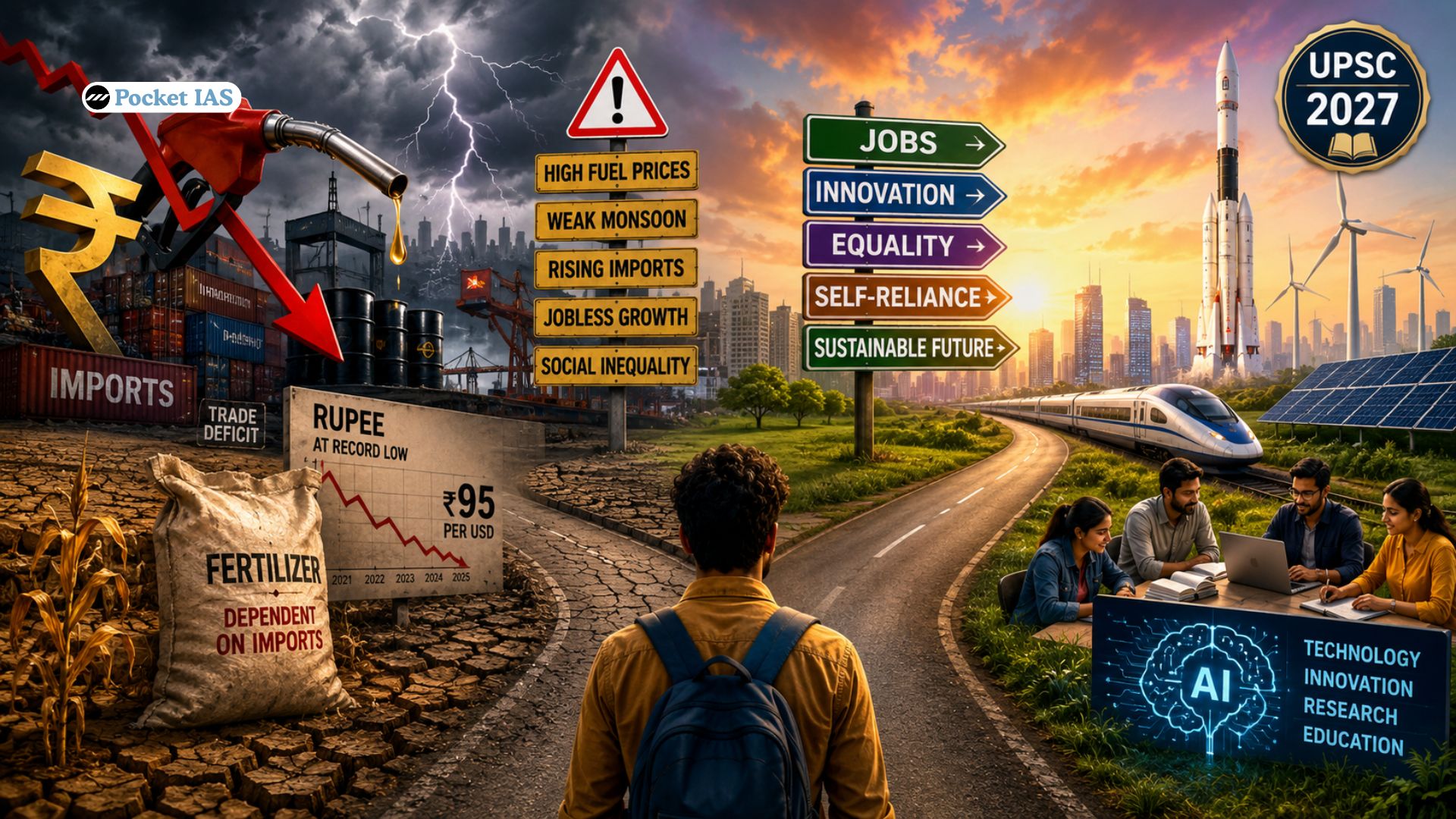
Despite being touted as a fast-growing economy, India's economic vulnerabilities threaten long-term stability and growth.
Surya Surya
4 mins read

India continues to be among the world's fastest-growing major economies. However, rapid GDP growth alone does not guarantee long-term economic resilience. The article argues that external shocks, structural weaknesses and technological gaps pose significant challenges to India's aspiration of becoming a developed economy by 2047.


Why are external vulnerabilities a concern?

India remains heavily dependent on imported energy, making the economy vulnerable to global commodity price fluctuations.

IndicatorStatus
Crude oil imports~90% of domestic requirement
Natural gas imports~50% of domestic requirement
RBI forex intervention (FY 2025โ€“26)Over US$53 billion
Forex reservesDeclined from US720+billionโˆ—โˆ—toโˆ—โˆ—ย US720+ billion** to **~US681 billion
Rupee valueAround โ‚น95 per US$

Higher global oil and LNG prices can:

  • Widen the trade deficit
  • Increase inflationary pressures
  • Raise production costs
  • Weaken the rupee
  • Increase pressure on foreign exchange reserves

Agriculture and fertilizer dependence

India's fertilizer sector also remains exposed to external shocks.

Although domestic production is substantial, critical inputs such as Liquefied Natural Gas (LNG) and potash are largely imported.

Higher LNG Prices
        โ†“
Costlier Fertilizers
        โ†“
Higher Cost of Cultivation
        โ†“
Pressure on Farm Incomes & Food Prices

The article argues that disruptions in global energy markets can therefore directly affect agricultural productivity and food security.


Impact of a weak monsoon

The article highlights that a deficient monsoon has economy-wide consequences.

Potential effects include:

  • Lower agricultural output
  • Reduced rural incomes
  • Weakening of rural consumption
  • Food inflation
  • Increased demand for relief and subsidy expenditure

When combined with rising fuel and fertilizer costs, these factors can suppress domestic demand and slow economic growth.


Rural safety nets and employment

The article argues that periods of economic stress require stronger social protection.

It contends that weakening rural employment support could increase vulnerability among low-income households.

Key concern highlighted:

  • Reduced effectiveness of employment guarantee programmes as rural safety nets.

External sector challenges

India's current account has been supported by strong services exports and overseas remittances.

IndicatorStatus
Remittances (FY 2024โ€“25)US$135 billion

However, the article identifies emerging risks:

  • Increasing dependence on remittances from skilled professionals in advanced economies.
  • Rising anti-immigration sentiment in several developed countries.
  • Artificial Intelligence (AI) disrupting sectors such as software and data services.

Together, these factors could gradually weaken an important source of foreign exchange earnings.


Investor sentiment

The article points to signs of increasing investor caution.

  • Foreign Portfolio Investors (FPIs) reportedly withdrew over โ‚น2.2 lakh crore from Indian equities.
  • India slipped from 6th to 7th in global market capitalisation rankings.
  • Domestic retail investors have partly offset these outflows.

While not necessarily indicating a long-term trend, the developments suggest evolving perceptions among global investors.


Technology and manufacturing challenges

The article argues that future global competitiveness will depend increasingly on:

  • Artificial Intelligence (AI)
  • Semiconductors
  • Robotics
  • Advanced manufacturing
  • Frontier scientific research

It contrasts India's position with leading economies.

EconomyComparative Strength
TaiwanAdvanced semiconductor manufacturing
South KoreaElectronics and semiconductor ecosystem
United StatesAI and frontier technologies
ChinaAdvanced manufacturing and strategic technologies
IndiaStrong engineering talent but dependence on imported technology and semiconductors

The article argues that much of India's startup ecosystem remains concentrated in digital platforms rather than deep technological innovation.


Structural concerns highlighted

The article identifies several long-term issues:

  • High dependence on imported energy
  • External sector vulnerabilities
  • Limited manufacturing transformation
  • Employment challenges
  • Slow technological advancement
  • Growing inequality
  • Concentration of wealth and opportunities

Sustainable economic development requires strengthening structural fundamentals alongside maintaining high growth.


Way Forward

  • Reduce dependence on imported energy through diversified domestic energy sources.
  • Accelerate investments in semiconductor manufacturing, AI and frontier technologies.
  • Strengthen manufacturing under global value chains with higher technological intensity.
  • Enhance rural employment, social protection and agricultural resilience.
  • Invest in research, innovation and advanced skill development.
  • Improve macroeconomic resilience through export diversification and stronger domestic demand.

Conclusion

India possesses significant demographic, technological and entrepreneurial potential. However, achieving the vision of a developed economy requires addressing structural vulnerabilities alongside sustaining economic growth. Greater resilience will depend on reducing external dependence, strengthening manufacturing competitiveness, investing in future technologies and ensuring inclusive growth that generates employment and enhances long-term economic stability.

Attribution

Original content sources and authors

Author D. Raja The Hindu Source The Hindu

Syllabus classification

How this article maps to GS papers

Main syllabus

GS3Indian-Economy

Quick Q&A

What are the major structural vulnerabilities facing the Indian economy despite its strong macroeconomic growth narrative, and why are they significant for long-term development?
Structural vulnerabilities refer to deep-rooted weaknesses within an economy that persist irrespective of short-term growth rates. The article argues that India's economy, despite being projected as one of the world's fastest-growing major economies, continues to face several structural challenges including heavy dependence on imported crude oil, liquefied natural gas (LNG), fertilizers, imported semiconductors, foreign capital, services exports, and remittances. These dependencies increase India's exposure to global commodity price fluctuations, geopolitical conflicts, supply chain disruptions, and currency volatility. For example, India imports nearly 90% of its crude oil requirements and around half of its natural gas needs. Rising energy prices widen the trade deficit, contribute to inflation, increase production costs, and put pressure on the rupee. The article also highlights RBI's significant foreign exchange interventions and declining foreign exchange reserves as indicators of external pressure. However, these arguments represent one perspective in a broader policy debate. The government emphasizes achievements such as infrastructure expansion, Production Linked Incentive (PLI) schemes, digital public infrastructure, manufacturing promotion, and renewable energy expansion as efforts to address long-term vulnerabilities. For UPSC, the issue is highly relevant across GS Paper III (Indian Economy, Infrastructure, Energy Security), GS Paper II (Governance and Public Policy), and the Personality Test. Candidates should present a balanced assessment by recognizing both India's growth achievements and the continuing need for economic diversification, technological self-reliance, energy transition, and resilient domestic manufacturing to achieve sustainable and inclusive development.
Why is reducing India's dependence on imported energy and critical technologies considered essential for achieving sustainable economic growth and strategic autonomy?
Reducing dependence on imported energy and strategic technologies is central to India's long-term economic resilience and national security. Energy security refers to ensuring reliable, affordable, and uninterrupted access to energy resources, while technological sovereignty involves developing domestic capabilities in critical sectors such as semiconductors, artificial intelligence (AI), advanced manufacturing, and electronics. According to the article, India's heavy reliance on imported crude oil, LNG, fertilizers, semiconductors, and capital equipment exposes the economy to international price shocks, exchange rate volatility, and geopolitical disruptions. Such dependence affects inflation, fiscal stability, industrial competitiveness, and the balance of payments. At the same time, the government has promoted initiatives such as Make in India, Atmanirbhar Bharat, the National Green Hydrogen Mission, renewable energy expansion, semiconductor incentives, and the PLI scheme to reduce strategic dependence over time. Critics, however, argue that progress remains uneven and manufacturing transformation has been slower than anticipated. International examples reinforce the importance of technological leadership: Taiwan's TSMC dominates advanced semiconductor fabrication, South Korea leads through Samsung, while the United States and China compete in AI and frontier technologies. UPSC aspirants should appreciate that strategic autonomy today extends beyond defence to encompass energy, supply chains, critical minerals, digital infrastructure, and innovation ecosystems. The topic connects with GS Paper III (Science and Technology, Economy, Energy), GS Paper II (International Relations), and Essay. A balanced answer should acknowledge the need for continued investment in research and development, skill development, domestic manufacturing, clean energy, and international technological partnerships to reduce external vulnerabilities while maintaining integration with global markets.
How do external economic shocks such as rising oil prices, exchange rate pressures, weak monsoons, and global political developments interact to influence India's macroeconomic stability?
Macroeconomic stability depends upon stable inflation, sustainable growth, manageable fiscal and current account deficits, and a stable financial system. The article illustrates how multiple external shocks can reinforce one another and create cumulative stress on the Indian economy. Rising international crude oil and LNG prices increase India's import bill because the country remains heavily dependent on imported energy. This widens the trade deficit, weakens the rupee, raises transportation and manufacturing costs, and contributes to inflation. A depreciating currency further increases the cost of imports, creating additional inflationary pressures. Simultaneously, a weak southwest monsoon may reduce agricultural output, lower rural incomes, raise food inflation, and increase demand for public welfare expenditure. The article also points to uncertainty surrounding remittances due to changing immigration policies in advanced economies and the potential impact of AI on global services employment. Slower remittance growth, combined with persistent energy imports, could place additional pressure on the current account balance. Furthermore, foreign portfolio investment flows are influenced by global interest rates, geopolitical uncertainty, and investor confidence, affecting domestic capital markets. While the article presents these risks prominently, policymakers often argue that India's diversified economy, strong foreign exchange reserves, inflation-targeting framework, and expanding domestic demand provide important buffers. UPSC candidates should analyze both vulnerabilities and resilience factors. This topic is relevant for GS Paper III (Indian Economy, Agriculture, Disaster Management), GS Paper I (Geography and Monsoon), and Interview discussions because it demonstrates the interconnected nature of climate, global politics, external trade, and macroeconomic management.
Critically analyze the debate on whether India has successfully transformed into a global manufacturing and technology power or continues to face structural constraints in these sectors.
India's aspiration to emerge as a global manufacturing and technology hub has been supported through policies such as Make in India, Digital India, Startup India, Production Linked Incentive (PLI) schemes, semiconductor missions, and infrastructure expansion. The article, however, argues that the expected manufacturing transformation has not fully materialized and that India's startup ecosystem remains concentrated in digital platforms rather than deep technological innovation. According to this perspective, sectors such as food delivery, ride-hailing, and quick commerce generate market valuations but contribute less to technological sovereignty compared to advanced semiconductor fabrication, robotics, AI, and frontier research. The article contrasts India's position with Taiwan's semiconductor leadership through TSMC, South Korea's electronics ecosystem led by Samsung, and the technological dominance of the United States and China. Nevertheless, a balanced assessment is essential. India has made measurable progress in mobile phone manufacturing, digital payments through UPI, space technology, pharmaceutical production, renewable energy, and expanding startup activity. Semiconductor fabrication projects have also been announced, although commercialization will take time. Challenges remain in research and development expenditure, skilled manufacturing employment, logistics, high-end electronics, intellectual property generation, and industry-academia collaboration. UPSC candidates should avoid extreme positions and instead evaluate both achievements and gaps. The debate is relevant to GS Paper III (Industry, Science and Technology, Innovation), GS Paper II (Public Policy), and Essay. A nuanced answer should conclude that sustained public and private investment, stronger innovation ecosystems, improved education and skilling, robust research institutions, and global partnerships are essential if India is to move from assembly-led manufacturing toward leadership in frontier technologies.
Using the issues discussed in the article as a case study, what policy measures should India adopt to strengthen inclusive growth, economic resilience, and long-term development?
The article presents India's current economic situation as a case study of balancing high growth aspirations with persistent structural vulnerabilities. It argues that external dependence on energy, imported technology, and remittance flows, combined with concerns regarding employment generation and rural distress, requires comprehensive policy responses. Whether one fully agrees with the article's interpretation or not, the issues raised offer valuable lessons for public policy. First, India should continue diversifying its energy mix through renewable energy, green hydrogen, energy storage, biofuels, and domestic exploration to reduce import dependence. Second, manufacturing competitiveness can be strengthened through infrastructure development, logistics reforms, research and development incentives, semiconductor ecosystems, and skill development aligned with Industry 4.0. Third, employment-intensive sectors such as textiles, food processing, tourism, construction, and MSMEs require sustained policy support. Fourth, social protection mechanisms including rural employment programmes, health, education, nutrition, and targeted welfare can strengthen human capital and reduce vulnerability during economic shocks. Fifth, fiscal prudence should be balanced with productive public investment in science, innovation, digital infrastructure, and climate resilience. Sixth, strengthening agricultural productivity through irrigation, climate-resilient crops, precision farming, and fertilizer efficiency can improve rural incomes. Finally, institutional reforms that promote regulatory certainty, judicial efficiency, ease of doing business, and cooperative federalism can attract long-term investment. UPSC candidates should recognize that policy debates often involve competing priorities between welfare and fiscal discipline, domestic protection and global integration, or public investment and private enterprise. The topic integrates GS Paper II (Governance), GS Paper III (Economy, Agriculture, Science and Technology, Environment), Ethics, and Essay, making it highly relevant for both the Mains examination and the Personality Test.

Practice questions

1 question for mains preparation

Critically examine the structural challenges that constrain India's long-term economic growth despite sustained high GDP growth. Discuss the measures required to build a resilient and globally competitive economy

10 marks ยท 150 words ยท 8 mins