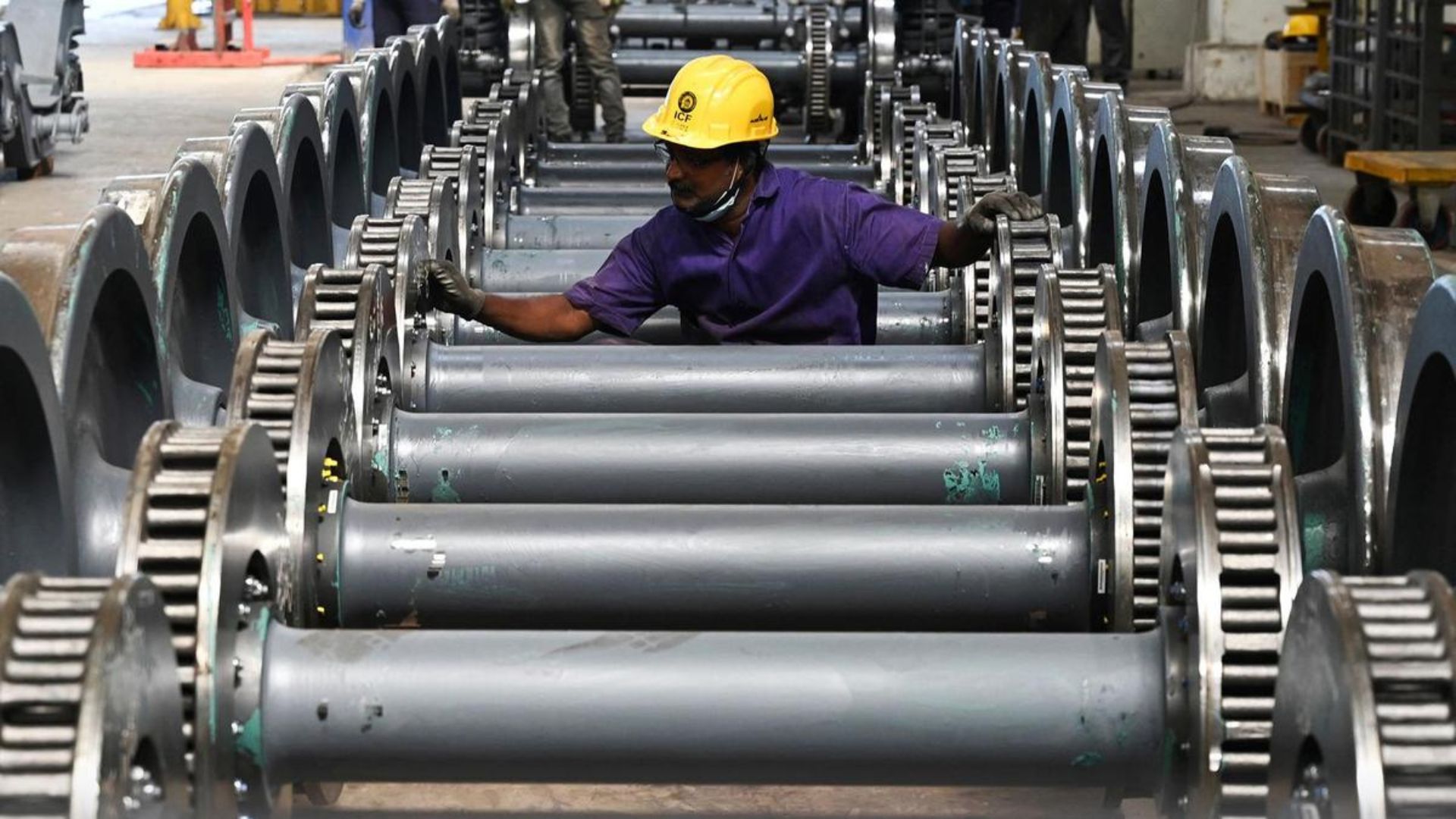
India's Manufacturing Gap: The Missing Bridge to Viksit Bharat

India has grown impressively. But growth alone does not guarantee transformation — and the weakness at the centre of India's economic structure is becoming impossible to ignore.
The Strong Foundation
India's macroeconomic story over the last decade is genuinely impressive:
- Real GDP growth of 6.5% in FY2024–25 — among the fastest of all major economies
- Strong domestic demand, subdued inflation, gradual fiscal consolidation
- A broadly stable financial sector through global turbulence
But sustaining this into the Viksit Bharat vision of 2047 requires more than macroeconomic stability. It requires activating all three engines of growth simultaneously:
Labour       →   absorbing workforce at scale
Capital      →   deploying it productively
Productivity →   accelerating structural efficiency
Currently, only some cylinders are firing.
The Structural Skew: Services Without Manufacturing
India's growth has been driven predominantly by services — IT, finance, business process — sectors that are high-productivity but low on labour absorption. Manufacturing, which should act as the critical bridge between low-productivity agriculture and high-productivity modern sectors, has not played that role.
In most successful development experiences — particularly East Asia — manufacturing created a cohort of medium and large firms that drove exports, absorbed labour, and generated broad-based productivity gains. India's manufacturing sector looks very different:
- A large number of small, low-productivity firms
- Very few mid-sized firms capable of scaling up
- A significant share of the workforce still trapped in agriculture, where productivity is far lower
The Economic Survey 2025–26 explicitly flags this: manufacturing is the weak link in India's development story, and without it, growth risks being neither sufficiently robust nor structurally stable.
Zombie Firms: The Hidden Drag
The deeper problem is what economists call weak business dynamism — the failure of creative destruction.
In a healthy economy, new, efficient firms replace older, unproductive ones. Resources — capital and labour — flow toward better uses. In India, this reallocation process remains slow. The result: the persistence of "zombie firms" — enterprises that are no longer economically viable but continue to operate.
A 2025 research paper, Zombie Firms in Emerging Markets: Survival and Funding Mechanisms, finds:
- Zombie firms constitute a small share of total firms but hold a disproportionately large share of total debt and assets
- Capital locked in zombie firms is capital unavailable to productive firms — a systemic drag
- Zombification is gradual and persistent, not cyclical — financial deterioration begins well before a firm is classified as a zombie
- Once zombified, firms become increasingly debt-dependent with little recovery in core performance
The financing structure matters critically:
Bank-financed firms   →   More likely to become zombies
                      →   Stay distressed longer
                      →   Relapse after partial recovery

Equity-financed firms →   Less prone to zombification
                      →   More likely to recover sustainably
This points to an institutional failure: financial and regulatory structures are sustaining inefficient firms rather than facilitating their exit — crowding out credit from productive enterprises and undermining overall productivity growth.
Why This Matters for Viksit Bharat
The ambition of becoming a developed economy by 2047 rests on a productivity leap that the current structure cannot deliver:
- Labour remains in low-productivity agriculture because manufacturing hasn't expanded enough to absorb it
- Capital is locked in zombie firms instead of flowing to scalable, productive enterprises
- Efficiency gaps persist despite significant infrastructure investment
Growth has laid the foundation. But without a manufacturing sector that is both larger and more productive, India risks a growth pattern that generates GDP numbers without generating broad-based income improvements or structural stability.
Way Forward
- Simplify regulations: Reduce compliance burden that disproportionately traps small firms in low-productivity equilibrium
- Strengthen insolvency processes: The IBC framework needs faster resolution to enable genuine exit of zombie firms and free up capital
- Improve credit allocation: Shift from bank-dominated, relationship-based lending toward equity financing — which demonstrably produces more resilient firms
- Ease labour constraints: Rigid labour laws discourage firms from scaling; reform must enable firms to grow without fear of hiring
- Deeper GVC integration: Manufacturing productivity requires exposure to global value chains — export competitiveness forces efficiency improvements that domestic markets do not
- Productive R&D investment: Firm-level innovation capacity must be built alongside infrastructure investment, not treated as a later-stage priority
Conclusion
India's growth record is real and earned. But growth built on services and domestic demand, without a productive manufacturing base, is a one-legged stool. The Economic Survey 2025–26 is right to identify manufacturing as the weak link. The zombie firm problem crystallises the deeper issue: India's institutional structures are better at keeping inefficient firms alive than at helping efficient ones grow. Viksit Bharat is not just a GDP target — it is a structural transformation. And that transformation will be decided not by how fast India grows, but by whether it can build the manufacturing depth, business dynamism, and capital efficiency to sustain that growth across decades.
Attribution
Original content sources and authors


Syllabus classification
How this article maps to GS papers
Main syllabus
GS3Indian-EconomyQuick Q&A
What is meant by the ‘missing manufacturing link’ in India’s development story, and why is it significant for Viksit Bharat 2047?
India’s economic structure remains unusual because a significant share of labour continues to be trapped in agriculture, where productivity is comparatively low. Services, though productive, often require higher skills and cannot absorb the large semi-skilled workforce. As a result, India faces a structural imbalance where growth is concentrated but not broad-based. This can create income inequality and jobless growth.
Why it matters:
- Employment generation: Manufacturing can absorb labour from agriculture at scale.
- Export competitiveness: It enables integration into global value chains.
- Productivity gains: Industrialization improves technological adoption.
- Regional balance: Manufacturing disperses growth beyond metros.
Countries like South Korea and China leveraged manufacturing to transform their economies. India’s Viksit Bharat aspiration depends on strengthening this missing link to ensure sustainable, inclusive, and resilient growth.
Why is manufacturing considered essential for sustaining high growth and inclusive development in India?
The Economic Survey 2025-26 rightly identifies manufacturing as central to India’s next growth phase. As India seeks developed-country status by 2047, relying solely on services may create structural vulnerabilities. Manufacturing contributes not only to GDP but also to export diversification, technological upgrading, and regional industrial ecosystems.
Its importance lies in:
- Creating formal employment for youth.
- Enhancing domestic value addition.
- Reducing dependence on imports.
- Strengthening supply chain resilience.
East Asian economies demonstrated that industrialization creates virtuous cycles of productivity, exports, and rising living standards. India must similarly make manufacturing the backbone of long-term development.
Critically analyze the problem of ‘zombie firms’ in India and their impact on economic productivity.
This creates a major efficiency problem. Capital that could flow to innovative and productive firms remains locked in distressed enterprises. The 2025 study cited in the article shows that zombie firms absorb substantial debt, especially when bank-financed, and tend to relapse even after temporary recovery. This weakens overall business dynamism.
Impacts:
- Capital misallocation: Productive firms face credit shortages.
- Low productivity: Resources remain in inefficient sectors.
- Financial stress: Banks accumulate bad assets.
- Reduced innovation: Competitive churn declines.
Thus, zombie firms reflect institutional rigidity. Their persistence undermines creative destruction—the process through which efficient firms replace inefficient ones. Managing this issue is vital for sustained productivity growth.
How does creative destruction contribute to economic development, and why is it weak in India?
In India, this process is weak because inefficient firms often remain operational due to regulatory barriers, delayed insolvency, and easy debt rollover. This slows industrial renewal and prevents the rise of medium-sized competitive firms. Consequently, productivity gains are slower than they could be.
Barriers in India:
- Complex regulatory compliance.
- Weak insolvency resolution.
- Credit biases favoring existing borrowers.
- Limited equity financing.
A stronger creative destruction process would encourage entrepreneurship, innovation, and industrial competitiveness, making growth more durable.
As an economic policymaker, what reforms would you recommend to strengthen India’s manufacturing sector for Viksit Bharat?
The first priority is integrating India into global value chains through trade facilitation and logistics improvements. The second is improving factor markets, especially land, labour, and capital, so firms can scale. Third, stronger research and innovation systems must support domestic industrial competitiveness.
Reforms:
- Simplify labour and regulatory compliance.
- Strengthen insolvency and bankruptcy systems.
- Expand equity-based financing.
- Promote industrial clusters and export zones.
These reforms can help India transition from growth-led expansion to productivity-led development.
Why is productivity growth considered the decisive factor in India’s journey toward developed-country status?
Productivity is especially important because demographic dividends alone cannot sustain long-term prosperity. A growing workforce must be matched with higher-value jobs and technological progress. Manufacturing productivity, therefore, becomes critical.
Why decisive:
- Raises per capita income sustainably.
- Improves export competitiveness.
- Supports fiscal strength.
- Enhances living standards.
Countries that became developed economies did so by sustained productivity growth, not merely by increasing investment.
What lessons can India draw from East Asian industrialization for strengthening manufacturing competitiveness?
A common feature was the rise of medium and large firms that scaled rapidly. India’s challenge is that many firms remain small and informal, limiting productivity and innovation. Policies must therefore encourage scale and technology adoption.
Lessons:
- Build strong industrial ecosystems.
- Encourage export orientation.
- Support R&D and skills.
- Ensure efficient capital allocation.
India can adapt these lessons to create a competitive manufacturing base suited to its demographic and economic realities.
Practice questions
2 questions for mains preparation