What does the record rise in India’s merchandise exports in May 2026 signify for the external sector and economic growth trajectory?
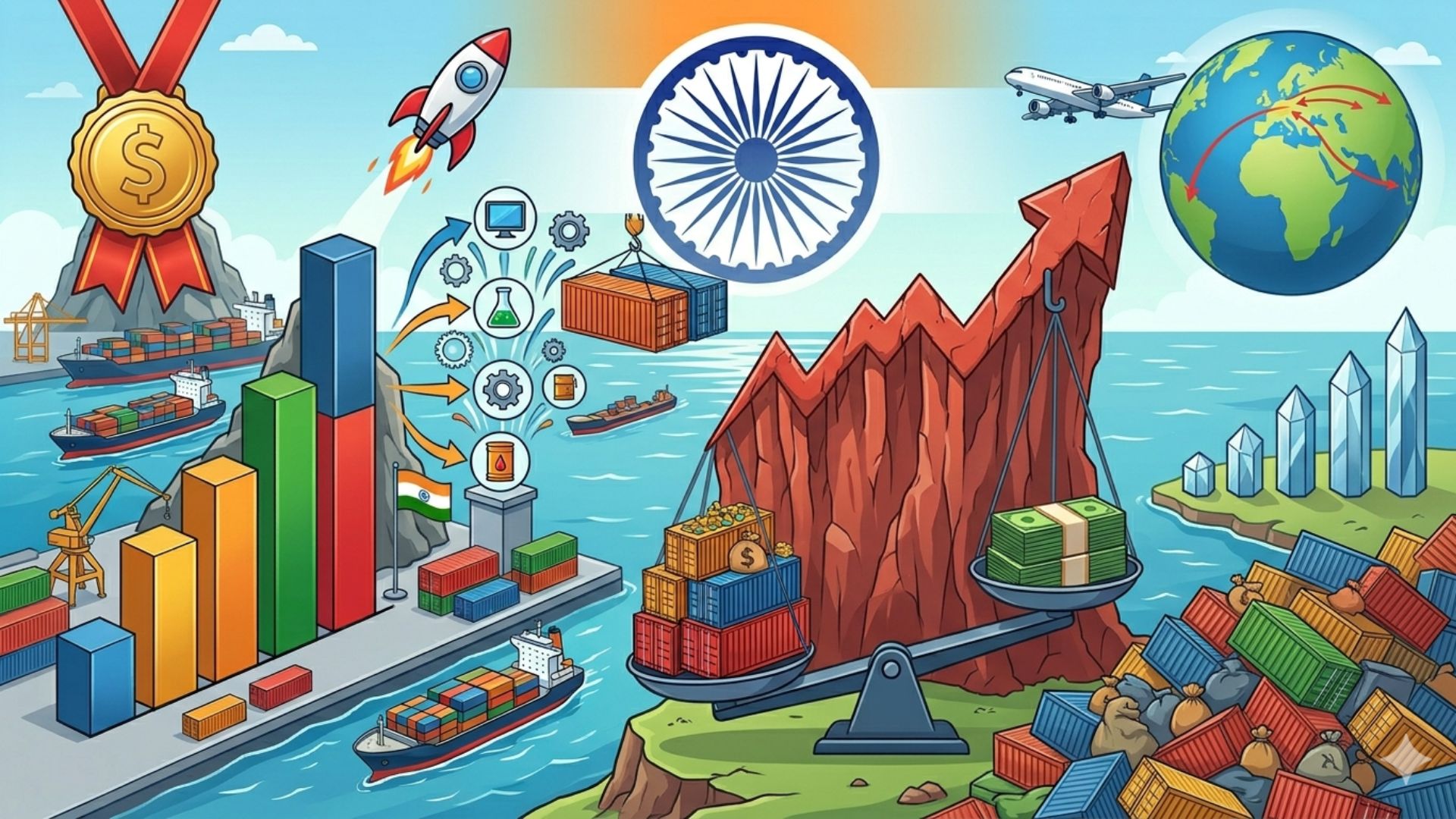
India’s merchandise exports touched a record high of $45.2 billion in May 2026, registering an 18% increase over May 2025. Merchandise exports refer to the sale of physical goods to foreign countries and constitute an important component of the current account of the Balance of Payments. Along with services exports of $36.8 billion, the data reflects increasing integration of India with global value chains and expanding international demand for Indian products.
The growth was broad-based. Engineering goods exports rose by 24.5% to $12.3 billion, electronic goods exports increased by 11.6% to $5.1 billion, chemicals exports expanded by 12.7%, while gems and jewellery exports recorded 6.7% growth. Major destinations included Singapore, China, the United Kingdom, Bangladesh, Germany and South Africa.
Historically, India's export basket was dominated by petroleum products and traditional sectors. However, the recent trend indicates diversification towards manufacturing and high-value products, aligning with initiatives such as Make in India, Production Linked Incentive (PLI) schemes and Atmanirbhar Bharat.
For UPSC GS-3, the development highlights themes relating to external sector management, industrial policy, employment generation and economic growth. Higher exports contribute to foreign exchange earnings, support manufacturing and create jobs. However, export growth alone does not automatically ensure external stability, as imports and global economic conditions also influence the trade balance.
Thus, the record export performance demonstrates India's increasing competitiveness and diversification, while also emphasizing the need for sustained reforms to enhance productivity and global market access.
Why is the widening trade deficit despite record exports an important issue for policymakers and UPSC aspirants?
The widening of India's trade deficit to $10.5 billion in May 2026 despite record exports represents an important macroeconomic issue. Trade deficit refers to the excess of imports over exports and directly affects the current account balance and external sector stability.
Although merchandise exports reached $45.2 billion, merchandise imports increased more rapidly by 22.1% to $73.4 billion. Consequently, the merchandise trade deficit rose to $28.2 billion, about 25% higher than in May 2025. Services imports also grew by 14.1% to $19.1 billion.
A moderate trade deficit is not necessarily harmful because imports of capital goods, crude oil and intermediate products can support economic growth. However, a persistently large deficit may increase dependence on external financing and expose the economy to global shocks, exchange rate volatility and pressure on foreign exchange reserves.
Historically, India has been a net importer due to heavy dependence on energy imports. Episodes such as the 2013 current account crisis highlighted the vulnerability arising from large external imbalances. Therefore, policymakers closely monitor trade deficits.
For UPSC GS-3 and interview preparation, the issue connects with topics such as Balance of Payments, exchange rate management, inflation, energy security and globalization. There are differing viewpoints regarding trade deficits. Some economists view them as a reflection of strong domestic demand, while others consider persistent deficits a structural weakness.
Hence, understanding the causes and implications of the widening trade deficit is crucial for analyzing India's macroeconomic stability and framing sustainable trade policies.
How do exports and imports influence India’s Balance of Payments and overall external sector performance?
Exports and imports are fundamental determinants of a country's Balance of Payments (BoP), which records all economic transactions between residents and the rest of the world. The current account component of the BoP includes trade in goods, services, remittances and income flows.
Exports generate foreign exchange earnings and strengthen external stability. In May 2026, India earned $45.2 billion from merchandise exports and $36.8 billion from services exports. These inflows help finance imports and maintain adequate foreign exchange reserves.
Imports, on the other hand, represent outflows of foreign exchange. India’s merchandise imports rose to $73.4 billion and services imports to $19.1 billion in May 2026. Since imports grew faster than exports, the trade deficit widened. A persistent deficit in the current account may require financing through foreign direct investment, foreign portfolio investment or external borrowing.
India's external sector has evolved significantly since the economic reforms of 1991. Liberalization, globalization and technological advancements have expanded trade volumes and integrated India into global supply chains. Today, services exports, especially IT and business services, provide resilience against merchandise trade imbalances.
For UPSC GS-3, this topic links with international trade, foreign exchange reserves, globalization and macroeconomic management. Practical examples include the impact of crude oil prices on import bills and the role of remittances in reducing current account pressures.
Therefore, maintaining a healthy balance between exports and imports is essential for sustaining economic growth, preserving exchange rate stability and ensuring long-term external sector resilience.
What are the major reasons behind the strong growth in India’s merchandise exports during May 2026?
The strong growth in India's merchandise exports during May 2026 can be attributed to multiple structural and cyclical factors. Merchandise exports increased by 18% year-on-year to a record $45.2 billion, indicating broad-based expansion across sectors and destinations.
One important reason was the robust performance of engineering goods, whose exports rose by 24.5% to $12.3 billion. Electronics exports expanded to $5.1 billion, while chemical exports increased by 12.7%. Such growth reflects increasing manufacturing capabilities and greater integration with global value chains.
Government initiatives have also played a significant role. Policies like Production Linked Incentive (PLI) schemes, Make in India and improvements in logistics infrastructure have enhanced competitiveness. Digitalization, trade facilitation measures and efforts to diversify export markets have further strengthened export performance.
Demand from countries such as Singapore, China, the United Kingdom, Bangladesh, Germany and South Africa contributed significantly. Diversification of destinations reduced excessive dependence on traditional markets.
Historically, India's exports were concentrated in petroleum products and low-value goods. Recent trends indicate movement towards value-added manufacturing, electronics and engineering products. This transition supports employment generation and industrial development.
For UPSC GS-3, this issue relates to industrial policy, globalization, infrastructure and economic development. However, experts caution that global uncertainties, geopolitical tensions and protectionist tendencies could affect export momentum. Rising shipping costs and supply chain disruptions also remain concerns.
Thus, export growth in May 2026 reflects the combined impact of domestic reforms, market diversification and expanding manufacturing competitiveness.
What is the critical analysis of India’s external trade performance in light of record exports and rising imports?
India's trade performance in May 2026 presents a mixed picture. On one hand, merchandise exports reached a historic high of $45.2 billion and services exports rose to $36.8 billion, indicating strong external demand and improved competitiveness. On the other hand, imports increased even faster, resulting in a trade deficit of $10.5 billion.
Supporters of the current trend argue that rising imports are not entirely negative. A large proportion of imports consists of crude oil, capital goods and intermediate products that are essential for industrial expansion and economic growth. Strong imports may therefore reflect robust domestic demand and investment activity.
However, critics point out that persistent trade deficits can increase dependence on external financing and expose the economy to global shocks. Rising energy prices, geopolitical tensions and disruptions in supply chains can worsen external vulnerabilities. Excessive reliance on imports in strategic sectors may also undermine self-reliance objectives.
Another challenge is that export growth remains vulnerable to fluctuations in global demand. Slowdowns in major economies and increasing protectionism can adversely affect India's export prospects.
For UPSC GS-3, the issue intersects with economic growth, industrial policy, globalization and energy security. It also relates to GS-2 topics involving international economic relations.
Policy responses include promoting export diversification, enhancing manufacturing competitiveness, expanding free trade agreements and reducing logistics costs. Simultaneously, boosting domestic production of critical inputs and renewable energy can reduce import dependence.
Therefore, India's recent trade performance should be viewed through a balanced lens, recognizing both its achievements and the structural challenges that require sustained policy attention.
What lessons can be drawn from the May 2026 trade data as a case study for India’s economic strategy and external sector management?
The May 2026 trade performance provides an important case study in external sector management and economic strategy. Merchandise exports reached a record $45.2 billion, while services exports touched $36.8 billion. Simultaneously, imports rose sharply, leading to a wider trade deficit of $10.5 billion.
This case highlights the complexity of managing a rapidly growing economy. Strong export growth demonstrates the effectiveness of policies aimed at promoting manufacturing and integration with global markets. Engineering goods exports rising by 24.5% and electronics exports crossing $5.1 billion indicate progress in diversification and value addition.
The experience also shows that export success alone is insufficient for achieving external balance. Rising imports of essential commodities and industrial inputs increased the trade deficit. Therefore, policymakers need a comprehensive approach involving both export promotion and import management.
Historically, India's 1991 balance of payments crisis underscored the dangers of external vulnerabilities. Since then, economic reforms have strengthened foreign exchange reserves and diversified trade. The May 2026 data illustrates the continuing importance of maintaining resilience amid global uncertainties.
For UPSC GS-3, this case study links with topics such as economic reforms, globalization, industrial policy and balance of payments. It also has relevance for essay papers and personality tests where candidates are expected to analyze both opportunities and challenges.
Important policy lessons include strengthening domestic manufacturing, encouraging innovation, investing in logistics infrastructure, diversifying export destinations and reducing dependence on imported energy.
Thus, the May 2026 trade data serves as a practical example of how economic growth, trade competitiveness and macroeconomic stability must be balanced through prudent policymaking.