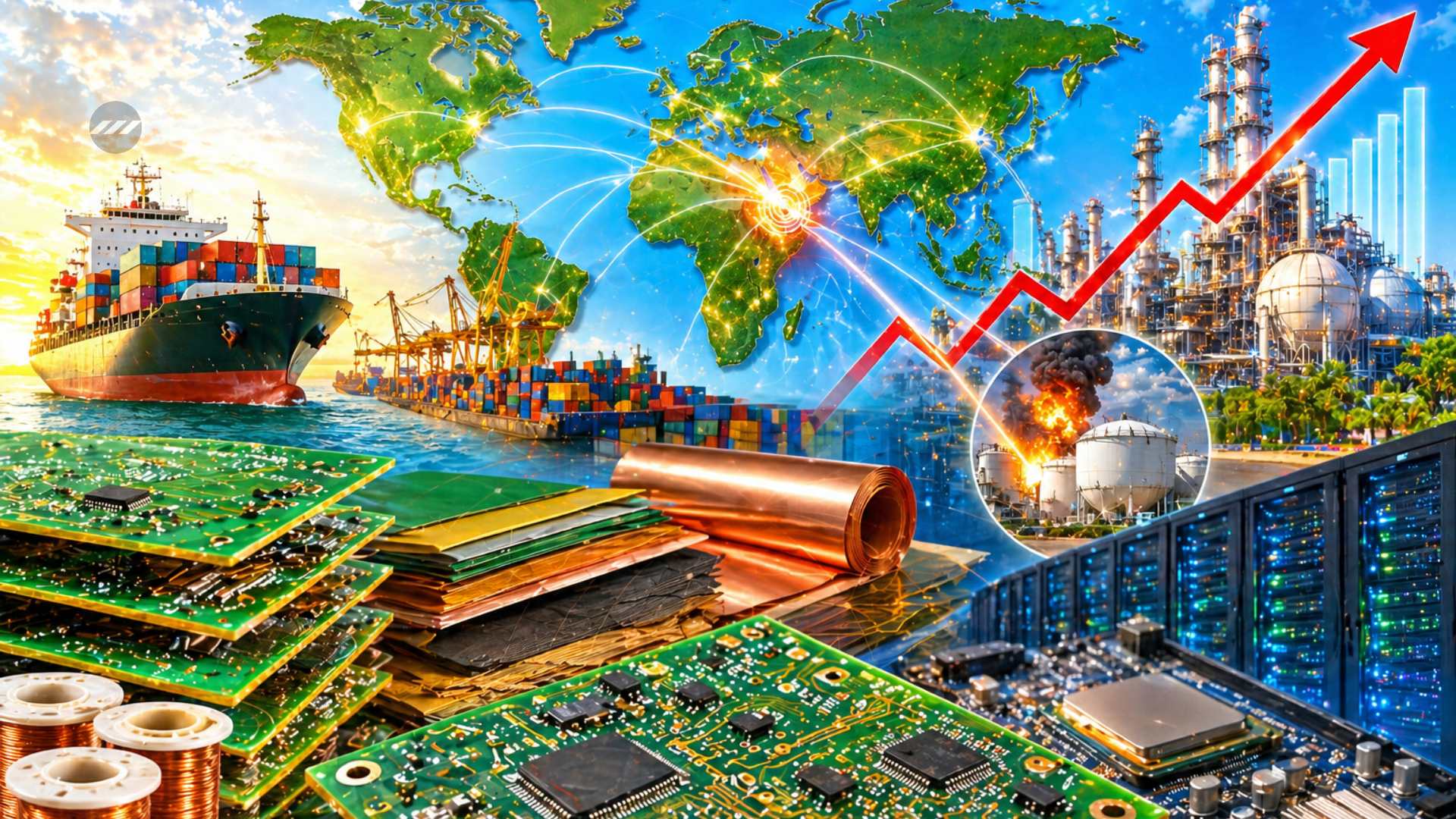
Iran War Disrupts Circuit Board Supplies Amid Rising Costs

Introduction
- The global electronics industry, valued at over $2 trillion, is highly dependent on integrated supply chains and critical raw materials.
- The ongoing West Asia conflict has triggered sharp price rises in Printed Circuit Boards (PCBs)—with prices surging up to 40% in April 2026.
- In a globalised economy, geopolitical shocks quickly translate into supply chain disruptions.
“Resilient supply chains are the backbone of modern economic security.”
Background / Context
-
The conflict involving Iran has disrupted:
- Petrochemical production
- Shipping routes in the Gulf
- Availability of key industrial inputs
-
A major trigger:
- Attack on Saudi Arabia’s Jubail petrochemical complex
- Halt in production of polyphenylene ether (PPE) resin
👉 This has severely impacted PCB manufacturing globally.
Key Concept: Printed Circuit Boards (PCBs)
-
PCBs are the foundation of all electronic devices, including:
- Smartphones
- Computers
- AI servers
-
They consist of:
- Copper layers
- Insulating materials (resins like PPE)
Key Raw Materials in PCB Manufacturing
| Material | Role | Issue |
|---|---|---|
| PPE Resin | Base for laminates | Supply disruption |
| Copper Foil | Conductive layer | Prices ↑ (~30%) |
| Glass Fiber | Structural strength | Supply shortage |
Supply Chain Disruption: Root Causes
1. Petrochemical Disruption
- Saudi facility shutdown impacted global PPE supply
- Major supplier (SABIC) contributes ~70% of global supply
2. Logistics & Shipping Constraints
-
Gulf region disruptions slowed:
- Imports
- Exports
3. Rising Demand (AI Boom)
-
Increasing demand for:
- AI servers
- Cloud infrastructure
👉 Demand–supply mismatch intensified price rise
Economic Impact
1. Price Surge
-
PCB prices increased:
- Up to 40% in April 2026
2. Rising Input Costs
-
Copper accounts for:
- ~60% of PCB raw material cost
3. Production Delays
-
Waiting time for materials:
- Increased from 3 weeks → 15 weeks
4. Industry Growth vs Constraints
| Indicator | Data |
|---|---|
| Global PCB market (2026) | $95.8 billion |
| Growth rate | 12.5% |
👉 Growth continues, but under cost pressure
Implications
1. Global Electronics Industry
-
Increased production costs
-
Potential price rise in:
- Smartphones
- Computers
- AI hardware
2. Supply Chain Vulnerability
-
Highlights:
- Overdependence on limited suppliers
- Fragility of globalised production systems
3. Inflationary Pressures
-
Rising input costs may:
- Increase consumer prices
- Affect global inflation
4. Strategic Implications
-
Countries may shift towards:
- Supply chain diversification
- Domestic manufacturing
Case Study: AI Hardware Boom
- Cloud companies continue buying despite price rise 👉 Reason:
- Future demand expected to exceed supply
Comparative Insight
| Traditional Manufacturing | Modern Electronics Supply Chain |
|---|---|
| Localised | Highly globalised |
| Stable inputs | Geopolitically sensitive |
| Low dependency | High interdependence |
Implications for India
1. Electronics Manufacturing Push
-
Affects:
- Make in India
- Semiconductor ecosystem
2. Import Dependency
-
India relies heavily on:
- Imported electronic components
3. Opportunity
-
Develop:
- Domestic PCB manufacturing
- Alternative supply chains
Challenges
- Limited domestic capacity
- High dependence on imports
- Price volatility of raw materials
- Geopolitical uncertainties
Way Forward
1. Supply Chain Diversification
-
Reduce reliance on:
- Single regions (e.g., Gulf, China)
2. Strengthen Domestic Manufacturing
-
Incentivise:
- PCB production
- Raw material processing
3. Strategic Stockpiling
-
Maintain reserves of:
- Critical materials
4. Global Cooperation
- Build resilient supply networks
- Trade partnerships
Conclusion
The disruption in PCB supply due to geopolitical conflict underscores the deep interlinkage between global politics and economic systems. As electronics become central to modern economies, ensuring resilient, diversified, and secure supply chains will be critical for sustainable growth and technological sovereignty.
Attribution
Original content sources and authors


Syllabus classification
How this article maps to GS papers
Main syllabus
GS3Indian-EconomyQuick Q&A
What is the role of Printed Circuit Boards (PCBs) in the electronics industry, and why are they strategically important?
Strategic importance:
- Ubiquity: PCBs are used across industries including consumer electronics, telecommunications, healthcare, and defence.
- Critical for emerging technologies: High-end PCBs are essential for AI servers, cloud computing, and advanced data centres.
- Supply chain centrality: They depend on multiple raw materials such as copper foil, glass fibre, and resins, making them sensitive to global disruptions.
For instance, companies like Nvidia and AMD rely on advanced multi-layer PCBs to power AI chips and high-performance computing systems.
Broader implications: The strategic importance of PCBs lies in their role as a foundational technology. Any disruption in PCB supply can cascade across industries, affecting everything from consumer electronics prices to national security capabilities. Thus, ensuring stable PCB supply chains has become a priority for governments and corporations alike.
Why has the Middle East conflict significantly impacted global PCB supply chains?
Key reasons for disruption:
- Concentration of supply: Heavy reliance on a few producers makes the system vulnerable.
- Logistical challenges: Shipping routes in the Gulf have been disrupted due to conflict.
- Interlinked supply chains: Shortages of one material (PPE) affect the entire PCB manufacturing process.
For example, delays in resin supply have increased waiting times for manufacturers from 3 weeks to 15 weeks, indicating severe supply stress.
Wider implications: The disruption highlights the fragility of globalised supply chains, where regional conflicts can have worldwide economic consequences. It underscores the need for diversification and resilience in sourcing critical materials, especially for industries tied to technological advancement and economic growth.
How are rising raw material costs influencing PCB prices and the broader electronics industry?
Transmission mechanism:
- Cost-push inflation: Higher input costs directly increase production expenses.
- Supply shortages: Limited availability forces manufacturers to bid up prices.
- Demand pressures: Growing demand for AI servers exacerbates the imbalance.
For instance, companies like Daeduck Electronics have initiated discussions with customers to pass on increased costs, reflecting the widespread impact across the value chain.
Industry-wide effects: Rising PCB costs lead to higher prices for end products such as smartphones, computers, and cloud services. While large cloud providers may absorb these costs due to strong demand, smaller firms face margin pressures. This dynamic could lead to market consolidation and slower innovation in cost-sensitive segments, reshaping the competitive landscape of the electronics industry.
What are the key reasons behind the sharp increase in PCB demand, particularly in recent years?
Key factors:
- AI boom: Increased deployment of AI models and data centres.
- Digital transformation: Growth in cloud services and remote computing.
- Consumer electronics: Continued demand for advanced smartphones and devices.
- Industrial applications: Automation and IoT expansion.
For example, high-end PCBs used in AI servers can cost significantly more than standard ones, reflecting their complexity and demand.
Structural implications: This demand surge is not cyclical but structural, meaning it is likely to persist over the long term. As a result, supply chains are under constant pressure, and any disruption—such as geopolitical conflicts—has amplified effects. This trend underscores the importance of capacity expansion and supply chain resilience in sustaining technological growth.
Critically analyse the vulnerability of global electronics supply chains in light of recent geopolitical disruptions.
Key vulnerabilities:
- Overdependence on specific regions: Concentration of production in limited geographic areas.
- Just-in-time systems: Minimal inventory buffers increase risk.
- Complex interdependencies: Multiple inputs required for a single product.
However, globalisation has also provided efficiency and cost advantages, which cannot be easily replaced.
Counterpoints and resilience: Some firms and countries are now diversifying supply chains, investing in domestic manufacturing, and building strategic reserves. For example, companies are exploring alternative suppliers for materials like resin and copper.
Conclusion: While global supply chains have inherent vulnerabilities, they remain essential for economic efficiency. The challenge lies in balancing resilience with competitiveness. Policymakers must focus on diversification, technological innovation, and international cooperation to mitigate risks without undermining the benefits of global integration.
Provide examples of how industry players are responding to the rising PCB costs and supply disruptions.
Key examples:
- Price adjustments: Firms like Daeduck Electronics are negotiating price increases with customers.
- Supplier prioritisation: Companies are focusing more on securing raw materials than expanding customer bases.
- Inventory management: Building stockpiles of critical inputs to mitigate disruptions.
- Supply diversification: Exploring alternative sources for materials such as copper and resin.
For instance, cloud service providers have shown willingness to absorb higher costs, anticipating sustained demand growth.
Implications: These strategies reflect a shift from efficiency-driven models to resilience-focused approaches. While large firms may adapt successfully, smaller players could struggle, leading to industry consolidation. This highlights the uneven impact of supply chain disruptions and the need for systemic solutions.
Examine the Jubail petrochemical disruption as a case study to understand the global impact of regional conflicts on technology supply chains.
Impact analysis:
- Supply shock: अचानक halt in production led to global scarcity of PPE resin.
- Price escalation: PCB prices surged significantly due to constrained supply.
- Production delays: Waiting times for materials increased पाँचfold.
This disruption affected not just PCB manufacturers but also downstream industries such as consumer electronics and cloud computing.
Lessons learned: The Jubail case highlights the risks of geographic concentration and lack of redundancy in supply chains. It underscores the need for diversification, strategic reserves, and international cooperation to ensure stability. Additionally, it demonstrates how geopolitical risks are increasingly intertwined with economic and technological systems.
Conclusion: Regional conflicts are no longer isolated events; they have global repercussions. The Jubail disruption exemplifies the importance of building resilient supply chains to sustain technological progress in an interconnected world.
Practice questions
1 question for mains preparation