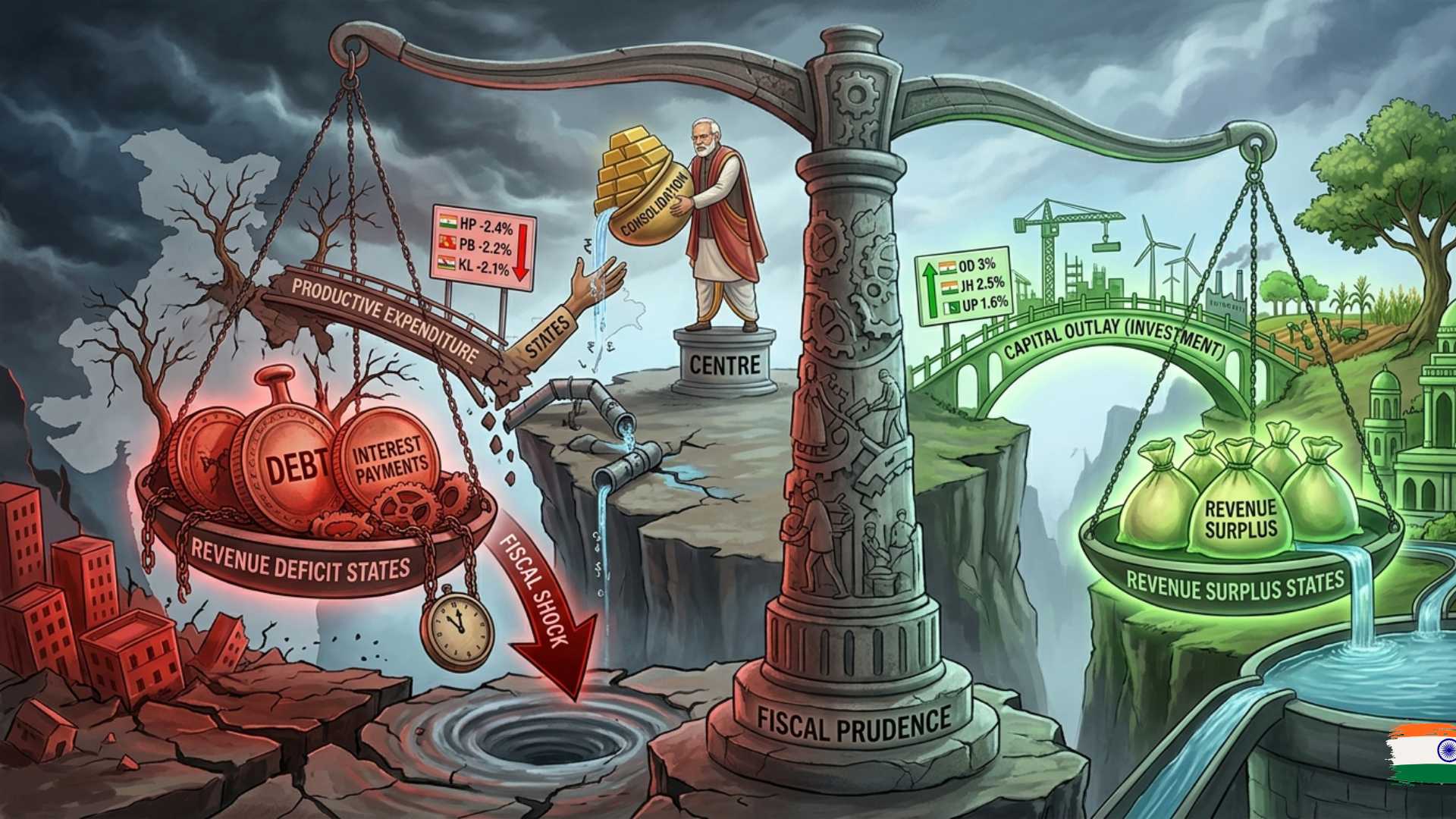
Revenue-Deficit States and Their Struggle with Fiscal Stress
An analysis highlights how revenue-deficit states may cut spending or seek aid from the Centre amid fiscal challenges.
4 mins read

Introduction
- India's federal fiscal architecture is under stress — as of 2026-27 projections, 9 of 18 large States are in revenue deficit, constraining their capacity to respond to economic shocks (DEA Monthly Economic Review, April 2026).
- A revenue deficit signals that a government is borrowing not to build assets but to fund day-to-day consumption — salaries, pensions, subsidies, interest — a structurally unsustainable position. Add as a third bullet:
- When States breach fiscal limits: High debt → ↑ interest burden → ↓ capital outlay → ↓ growth → ↑ welfare cuts → ↓ HDI — a compounding downward spiral where borrowing funds consumption, not creation, ultimately forcing states to either cut productive spending or demand central bailouts.
"States simultaneously running a revenue deficit and high outstanding liabilities have fewer degrees of freedom to respond to fiscal shocks." — DEA, MER April 2026
Key Concepts
| Term | Meaning |
|---|---|
| Revenue Deficit | Revenue expenditure exceeds revenue receipts — borrowing funds consumption, not assets |
| Fiscal Deficit | Total expenditure exceeds total receipts including borrowings |
| Golden Rule of Fiscal Financing | Zero revenue deficit — borrowings must only finance capital/asset creation |
| Capital Outlay | Expenditure creating long-term assets (roads, infrastructure, etc.) |
| GSDP | Gross State Domestic Product — state-level equivalent of GDP |
| Interest-to-Revenue Ratio | % of revenue receipts consumed by interest payments on debt |
States in Revenue Deficit (2026-27 Projections)
| State | Revenue Deficit (% of GSDP) |
|---|---|
| Himachal Pradesh | -2.4% |
| Punjab | -2.2% |
| Kerala | -2.1% |
| Andhra Pradesh | -1.1% |
| Rajasthan | -1.1% |
| Haryana | -0.9% |
| Karnataka | -0.7% |
| Maharashtra | -0.7% |
| Chhattisgarh | -0.3% |
Punjab's alarming indicator: For every ₹100 earned, ₹22.8 goes to interest payments alone — highest among all analysed states.
States in Revenue Surplus (2026-27 Projections)
| State | Revenue Surplus (% of GSDP) |
|---|---|
| Odisha | +3.0% |
| Jharkhand | +2.5% |
| Uttar Pradesh | +1.6% |
| Goa | +1.3% |
| Gujarat | +0.8% |
| Uttarakhand | +0.6% |
| Telangana | +0.3% |
| Bihar | +0.1% |
Key distinction: Barring Telangana, all surplus states have capital outlay > fiscal deficit as % of GSDP — meaning borrowings are financing assets, not consumption.
Odisha as a Model Case
- Fiscal deficit at 3.5% of GSDP — above the 3% norm.
- Yet: revenue surplus of 3% + capital outlay of 6.5% of GSDP.
- DEA characterises this as "deliberate investment rather than fiscal stress" — a critical distinction for UPSC answers.
Implications & Challenges
For Deficit States:
- Debt servicing obligations crowd out productive expenditure (health, education, infrastructure).
- Many spend more than 15% of revenue receipts on interest — a debt trap dynamic.
- Forced to either reprioritise away from capital expenditure or demand higher central transfers.
For Centre-State Relations:
- Stressed states demand transfers precisely when the Centre is attempting its own fiscal consolidation — creating a pro-cyclical fiscal squeeze.
- Undermines cooperative federalism and strains the Finance Commission's transfer architecture.
For Macroeconomic Stability:
- Revenue deficit states contribute to aggregate demand through unproductive government consumption — inflationary without growth dividends.
- Limits India's ability to present a consolidated fiscal position internationally.
Structural Causes of Revenue Deficits
- High committed expenditure — salaries, pensions, interest payments leave little discretionary space.
- Populist subsidies — free electricity, loan waivers increasing revenue expenditure without asset creation.
- Own tax revenue weakness — overdependence on central transfers and GST devolution.
- UDAY scheme legacy — electricity distribution company debt absorption by states like Rajasthan and Punjab.
- Pay commission arrears — periodic spikes in salary/pension expenditure.
Relevant Constitutional & Institutional Framework
| Mechanism | Role |
|---|---|
| Article 293 | States cannot borrow without Centre's consent if indebted to Centre |
| FRBM Act (State versions) | Mandates fiscal deficit ceiling of 3% of GSDP |
| Finance Commission | Determines tax devolution and grants; 16th FC currently deliberating |
| RBI State Finances Report | Annual assessment of state fiscal health |
| DEA Monthly Economic Review | Real-time fiscal monitoring by Centre |
Way Forward
- Enforce golden rule of fiscal financing — zero revenue deficit as a binding norm, not merely advisory.
- Rationalise subsidies — shift from untargeted to DBT-linked transfers.
- Strengthen own tax revenue through property tax reforms and GST compliance.
- Incentivise capital outlay through performance-linked borrowing limits (as recommended by 15th Finance Commission).
- Debt restructuring for chronically stressed states with conditionalities tied to fiscal reform.
Conclusion
- India's federal fiscal health is increasingly bifurcated — a group of disciplined, investment-oriented surplus states and a group of consumption-trapped deficit states with shrinking fiscal space.
- The golden rule — borrow only to invest, never to consume — must become the organising principle of state finances.
- Without structural expenditure reform and own-revenue strengthening, revenue-deficit states risk becoming permanent dependents on central transfers, weakening both federalism and macroeconomic stability.
Attribution
Original content sources and authors


Syllabus classification
How this article maps to GS papers
Main syllabus
GS3Indian-EconomyQuick Q&A
What is a revenue deficit, and how does it differ from a fiscal deficit in the context of State finances?
Revenue deficit refers to a situation where a government’s revenue expenditure (such as salaries, pensions, subsidies, and interest payments) exceeds its revenue receipts (like taxes and fees). It indicates that the government is unable to meet its day-to-day operational expenses from its regular income, forcing it to borrow even for consumption purposes.
In contrast, a fiscal deficit represents the total borrowing requirement of the government, including both revenue and capital expenditures. While a fiscal deficit may be justified if borrowings are used for productive capital investments (like infrastructure), a revenue deficit is generally seen as a sign of fiscal stress because it implies borrowing for non-productive uses.
Key distinction:
In contrast, a fiscal deficit represents the total borrowing requirement of the government, including both revenue and capital expenditures. While a fiscal deficit may be justified if borrowings are used for productive capital investments (like infrastructure), a revenue deficit is generally seen as a sign of fiscal stress because it implies borrowing for non-productive uses.
Key distinction:
- Revenue deficit: Borrowing for consumption (undesirable)
- Fiscal deficit: Borrowing for overall expenditure (can be acceptable if used for asset creation)
Why is maintaining the ‘golden rule’ of zero revenue deficit crucial for fiscal sustainability of States?
The golden rule of fiscal policy suggests that governments should borrow only for investment purposes and not for meeting routine expenditures. Maintaining a zero revenue deficit ensures that all revenue expenditure is financed through current revenues, thereby preserving fiscal discipline.
This rule is crucial because it prevents the accumulation of unsustainable debt. When States run persistent revenue deficits, they are forced to borrow for consumption, leading to a debt trap where a significant portion of revenue is diverted towards interest payments. For instance, Punjab spends nearly 22.8% of its revenue receipts on interest payments, severely limiting its fiscal flexibility.
Implications of violating the golden rule:
This rule is crucial because it prevents the accumulation of unsustainable debt. When States run persistent revenue deficits, they are forced to borrow for consumption, leading to a debt trap where a significant portion of revenue is diverted towards interest payments. For instance, Punjab spends nearly 22.8% of its revenue receipts on interest payments, severely limiting its fiscal flexibility.
Implications of violating the golden rule:
- Reduced fiscal space for development expenditure
- Higher debt servicing burden
- Vulnerability to economic shocks
How do high debt levels and revenue deficits constrain a State’s ability to respond to fiscal shocks?
States with high debt burdens and persistent revenue deficits face significant constraints in responding to fiscal shocks, such as economic downturns or natural disasters. A large share of their revenue is pre-committed to interest payments and debt servicing, leaving limited resources for discretionary spending.
As highlighted in the article, many revenue-deficit States spend over 15% of their revenue receipts on interest payments. This reduces their ability to undertake counter-cyclical fiscal policies, such as increasing public spending during crises. Consequently, they may be forced to either cut essential expenditures or seek additional support from the Centre.
Key constraints include:
As highlighted in the article, many revenue-deficit States spend over 15% of their revenue receipts on interest payments. This reduces their ability to undertake counter-cyclical fiscal policies, such as increasing public spending during crises. Consequently, they may be forced to either cut essential expenditures or seek additional support from the Centre.
Key constraints include:
- Expenditure compression: Reduction in developmental and welfare spending
- Limited borrowing capacity: Due to already high debt levels
- Dependence on Centre: Increased reliance on central transfers
Critically analyze whether a higher fiscal deficit always indicates poor fiscal management by a State.
A higher fiscal deficit does not necessarily indicate poor fiscal management; its implications depend largely on the quality of expenditure. If the borrowed funds are used for capital formation, such as infrastructure development, education, or health, it can lead to long-term economic growth and improved revenue generation.
The article highlights the case of Odisha, which has a fiscal deficit of 3.5% of GSDP, exceeding the conventional 3% norm. However, it maintains a revenue surplus and allocates 6.5% of GSDP to capital outlay. This indicates that its borrowings are being used productively, making it an example of deliberate investment rather than fiscal stress.
Critical perspective:
The article highlights the case of Odisha, which has a fiscal deficit of 3.5% of GSDP, exceeding the conventional 3% norm. However, it maintains a revenue surplus and allocates 6.5% of GSDP to capital outlay. This indicates that its borrowings are being used productively, making it an example of deliberate investment rather than fiscal stress.
Critical perspective:
- Positive: High fiscal deficit for capital investment can boost growth and future revenues
- Negative: High fiscal deficit combined with revenue deficit indicates borrowing for consumption, which is unsustainable
Provide examples of States with contrasting fiscal positions and explain what lessons can be drawn from them.
The article provides a clear contrast between revenue-deficit States like Punjab and Kerala, and revenue-surplus States like Odisha and Gujarat. Punjab, for instance, has a high revenue deficit and spends nearly 22.8% of its revenue receipts on interest payments, indicating a heavy debt burden and limited fiscal flexibility.
On the other hand, Odisha maintains a revenue surplus and allocates a significant share of its GSDP to capital outlay. Similarly, States like Gujarat and Uttar Pradesh also exhibit revenue surpluses, suggesting better fiscal discipline and prioritization of productive expenditure.
Lessons drawn:
On the other hand, Odisha maintains a revenue surplus and allocates a significant share of its GSDP to capital outlay. Similarly, States like Gujarat and Uttar Pradesh also exhibit revenue surpluses, suggesting better fiscal discipline and prioritization of productive expenditure.
Lessons drawn:
- Fiscal discipline matters: Maintaining a revenue surplus enhances resilience
- Quality of spending is crucial: Investment in capital assets yields long-term benefits
- Debt management: Keeping liabilities in check reduces interest burden
As a policy advisor, how would you suggest a revenue-deficit State restructure its finances to achieve fiscal sustainability?
As a policy advisor, restructuring the finances of a revenue-deficit State would require a multi-pronged strategy focusing on both revenue augmentation and expenditure rationalization. The first step would be to enhance revenue mobilization through improved tax compliance, widening the tax base, and leveraging digital tools for efficient tax administration.
Simultaneously, the State must rationalize its expenditure by reducing non-essential subsidies and improving the efficiency of welfare schemes through targeted delivery mechanisms like Direct Benefit Transfer (DBT). Prioritizing capital expenditure over revenue expenditure is essential to stimulate economic growth and generate future revenues.
Key policy measures:
Simultaneously, the State must rationalize its expenditure by reducing non-essential subsidies and improving the efficiency of welfare schemes through targeted delivery mechanisms like Direct Benefit Transfer (DBT). Prioritizing capital expenditure over revenue expenditure is essential to stimulate economic growth and generate future revenues.
Key policy measures:
- Debt restructuring: Refinance high-cost debt to reduce interest burden
- Expenditure prioritization: Shift focus from consumption to investment
- Institutional reforms: Strengthen fiscal responsibility frameworks
Practice questions
1 question for mains preparation