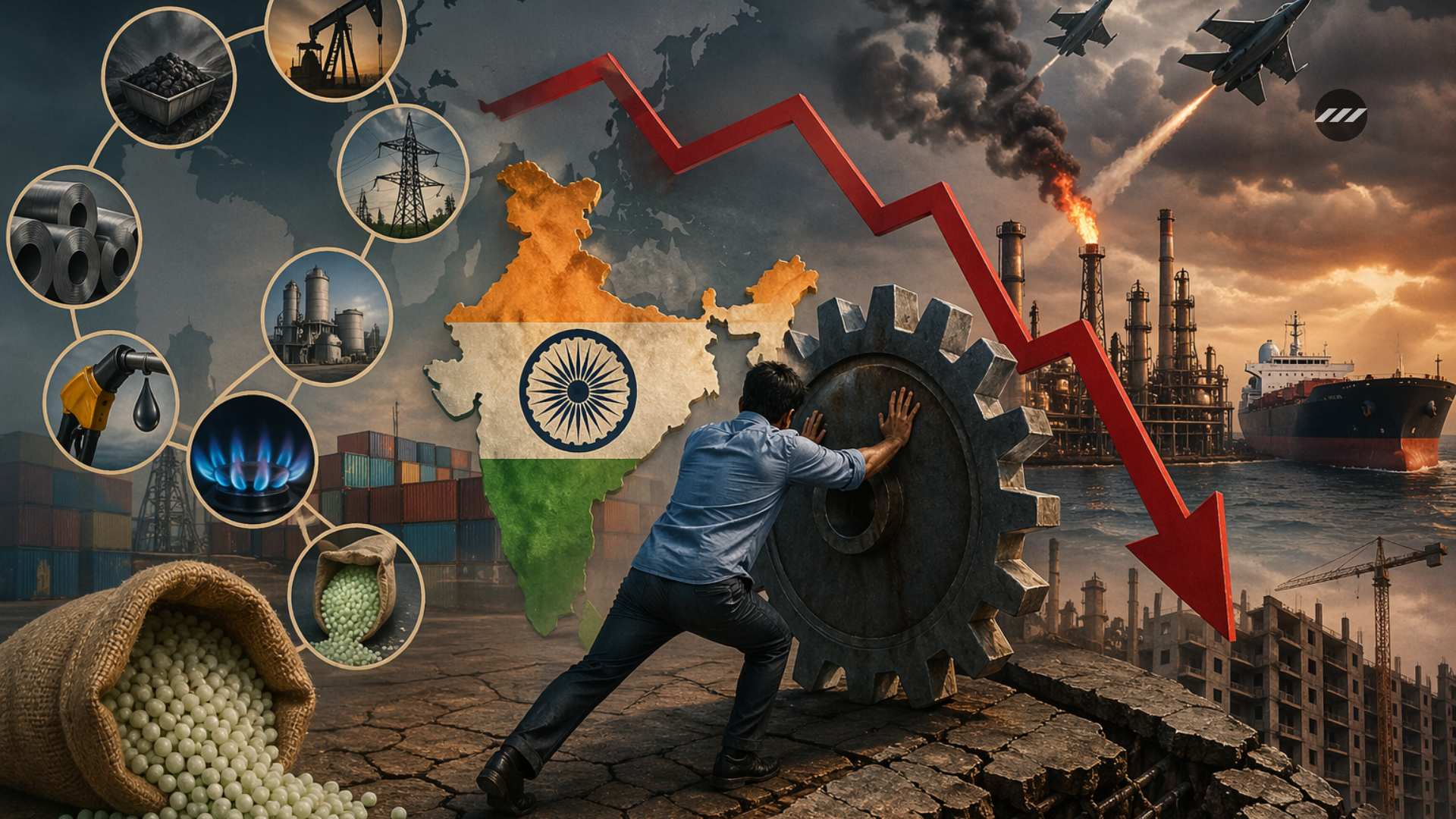
Impact of West Asia on the Indian Economic Slowdown

"External shocks are the true stress-test of structural resilience — India's challenge is to build buffers, not just ride tailwinds." — Economic Survey 2024-25
India's Index of Eight Core Industries contracted 0.4% in March 2026 — the worst performance in 19 months — as the West Asia conflict disrupted supply chains, fuel availability, and investor sentiment. With fertilizer output shrinking 24.6% and an El Niño-impacted monsoon predicted, India faces a rare confluence of external and agrarian stress.
Background / Context
The West Asia crisis (centered on the Iran war) delivered a multi-channel shock to India: costlier energy imports, constrained natural gas supply, and subdued FDI sentiment. This comes at a time when India's household real incomes remain stagnant and trade frictions with the US under Trump add to uncertainty.
India imports ~85% of its crude oil and is among the world's largest LNG importers — making it structurally vulnerable to West Asian instability.
Key Concepts / Definitions
Index of Eight Core Industries (ICI) A composite index tracking eight infrastructure-heavy sectors that constitute ~40.27% of India's Index of Industrial Production (IIP).
| Sector | IIP Weight (%) |
|---|---|
| Petroleum Refinery Products | 28.04 |
| Electricity | 19.85 |
| Steel | 17.92 |
| Coal | 10.33 |
| Crude Oil | 8.98 |
| Natural Gas | 6.88 |
| Cement | 5.37 |
| Fertilizers | 2.63 |
Manufacturing PMI (Purchasing Managers' Index) A private-sector survey index. A reading above 50 = expansion; below 50 = contraction. March 2026 data showed a significant deceleration due to fewer fresh orders — a leading indicator of weakening demand.
Key Features of the Current Slowdown
Sectoral Breakdown — March 2026
| Sector | Status | Key Driver |
|---|---|---|
| Fertilizers | Contracted (–24.6%) | Natural gas import constraint |
| Coal | Contracted | Subdued industrial demand |
| Crude Oil | Contracted | Upstream investment pause |
| Petroleum Products | Contracted | Refinery input cost pressure |
| Electricity | Sharp slowdown | Fuel shortage, lower generation |
| Steel | Sharp slowdown | Construction activity pause |
| Cement | Sharp slowdown | New investment freeze |
| Natural Gas | Grew (+6.4%) | Domestic production held up |
Four sectors contracted, one remained flat, two saw sharp slowdowns — dragging the full-year 2025-26 core sector growth to its lowest since COVID-19.
Analysis / Significance
ECONOMIC
Steel & Cement contraction → Pause in private capital formation
→ Dangerous when public capex is already the primary growth engine

AGRICULTURAL
Fertilizer sector contraction → Threatens Kharif 2026 sowing
+ IMD predicts below-normal El Niño monsoon
→ Rural distress could deepen sharply

INFLATIONARY
Energy import costs ↑ → CPI elevated
→ Squeezes already-stagnant household real incomes
→ Compresses consumption demand from the bottom up

POLITICAL ECONOMY
Modi Term 1 & 2 → Structural tailwinds:
  ✓ Low oil prices
  ✓ China+1 FDI wave
  ✓ Pandemic recovery bounce
Now (Term 3) → All three tailwinds reversing simultaneously
EXTERNAL SHOCK (West Asia War)
        ↓
Energy Costs ↑ + Natural Gas Supply ↓
        ↓
Fertilizer Output ↓ → Farm Input Shortage
Steel/Cement ↓ → Investment Pause
PMI ↓ → Demand Contraction
        ↓
Inflation ↑ + Rural Demand ↓ + FDI Cooling
        ↓
Full-Year Core Sector: Lowest Growth Since COVID
Challenges / Issues
- Import Dependence: ~85% crude oil import dependence leaves India with limited autonomy during West Asian conflicts.
- Fertilizer Vulnerability: India imports ~25–30% of its urea needs and is heavily dependent on natural gas-based domestic production — a double exposure.
- FDI Cooling: India–US trade friction under Trump + geopolitical uncertainty = foreign investor hesitation precisely when private domestic investment is also slowing.
- El Niño + Agrarian Stress: Below-normal monsoon prediction threatens Kharif output, rural purchasing power, and food inflation simultaneously.
- Structural Stagnation: Household real income stagnation means consumption-led recovery is weak — the economy has no strong domestic buffer against external shocks.
Government Steps / Policy Measures
| Area | Measure |
|---|---|
| Energy Security | PM KUSUM, National Green Hydrogen Mission — long-term import substitution |
| Fertilizer Supply | Urea subsidy scheme, neem-coating mandate, DBT reform |
| Agriculture Resilience | PM-AASHA, MSP revision, crop insurance (PMFBY) |
| FDI Attraction | PLI schemes across 14 sectors, GatiShakti infra push |
| Inflation Control | RBI monetary tightening; strategic petroleum reserve use |
Way Forward
Short-Term:  Emergency fertilizer procurement + LNG spot purchase diplomacy
Medium-Term: Accelerate Green Hydrogen for fertilizer feedstock substitution
Long-Term:   Reduce structural import dependence via domestic energy transition
Macro:       Revive household income through rural wage indexation + labour reforms
India must convert this moment of external vulnerability into structural reform urgency — diversifying energy sourcing, deepening domestic gas production, and insulating agriculture from import-linked input shocks. The "bright spot" narrative must be backed by resilience architecture, not just cyclical tailwinds.
Attribution
Original content sources and authors


Syllabus classification
How this article maps to GS papers
Main syllabus
GS3Indian-EconomyQuick Q&A
What does the Index of Eight Core Industries indicate, and why is it significant in assessing India's economic health?
A contraction of 0.4% in March 2026, as highlighted in the article, signals a slowdown in core economic activities. This decline is particularly concerning because these industries have strong forward and backward linkages. For instance, reduced steel and cement production directly impacts construction and infrastructure development, while lower electricity generation reflects weak industrial demand.
Its significance lies in its predictive value:
- It acts as an early warning system for broader economic slowdown.
- It influences investor sentiment and policy decisions.
- It reflects supply-side constraints and demand-side weaknesses simultaneously.
Why has the West Asia crisis significantly impacted India's economic performance?
Key reasons for the impact include:
- Supply disruptions: Conflict affects production and transportation routes, leading to shortages.
- Rising input costs: Higher fuel prices increase costs across industries, from manufacturing to agriculture.
- Investor uncertainty: Geopolitical instability reduces foreign investment inflows.
The article highlights how sectors like fertilizers were severely affected due to constraints in natural gas imports, which is a critical input. This has cascading effects on agriculture and food security.
Broader implications:
- Increased inflation, reducing purchasing power.
- Strain on fiscal balance due to higher subsidy burdens.
- Slower industrial growth due to higher production costs.
How do external shocks like geopolitical conflicts transmit into domestic economic slowdown in India?
Key transmission mechanisms include:
- Trade channel: Disruptions in imports of essential commodities like oil and gas increase costs and reduce availability.
- Inflation channel: Rising global prices lead to domestic inflation, affecting consumption and investment.
- Financial channel: Foreign investors may withdraw or reduce investments due to uncertainty.
The article points to reduced manufacturing PMI due to fewer fresh orders, indicating weakening demand. Similarly, the slowdown in steel and cement production shows how investment activity declines when uncertainty rises.
Case example: During the Russia-Ukraine war, global energy prices surged, leading to inflation and slower growth worldwide, including in India. A similar pattern is visible here.
Conclusion: External shocks not only disrupt supply chains but also dampen business sentiment, making recovery more challenging without strong domestic policy interventions.
What are the reasons behind the sharp contraction in the fertilizer sector, and what are its implications?
Key reasons include:
- Import dependency: India relies heavily on imported natural gas, making it vulnerable to global supply disruptions.
- Rising input costs: Increased gas prices reduce production viability.
- Logistical constraints: Conflict zones disrupt shipping and supply chains.
Implications for the economy are significant:
- Agricultural productivity: Reduced fertilizer availability can lower crop yields.
- Rural demand: Poor harvests weaken rural incomes and consumption.
- Food inflation: Lower supply of agricultural produce can push prices upward.
The situation is further aggravated by the forecast of an El Niño-induced weak monsoon, which could compound agricultural distress.
Example: Past instances of fertilizer shortages have led to reduced sowing and lower output, impacting GDP growth. Thus, the current contraction is not just a sectoral issue but a macroeconomic concern.
Critically analyze whether India's economic slowdown is primarily due to external factors or domestic structural issues.
External factors:
- Geopolitical conflicts like the West Asia crisis disrupting energy supplies.
- Global inflationary pressures increasing input costs.
- Declining foreign investment due to global uncertainties.
These factors are largely beyond India’s control and have immediate impacts on economic performance.
Domestic structural issues:
- Stagnant household incomes, limiting consumption demand.
- Dependence on imports, especially for energy and fertilizers.
- Investment slowdown, as seen in reduced construction activity.
The article notes that even before the crisis, signs of weakening investor sentiment and trade frictions were emerging. This suggests that the economy was already vulnerable.
Critical evaluation: While external shocks may have triggered the slowdown, domestic weaknesses have amplified its impact. For instance, a more diversified energy base could have mitigated the crisis.
Conclusion: The slowdown is a result of both external and internal factors, but addressing structural issues is key to building long-term resilience.
As a policymaker, how would you respond to the current slowdown to restore India's position as a 'bright spot' economy?
Short-term measures:
- Stabilizing inflation: Use monetary tools and targeted subsidies to control rising prices.
- Ensuring supply chains: Diversify import sources for energy and fertilizers.
- Boosting demand: Increase public spending on infrastructure to stimulate economic activity.
Long-term strategies:
- Energy diversification: Invest in renewable energy to reduce dependence on imports.
- Agricultural resilience: Promote climate-resilient farming to counter monsoon variability.
- Investment climate सुधार: Address regulatory bottlenecks to attract foreign and domestic investment.
Case example: After the 1991 economic crisis, India implemented structural reforms that transformed its economy. A similar reform-oriented approach is needed today.
Conclusion: By combining immediate relief with structural transformation, India can not only recover from the current slowdown but also strengthen its position as a global growth engine.
Practice questions
1 question for mains preparation