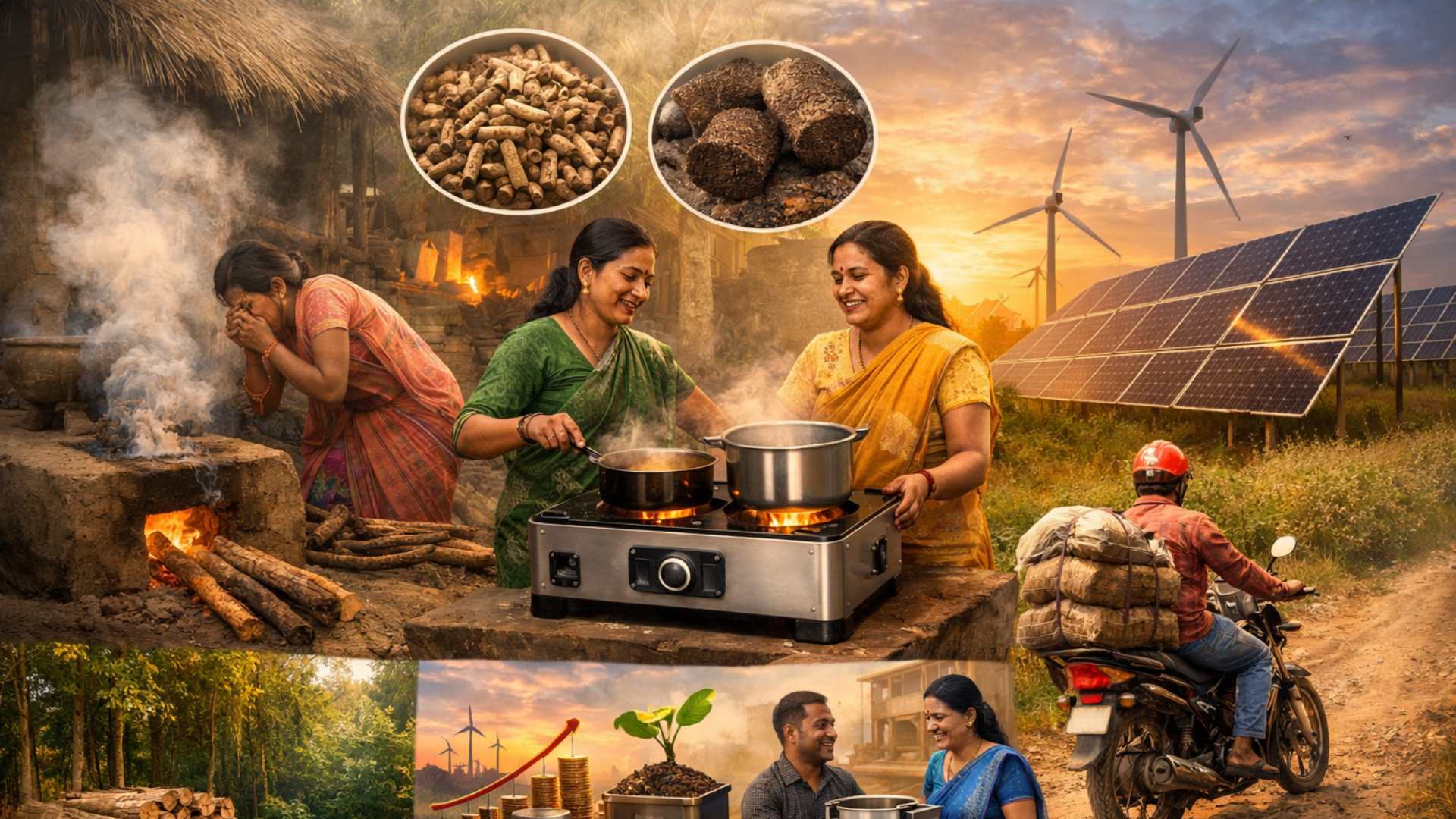
Are Biomass Stoves a Cleaner Alternative to LPG?

Introduction
India's Pradhan Mantri Ujjwala Yojana (PMUY) connected over 10 crore BPL households to LPG since 2016 — yet refill rates remain dismally low (~3–4 cylinders/year vs. the national average of 6+), pushing rural households back to biomass. With commercial LPG exceeding ₹100/kg in major cities amid the ongoing supply crunch, Improved Cookstoves (ICS) — a technology that merges traditional biomass use with modern combustion engineering — are re-emerging as a critical energy bridge. Nearly 660 million Indians still rely on solid biomass for cooking (IEA), making this not merely an energy issue but a public health, gender, and climate crisis simultaneously.
"Household air pollution from solid fuels is responsible for approximately 600,000 premature deaths annually in India." — WHO Global Health Observatory
Traditional vs. Improved Cookstoves: Key Comparison
| Parameter | Traditional Chulha | Improved Cookstove (ICS) |
|---|---|---|
| Thermal efficiency | ~10% | 38%–45% |
| Fuel consumption | High (baseline) | Reduced by 50–66% |
| Smoke/particulate matter | Very high | Significantly reduced |
| CO₂ equivalent emissions | High | Low–moderate |
| Fuel flexibility | Firewood only | Firewood, pellets, briquettes, agri-waste |
| Cost (household) | Near zero (mud stove) | ₹2,000–₹20,000+ |
| Carbon credit eligibility | No | Yes |
Sustainability of Firewood-Based Cooking
Conditions for sustainability:
- Harvest rate must not exceed forest regrowth rate
- Shift from raw firewood → processed biomass (pellets, briquettes from sawdust/agricultural waste)
- ICS reduces wood needed per meal — easing extraction pressure on forests
Alternative biomass fuels widening the base:
| Fuel Type | Source | Advantage |
|---|---|---|
| Wood pellets | Sawdust, wood waste | Uniform combustion, low smoke |
| Briquettes | Agricultural residue | Uses crop waste, reduces stubble burning |
| Dung cakes | Livestock waste | Widely available in rural India |
| Crop residue | Rice husk, sugarcane bagasse | Zero additional cost |
Cost Economics: ICS vs. LPG
| Parameter | LPG (Commercial) | Firewood + ICS |
|---|---|---|
| Fuel cost | ₹100+/kg | ~₹10/kg (purchased) |
| Cooking energy equivalence | 1 kg LPG | ~4 kg firewood (in ICS) |
| Effective cost per unit energy | ₹100 | ~₹40 |
| Potential household savings | Baseline | 60%+ cost reduction |
| Upfront equipment cost | Negligible (stove provided) | ₹2,000–₹20,000 |
| Payback period | — | Short (months, not years) |
Financing pathways for affordability:
- Microfinance institution (MFI) partnerships
- CSR funding from corporates
- Carbon credits — emissions savings converted into tradeable credits, subsidising stove cost for low-income families
Health & Gender Dimensions
Health impact of traditional chulhas:
- Particulate Matter (PM2.5) levels inside traditional kitchens can be 15–20x WHO safe limits
- Linked to chronic obstructive pulmonary disease (COPD), lung cancer, and low birth weight
- Women and children — who spend most time near the cooking fire — bear disproportionate health burden
Gender-drudgery nexus:
- Return to firewood increases women's unpaid labour — collecting wood can take 2–5 hours/day in resource-scarce areas
- ICS's 50%+ fuel efficiency directly reduces collection time
- Reduced smoke → reduced eye and respiratory ailments → improved women's productive capacity
NCERT link: Class 10 Social Science — "Gender, Religion and Caste" — unpaid domestic labour and women's time poverty
Policy & Programme Landscape
| Scheme | Details | Gap |
|---|---|---|
| PMUY (Ujjwala) | 10 crore LPG connections to BPL | Low refill rates — affordability barrier |
| National Biomass Cookstoves Programme (NBCP) | BEE-led ICS promotion | Weak last-mile implementation |
| MNRE Biomass Programme | Briquette/pellet promotion | Limited rural reach |
| Carbon credit frameworks | ICS eligible under Gold Standard/VCS | Underutilised in India |
Supply Chain for Mass Adoption: What Is Actually Needed
What is NOT needed:
- Massive centralised infrastructure investment
- New fuel supply chains (biomass already locally available)
What IS needed:
| Requirement | Action |
|---|---|
| Distribution networks | Strengthen last-mile logistics via SHGs, FPOs |
| Local manufacturing | Promote cottage-level ICS production |
| User awareness | Behaviour change communication — especially for women |
| After-sales support | Repair networks, spare parts availability |
| Quality standards | BEE star-rating system for ICS — enforce compliance |
| Carbon finance | Link ICS distribution to verified carbon credit markets |
Environmental Co-benefits
- Reduced deforestation pressure when ICS + sustainable sourcing combined
- Lower Black Carbon emissions — significant climate co-benefit
- Crop residue use in briquettes reduces stubble burning — addresses North India air quality crisis
- ICS adoption earns carbon credits under international climate frameworks (Gold Standard, Verra VCS)
Way Forward
- Revive and restructure NBCP with mandatory quality certification and last-mile delivery targets
- Integrate ICS with PMUY — offer ICS as a backup/complement, not competitor, to LPG
- Link ICS to carbon markets — create a domestic carbon credit mechanism for rural cookstove programmes
- SHG-led distribution model — leverage women's self-help groups for awareness, sales, and after-sales service
- Standardise biomass briquette supply chains — connect agricultural waste aggregators to ICS manufacturers
- Include ICS in National Clean Air Programme (NCAP) metrics — indoor air quality alongside outdoor
Conclusion
The return to firewood amid India's LPG crisis need not be a regression — it can be a technology-mediated transition if managed correctly. Improved cookstoves sit at the intersection of energy access, climate action, public health, and women's empowerment. They are not a permanent solution to India's clean cooking challenge, but they are a pragmatic, affordable, and immediately deployable bridge. The policy failure so far has not been technological — ICS works — but institutional: weak distribution, absent financing, and poor behaviour change outreach. Fixing these systemic gaps costs far less than the health and gender toll of doing nothing.
Attribution
Original content sources and authors

Syllabus classification
How this article maps to GS papers
Main syllabus
GS3InfrastructureQuick Q&A
What are improved cookstoves (ICS), and how do they differ from traditional biomass-based cooking methods?
In contrast, ICS incorporate technological innovations such as better combustion chambers and secondary aeration, which allow for more complete burning of biomass. This significantly improves thermal efficiency to around 38–45%, reducing fuel consumption by up to two-thirds. Moreover, these stoves are designed to trap soot and harmful gases before they are released into the environment, thereby reducing indoor air pollution.
Key differences include:
- Efficiency: ICS are 3–4 times more efficient than traditional chulhas.
- Emissions: Significant reduction in smoke and particulate matter.
- Fuel use: Lower consumption of firewood or biomass.
Thus, ICS represent a crucial technological intervention in improving rural energy access while addressing environmental and health concerns.
Why has the LPG crisis led to a resurgence of firewood usage, and what are its socio-economic implications?
However, this shift has important socio-economic implications. Women, who are primarily responsible for cooking and fuel collection, face increased drudgery and time burden. Additionally, reliance on traditional firewood use exposes households to indoor air pollution, leading to respiratory illnesses and other health hazards.
Broader implications include:
- Gender inequality: Increased workload for women and girls.
- Health risks: Higher exposure to smoke and toxic emissions.
- Environmental degradation: Unsustainable firewood extraction may lead to deforestation.
Thus, while firewood offers short-term economic relief, it raises long-term developmental and environmental concerns.
How can firewood-based cooking be made sustainable in the context of rural energy needs?
The adoption of Improved Cookstoves (ICS) plays a central role in sustainability. By reducing fuel consumption by over 50%, ICS decrease pressure on forest resources. Additionally, the use of alternative biomass fuels such as pellets, briquettes, and agricultural waste diversifies the energy base and reduces reliance on raw firewood.
Key strategies include:
- Sustainable harvesting: Community-based forest management practices.
- Fuel diversification: Use of crop residues and processed biomass fuels.
- Carbon finance: Leveraging carbon credits to fund adoption of clean technologies.
Countries like India have promoted such approaches through schemes like the National Biomass Cookstoves Initiative. A sustainable model thus requires technological, ecological, and financial integration.
Critically analyze the economic viability of firewood-based cooking compared to LPG in the current context.
However, a deeper analysis reveals several hidden costs and limitations. While firewood may be cheaper monetarily, it often involves unpaid labor, particularly by women, in collecting fuel. Additionally, health costs arising from indoor air pollution and environmental costs due to deforestation are not reflected in direct pricing.
Comparative assessment:
- Short-term affordability: Firewood is cheaper and locally accessible.
- Long-term sustainability: LPG is cleaner and less harmful.
- Externalities: Firewood use leads to health and environmental costs.
Thus, while firewood may serve as a temporary alternative, a balanced approach involving cleaner fuels and efficient technologies is essential for sustainable development.
Provide examples of successful initiatives or models that promote clean and efficient biomass cooking.
Another example comes from Africa, where organizations like Clean Cooking Alliance have promoted ICS adoption through public-private partnerships. These initiatives combine technology deployment with financing mechanisms such as microcredit and carbon credits, making stoves affordable for low-income households.
Key features of successful models include:
- Subsidies and financing: Reducing upfront costs through microfinance and CSR programs.
- Awareness campaigns: Educating users about health and efficiency benefits.
- After-sales support: Ensuring long-term usability and maintenance.
These examples highlight that technological solutions must be supported by institutional and financial frameworks to achieve large-scale adoption.
Examine the LPG crisis and shift to biomass as a case study to understand energy transition challenges in developing countries.
This case highlights the gap between access and adoption. Even when households have LPG connections, high refill costs and supply disruptions push them back to traditional fuels. This phenomenon, known as "fuel stacking," reflects the economic realities faced by low-income households.
Key lessons from this case include:
- Affordability is crucial: Subsidies and price stability are needed for sustained adoption.
- Infrastructure gaps: Reliable supply chains are essential.
- Behavioral factors: Cultural preferences and habits influence fuel choices.
The case underscores that energy transition is not just a technological issue but also a socio-economic challenge. A hybrid approach combining LPG, improved biomass technologies, and renewable energy solutions is necessary for inclusive and sustainable energy access.
Practice questions
1 question for mains preparation