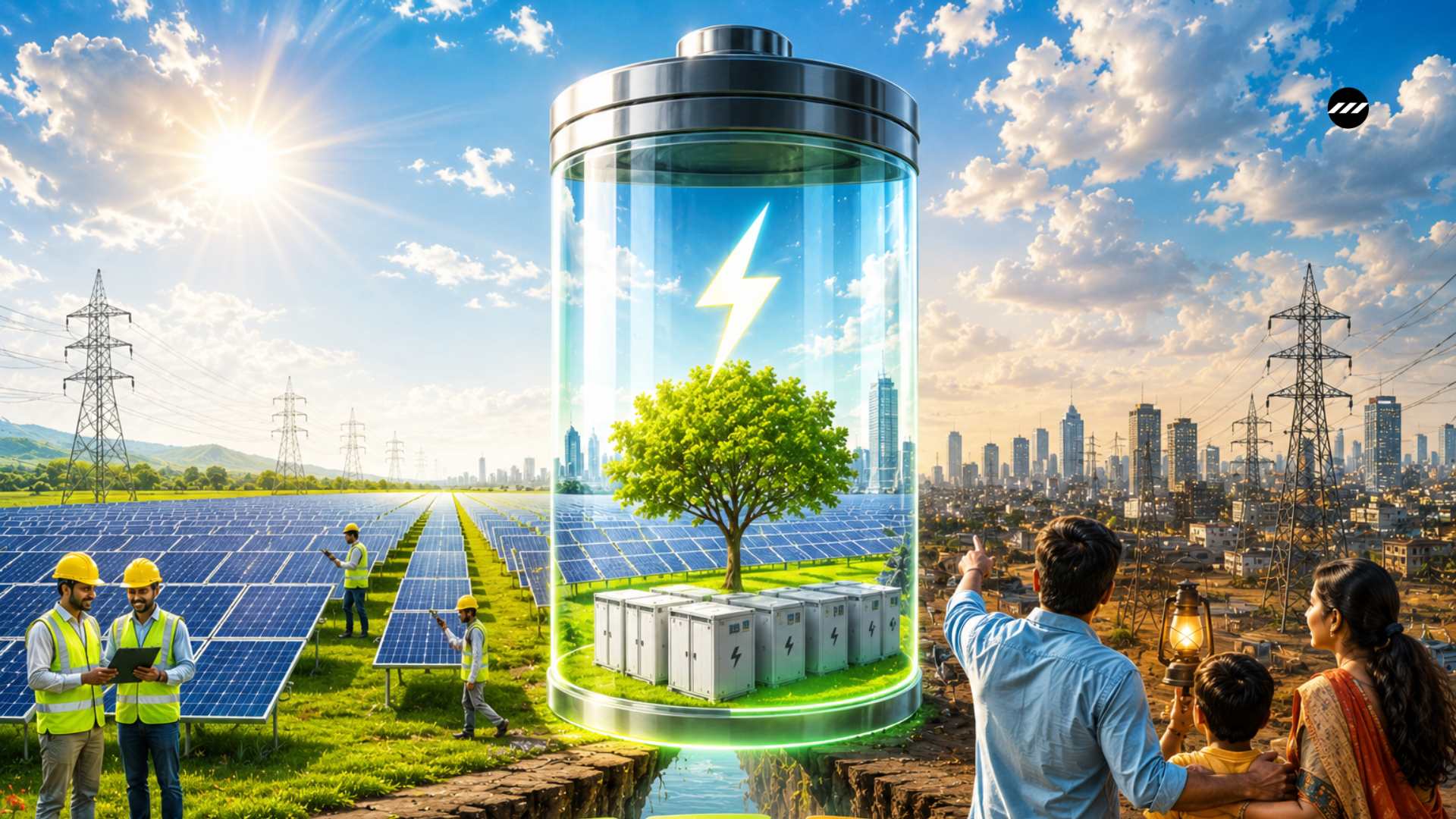
Building Bridges in Solar Energy: The Need for Battery Storage

Introduction
"Solar capacity without storage is a half-built bridge — generating power the grid cannot hold, and delivering nothing when the nation needs it most."
On April 25, 2026, India scaled a record peak demand of 256.1 GW, with solar meeting 21.5% of afternoon load — an all-time high. Yet by evening, solar's contribution collapsed to 0.1%. India's solar installed capacity share has nearly doubled from 15% (2022) to 28% (2026), but generation share on peak-demand days moved only from 5.6% to 10.8% — exposing the central paradox: panels are not the problem; storage is.
| Metric | Value |
|---|---|
| Peak demand (April 25, 2026) | 256.1 GW |
| Solar share — afternoon peak | 21.5% |
| Solar share — evening demand | 0.1% |
| Solar share — full day generation | 10.8% |
| Solar installed capacity share (2026) | ~28% |
| Solar curtailed in 2025 | 2.3 TWh (18% of avg monthly output) |
| Battery storage operational (end-2025) | 0.7 GWh |
Background & Context
India's Solar Trajectory
India's solar expansion has been among the fastest in the world — driven by falling panel costs, ambitious capacity targets (500 GW renewable by 2030), and state-level procurement. Solar's installed capacity share nearly doubled in four years.
Yet the generation-capacity gap persists: more panels installed does not mean proportionally more electricity delivered. Solar generation is hostage to daylight hours, and India's demand peaks sharply in the evening — precisely when solar output is zero.
The Monsoon Dimension
IMD has forecast a below-normal monsoon at 92% of Long Period Average (LPA) — the first such warning in 11 years. A hotter, drier summer means:
→ Greater daytime cooling demand — solar's peak supply window
→ Reduced hydropower availability — increasing grid dependence on thermal and solar
→ Heightened risk of evening demand spikes with no solar buffer
This makes battery storage not a future requirement but an immediate grid necessity.
Key Concepts
1. The Capacity-Generation Gap
| Year | Solar Installed Capacity Share | Solar Generation Share (Peak Day) |
|---|---|---|
| 2022 | ~15% | ~5.6% |
| 2026 | ~28% | ~10.8% |
Capacity doubled; generation share barely doubled on peak days — and collapsed to near-zero by evening. This is the fundamental inefficiency of solar without storage.
2. Solar Curtailment — A Public Exchequer Cost
When solar generation exceeds grid absorption capacity, grid operators instruct producers to halt supply (curtailment) to prevent frequency instability.
→ India curtailed 2.3 TWh of solar in 2025 (May–December)
→ 0.9 TWh wasted in October alone
→ Curtailed producers must still be compensated — power paid for but never delivered
→ Cost falls on the public exchequer — a fiscal inefficiency created by infrastructure lag
3. Battery Storage Economics
| Parameter | Early 2025 | End 2025 |
|---|---|---|
| Standalone 2-hr BESS tariff | ₹2.21 lakh/MW/month | ₹1.48 lakh/MW/month |
| Operational storage capacity | — | 0.7 GWh |
| Expected capacity (Dec 2026) | — | 2.7 GWh (0.7 + 2 GWh pipeline) |
Battery economics are moving in the right direction. The bottleneck has shifted from cost to execution — tendering without commissioning, and auctioning without co-located storage mandates.
Implications & Challenges
1. Grid Stability Risk
Solar's intermittency — full output at noon, zero at 6 PM — creates ramp rate challenges for grid operators. Without storage to absorb midday surplus and release it in the evening, the grid must rely on thermal plants for evening demand, undermining the renewable transition's core logic.
2. Fiscal Waste from Curtailment
Curtailment is not merely a technical inefficiency — it is a governance failure. Tendering solar capacity without simultaneously building storage or grid evacuation infrastructure creates a system that generates costs without benefits. The 2.3 TWh curtailed in 2025 represents public money spent on electricity that was never consumed.
3. The Financing Wall
Aggressively bid low-tariff solar projects — won on thin margins — face a financing wall when asked to add co-located storage. Developers who bid L1 (lowest tariff) cannot absorb the additional capital cost of Battery Energy Storage Systems (BESS). This creates a structural tension between competitive procurement and system-level adequacy.
4. Demand-Supply Mismatch by Design
India's electricity demand curve peaks in the evening. Solar's generation curve peaks at noon. Without storage, these two curves never meet — making solar structurally incapable of serving peak demand regardless of installed capacity.
Way Forward
→ Mandatory co-located storage — pair every fresh solar auction with BESS requirement; no standalone solar tendering without storage annexure
→ Commissioning over tendering — shift policy focus from MW awarded to MW operational with storage; create commissioning-linked incentives
→ Resolve financing wall — viability gap funding (VGF) or government-backed concessional finance for BESS addition to already-bid low-tariff projects
→ Pumped hydro as large-scale storage — accelerate pumped storage projects for multi-hour and seasonal buffering, complementing lithium-ion BESS
→ Time-of-Day (ToD) tariff universalisation — price electricity higher in the evening to incentivise private storage investment and demand-side shifting
→ Grid evacuation infrastructure — expand interstate transmission capacity in high-solar states (Rajasthan, Gujarat) to reduce curtailment from localised congestion
Conclusion
-
India's solar story is one of remarkable installation ambition colliding with inadequate systems thinking. The panels are there; the sunlight is there; the demand is there — but the infrastructure to connect midday generation with evening consumption remains critically underdeveloped.
-
The 0.7 GWh of operational storage against a grid that touched 256 GW of peak demand illustrates the scale of the gap. The policy imperative is unambiguous: stop measuring success in gigawatts installed and start measuring it in gigawatt-hours reliably delivered. A half-built bridge, however impressive its pylons, does not carry traffic.
Attribution
Original content sources and authors

Syllabus classification
How this article maps to GS papers
Main syllabus
GS3InfrastructureQuick Q&A
What explains the gap between installed solar capacity and its actual contribution to electricity generation in India?
The key issue is that solar power is available only during daylight hours, with negligible contribution during evening peaks (as low as 0.1%). Without storage systems such as batteries, excess daytime generation cannot be saved for later use. This leads to inefficiencies where solar power is either underutilized or wasted, despite high installed capacity.
Additionally, grid management challenges exacerbate the issue. States with surplus solar generation are often forced to curtail production to maintain grid stability. This indicates that India’s renewable transition is not just about adding capacity but about building a flexible and responsive energy system that can store and distribute power efficiently.
Why is battery storage considered critical for the success of India’s solar energy transition?
The absence of sufficient storage capacity has already led to significant curtailment. In 2025 alone, India curtailed around 2.3 terawatt-hours (TWh) of solar power, equivalent to 18% of average monthly output. This not only represents a loss of clean energy but also imposes a financial burden on the government, which compensates producers for unused electricity.
Encouragingly, battery costs are declining, making storage more economically viable. However, deployment remains limited, with only 0.7 GWh operational by the end of 2025. Thus, battery storage is not just a technological add-on but a foundational requirement for ensuring that solar energy can reliably meet India’s growing electricity needs.
How does the lack of storage infrastructure impact grid stability and economic efficiency in India’s power sector?
Economically, this leads to inefficiencies and financial losses. For example, curtailed solar power still needs to be compensated under power purchase agreements, meaning the government pays for electricity that is never consumed. This creates a burden on the public exchequer and undermines the cost-effectiveness of renewable energy investments.
Furthermore, the absence of storage necessitates continued reliance on fossil fuel-based power plants to meet evening demand. This not only increases carbon emissions but also reduces the overall efficiency of the energy system. Therefore, integrating storage solutions is essential for creating a resilient, cost-effective, and sustainable power grid.
Critically analyse the statement: “Solar capacity without storage is a half-built bridge.”
From a critical perspective, this creates both technical and economic inefficiencies. On one hand, valuable renewable energy is wasted due to curtailment; on the other, the grid continues to depend on fossil fuels for reliability. This undermines the environmental and economic benefits of solar investments. The analogy of a “half-built bridge” highlights that without storage, the transition to renewable energy remains incomplete and fragmented.
However, it is also important to recognize the progress being made. Falling battery costs and policy initiatives indicate that India is moving in the right direction. The challenge lies in accelerating execution and ensuring that storage deployment keeps pace with capacity addition. Thus, while the statement is largely valid, it also underscores the need for a holistic approach to energy planning.
Provide examples to illustrate the consequences of solar power curtailment in India.
The consequences of such curtailment are multifaceted. First, it leads to a direct loss of clean energy that could have reduced dependence on fossil fuels. Second, it imposes financial costs, as power producers are compensated for the curtailed electricity under contractual agreements. This effectively means that public funds are used to pay for energy that was never delivered.
Another example is the situation in solar-rich states, where producers are asked to halt supply to maintain grid stability. This not only discourages investment in renewable energy but also highlights the limitations of current infrastructure. These examples underscore the urgent need for storage solutions and grid modernization to fully harness India’s solar potential.
Analyse the April 25 peak demand event as a case study of India’s solar energy performance.
However, the full-day analysis reveals significant limitations. Over the entire 24-hour period, solar contributed only about 10.8% of total generation, and its share dropped to a negligible 0.1% during evening hours. This stark contrast underscores the challenge of intermittency and the lack of storage infrastructure to bridge the gap between supply and demand.
The case study also gains importance in the context of climate variability. With forecasts of a below-normal monsoon and rising temperatures, daytime electricity demand is expected to increase further. While solar is well-suited to meet this demand, its effectiveness will depend on the availability of storage systems. Thus, the April 25 event illustrates both the promise and limitations of India’s solar transition.
How can policy interventions accelerate the integration of solar energy with storage solutions in India?
Another important intervention is improving the financial viability of storage projects. While battery costs are declining, financing remains a challenge due to high upfront costs and uncertain revenue models. सरकार (government) can address this through viability gap funding, long-term contracts, and incentives for private investment.
Additionally, regulatory reforms are needed to modernize grid operations and enable better integration of renewable energy. This includes investments in smart grids, real-time data systems, and flexible dispatch mechanisms. By aligning policy, technology, and finance, India can transition from a capacity-driven approach to a system efficiency-driven model, ensuring that solar energy contributes meaningfully to its energy security and sustainability goals.
Practice questions
1 question for mains preparation