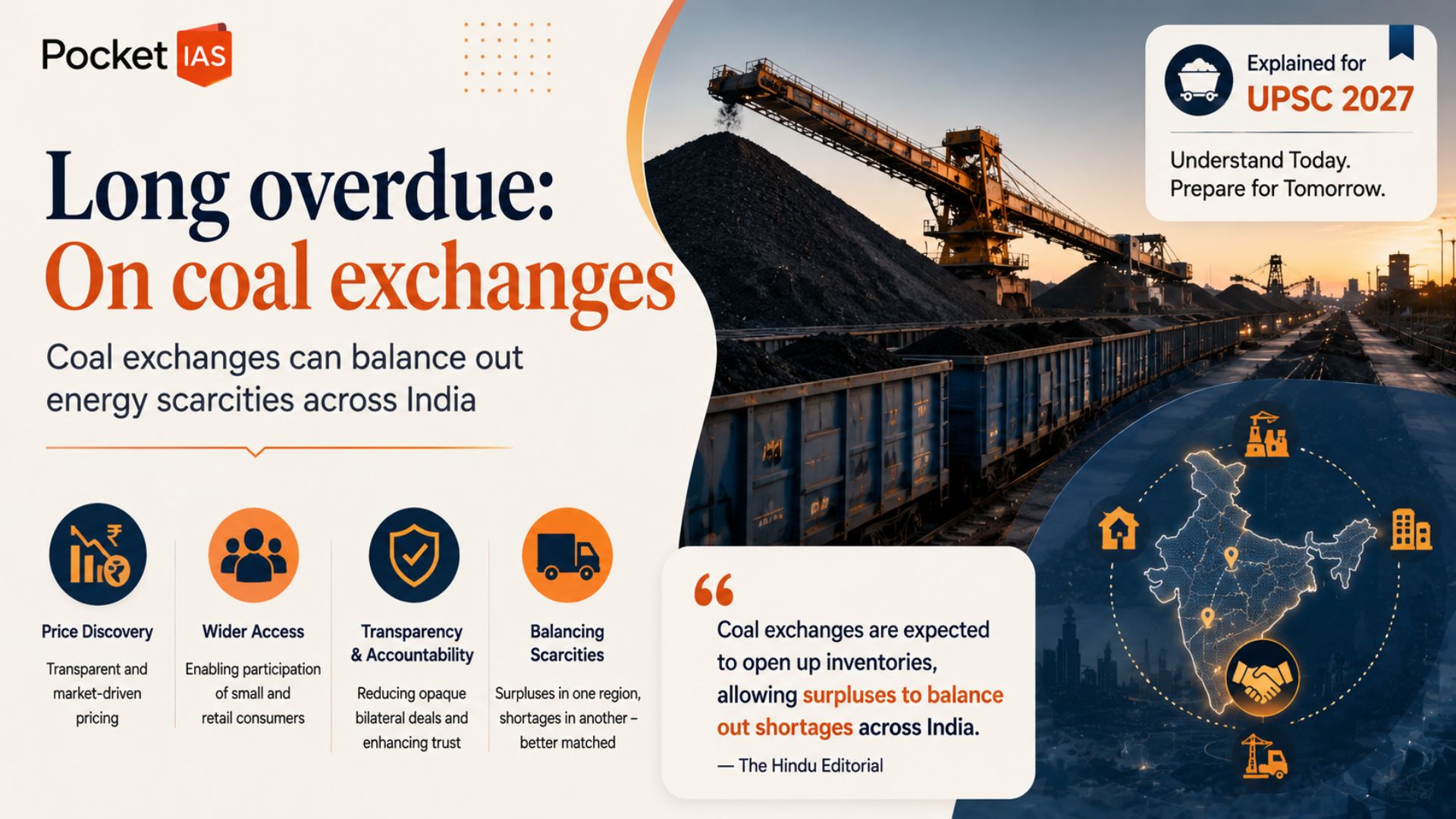
Coal Exchange Rules, 2026: Towards a Market-Based Coal Economy

India has introduced the Coal Exchange Rules, 2026 at a time of record domestic coal production. The reforms seek to establish regulated trading platforms for coal, bringing greater transparency, price discovery and market efficiency to a sector that remains central to India's energy security.
"Coal exchanges could do for coal what power exchanges did for electricity — improve transparency, market signalling and resource allocation."
Why Are Coal Exchanges Needed?
Currently, coal transactions occur through multiple channels.
| Existing Mechanism | Key Users |
|---|---|
| Long-term contracts | Power sector |
| Coal India auctions | Non-regulated sector |
| Imports | Industries requiring specific grades |
| Captive mining | Large industrial users |
Existing Challenges
- Limited price transparency
- Dependence on bilateral agreements
- Possibility of opaque transactions
- Restricted access for smaller consumers
- Coal often sold at high premiums in auctions
The new framework aims to create a competitive marketplace where prices are determined through market forces.
Learning from Power Exchanges
Coal exchanges resemble India's power exchanges more than conventional commodity exchanges.
Commodity vs Power vs Coal Exchanges
| Feature | Commodity Exchanges | Power Exchanges | Coal Exchanges |
|---|---|---|---|
| Nature | Mainly financial trading | Physical electricity market | Physical coal delivery |
| Role | Hedging and price discovery | Market balancing and price signals | Trading and allocation of coal |
| Delivery | Limited physical delivery | Real-time settlement | Physical delivery required |
Lessons from Power Exchanges
Initially, power exchanges helped manage electricity shortages.
Over time, they became:
- Indicators of scarcity and surplus
- Reference points for market pricing
- Platforms for balancing demand and supply
- Drivers of secondary market development
Power Exchanges
      ↓
Price Discovery
      ↓
Market Signals
      ↓
Efficient Resource Allocation

Coal Exchanges aim to replicate this process.
Potential Benefits of Coal Exchanges
One of the most important functions could be inventory balancing.
Expected Outcomes
- Transfer surplus coal to deficit regions
- Improve market efficiency
- Enhance competition
- Reduce information asymmetry
- Enable participation of smaller buyers
"The first role of coal exchanges could be to open up inventories, allowing surpluses to balance shortages across India."
Unique Challenges in Coal Trading
Unlike electricity, coal is not a uniform commodity.
Why Coal Is Different
| Electricity | Coal |
|---|---|
| Standardized product | Quality varies widely |
| Instantly transmitted | Requires transportation |
| Uniform characteristics | Different grades and calorific values |
| No storage issues | Storage and logistics matter |
This makes quality assurance critical.
Key Requirements
- Standardized grading mechanisms
- Quality certification systems
- Transparent contract specifications
- Reliable delivery mechanisms
Coal Quality Variation
      ↓
Need for Standards
      ↓
Buyer Confidence
      ↓
Market Liquidity
Factors Determining Success
The success of coal exchanges will depend on operational design rather than merely the existence of the platform.
Critical Enablers
1. Robust Quality Standards
- Uniform grading norms
- Independent verification
- Reduced disputes
2. Liquidity Creation
- Participation by major producers
- Active buyer involvement
- Sufficient trading volumes
3. Coal India's Role
Coal India remains the dominant producer.
Its willingness to participate and offer meaningful volumes will largely determine market depth.
4. Retail Participation
Unlike power exchanges, which are largely dominated by DISCOMs, coal exchanges should encourage:
- Small industries
- MSMEs
- Independent consumers
5. Logistics and Transportation
Because coal exchanges involve physical delivery:
- Railway connectivity
- Freight availability
- Supply-chain efficiency
become essential.
Risks and Concerns
Several safeguards must accompany market liberalization.
Potential Issues
- Excessive price volatility
- Market manipulation
- Quality disputes
- Delivery failures
- Regional supply imbalances
Required Safeguards
- Dispute resolution mechanisms
- Regulatory oversight
- Transparent trading rules
- Risk management systems
Way Forward
- Establish robust coal quality standards.
- Create independent certification and audit mechanisms.
- Ensure adequate participation from Coal India and major consumers.
- Improve rail and logistics infrastructure.
- Encourage MSME and retail consumer participation.
- Develop efficient dispute resolution systems.
- Introduce safeguards against excessive price volatility.
- Build transparent and liquid secondary coal markets.
Conclusion
The Coal Exchange Rules, 2026 mark a significant step towards modernising India's coal market. By improving transparency, price discovery and market access, coal exchanges can make coal allocation more efficient. However, their success will depend on quality assurance, market liquidity, logistics support and effective regulation. If implemented well, they can become an important pillar of India's evolving energy market architecture.
Attribution
Original content sources and authors


Syllabus classification
How this article maps to GS papers
Main syllabus
GS3InfrastructureQuick Q&A
What are the Coal Exchange Rules, 2026, and how can they transform coal trading and energy governance in India?
Why are coal exchanges considered important for improving price discovery, transparency and efficiency in India’s energy sector?
How do coal exchanges differ from power exchanges, and what operational challenges are unique to coal markets?
What are the major reasons behind India’s shift toward market-based coal trading mechanisms despite record domestic coal production?
Critically analyse the opportunities and challenges associated with implementing coal exchanges in India’s energy ecosystem.
How can the development of India’s power exchanges serve as a case study for understanding the future trajectory of coal exchanges?
Practice questions
2 questions for mains preparation