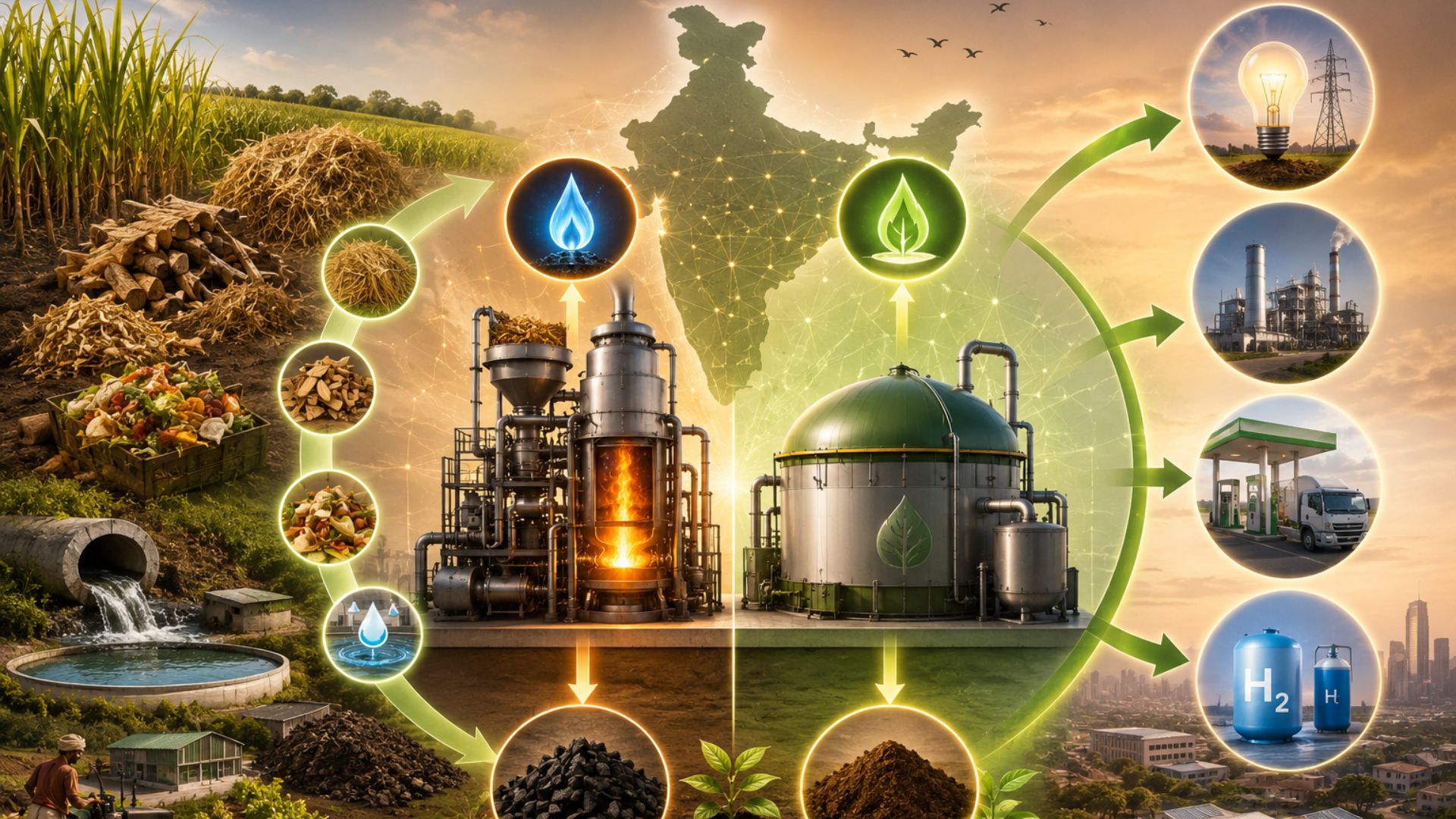
From Waste to Watts: India's Bioenergy Opportunity

"What is often treated purely as a disposal problem can also become a valuable energy resource — when supported by the right technology and infrastructure ecosystem."
Global energy supply chains remain volatile. Fuel prices continue to swing with geopolitical disruptions. For a country like India — heavily dependent on fossil fuel imports — the urgency of domestic energy security has never been greater. The answer, surprisingly, may already exist within India's own waste streams.
The Resource Hidden in Plain Sight
India generates enormous volumes of agricultural residue, food waste, sewage sludge, and organic municipal waste every year — most of it underutilised or poorly managed. This creates a powerful intersection between two national challenges: energy security and waste management.
India's Biomass Potential:
- Agricultural biomass generated annually: ~750 million tonnes
- Estimated surplus biomass: ~230 million metric tonnes
- Potential: Could replace nearly one-third of India's fuel imports
  if collected and processed efficiently
The real question is not whether India has the resource base. It does. The question is whether India can build efficient systems to convert this waste into reliable, commercially viable energy at scale.
Why Raw Biomass Isn't Enough
Converting biomass directly into energy is not straightforward. Unlike conventional fuels, biomass is inherently inconsistent:
- Moisture levels vary across feedstocks
- Density and ash content fluctuate significantly
- This affects combustion efficiency, transport economics, and industrial reliability
Most energy systems demand stable, predictable fuel inputs — something raw biomass cannot provide on its own. This is where conversion technologies become the critical bridge.
Technology 1: Gasification — For Dry Waste
Gasification is suited for dry biomass — crop residue, rice husk, woody waste, and other solid organic materials.
Inside a gasifier, feedstock undergoes four sequential stages — drying, pyrolysis, partial oxidation, and reduction — at temperatures of 800–1,000°C. The output is syngas: a mixture of carbon monoxide, hydrogen, carbon dioxide, and methane.
Syngas is valuable because it is versatile:
- Direct use for heat and power generation
- Upgradeable into renewable methane, methanol, ethanol, or hydrogen
- Process also yields biochar — a carbon-rich material that improves soil quality and creates carbon credit opportunities
This dual value — energy and environmental benefit — makes gasification one of the most promising pathways in advanced bioenergy systems.
Technology 2: Anaerobic Digestion — For Wet Waste
Wet organic waste requires a different approach. Anaerobic digestion uses microorganisms to break down waste in the absence of oxygen, producing:
- Biogas — primarily methane and carbon dioxide
- Digestate — nutrient-rich residue usable as soil amendment
Where anaerobic digestion fits:
- Urban sewage networks
- Dairy and livestock clusters
- Food processing units
- Industrial campuses and large canteens
- Rural and semi-urban communities
Unlike thermal systems, anaerobic digestion depends on a continuous biological process — meaning consistent feedstock supply is essential for round-the-clock operational efficiency.
The Integrated Opportunity: Decentralised Energy
India's real opportunity lies not in choosing one technology over the other — but in intelligently integrating both. Gasifiers handle dry waste; digesters handle wet waste. Together, they cover the full diversity of India's waste landscape.
This integration also strengthens the case for decentralised energy systems:
- Rural industries, agro-processing clusters, and MSMEs can convert local waste into local energy
- Reduces biomass transport costs over long distances
- Improves both energy access and waste management outcomes simultaneously
The government's SATAT scheme (Sustainable Alternative Towards Affordable Transportation) has already demonstrated this potential — converting biomass into compressed biogas as a renewable alternative to natural gas.
Way Forward
For this ecosystem to scale, several enabling conditions must be addressed:
- Waste segregation at source — Neither gasification nor anaerobic digestion achieves full potential without clean, separated feedstock
- Decentralised infrastructure investment — Policy must incentivise smaller distributed plants, not just large centralised facilities
- Carbon market development — Biochar and emissions offsets can generate additional revenue streams that improve project viability
- Regulatory clarity — Long-term policy certainty is essential for private capital to commit at scale
- Feedstock-technology matching — Forcing wet waste into gasifiers or dry biomass into digesters reduces efficiency; policy design must respect this distinction
Conclusion
India's energy future cannot rest on imported fuels and conventional systems alone. The country already possesses an enormous, underutilised resource base in its waste streams. Bioenergy is not a single silver-bullet technology — it is a family of solutions, each suited to specific feedstocks and end uses. Building the right technologies, infrastructure, and policy ecosystems around this resource is not just an energy opportunity. It is a waste management solution, an agricultural input, and a climate strategy — all at once.
Attribution
Original content sources and authors


Syllabus classification
How this article maps to GS papers
Main syllabus
GS3InfrastructureQuick Q&A
What is the significance of waste-to-energy in India’s energy security strategy?
India produces nearly 750 million tonnes of agricultural biomass annually, of which about 230 million tonnes is surplus. If scientifically utilised, this biomass could replace a meaningful portion of fuel imports. This is especially relevant in the context of climate commitments and rural development. Decentralised waste-to-energy systems can support local industries, MSMEs, and agro-processing units while reducing transportation costs and environmental degradation caused by stubble burning.
Examples:
- Punjab and Haryana can convert crop residue into energy instead of open-field burning.
- Urban sewage treatment plants can generate biogas for local electricity.
- The SATAT scheme demonstrates scalable compressed biogas production from organic waste.
Why is feedstock suitability crucial in determining the success of bioenergy technologies in India?
For example, dry biomass such as crop residue, husk, and woody waste is best suited for gasification because it can undergo thermal conversion efficiently. In contrast, wet waste like food waste, sewage sludge, and manure is better suited for anaerobic digestion because microorganisms can decompose it under oxygen-free conditions. Using wet waste in gasifiers increases drying costs, while using dry residue in digesters lowers microbial efficiency.
Implications:
- Technology selection must align with local waste composition.
- Collection and segregation systems become essential.
- Region-specific energy planning improves viability.
How does gasification convert agricultural waste into versatile energy carriers?
The importance of syngas lies in its versatility. It can be used directly for heat and power generation or converted into advanced fuels such as methanol, ethanol, renewable methane, and hydrogen. This makes gasification relevant not only for electricity but also for industrial decarbonisation and clean transport.
Additional benefits:
- Production of biochar improves soil fertility.
- Carbon sequestration supports carbon credit markets.
- Reduces crop burning and air pollution.
Critically analyse the role of decentralised waste-to-energy systems in India’s rural and urban development.
Advantages include:
- Lower transportation costs for biomass.
- Improved rural energy access.
- Support for MSMEs and agro-processing clusters.
- Better local waste management.
Challenges remain:
- High upfront capital investment.
- Lack of technical expertise at local levels.
- Poor waste segregation practices.
- Regulatory uncertainty and financing gaps.
How does the SATAT scheme illustrate the potential of bioenergy in India’s clean fuel transition?
The scheme encourages entrepreneurs to establish biogas plants using feedstocks such as cattle dung, food waste, sewage, and agricultural residue. The biogas is purified and compressed to produce CBG, which can be supplied through existing fuel infrastructure. This integrates waste management with clean transport objectives.
Broader significance:
- Supports farmers by monetising crop residue.
- Reduces methane emissions from unmanaged waste.
- Enhances rural employment.
- Promotes circular economy principles.
What are the major policy and institutional barriers to scaling waste-to-energy in India?
Another barrier is regulatory uncertainty. Investors need stable policies on pricing, subsidies, carbon credits, and long-term procurement contracts. Inconsistent state-level regulations discourage private participation. Additionally, weak infrastructure for waste collection, storage, and transportation affects plant viability.
Key barriers:
- Lack of scientific waste segregation.
- Insufficient carbon market incentives.
- Fragmented governance between urban and rural authorities.
- Limited financing and risk-sharing mechanisms.
Practice questions
1 question for mains preparation