Global Energy Transition 2025: The Inflection Point and India's Dual Reality

Global Energy Transition 2025: The Inflection Point and India's Dual Reality
Introduction
"For the first time in history, expanded global electricity demand was met entirely by renewable energy — not a single additional unit of fossil fuel was needed." — Ember Energy Institute, 2025
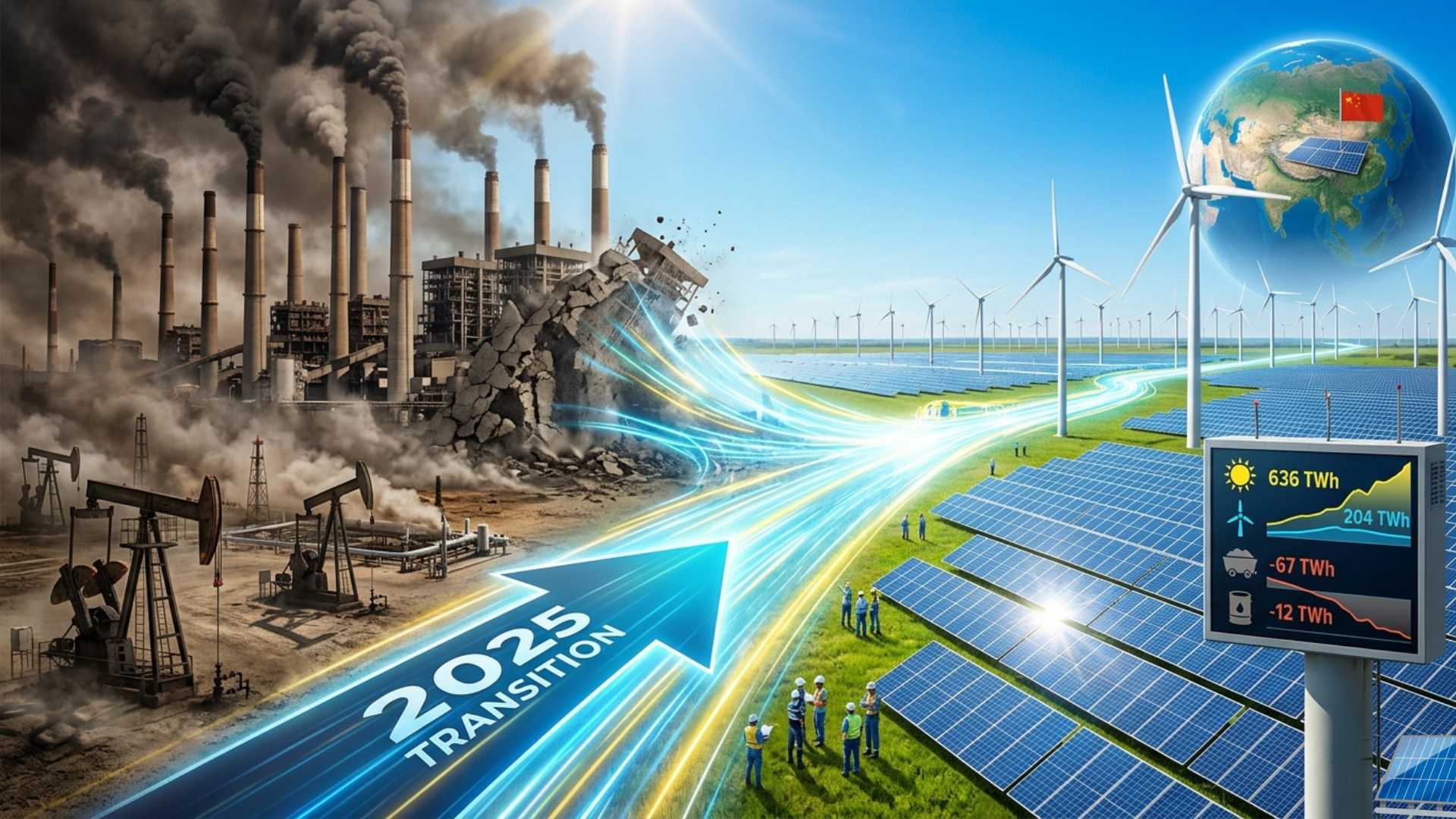
2025 marks a historic inflection point in the global energy transition: of the 850 TWh increase in global electricity generation, solar contributed 636 TWh and wind 204 TWh — together covering 100% of new demand growth. Simultaneously, India's crude oil imports fell 17% YoY in March 2026 as the Strait of Hormuz closure pushed Indian basket crude to dollar 113.49/barrel — a 56% spike from $72.47 in March 2025. India stands at the intersection of the world's fastest renewable buildout and its deepest fossil fuel import vulnerability.
| Global Metric | 2025 Data |
|---|---|
| Total electricity demand increase | ~850 TWh |
| Solar contribution to new demand | 636 TWh |
| Wind contribution to new demand | 204 TWh |
| Coal generation change | −67 TWh (first absolute fall) |
| Coal share in global electricity | 33% (down from 36% in 2015) |
| China solar growth (YoY) | +40% |
Background & Context
Two Decades of the Renewable Paradox
For twenty years, renewable capacity grew at double-digit rates — yet fossil fuel generation kept rising in absolute terms because electricity demand grew faster than renewables could cover. Renewables gained market share but could not displace fossil fuels volumetrically.
2025 broke this pattern for the first time: renewables not only gained share — they absorbed all incremental demand, pushing fossil fuel generation into absolute decline.
Why 2025 Was Different
→ Steep cost declines in solar and wind over the past decade
→ Improved battery storage and grid integration capacity
→ Simultaneous demand slowdown in coal-heavy economies (China, India)
→ Renewable capacity scaling fast enough to outpace demand growth globally
Key Concepts
1. The Global Shift — By Numbers
| Energy Source | Change in 2025 |
|---|---|
| Solar | +636 TWh |
| Wind | +204 TWh |
| Other Renewables | +23 TWh |
| Natural Gas | +45 TWh (offset by renewables) |
| Coal | −67 TWh |
| Oil | −12 TWh |
2. China's Pivot — A Structural Signal
China's fossil fuel generation fell for the first time since 2015 — a landmark in the world's largest energy market:
→ Electricity demand grew 5%; clean energy grew 15%
→ Solar alone grew 40% YoY, meeting two-thirds of China's incremental demand
→ Wind grew 14%
China and India together drove global fossil fuel generation to stagnation — their combined clean energy absorption removed the demand signal that previously justified new fossil fuel capacity globally.
3. India's Renewable Buildout
→ Renewable capacity grew over 210% in the past decade
→ In FY2024-25, renewables accounted for 89% of new capacity additions
→ India is adding renewable capacity at the fastest rate globally
Yet this buildout has not yet reduced fossil fuel import dependence — a structural lag between capacity installation and reliable energy delivery.
India's Dual Reality: Clean Growth + Import Vulnerability
Import Dependence — The Structural Exposure
| Fuel | Import Dependence | Key Suppliers |
|---|---|---|
| Crude Oil | 89% | Qatar, UAE, Saudi Arabia |
| Natural Gas | 47% | West Asia (LNG) |
| Coal | 26% | Despite being world's 3rd largest producer |
The Strait of Hormuz Shock (March 2026)
The closure of the Strait of Hormuz from March 1, 2026 — handling a significant share of global oil and gas shipments — simultaneously disrupted India's crude oil, LNG, and LPG imports:
→ Crude imports fell 17% YoY (18.9 MMT vs. 22.8 MMT in March 2025)
→ Indian basket crude averaged **72.47 — a 56% spike
→ LPG prices rose ₹60/cylinder; government paid ₹30,000 crore to oil marketing companies as subsidy cushion
→ LNG imports surged 20.5% to compensate — India's LNG imports hit a record 27 MMT in FY2024-25
The LPG-Welfare Linkage
The Pradhan Mantri Ujjwala Yojana expanded LPG connections from 62% of households (2016) to ~100% (2025) — a landmark welfare achievement. But it also deepened import exposure: LPG imports rose from 16.48 MMT (2020-21) to 18 MMT (2025-26). A geopolitical shock in West Asia now transmits directly to India's kitchen fuel supply.
Implications & Challenges
1. The Transition Lag Problem
Renewable capacity takes years to translate into reliable, usable power. Geopolitical shocks operate in real time. When the Strait closed, India could not redirect wind farm output — it maximised coal and gas infrastructure, prioritised domestic supply, and accelerated alternative LNG sourcing. The transition is real but not yet shock-proof.
2. The Coal Paradox
India imports 26% of its coal despite being the world's third-largest coal producer — reflecting a mismatch between domestic coal quality (high ash content) and industrial requirements. Even as renewables grow, coal remains India's primary energy source, and import dependence persists across all three fossil fuels simultaneously.
3. Fiscal Cost of Import Dependence
₹30,000 crore in oil marketing company subsidies in a single fiscal year illustrates the direct fiscal drain of fossil fuel import vulnerability. Every crude price spike transfers wealth from India's exchequer to foreign producers — a structural drag on public finance that renewable self-sufficiency would progressively eliminate.
4. Natural Gas — The Bridge Fuel Dilemma
Natural gas consumption rose 7% in March 2026 despite supply disruptions — filled by 20.5% surge in LNG imports. Gas is positioned as a transition fuel (cleaner than coal, more flexible than renewables alone), but it deepens West Asia dependence in the short term even as it supports decarbonisation in the medium term.
Way Forward
→ Accelerate storage deployment — solar and wind capacity without storage cannot substitute for dispatchable fossil fuel power during demand peaks or supply shocks
→ Diversify fossil fuel import sources — reduce West Asia concentration; deepen energy ties with the US, Russia, Africa, and Central Asia
→ Expand Strategic Petroleum and LNG reserves — current buffers are inadequate relative to the scale of Hormuz exposure
→ Domestic coal quality upgrade — invest in coal beneficiation (washing) to reduce dependence on imported high-grade coal
→ Green hydrogen as long-term hedge — position India as both a producer and consumer of green hydrogen to replace gas imports structurally
→ Welfare-to-clean-cooking transition — gradually migrate Ujjwala beneficiaries from LPG to electric induction cooking as renewable electricity becomes cheaper and more reliable
Conclusion
"The global energy story of 2025 is unambiguously historic: for the first time, human civilisation added electricity demand without adding fossil fuel generation."
-
India is a protagonist in this story — the world's fastest-growing renewable market. But India is simultaneously a cautionary tale: renewable capacity at the frontier and import vulnerability at the base.
-
The Strait of Hormuz closure did not pause India's solar auctions, but it did raise the price of every cylinder of LPG in every Indian kitchen.
-
The energy transition is real — but it is not yet complete, not yet storage-backed, and not yet sufficient to insulate India from the geopolitical physics of a West Asia-dependent fossil fuel supply chain.
-
Building that insulation — through storage, diversification, and reserves — is the defining energy governance challenge of the next decade.
Attribution
Original content sources and authors
.jpeg)

Syllabus classification
How this article maps to GS papers
Main syllabus
GS3InfrastructureQuick Q&A
What is the significance of 2025 being the first year when rising global electricity demand was met without increasing fossil fuel generation?
Why this matters:
- It demonstrates the maturity and scalability of renewable technologies.
- It signals that clean energy can now outpace demand growth, reversing historical trends.
- It reduces global carbon emissions trajectory, aligning with Paris Agreement goals.
Broader Implications: This shift also reflects advancements in battery storage, grid integration, and cost reduction of renewables. However, it does not imply complete displacement of fossil fuels yet, as they still form a significant share of the energy mix. The challenge ahead lies in sustaining this momentum while ensuring grid stability and equitable energy access across developing economies.
Why has the renewable energy transition not yet reduced India's dependence on imported fossil fuels?
Structural Constraints:
- Intermittency of renewables: Solar and wind are not always available, requiring backup from fossil fuels.
- Infrastructure lag: Grid integration, storage capacity, and transmission networks are still evolving.
- Sectoral dependence: Transport and industry continue to rely heavily on imported crude oil and LNG.
Case in Point: Even in 2025-26, India imported 89% of crude oil, 47% of natural gas, and 26% of coal. This shows that while renewables dominate new capacity additions (89%), they have not yet displaced fossil fuels in absolute consumption terms. The transition requires not just capacity addition, but system-wide transformation including storage, electrification, and demand-side efficiency.
How did geopolitical disruptions like the closure of the Strait of Hormuz impact India's energy security and policy response?
Policy Response:
- Short-term measures: Maximising output from existing coal and gas plants, increasing LNG imports from alternative suppliers, and prioritising domestic supply.
- Fiscal intervention: The government allocated ₹30,000 crore to oil marketing companies to cushion LPG price shocks.
- Price adjustments: LPG prices increased by ₹60 per cylinder, reflecting global pressures.
Long-term Lessons: The crisis underscored the vulnerability of India's energy system to geopolitical risks. It also highlighted the need for diversification of energy sources, strategic reserves, and accelerated renewable deployment. However, it revealed a critical gap: renewable energy cannot provide instant relief during sudden disruptions, necessitating a balanced energy mix.
What factors led to the reversal of the historical trend where fossil fuel generation kept rising despite growth in renewable energy?
Demand-Supply Dynamics:
- Earlier, electricity demand grew faster than renewable capacity, necessitating fossil fuel use.
- In 2025, renewable generation (especially solar and wind) outpaced demand growth, eliminating the need for additional fossil fuel generation.
- Policy support and climate commitments also accelerated clean energy adoption.
Global Examples: China and India, the largest energy consumers, saw declines in fossil fuel generation (0.9% and 3.3% respectively). In China, solar energy alone met two-thirds of new electricity demand. This indicates a systemic shift rather than a temporary fluctuation, driven by structural changes in energy economics and policy priorities.
Critically analyse whether rapid renewable energy expansion alone is sufficient to ensure energy security in countries like India.
Limitations and Challenges:
- Intermittency: Solar and wind are weather-dependent, requiring backup systems.
- Storage constraints: Battery technology is still expensive and not scaled sufficiently.
- Import dependence persists: Fossil fuels remain essential for transport, industry, and base-load power.
- Geopolitical vulnerability: As seen during the Hormuz crisis, immediate energy needs cannot be met by under-construction renewable projects.
Balanced Approach Needed: Energy security requires a diversified energy mix combining renewables, fossil fuels, nuclear energy, and strategic reserves. Additionally, investments in grid infrastructure, storage technologies, and demand-side management are crucial. Thus, while renewables are necessary for long-term sustainability, they are not sufficient on their own to ensure short-term energy security.
Using India as a case study, examine the paradox of simultaneous clean energy growth and rising fossil fuel import dependence.
Underlying Causes:
- Rising demand: Economic growth and population expansion have significantly increased energy needs.
- Sectoral constraints: Key sectors like transport and heavy industry are still fossil fuel-dependent.
- Transition lag: Renewable projects take years to become operational, whereas demand is immediate.
Illustrative Example: During the Strait of Hormuz crisis, India had to rely on coal, gas, and increased LNG imports despite its renewable push. This highlights the gap between installed capacity and usable energy.
Way Forward: Addressing this paradox requires electrification of transport, green hydrogen adoption, enhanced storage capacity, and diversification of import sources. India must also focus on making renewables more reliable and integrated into the grid to translate capacity gains into actual energy security.
Practice questions
2 questions for mains preparation