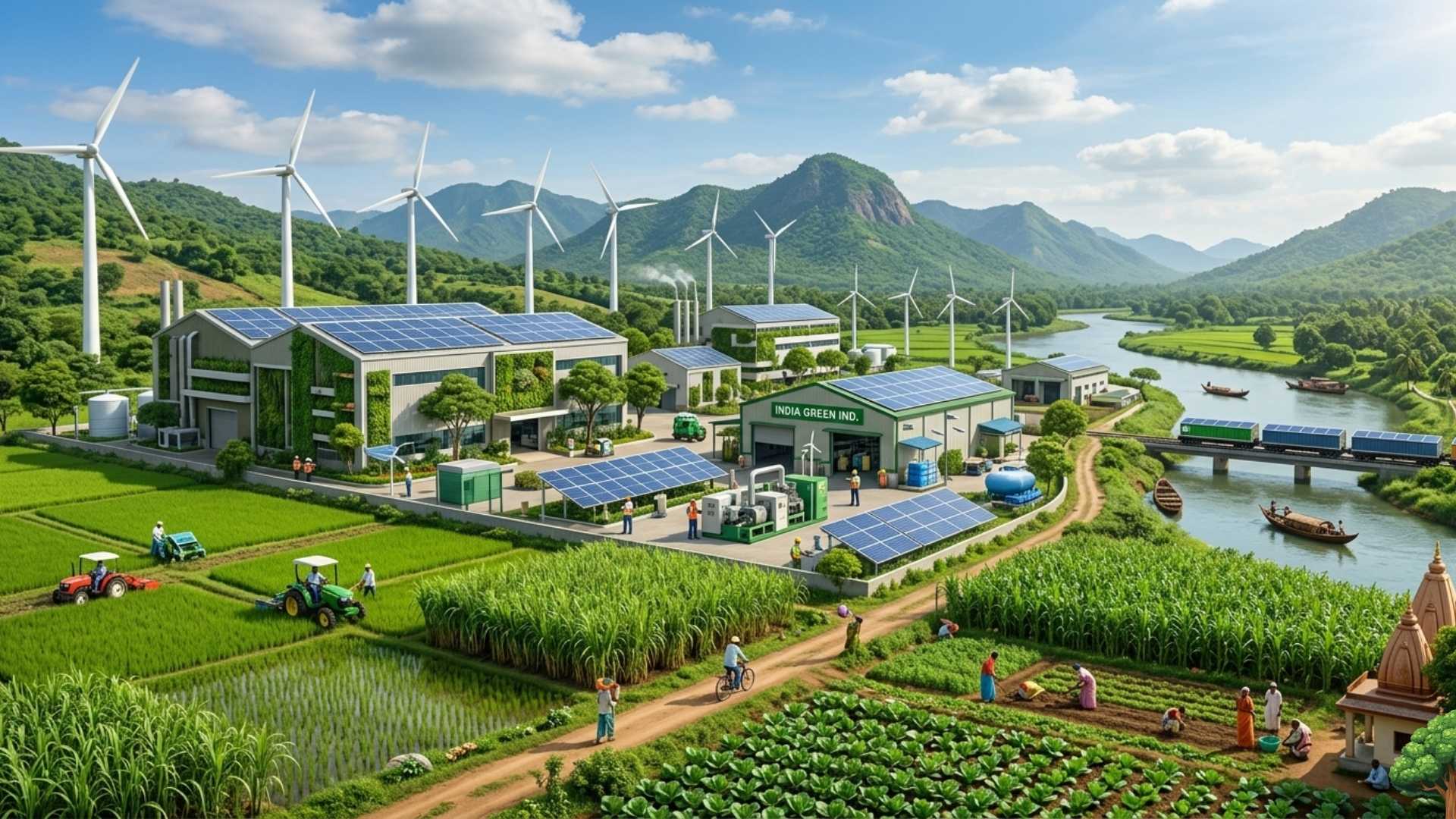
Green Industrialization: An Urgent Need for India’s Future
Introduction
Global industrial policy interventions surged from 52 in 2012 to over 1,500 in 2022 — signalling a worldwide retreat from free-market orthodoxy toward state-led strategic industrial policy. Simultaneously, the West Asia conflict has exposed the fragility of fossil fuel supply chains, with crude oil and gas price volatility threatening the growth trajectories of import-dependent economies like India. Against this backdrop, green industrialisation has shifted from a climate aspiration to a strategic necessity — the intersection of energy security, economic resilience, and India's ambition for global leadership in a multipolar world order. India's GDP growth of 7.6% in 2025–26 provides the macroeconomic foundation for this transition.
Background & Context
The world is experiencing simultaneous shocks — geopolitical fragmentation, weakening of multilateral institutions (WTO), supply chain vulnerabilities post-COVID, and climate-driven energy disruptions. This has triggered a global industrial policy resurgence, with major economies (USA's IRA, EU's Green Deal, China's Made in China 2025) deploying massive state subsidies for green manufacturing.
India's response — Atmanirbhar Bharat — consciously pivots from the old import-substitution model to competitive export-oriented green manufacturing, positioning India as a global supply chain alternative while decarbonising domestically.
"The growth momentum is not merely cyclical; it reflects a deeper commitment to economic and environmental sustainability and to balancing fiscal prudence, inclusive development, and productivity-enhancing reforms." — S. Mahendra Dev, Chairman, EAC-PM
India's Climate Commitments — Panchamrit (COP26)
| Commitment | Target |
|---|---|
| Renewable energy share | 50% of total energy by 2030 |
| GDP carbon intensity reduction | 45% reduction from 2005 levels by 2030 |
| Cumulative non-fossil electricity capacity | 500 GW by 2030 |
| Net-zero emissions | By 2070 |
| Carbon sink creation | 2.5–3 billion tonnes via forests by 2030 |
These commitments form the policy backbone of India's green industrialisation strategy — making them a high-frequency UPSC data set.
Five Pillars of Industrial Decarbonisation
India's approach to greening its most energy-intensive sectors — steel, cement, chemicals, and MSMEs — rests on five interlocking pillars:
1. Energy Efficiency — PAT Scheme The Perform, Achieve and Trade (PAT) scheme creates a market-linked mechanism where energy-intensive industries earn tradeable certificates for exceeding efficiency targets, incentivising continuous improvement without mandating specific technologies.
2. Electrification of Industrial Processes As renewable capacity scales up, replacing fossil-fuel-based industrial heat and processes with electricity — green electrification — becomes economically viable and ecologically necessary.
3. Alternative Fuels — Green Hydrogen The National Green Hydrogen Mission targets 5 million tonnes (MT) of green hydrogen annually by 2030, positioning India as a potential global green hydrogen exporter. Solar PV manufacturing is being scaled simultaneously to reduce input costs.
4. Circular Economy Measures
- Steel Scrap Recycling Policy — reduces energy and ore intensity of steel production
- Waste co-processing in cement kilns — substitutes fossil fuels with industrial waste, reducing emissions and landfill burden
5. Carbon Markets — Carbon Credit Trading Scheme (CCTS) India's Carbon Credit Trading Scheme prices emissions to create financial incentives for cleaner technology investment — a key step toward aligning India's industry with global carbon border adjustment mechanisms (EU CBAM).
Green Industrialisation & Inclusive Growth
A critical analytical distinction for UPSC: green industrialisation is not purely an environmental agenda — it is a jobs and equity agenda.
Dev distinguishes between:
- Pro-poor growth — targeting the poorest directly
- Inclusive development — structural shift toward labour-intensive green manufacturing that creates quality jobs across skill levels
On Jobs: While fossil fuel sectors will shed jobs, green sectors (renewable energy, EVs, green hydrogen, recycling) demand low-, semi-, and high-skilled workers simultaneously — offering net employment gains if accompanied by reskilling programmes, regional transition support, and safety nets. This is the just transition framework.
Sectors with green job potential in India: Solar panel manufacturing, EV and battery production, green hydrogen, sustainable construction, circular economy industries.
Federal Dimension — State-Level Green Hubs
Green industrialisation in India is not purely a central government project. State-level industrial policy plays a critical enabling role:
- Maharashtra: Green hydrogen hub development; renewable integration in industrial clusters
- Gujarat: Solar manufacturing; green port initiatives; renewable energy zones
- Odisha: Green steel (leveraging existing steel belt); renewable-powered mining
"This cooperative federal approach is essential for scaling up green industrialisation across a diverse economy." — S. Mahendra Dev, EAC-PM
This cooperative federalism dimension is directly relevant to GS Paper II questions on Centre-State relations and industrial policy.
Global Context — Implications for the Global South
India's green industrialisation model carries demonstration value for developing economies facing the same dilemma: how to industrialise without replicating the carbon-intensive pathways of earlier industrialisers.
Key conditions for success — applicable to the Global South broadly:
- Climate finance: Developed nations must honour $100 billion/year commitments (still unmet)
- Technology transfer: Green technologies must be accessible without prohibitive IP barriers
- Fair trade: Carbon border taxes (EU CBAM) must not penalise developing economy exporters unfairly
With India hosting the BRICS Summit in 2026, South-South cooperation on green industrialisation — technology sharing, green finance, joint manufacturing — could gain significant momentum.
Challenges
- Finance gap: Green transition requires massive upfront capital; India's green bond market is nascent
- Just transition risk: Coal-dependent regions (Jharkhand, Chhattisgarh, Odisha) face concentrated job losses without adequate safety nets
- Technology dependence: Critical mineral supply chains (lithium, cobalt) for batteries remain import-dependent
- WTO compatibility: Industrial subsidies under Atmanirbhar Bharat may face trade law challenges
- MSME capacity: Small enterprises lack capital and technical capacity for energy efficiency upgrades
Conclusion
India's green industrialisation agenda represents a rare convergence of climate responsibility, strategic autonomy, and economic opportunity. The West Asia conflict has sharpened this logic — dependence on fossil fuel imports is not merely an environmental liability but a national security vulnerability. The Panchamrit commitments, PAT scheme, National Green Hydrogen Mission, and Carbon Credit Trading Scheme together constitute a credible policy architecture. The real test, however, lies in execution: ensuring that the green transition is just (protecting workers in fossil fuel sectors), inclusive (generating quality jobs across skill levels), and federated (harnessing state-level dynamism). India's ability to prove that development and decarbonisation reinforce rather than contradict each other will be its most consequential contribution to the global climate conversation.
Attribution
Original content sources and authors
Syllabus classification
How this article maps to GS papers
Main syllabus
GS3InfrastructureQuick Q&A
What is meant by green industrialisation, and why is it being termed a strategic necessity for India in the current global context?
In the current global context, it has become a strategic necessity for India due to multiple factors. The West Asia conflict has exposed vulnerabilities in global fuel markets, leading to volatility in oil and gas prices. This highlights India's dependence on imported fossil fuels and underscores the importance of energy security for sustained economic growth.
Additionally, structural global changes such as:
- The emergence of a multipolar world order
- Geopolitical fragmentation and trade disruptions
- Weakening multilateral institutions like the WTO
Thus, green industrialisation is not merely an environmental agenda but a comprehensive economic strategy that integrates sustainability, energy security, and global competitiveness, positioning India for long-term leadership.
Why is energy security central to India’s growth strategy, especially in light of recent geopolitical developments?
Recent geopolitical developments, particularly the West Asia conflict, have disrupted global supply chains and caused sharp increases in crude oil and gas prices. Since India imports a significant portion of its energy needs, such disruptions directly impact its fiscal balance and economic growth. This makes energy security a strategic priority rather than a mere policy concern.
Its importance can be understood through:
- Economic stability: Stable energy prices prevent inflationary pressures.
- Industrial growth: Energy-intensive sectors like steel and cement rely heavily on consistent supply.
- National security: Reduced dependence on volatile regions enhances strategic autonomy.
India’s push towards renewables, green hydrogen, and electrification aligns with its Panchamrit commitments and reduces vulnerability to external shocks. Thus, energy security is deeply intertwined with sustainable development and long-term resilience.
How do the five pillars of industrial decarbonisation contribute to India's green transition?
First, energy efficiency: Initiatives like the Perform, Achieve and Trade (PAT) scheme create market-based incentives for industries to reduce energy consumption. This improves competitiveness while lowering emissions.
Second, electrification of processes: As renewable energy capacity expands, industries are encouraged to shift from fossil fuels to electricity-based operations, reducing carbon intensity.
Third, alternative fuels: The National Green Hydrogen Mission aims to produce 5 million tonnes annually by 2030, offering a clean substitute for fossil fuels in hard-to-abate sectors like steel and fertilizers.
Fourth, circular economy practices:
- Steel scrap recycling reduces the need for virgin raw materials
- Waste co-processing in cement kilns enhances resource efficiency
Fifth, carbon management: The Carbon Credit Trading Scheme introduces pricing mechanisms that incentivize industries to adopt cleaner technologies.
Together, these pillars create a holistic framework that balances environmental sustainability with industrial growth, ensuring a smooth transition to a low-carbon economy.
Critically analyse the relationship between green industrialisation and inclusive growth in India.
Positive linkages include:
- Job creation: Renewable energy, green hydrogen, and energy-efficient industries generate employment across skill levels.
- Regional development: States like Gujarat and Odisha are emerging as green industrial hubs.
- Health benefits: Reduced pollution improves public health, especially for poorer communities.
However, challenges remain:
- Job displacement: Workers in fossil fuel industries may face unemployment.
- Skill gaps: Green sectors require new technical skills.
- Regional disparities: Not all states have equal capacity to transition.
To address these issues, India emphasizes a ‘just transition’ framework involving reskilling programs, social safety nets, and targeted regional policies.
Thus, while green industrialisation has the potential to drive broad-based inclusive growth, its success depends on proactive policy interventions that ensure no section of society is left behind.
Provide examples of how state-level initiatives are contributing to green industrialisation in India.
Key examples include:
- Gujarat: अग्रणी in renewable energy and green hydrogen projects, supported by strong industrial infrastructure and policy incentives.
- Maharashtra: Focuses on integrating clean energy into manufacturing clusters and promoting electric mobility.
- Odisha: Leveraging its mineral base to develop green steel production using hydrogen-based technologies.
These states are aligning industrial policies with renewable energy expansion, creating green industrial hubs that attract investment and innovation.
Impact of such initiatives:
- Enhances regional competitiveness
- Encourages private sector participation
- Facilitates faster adoption of clean technologies
Thus, state-level dynamism complements national policies, ensuring that green industrialisation is not just a top-down approach but a decentralised and inclusive process.
What are the key reasons behind India’s shift from import substitution to export-oriented green manufacturing?
Key reasons include:
- Global industrial policy resurgence: Interventions increased from 52 in 2012 to 1,500 in 2022, indicating a shift towards strategic industries.
- Supply chain diversification: Firms are seeking alternatives to concentrated production hubs, creating opportunities for India.
- Rising demand for green products: International markets increasingly prefer low-carbon goods.
Domestic factors also play a role:
- Strong macroeconomic fundamentals: GDP growth of 7.6% supports industrial expansion.
- Policy frameworks: Initiatives like Atmanirbhar Bharat focus on competitiveness rather than protectionism.
This shift enables India to position itself as a global manufacturing hub while aligning with climate goals.
Thus, export-oriented green manufacturing represents a strategic convergence of economic growth, sustainability, and global integration, enhancing India’s role in the evolving world economy.
How can India’s green industrialisation model serve as a case study for the Global South?
Key features of the model include:
- Tech leapfrogging: India is bypassing polluting technologies and directly adopting cleaner alternatives.
- Policy innovation: Schemes like PAT, carbon markets, and green hydrogen missions provide scalable solutions.
- Inclusive focus: Emphasis on job creation, reskilling, and equitable growth ensures social acceptance.
For example, India’s Panchamrit commitments set clear targets for renewable energy and emissions reduction while maintaining economic growth. This demonstrates that development and decarbonisation can be mutually reinforcing.
However, replicability depends on:
- Access to climate finance
- Technology transfer from developed nations
- Fair and equitable global trade systems
India’s leadership in platforms like BRICS further strengthens South-South cooperation.
Thus, India’s approach provides a pragmatic and adaptable framework for other developing countries, though its success hinges on supportive global conditions and collaborative international efforts.
Practice questions
1 question for mains preparation