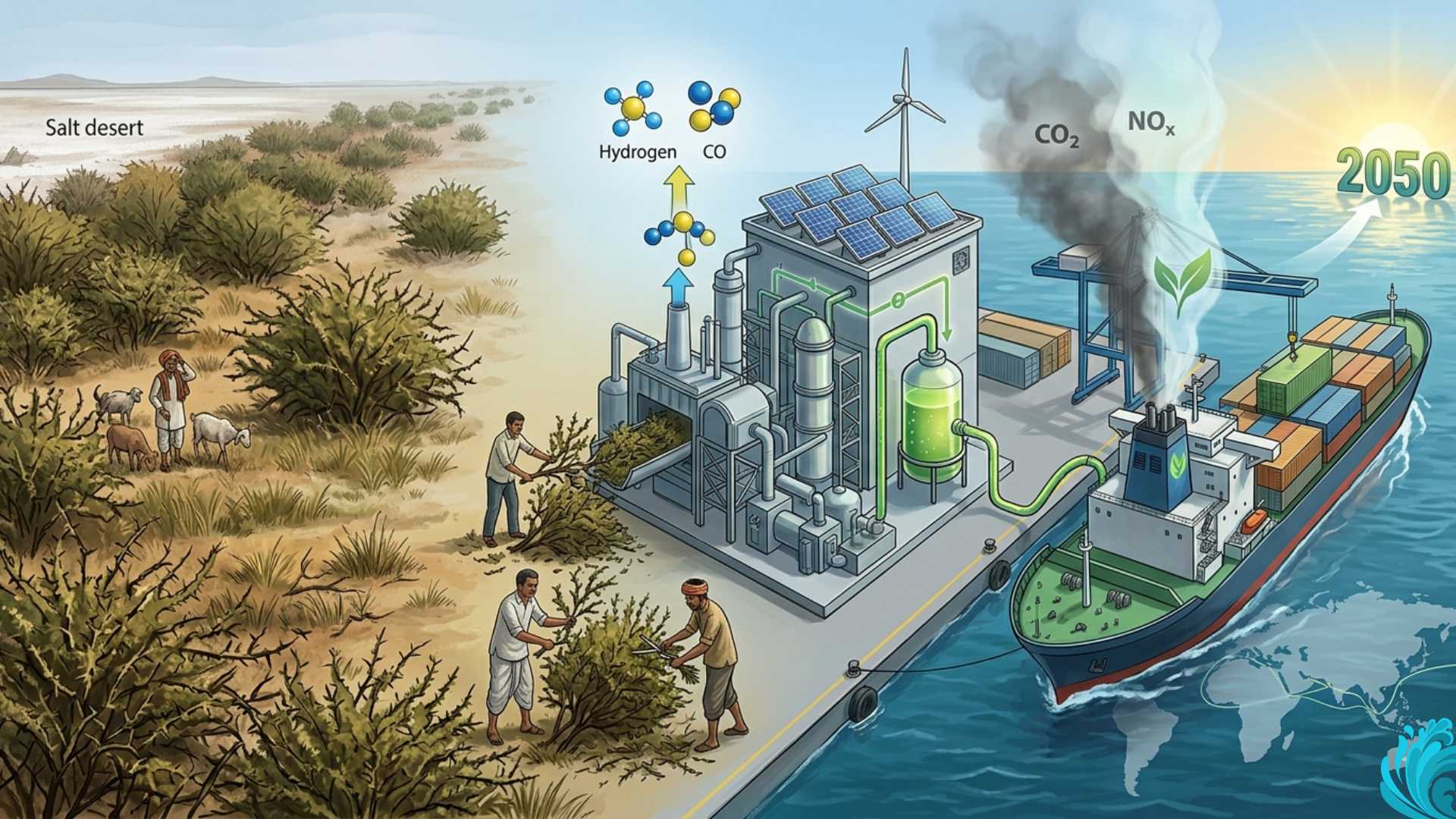
India's First Green Methanol Plant to Combat Invasive Weeds
Transforming Prosopis juliflora into green methanol, this project will address both biodiversity and fuel needs for the shipping industry.
4 mins read

Introduction
- India's first green methanol production plant at Kandla (Deendayal Port Authority) will convert Prosopis juliflora — one of the "top 100 invasive species in the world" — into clean shipping fuel, turning an ecological threat into an energy resource.
- International shipping contributes ~2.5% of global GHG emissions; the IMO's 2023 GHG Strategy mandates net-zero shipping emissions by 2050, creating urgent demand for green alternatives to bunker oil.
"At this point of time, they are being driven by penalties" — Ankur Jain, Ankur Scientific, on why green methanol adoption is accelerating globally.
Key Concepts
| Term | Meaning |
|---|---|
| Green Methanol | Methanol produced from biomass/renewable feedstock — not fossil fuels |
| E-Methanol | Methanol produced using renewable electricity + captured CO₂ |
| Syngas | Intermediate gas (H₂ + CO + CO₂) produced via gasification; base for methanol |
| Gasification | Heating biomass in absence of oxygen to produce syngas — between combustion and pyrolysis |
| Bunker Oil | Conventional heavy fuel oil used in shipping; high sulphur, high emissions |
| Prosopis juliflora | Mexican-origin invasive shrub; gando baval (Kutch), vilayati keekar (North India), velikathan (Tamil) |
About Prosopis Juliflora — The Invasive Feedstock
- Introduced by the British in the 1920s to green Delhi; reintroduced by Gujarat Forest Department in 1961 to halt salt desert encroachment in the Rann of Kutch.
- Has since crowded out native grasses across thousands of kilometres in Banni grasslands — destroying one of India's most ecologically significant pastoral ecosystems.
- Now ranked among the top 100 invasive species globally; Gujarat government actively seeks its clearance.
- Ideal feedstock: hardwood, dense, good energy profile, low acid content.
The Green Methanol Production Process
Two-step process:
| Step | Actor | Process |
|---|---|---|
| Step 1 | Ankur Scientific (Vadodara) | Gasification of juliflora biomass → Syngas (H₂ + CO + CO₂) |
| Step 2 | Thermax Energy (Pune) | Syngas conversion → Green Methanol |
- Plant capacity: 5 tonnes/day (demonstration scale); commercial viability requires 100–500 tonnes/day.
- Located at: Deendayal Port Authority, Kandla — owned by the port authority.
- Gasification is self-sustaining once started; needs only ~10–15 litres of oil for 30-minute startup.
- Key gap: Plant still draws conventional grid electricity — full green certification requires renewable power sourcing.
Environmental Benefits of Green Methanol
- Cuts vessel CO₂ emissions by up to 95%
- Reduces NOx by up to 80%
- Eliminates sulphur oxides and particulate matter entirely
- Addresses both climate change and air quality simultaneously (Methanol Institute)
Economic & Policy Drivers
Cost Challenge:
| Fuel Type | Price |
|---|---|
| Conventional methanol (natural gas) | ~₹30/kg (pre-Ukraine war) |
| Conventional methanol (post-Ukraine) | ₹70–80/kg |
| Green methanol (international) | ~$700–800/tonne |
| E-methanol | ~$2,000/tonne |
Policy Support:
- IMO 2023 GHG Strategy — net-zero shipping by 2050; drives international demand.
- EU penalties — heavy charges on ships entering EU ports without minimum green fuel share.
- India's Shipbuilding Financial Assistance Policy (amended August 2023) — flat 30% subsidy for vessels using green fuels (methanol, ammonia, hydrogen).
- India's Green Ports Policy — converting western coast ports into green fuel hubs.
Broader Significance
- Juliflora-based methanol is a demonstration; the plant is certified to also run on bagasse and cotton stalk — which at maximum potential could displace up to one-third of India's oil imports.
- Links invasive species management + renewable energy + maritime decarbonisation — a rare triple-dividend intervention.
- Aligns with India's commitments under Paris Agreement and Panchamrit targets (net-zero by 2070).
Challenges
- Cost uncompetitiveness without policy penalties or subsidies.
- Scale gap — 5 tonnes/day is far from commercial viability.
- Green electricity dependency — partial greenwashing risk if grid power remains conventional.
- Supply chain — consistent biomass collection from invasive species at scale is logistically complex.
- Ecological caution — complete eradication of juliflora must be managed carefully to avoid secondary ecological disruption.
Conclusion
- The Kandla green methanol project exemplifies circular ecology meeting climate policy — converting a biodiversity threat into a decarbonisation asset.
- It signals India's emerging role in the global green shipping fuel value chain, but demonstration must rapidly scale to commercial viability.
- True sustainability requires closing the renewable electricity loop and building robust biomass supply chains — making this as much a governance challenge as a technological one.
Attribution
Original content sources and authors


Syllabus classification
How this article maps to GS papers
Main syllabus
GS3InfrastructureQuick Q&A
What is green methanol, and how does it differ from conventional methanol in terms of production and environmental impact?
Green methanol is a low-carbon fuel produced from renewable feedstocks such as agricultural residues, biomass, or captured carbon dioxide, unlike conventional methanol which is derived from fossil fuels like natural gas or coal. The production of green methanol involves converting biomass into syngas (a mixture of hydrogen, carbon monoxide, and carbon dioxide) through gasification, and then synthesizing methanol from this syngas.
In contrast, conventional methanol production relies heavily on fossil fuel-based processes such as steam methane reforming or coal gasification, which generate significant greenhouse gas emissions. Green methanol, by using renewable inputs, aligns with global decarbonisation goals and reduces lifecycle emissions substantially.
Environmental advantages:
In contrast, conventional methanol production relies heavily on fossil fuel-based processes such as steam methane reforming or coal gasification, which generate significant greenhouse gas emissions. Green methanol, by using renewable inputs, aligns with global decarbonisation goals and reduces lifecycle emissions substantially.
Environmental advantages:
- Reduction of CO₂ emissions by up to 95%
- Reduction of NOx emissions by up to 80%
- Elimination of sulphur oxides and particulate matter
Why is the utilization of Prosopis juliflora for green methanol production considered both an ecological and economic opportunity?
Prosopis juliflora, an invasive species in India’s Banni grasslands, has long been associated with ecological degradation due to its ability to outcompete native vegetation and alter ecosystems. Its widespread presence has reduced biodiversity and impacted pastoral livelihoods. However, its utilization as a feedstock for green methanol presents a unique opportunity to convert an environmental challenge into a productive resource.
From an ecological perspective, harvesting this invasive species can aid in restoring native grasslands and improving biodiversity. Simultaneously, its characteristics—such as high density, hardwood nature, and favorable energy profile—make it an efficient biomass source for gasification processes.
Economic and policy advantages:
From an ecological perspective, harvesting this invasive species can aid in restoring native grasslands and improving biodiversity. Simultaneously, its characteristics—such as high density, hardwood nature, and favorable energy profile—make it an efficient biomass source for gasification processes.
Economic and policy advantages:
- Reduces costs of feedstock procurement
- Generates rural employment in biomass collection
- Aligns with government initiatives for invasive species management
How does the gasification process enable the conversion of biomass into green methanol?
The gasification process is a thermochemical method that converts carbon-based materials like biomass into a gaseous mixture known as syngas. This process occurs at high temperatures in a controlled environment with limited oxygen, positioning it between combustion and pyrolysis. The biomass is partially oxidized, breaking it down into simpler molecules such as hydrogen, carbon monoxide, and carbon dioxide.
Once syngas is produced, it undergoes purification and conditioning to remove impurities. In the second stage, catalytic processes convert this cleaned syngas into methanol. This two-step mechanism—gasification followed by synthesis—forms the backbone of green methanol production.
Key features of gasification:
Once syngas is produced, it undergoes purification and conditioning to remove impurities. In the second stage, catalytic processes convert this cleaned syngas into methanol. This two-step mechanism—gasification followed by synthesis—forms the backbone of green methanol production.
Key features of gasification:
- Efficient conversion of diverse biomass feedstocks
- Self-sustaining reaction after initial energy input
- Scalability for industrial applications
Critically analyze the potential and challenges of green methanol as a maritime fuel in achieving decarbonisation goals.
Green methanol holds significant promise as an alternative maritime fuel, particularly in the context of the International Maritime Organization’s (IMO) target of achieving net-zero emissions by 2050. Its ability to drastically reduce emissions—up to 95% CO₂ reduction and near elimination of sulphur pollutants—makes it an attractive option for the shipping industry, which is otherwise heavily reliant on bunker fuels.
However, several challenges hinder its widespread adoption. The most prominent issue is cost competitiveness. Green methanol is significantly more expensive than conventional fuels, with prices driven more by regulatory penalties than market efficiency. Additionally, infrastructure for storage, transport, and bunkering of methanol is still underdeveloped in many parts of the world.
Critical evaluation:
However, several challenges hinder its widespread adoption. The most prominent issue is cost competitiveness. Green methanol is significantly more expensive than conventional fuels, with prices driven more by regulatory penalties than market efficiency. Additionally, infrastructure for storage, transport, and bunkering of methanol is still underdeveloped in many parts of the world.
Critical evaluation:
- Strengths: High emission reduction potential, compatibility with existing engines (with modifications)
- Weaknesses: High production cost, dependence on policy incentives
- Opportunities: Growing global regulatory push for green fuels
- Threats: Competition from hydrogen and ammonia fuels
Examine the Kandla green methanol project as a model for sustainable industrial development in India.
The Kandla green methanol project, located at the Deendayal Port Authority, represents a pioneering initiative in India’s transition towards green fuels. Designed to produce five tonnes of methanol per day, it utilizes invasive biomass like Prosopis juliflora, thereby integrating environmental management with industrial production.
This project is significant as it aligns with India’s broader vision of developing ‘green ports’ along its coastline. By leveraging domestic technology from companies like Thermax Energy and Ankur Scientific, it also promotes indigenous innovation and reduces dependence on imported fossil fuels.
Key takeaways:
This project is significant as it aligns with India’s broader vision of developing ‘green ports’ along its coastline. By leveraging domestic technology from companies like Thermax Energy and Ankur Scientific, it also promotes indigenous innovation and reduces dependence on imported fossil fuels.
Key takeaways:
- Demonstrates viability of biomass-based fuel production
- Supports India’s commitments under global climate agreements
- Encourages public-private partnerships in green technology
What are the key reasons behind the high cost of green methanol, and how can they be addressed?
The high cost of green methanol arises primarily from the use of renewable feedstocks, advanced technologies, and limited economies of scale. Unlike conventional methanol, which benefits from established infrastructure and cheap fossil fuels, green methanol production involves complex processes like biomass gasification and requires significant capital investment.
Another factor is the cost of renewable energy inputs. For the fuel to be truly ‘green’, the electricity used in production must also come from renewable sources, which can further increase costs. Additionally, global pricing is influenced by regulatory frameworks, such as carbon taxes and emission penalties, rather than pure market demand.
Possible solutions:
Another factor is the cost of renewable energy inputs. For the fuel to be truly ‘green’, the electricity used in production must also come from renewable sources, which can further increase costs. Additionally, global pricing is influenced by regulatory frameworks, such as carbon taxes and emission penalties, rather than pure market demand.
Possible solutions:
- Scaling up production to achieve economies of scale
- Government subsidies and financial incentives
- Investment in R&D to improve efficiency
- Development of robust supply chains for biomass
As a policymaker, how would you design a strategy to promote green fuels like methanol in India’s shipping sector?
As a policymaker, promoting green fuels like methanol in India’s shipping sector would require a comprehensive strategy combining regulatory support, financial incentives, and infrastructure development. The first step would be to align national policies with global frameworks like the IMO’s decarbonisation targets, ensuring regulatory certainty for stakeholders.
Financial incentives such as subsidies, tax benefits, and viability gap funding can help offset the high initial costs. India’s existing policy of offering a 30% subsidy for green-fuel-powered vessels is a step in the right direction, but it must be complemented by investments in port infrastructure for methanol storage and bunkering.
Strategic measures:
Financial incentives such as subsidies, tax benefits, and viability gap funding can help offset the high initial costs. India’s existing policy of offering a 30% subsidy for green-fuel-powered vessels is a step in the right direction, but it must be complemented by investments in port infrastructure for methanol storage and bunkering.
Strategic measures:
- Encourage public-private partnerships for technology development
- Promote indigenous manufacturing of green fuel technologies
- Develop integrated biomass supply chains
Practice questions
2 questions for mains preparation