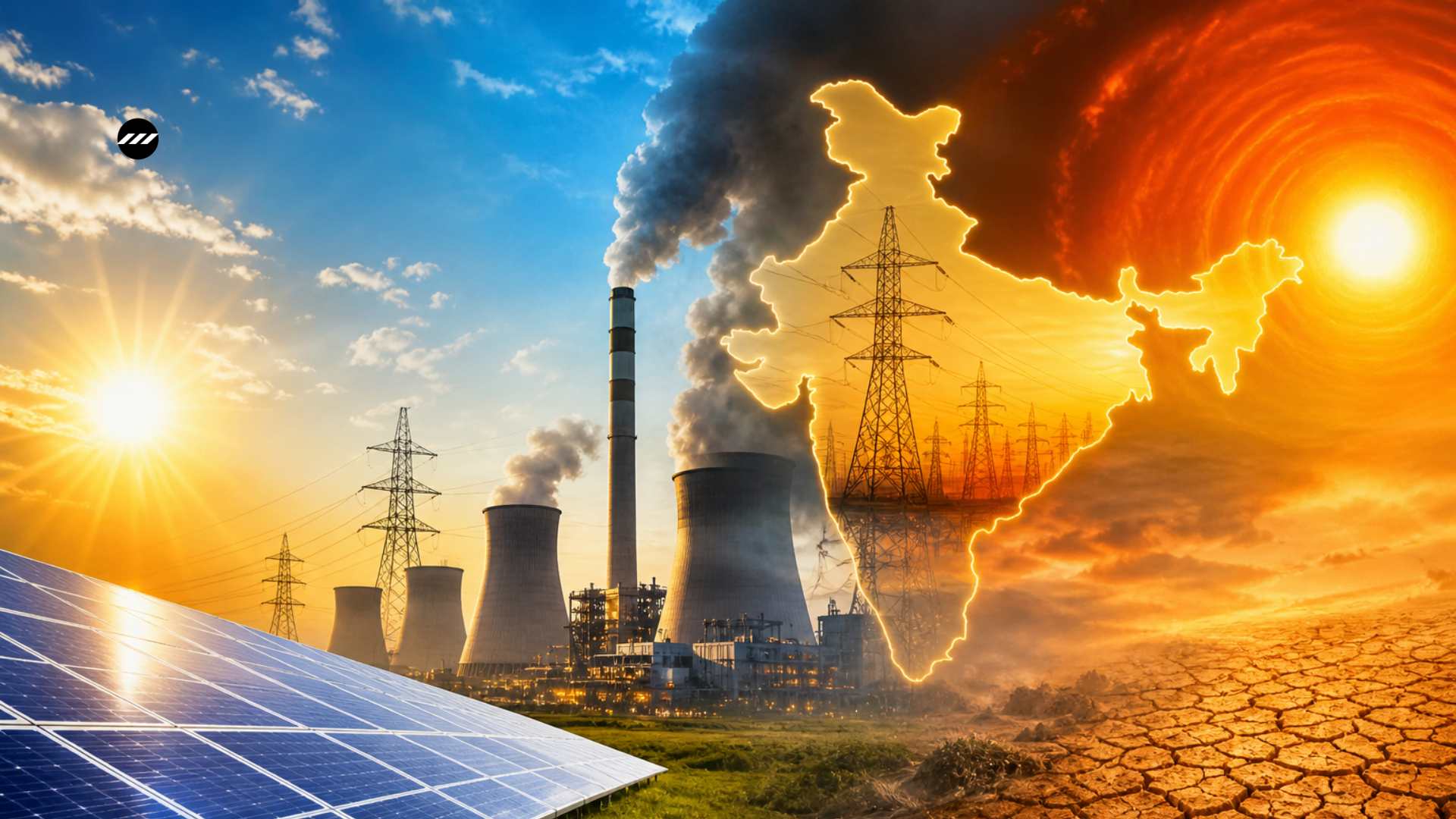
India's Energy Strategy: Augmented Solar and Coal for Peak Demand

Introduction
India's peak power demand touched a record 256.1 GW on April 25, 2025, with thermal plants supplying 66.9% and solar contributing 21.5% of generation on that day. As El Niño conditions threaten monsoon reliability and summer heat intensifies, India's energy security hinges on the dual pillars of coal-based thermal capacity and rapidly scaling solar infrastructure.
"With stronger transmission networks, more flexible grid operations and faster battery deployment, a larger share of evening and night-time demand can also be met through non-fossil sources." — Manoj Kumar, CREA India Analyst
Solar Power's Rising Share in Peak Demand
| Year | Solar Contribution on Peak Demand Day |
|---|---|
| 2022 | 5.63% |
| 2023 | ~6.0% |
| 2024 | 7.3% |
| 2025 | 8.9% |
| 2025-26 (installed capacity share) | ~30% |
India added a record 44.61 GW of solar capacity in FY 2025-26 — more than double the addition in the preceding fiscal year. Yet the gap between installed capacity (30%) and actual peak contribution (~9–21%) reveals a structural challenge: curtailment due to limited battery storage and grid stability constraints.
Key Concepts
Grid Curtailment Solar power is frequently held back (curtailed) to prevent grid instability when supply exceeds manageable demand at peak solar hours. This structural inefficiency underscores the urgency of battery storage deployment.
El Niño and Energy Demand El Niño conditions lead to below-normal monsoon rainfall, extended dry spells, and higher temperatures — directly increasing cooling and irrigation-based power demand while reducing hydropower potential. IMD has forecast El Niño conditions prevailing through June–September 2025, potentially capping rainfall at ≤92% of the Long Period Average (LPA) of 87 cm — the first such event in 11 years.
Thermal Plant Dependence Despite renewable expansion, coal-based thermal plants remain the backbone of India's dispatchable (on-demand) power supply, particularly during evening/night peaks when solar generation is absent.
Coal Stock Position
| Category | Stock (million tonnes) |
|---|---|
| Pithead (mine-end) stocks | ~125 MT |
| Power plant stocks | ~52 MT |
| Captive mines | ~20 MT |
| In transit | ~3 MT |
| Total | ~200 MT |
- Daily consumption by thermal plants: ~2.3–2.4 MT/day
- Implied cover: 83+ days, with production continuously replenishing stocks
- April 2025 depletion rate: –0.145 MT/day (stable, indicating production near-matching consumption)
Challenges & Implications
Energy Transition Bottlenecks The renewable-to-peak-supply gap persists because:
- Battery storage at grid scale remains expensive and underdeployed
- Transmission infrastructure cannot fully absorb renewable surpluses in generating states
- Evening demand peaks coincide precisely with zero solar generation
El Niño's Multi-Sector Impact
- Power: Reduced hydropower output, increased cooling demand
- Agriculture: Below-normal kharif sowing, potential food inflation
- Water security: Depleted reservoirs reducing hydro capacity further
- India's worst El Niño year was 2015, when actual rainfall was only 86% of LPA — worse than the IMD's own forecast of 93%
Coal Import Risk While domestic coal stocks appear comfortable, sustained El Niño-driven demand spikes could accelerate depletion rates, testing the replenishment pipeline — particularly for power plants in coal-deficit states dependent on rail logistics.
Policy Relevance
| Policy/Initiative | Relevance |
|---|---|
| PM Surya Ghar Muft Bijli Yojana | Rooftop solar + distributed generation reduces grid load |
| National Electricity Plan 2023 | Targets 500 GW non-fossil capacity by 2030 |
| Battery Energy Storage Systems (BESS) Policy | Grid-scale storage to reduce curtailment |
| Revamped Distribution Sector Scheme (RDSS) | Strengthening distribution networks for renewable integration |
| Green Energy Corridor | Transmission infrastructure for renewable-rich states |
Conclusion
India's energy landscape in 2025 reflects a classic transition economy paradox: record renewable capacity additions coexist with persistent coal dependence because storage, grid, and transmission infrastructure have not kept pace. The El Niño threat underscores that energy security and climate adaptation are inseparable policy questions. Addressing grid curtailment, accelerating BESS deployment, and modernising transmission networks are not merely technical imperatives — they are prerequisites for India to honour both its developmental obligations and its climate commitments under the Paris Agreement.
Attribution
Original content sources and authors


Syllabus classification
How this article maps to GS papers
Main syllabus
GS3InfrastructureQuick Q&A
What is the current energy mix in India during peak power demand, and what does it reveal about the structure of the power sector?
Structural Insights: The data highlights a crucial reality—while India has rapidly expanded its installed renewable capacity (around 30% from solar), actual utilization remains constrained. Solar energy’s contribution varies significantly throughout the day, averaging much lower annual shares due to intermittency and lack of storage. Thus, thermal power remains the backbone of grid stability, especially during non-solar hours.
Implications for Energy Transition: This mix underscores the transitional phase of India’s energy sector. While renewable capacity addition is impressive—such as the record 44.61 GW solar addition in FY 2025-26—the system still depends on coal for reliability. For example, during evening peak hours when solar generation drops, coal plants must ramp up output. This indicates that India’s transition is not merely about capacity addition but about integrating renewables effectively into the grid.
Why does coal continue to play a dominant role in India’s energy mix despite significant growth in renewable energy capacity?
Limitations of Renewable Integration: Despite solar contributing nearly 30% of installed capacity, its actual utilization is constrained by lack of adequate battery storage and grid flexibility. Solar power is often curtailed to maintain grid stability, particularly when supply exceeds demand during daylight hours. Additionally, evening and night-time demand cannot be met by solar alone, necessitating reliance on thermal sources.
Economic and Infrastructure Factors: Coal infrastructure is already well-established in India, with abundant domestic reserves and a robust supply chain. The presence of 200 million tonnes of coal stock ensures energy security, especially during uncertain climatic events like El Nino. Transitioning away from coal also involves significant financial and technological challenges, including upgrading transmission networks and deploying storage solutions.
Conclusion: Thus, coal’s dominance is not merely a policy choice but a structural necessity in the current stage of India’s energy transition. The challenge lies in gradually reducing dependence while ensuring energy security.
How do El Nino conditions influence India’s energy demand and supply dynamics?
Supply-Side Challenges: On the supply side, El Nino can adversely affect hydropower generation due to reduced water availability. This further increases reliance on thermal and solar power. While solar generation may benefit from clear skies, its intermittency still poses challenges during non-daylight hours.
Case Example: The 2015 drought year, when rainfall dropped to 86% of the Long Period Average (LPA), illustrates how severe El Nino conditions can strain both agriculture and energy sectors. Similarly, forecasts of rainfall at or below 92% LPA in upcoming years indicate potential stress on water-dependent energy sources.
Conclusion: El Nino amplifies both demand pressures and supply constraints, making it essential for India to maintain adequate coal stocks and diversify its energy mix. It also highlights the importance of climate-resilient energy planning.
What are the reasons behind the underutilization and curtailment of solar power in India despite high installed capacity?
Lack of Energy Storage Infrastructure: One of the most critical constraints is the limited deployment of battery storage systems. Without storage, excess solar energy generated during the day cannot be used during evening or night-time peak demand. This restricts the effective contribution of solar power to the overall energy mix.
Transmission and Distribution Constraints: Inadequate transmission infrastructure also hampers the evacuation of solar power from generation sites (often in remote areas) to consumption centers. For instance, delays in building green energy corridors can lead to bottlenecks and wastage of renewable energy.
Way Forward: Experts suggest improving grid flexibility, strengthening transmission networks, and accelerating battery deployment to address these issues. Only then can India fully harness its solar potential and reduce dependence on fossil fuels.
Critically analyze India’s preparedness to meet peak summer electricity demand in the context of El Nino and rising consumption.
Limitations and Risks: However, several vulnerabilities remain.
- Overdependence on coal: Despite environmental concerns, coal remains the primary source of energy.
- Renewable integration challenges: Solar energy cannot fully meet demand due to storage and grid issues.
- Climate uncertainties: El Nino could disrupt hydropower and increase demand unpredictably.
Case Insight: Past experiences, such as the 2015 drought and 2023 near-normal rainfall shortfall, show that climate variability can significantly impact energy planning. Even accurate forecasts may underestimate actual impacts.
Conclusion: While short-term preparedness appears adequate, long-term resilience requires reducing coal dependence, enhancing renewable integration, and investing in climate-resilient infrastructure. Without these reforms, India’s energy security could face recurring stress during extreme weather events.
Provide an example to illustrate how India balances traditional and renewable energy sources during peak demand periods.
Operational Dynamics: During daylight hours, solar energy reduces the burden on coal plants, allowing them to operate at lower capacities. However, as the sun sets, solar generation declines sharply, and thermal plants ramp up production to meet evening peak demand. This dynamic interplay ensures uninterrupted power supply.
Policy and Infrastructure Role: The government’s push for renewable energy expansion, such as the addition of 44.61 GW of solar capacity in FY 2025-26, complements existing thermal capacity. However, without adequate storage and grid flexibility, the system still relies on coal for reliability.
Conclusion: This example highlights India’s pragmatic approach—leveraging renewables for sustainability while depending on thermal power for stability. It underscores the need for better integration mechanisms to optimize this balance in the future.
Practice questions
4 questions for mains preparation