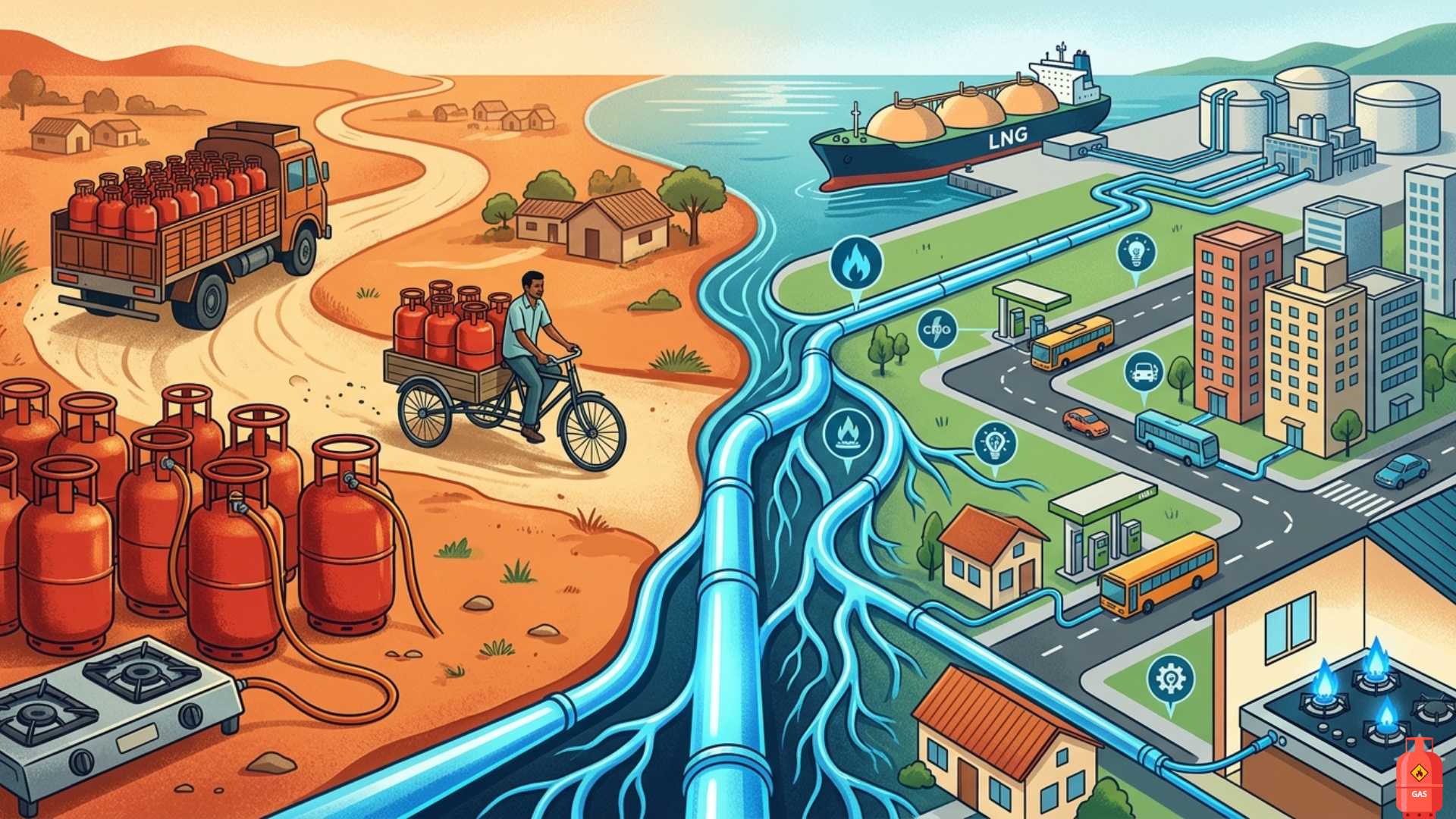
India's Shift to Piped Natural Gas: A Comprehensive Analysis
India's domestic energy security is at an inflection point, as geopolitical disruptions to the Strait of Hormuz have exposed the structural vulnerability of its LPG-dependent cooking fuel model. With over 90% of LPG imports routed through this single chokepoint, the government is now accelerating a strategic pivot to Piped Natural Gas (PNG) — a shift backed by regulatory mandates, pipeline expansion targets, and domestic production ambitions.
"Domestic natural gas production alone could cater to 30 crore connections if all were to switch to piped natural gas." — Anjan Kumar Mishra, Secretary, PNGRB
| Parameter | LPG | Natural Gas (PNG) |
|---|---|---|
| Annual consumption | 34 million tonnes | — |
| Domestic production | 12 million tonnes (~35%) | ~27 million tonnes |
| Import dependency | ~65% | ~50% |
| Primary import sources | Saudi Arabia, Qatar | Diversified (global LNG market) |
| Chokepoint exposure | High (Strait of Hormuz) | Low (multiple LNG terminals) |
Key Concepts: LPG vs. PNG vs. CNG vs. LNG
| Fuel | Full Form | State | Primary Use | Transport Mode |
|---|---|---|---|---|
| LPG | Liquefied Petroleum Gas | Liquid (pressurised) | Domestic cooking, MSMEs | Cylinders via trucks/tricycles |
| PNG | Piped Natural Gas | Gas | Domestic cooking, industry | Underground pipelines |
| CNG | Compressed Natural Gas | Compressed gas | Vehicular fuel | Filling stations |
| LNG | Liquefied Natural Gas | Liquid (−160°C) | Import/shipping of natural gas | LNG carriers/ships |
Key distinction: LPG is a co-product of oil refining and gas processing. Natural gas (PNG/CNG/LNG) comes from geological gas fields and has more diversified global sources.
Why the Shift Now? — Context and Drivers
1. Supply Chain Vulnerability India sourced ~90% of its LPG imports from Saudi Arabia and Qatar, routed through the Strait of Hormuz. The West Asia conflict has disrupted this corridor, exposing a critical single-point-of-failure in energy supply chains.
2. Import Substitution India imported ~27 million metric tonnes of LNG last year — roughly matching domestic production. For LPG, however, India produced only 12 million out of 34 million tonnes consumed annually. LNG has far more diversified global suppliers, reducing geopolitical risk.
3. Domestic Production Potential PNGRB Secretary Anjan Kumar Mishra noted that domestic natural gas production alone could serve 30 crore connections if all households switched to PNG — a significant untapped potential.
4. Regulatory Push A recent gazette notification mandates that households cannot hold both LPG and PNG connections simultaneously, requiring ~60 lakh dual-connection households to surrender LPG within three months — pushing total PNG connections toward 2 crore.
Status of PNG Expansion
| Parameter | Current Status |
|---|---|
| Total LPG connections | 33 crore |
| PNG connections (as of 2025) | ~1.5 crore |
| Target PNG connections | 12 crore by 2034–35 |
| CAGR required to meet target | ~24% (current CAGR: 18%) |
| Existing gas pipeline network | ~25,000 km |
| Pipeline under construction | ~10,500 km |
| CGD geographical areas licensed | 300+ |
| CGD areas not yet connected to trunk pipeline | ~90 |
Challenges in Scaling PNG
Infrastructure Gaps The GAIL pipeline network is concentrated in western and northern India, with limited coverage in central, southern, and northeastern regions. Last-mile connectivity — navigating dense urban infrastructure — remains the foremost operational bottleneck.
Gas Availability and Sectoral Competition Natural gas use in India is currently distributed as: fertilisers (~30%), industries/refineries (~35%), city gas distribution (~20%), and power (~13%). Scaling household PNG will require either significant production ramp-up or diversion from industrial uses — creating difficult sectoral trade-offs.
Storage Deficit India's LNG system operates on a near-just-in-time basis with little long-term storage infrastructure, unlike Europe. Any import disruption directly and immediately affects availability — a structural vulnerability.
Production Ramp-Up Needed To supply 13 crore PNG connections, India must increase domestic gas production by at least one-third. Rystad Energy projects a 25% production increase as feasible. ONGC's KG-DWN 98/2 Block in the Krishna-Godavari basin (commenced 2024, peak output expected at 10 MMSCMD) could add ~10% to overall national gas production.
Industrial Transition Friction MSMEs using LPG for welding and cutting face technical and awareness barriers in transitioning to PNG, as equipment may require recalibration or replacement.
Government Policy Measures
- Gazette notification with specific timelines for pipeline approvals in housing and non-housing areas
- Mandatory surrender of LPG connections upon availing PNG
- MoPNG targeting 12 crore PNG connections by 2034–35 with a ₹-competitive PNG pricing policy
- Parliamentary Standing Committee reviewing CGD expansion hurdles: permissions, land acquisition, NOC requirements
Conclusion
India's PNG push represents a strategic reorientation of domestic energy policy — from a geographically concentrated import-dependent model toward a diversified, infrastructure-led gas economy. However, the transition hinges on three simultaneous deliverables: pipeline infrastructure expansion at an unprecedented pace, domestic gas production scaling by at least one-third, and sectoral reallocation without disrupting fertiliser and power security. The government's regulatory interventions are necessary but insufficient in isolation. Long-term energy security demands that pipeline infrastructure reach tier-2, tier-3 cities and rural clusters — precisely where last-mile connectivity is hardest and most expensive. Done well, the LPG-to-PNG transition could reduce India's import bills, diversify energy sources, and improve urban air quality — a governance achievement with compounding strategic returns.
Attribution
Original content sources and authors
Syllabus classification
How this article maps to GS papers
Main syllabus
GS3InfrastructureQuick Q&A
What are the key differences between LPG, LNG, PNG, and CNG, and how do their physical properties influence their usage?
LNG (Liquefied Natural Gas), on the other hand, is natural gas cooled to around –160°C, reducing its volume by nearly 1,000 times. This makes it suitable for long-distance transportation via specialized carriers. After reaching the destination, LNG is regasified and distributed through pipelines. PNG (Piped Natural Gas) is simply natural gas supplied directly to households through pipelines, offering convenience and continuous supply. CNG (Compressed Natural Gas) is natural gas compressed at high pressures (200–250 kg/cm²) and is primarily used as a cleaner vehicular fuel.
The physical properties—such as energy density, compressibility, and storage requirements—determine their applications. For instance, LPG’s ease of storage makes it ideal for rural areas, while PNG’s continuous flow suits urban households. Similarly, LNG’s transport efficiency supports global trade, and CNG’s low emissions make it suitable for transportation. Thus, each fuel serves a distinct niche within the broader energy ecosystem.
Why is India increasingly pushing for piped natural gas (PNG) over LPG for domestic consumption?
Economic and operational advantages also play a role. PNG eliminates the need for cylinder logistics, reducing transportation costs and leakages. It provides uninterrupted supply and can be metered, ensuring transparent billing. Additionally, domestic natural gas production has the potential to support a large number of connections, making PNG a more sustainable long-term option.
Policy push is another critical factor. The government has introduced regulatory measures, such as restricting households from holding both LPG and PNG connections and setting ambitious targets like 12 crore PNG connections by 2034. This reflects a strategic shift toward building a gas-based economy, improving urban energy efficiency, and reducing reliance on imported fuels.
How does the supply chain and distribution mechanism differ between LPG and piped natural gas (PNG)?
In contrast, PNG relies on a continuous pipeline-based system. Natural gas is either produced domestically or imported as LNG, which is then regasified at terminals. From there, it flows through trunk pipelines and city gas distribution (CGD) networks directly to consumers. This eliminates the need for intermediate storage and manual handling.
Implications of these differences are significant. LPG’s cylinder-based model is more flexible and suitable for areas without pipeline infrastructure, especially rural regions. However, PNG offers greater efficiency, safety, and convenience in urban areas. For example, cities like Delhi and Mumbai have successfully implemented PNG networks, reducing dependence on cylinder delivery systems. Thus, while LPG excels in accessibility, PNG represents a modern, infrastructure-intensive energy delivery model.
Critically analyse whether natural gas can act as a complete substitute for LPG in India.
However, several constraints limit full substitution. Infrastructure remains the biggest challenge—pipeline networks are unevenly distributed, with large parts of central, southern, and northeastern India still uncovered. Additionally, LPG’s portability makes it indispensable in rural and remote areas where pipeline connectivity is not feasible. In industrial applications, switching from LPG to natural gas may require equipment modifications, increasing costs and slowing adoption.
From a strategic perspective, even if India achieves its target of 12 crore PNG connections, over 20 crore LPG connections will remain. This indicates that LPG will continue to play a significant role. Therefore, rather than complete substitution, a complementary approach—where PNG dominates urban areas and LPG serves rural regions—appears more realistic and sustainable.
Examine the challenges faced in expanding piped natural gas (PNG) infrastructure in India with suitable examples.
Regional imbalance is another major concern. The existing pipeline network is concentrated in western and northern India, with limited penetration in central, eastern, and northeastern regions. For instance, while areas near GAIL pipelines in Maharashtra or Coimbatore are witnessing expansion, many tier-2 and tier-3 cities remain unconnected despite being included in CGD licensing rounds.
Institutional and economic barriers further complicate the situation. Around 90 licensed geographical areas are still not connected to the main trunk pipeline. Additionally, building pipelines requires significant capital investment and long gestation periods. These challenges highlight that infrastructure expansion is not merely a technical issue but also involves governance, financing, and coordination complexities.
What are the key factors affecting India’s ability to scale up natural gas usage for domestic cooking?
Import dependence and infrastructure readiness also play a crucial role. India has multiple LNG import terminals, but its gas system operates on a near just-in-time basis with limited storage capacity. Any disruption in global supply chains can immediately impact availability. Moreover, expanding pipeline networks is essential to distribute imported gas efficiently across regions.
Competing sectoral demand adds another layer of complexity. Natural gas is already heavily used in fertilizers, power generation, and industries. Diverting gas to domestic cooking may require these sectors to shift to alternative fuels like naphtha or furnace oil. Thus, achieving large-scale adoption of PNG requires a balanced approach that integrates production, imports, infrastructure, and sectoral priorities.
India's energy security pivot to PNG is a strategic shift from import reliance to domestic infrastructure-led resilience.
Practice questions
1 question for mains preparation