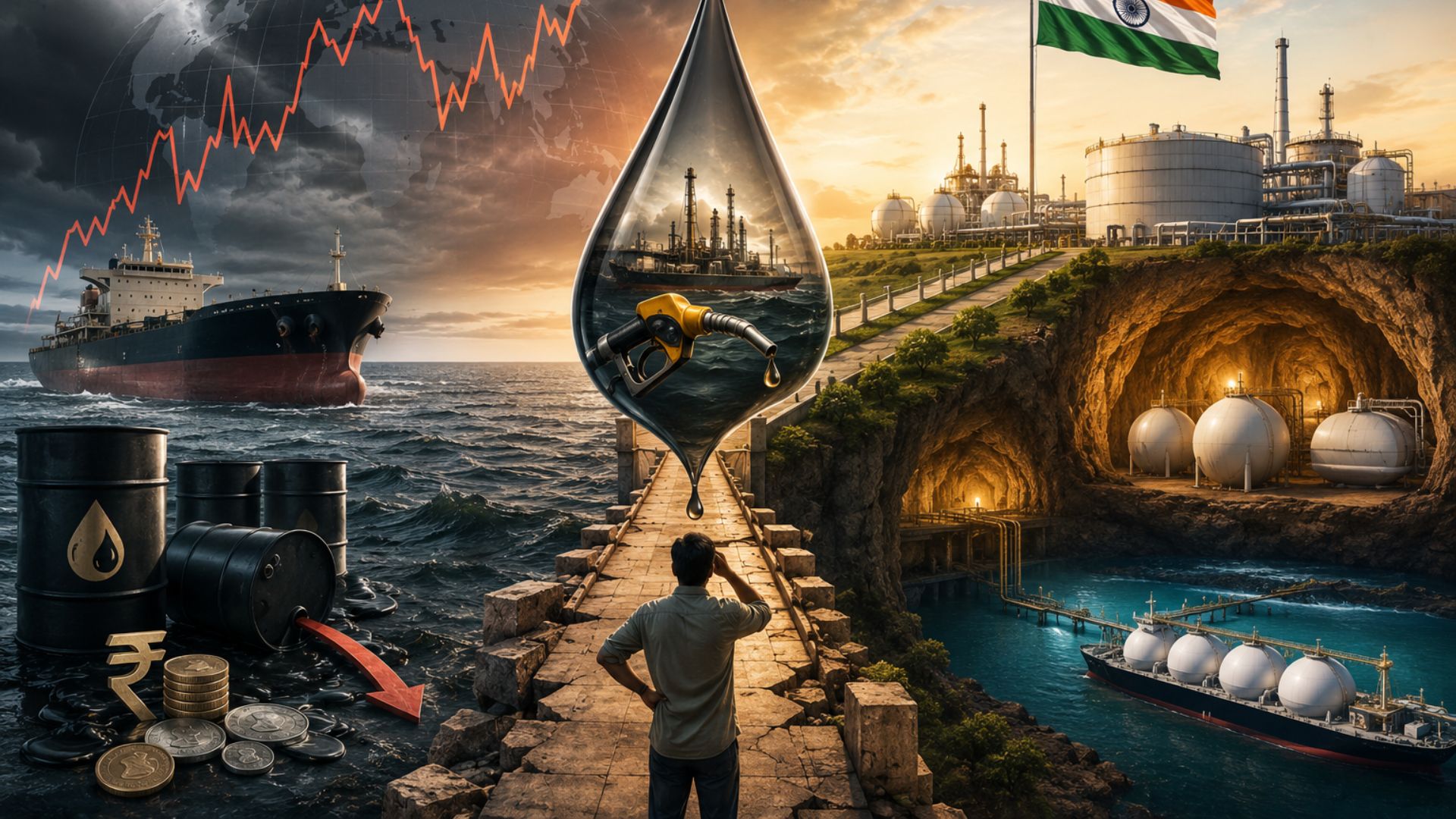
India's Strategic Petroleum and Gas Reserves: A Critical Review

"India's inadequate strategic petroleum and gas reserves — a problem the country could have addressed decades earlier."
Last week's hike in retail petroleum prices — the first in four years — was anticipated. Public sector oil marketing companies had been absorbing heavy under-recoveries as crude prices surged. The government had been signalling the move for months and timed it after five State Assembly results. But the price hike itself is a symptom. The deeper problem it exposes is structural: India, the world's third-largest automobile market, has dangerously thin strategic energy reserves.
What India Has — and What It Needs
India's Strategic Petroleum Reserve (SPR) programme was conceived after the post-1991 balance of payments crisis and formalised in the early 2000s. Today it holds:
India's Strategic Petroleum Position:
- SPR capacity: ~36.7–39 million barrels
- Daily consumption: ~5.5 million barrels per day (mbpd)
- SPR cover: ~7 days of consumption
- Combined cover (SPR + OMC inventories + import cover): ~70+ days
- IEA recommended minimum: 90 days
Seventy days sounds substantial — until you compare it with peer economies:
Global SPR Comparison:
- USA: ~400 million barrels currently; ~20 days consumption cover
  (peak capacity 714 million barrels — 18x India's reserve)
  US oil output: ~13 mbpd (world's largest producer)
  Total system cover: 90+ days
- China: ~900 million barrels
  Comparable import dependence to India
  Total system cover: 90+ days
- India: ~36.7–39 million barrels
  Cover: ~7 days SPR alone
India is the world's third-largest automobile market. Its reserve infrastructure belongs to a much smaller economy.
The LPG and LNG Gap: India's Most Exposed Flank
The petroleum reserve deficit is serious. The gas reserve deficit is alarming:
LPG:
- India's total LPG storage: ~1.4 lakh tonnes
- Daily LPG consumption: ~80,000 tonnes
- This means India holds barely 1.75 days of LPG reserves — more than half its reserve capacity consumed in a single day
LNG:
- India has no underground LNG storage
- Relies entirely on stocks at regasification terminals — Petronet LNG and BPCL facilities
- LNG is critical for fertilizer production — making this a food security vulnerability, not just an energy one
- Both the US and China have made heavy investments in underground LNG storage
What Advanced Economies Did Differently
The contrast in strategic preparedness is sharp and instructive:
- The US built its SPR after the 1973 oil shock — a crisis that directly demonstrated the cost of supply vulnerability. It never forgot the lesson.
- The EU, following the Russia-Ukraine war, rapidly restructured its energy dependence on Russian gas and built strategic buffers — demonstrating institutional agility when existential energy risk became undeniable
- China combined large strategic reserves with strategic procurement autonomy — its defiance of American sanctions on Russian oil delivered significant cost advantages during the supply disruption period
As the article notes: "India would have benefited too, had it maintained greater strategic autonomy." Strategic reserves and strategic procurement independence reinforce each other — one enables the other.
Why This Matters Now
Several converging pressures have made India's reserve inadequacy acutely visible:
- Crude price surge following the US-Israel war against Iran — up 53% since the conflict began
- Rupee depreciation — a weakening currency makes every import barrel more expensive in domestic terms
- April inflation prints — energy price pass-throughs feeding into broader price levels
- OMC under-recoveries — public sector companies absorbing losses that the thin reserve buffer cannot help hedge against
- PM's austerity appeal — a Head of Government asking citizens to reduce petroleum consumption is an extraordinary signal of reserve stress
Way Forward
- Expand SPR capacity towards the IEA-recommended 90-day cover — prioritising underground cavern storage at Visakhapatnam, Mangaluru, and Padur, with new sites identified
- Build dedicated LPG strategic reserves — current 1.75-day cover is critically inadequate for a cooking fuel used by over 30 crore households
- Invest in underground LNG storage — essential for fertilizer security, industrial use, and city gas distribution resilience
- Diversify crude sourcing and build long-term supply contracts to reduce spot market exposure during price spikes
- Enable strategic autonomy in procurement — India must develop the institutional capacity to make independent procurement decisions during sanctions environments, as China has demonstrated
- Public-private partnership in storage infrastructure — given the capital intensity of underground storage, private sector participation with regulatory oversight must be explored
Conclusion
A nation that imports over 85% of its crude oil, holds barely seven days of strategic petroleum reserves, and has no underground LNG storage is structurally exposed to every global energy disruption. The 1973 oil shock built America's SPR. The 1991 crisis gave India the idea — but not the follow-through. Decades later, as fuel prices rise, the rupee weakens, and the Prime Minister appeals for austerity, the cost of that incomplete response is becoming visible. Strategic energy reserves are not a luxury infrastructure project. They are the foundation of economic sovereignty.
Attribution
Original content sources and authors

Syllabus classification
How this article maps to GS papers
Main syllabus
GS3InfrastructureQuick Q&A
What are Strategic Petroleum Reserves (SPR), and why are they critical for India's energy security?
For an import-dependent country like India, which relies on foreign sources for nearly 85% of its crude oil needs, SPRs are essential to protect the economy from external shocks. Oil is central not only for transport but also for industrial production, fertilizers, and inflation management. Any sudden rise in global prices directly impacts India’s current account deficit, exchange rate, and household expenditure.
Importance of SPR:
- Ensures continuity during global supply disruptions
- Reduces vulnerability to geopolitical conflicts
- Stabilises domestic fuel prices
- Supports strategic autonomy in foreign policy
Why is India’s current petroleum reserve capacity considered inadequate despite having over 70 days of total stock cover?
Commercial inventories are tied to routine market operations and cannot fully substitute strategic reserves during prolonged geopolitical disruptions. In contrast, advanced economies maintain dedicated reserves beyond the 90-day benchmark recommended by the International Energy Agency. This gives them flexibility to negotiate long-term contracts and absorb price shocks.
Concerns include:
- Low sovereign control over total reserves
- High import dependency
- Limited storage for LPG and LNG
- Exposure to global shipping disruptions
How do inadequate petroleum and gas reserves affect India’s macroeconomic stability?
Inadequate reserves limit the government’s ability to delay or smooth domestic price hikes. This often forces politically sensitive fuel price revisions, as seen after the recent petroleum price increase. Such increases can trigger cost-push inflation and reduce purchasing power.
Macroeconomic effects:
- Higher inflation
- Rupee depreciation
- Increased subsidy burden
- Fiscal stress on OMCs
What explains the greater vulnerability of India in LPG and LNG compared to crude oil reserves?
This is problematic because LNG is critical for power generation, urban energy use, and fertilizer production. Fertilizer manufacturing depends on natural gas feedstock, meaning any disruption affects agriculture and food security. Unlike the U.S., China, or the EU, India has not invested significantly in underground gas storage infrastructure.
Reasons for vulnerability:
- Insufficient storage investment
- Rapid rise in domestic demand
- No underground LNG reserve facilities
- Dependence on spot market imports
Critically analyse whether India’s energy security strategy has kept pace with its economic growth.
The government has expanded refining capacity and diversified crude sources, but storage and reserve planning remain limited. The focus has often been on short-term price management rather than structural resilience. This weakens strategic autonomy and increases vulnerability to external conflicts.
Strengths:
- Diversified crude import sources
- Growing refining capability
- SPR infrastructure established
- Insufficient reserve size
- Weak gas storage systems
- High import dependence
As an energy policy advisor, what measures would you recommend to strengthen India’s strategic petroleum and gas resilience?
Second, India should negotiate long-term supply contracts with multiple producers while strengthening strategic autonomy in procurement decisions. Simultaneously, reducing dependence through electric mobility, renewable energy, and biofuels can lower import vulnerability.
Recommended actions:
- Expand SPR capacity substantially
- Create underground LNG storage
- Strengthen long-term energy contracts
- Promote domestic exploration
- Accelerate renewable transition
Practice questions
1 question for mains preparation