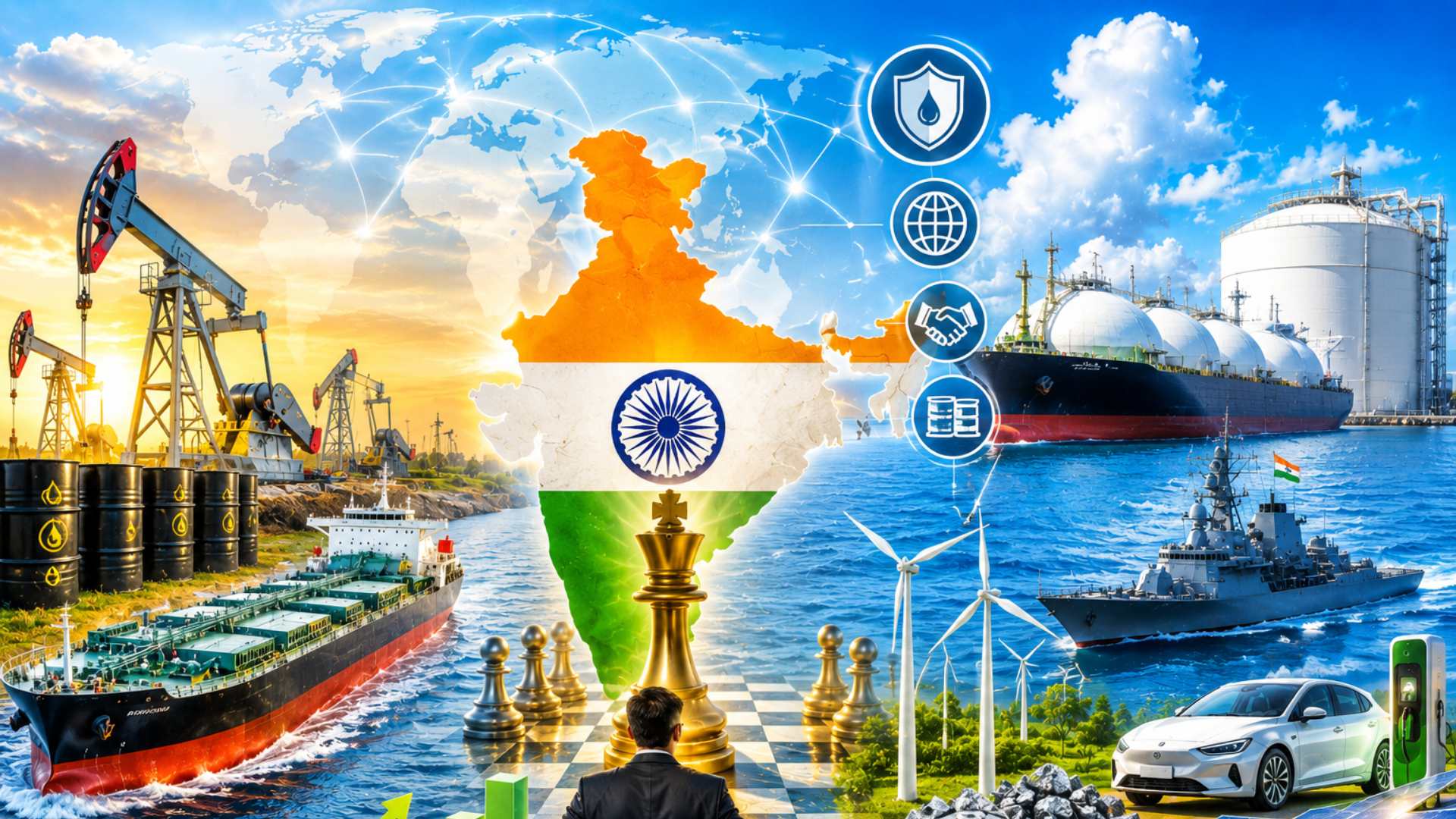
India's Energy Security in a Fractured World Order

Introduction
"Energy security can no longer be defined solely as purchasing fuel at the lowest possible price. It now rests on resilience, diversification, and protection of macroeconomic stability." — IEA Director General
The West Asia conflict has exposed the structural fragility of India's energy imports, with Brent crude spiking to dollar 109/barrel (peak ~dollar 120). India, importing 89.4% of its crude needs, faces GDP growth moderation from 7.4% (FY26) to 6.5% (FY27) and inflation rising from 2.3% to 4.4%. The IEA has called the current geoeconomic crisis more severe than the combined shocks of 1973, 1979, and 2022 combined.
| Indicator | FY26 | FY27 (Projected) |
|---|---|---|
| GDP Growth | 7.4% | 6.5% |
| Inflation | 2.3% | 4.4% |
| Brent Crude (peak) | ~$120/barrel | Stabilised ~$109 |
Background: Collapse of the Old Energy Order
Two successive shocks have dismantled the pre-existing energy market architecture:
Russia-Ukraine War (2022): Exposed pipeline dependency. Europe, which once sourced 45% of its gas from Russia, cut that to 12% by 2025. EU gas consumption fell 20% (2021–2024); LNG imports declined 18%. Europe accepted LNG terminal utilisation as low as 52% — paying an insurance premium for supply security.
West Asia Conflict (2025–26): Exposed maritime dependency. The Strait of Hormuz, through which ~25% of global crude transits, became a critical chokepoint again. Indian LPG carriers carrying 97,000 metric tonnes of cargo required naval escort under Operation Sankalp.
Key Concepts
Strategic Reserves vs. Tactical Diversification
| Country | Strategy | Scale |
|---|---|---|
| Japan | Stockpiling | 470 million barrels (254 days) |
| South Korea | Non-Hormuz contracts | 273 million barrels secured |
| China | Long-term LNG contracts | ~25 MMT/year locked in |
| India | Supplier diversification | Russia: 2% (pre-2022) → 36% (FY25) |
India's approach has been optionality over stockpiling — switching suppliers tactically rather than building strategic buffers.
India's Import Basket (FY2024-25)
- Russia: ~36% (largest single supplier)
- Gulf: Iraq, Saudi Arabia, UAE (collectively significant)
- Others: USA and diversified sources
India's Strategic Importance in Global Demand
OPEC projects India's oil consumption at 5.74 mb/d (2025) and 5.99 mb/d (2026). The IEA projects Indian crude demand growth at 130 kb/d vs. China's 80 kb/d. As Chinese demand plateaus, India is now one of the few large engines of incremental global oil demand — giving it rare geopolitical leverage with exporters.
Implications and Challenges
1. Structural Vulnerability: High Import Dependence India produced only 28.7 MMT of crude domestically in FY25 against an import dependence of 89.4%. Freight rates, exchange rate fluctuations, and geopolitical choke-points directly transmit into domestic inflation.
2. Geographic Constraint: Hormuz Dependency ~45% of India's crude imports transit through the Strait of Hormuz. Diversification of suppliers does not resolve chokepoint vulnerability — the maritime route remains the weak link.
3. Energy Transition Paradox Solar, EV, and battery expansion reduces oil dependency but creates a new mineral dependency:
| Critical Mineral | China's Control | India's Domestic Processing |
|---|---|---|
| Rare Earths | >91% global production | <5% of 2035 projected need |
| Lithium, Cobalt, Nickel | Dominant processing | Negligible |
India risks trading oil dependence for critical mineral dependence — both concentrated in geopolitically sensitive supply chains.
4. Strategic Reserves Gap Japan holds 254 days of consumption in reserves. India's Strategic Petroleum Reserve (SPR) capacity remains far below comparable economies, limiting its crisis buffer.
Way Forward
→ Scale up Strategic Petroleum Reserves — move beyond tactical supplier switching to structural buffer-building.
→ Reduce oil intensity in transport — accelerate EV penetration, expand public transit, promote CNG/biofuel blends.
→ Strengthen maritime resilience — expand the scope of Operation Sankalp-type frameworks; deepen Indian Ocean naval partnerships (Quad, IORA).
→ Secure critical mineral supply chains — fast-track bilateral mineral partnerships (Australia, Africa), develop domestic processing capacity for battery-grade minerals.
→ Deepen non-Hormuz routing — explore overland and alternative sea routes; expand Iran-Chabahar and Central Asia connectivity.
Conclusion
-
India has navigated successive energy shocks with commendable tactical agility — leveraging its status as the world's third-largest consumer to diversify suppliers and extract geopolitical optionality.
-
However, tactical flexibility is not strategic security. The real test of India's energy policy is not whether it can switch suppliers during a crisis, but whether future crises will impose lower economic costs on Indian households and growth.
-
This demands a shift from reactive procurement to proactive resilience — through deeper reserves, reduced oil intensity, maritime security, and mineral supply chain sovereignty. Energy security, in the 21st century, is fundamentally an issue of macroeconomic sovereignty.
Attribution
Original content sources and authors


Syllabus classification
How this article maps to GS papers
Main syllabus
GS3InfrastructureQuick Q&A
What is meant by energy security in the contemporary geopolitical context, and how has its definition evolved?
The breakdown of the old energy market order highlights this transformation. For example, Europe reduced its dependence on Russian gas from 45% to 12% not merely by seeking cheaper alternatives but by diversifying sources and even maintaining underutilized LNG infrastructure as a form of insurance. Similarly, countries like Japan and South Korea have focused on stockpiling and diversifying supply routes rather than relying on efficiency alone.
For India, energy security now involves managing a complex mix of import dependence, supply chain risks, and geopolitical uncertainties. With over 85% of crude oil imported and a large share transiting through chokepoints like the Strait of Hormuz, India must prioritize strategic reserves, diversified sourcing, and reduced vulnerability to external shocks. Thus, energy security today is less about minimizing costs and more about ensuring long-term stability and adaptability in an uncertain global environment.
Why are geopolitical shocks in regions like West Asia transmitted rapidly to India’s domestic economy?
The impact is not limited to the energy sector alone. Rising crude prices lead to inflationary pressures, as fuel costs influence transportation, manufacturing, and food prices. This explains why India’s economic growth is projected to slow from 7.4% to 6.5%, while inflation may rise from 2.3% to 4.4% due to such disruptions. Additionally, exchange rate fluctuations further amplify the impact, making imports more expensive.
Another factor is the increasing integration of global markets. Financial markets, trade flows, and investor sentiment react quickly to geopolitical uncertainties, causing capital flow volatility. Thus, India’s vulnerability arises from a combination of import dependence, strategic chokepoints, and global economic interlinkages, making it highly sensitive to external shocks.
How has India adapted to the changing global energy market, and what strategies has it employed to enhance resilience?
Another key strategy has been leveraging its position as a major demand center. With India emerging as one of the fastest-growing oil consumers, its demand growth provides it with bargaining power in a relatively weaker global market. This allows India to negotiate better terms and maintain supply stability even during disruptions. Additionally, India has shown operational agility, such as rerouting supplies and ensuring naval protection for shipments during crises like Operation Sankalp.
However, India’s approach is largely tactical rather than structural. While diversification and flexibility help manage short-term shocks, long-term resilience requires investments in strategic reserves, domestic production, renewable energy, and infrastructure. Thus, India’s adaptation reflects a balance between immediate crisis management and gradual structural transformation.
Critically analyse the strengths and vulnerabilities of India’s current energy strategy.
However, significant vulnerabilities persist. India’s crude oil import dependence has reached nearly 89.4%, exposing it to global price volatility, currency fluctuations, and logistical disruptions. Geographic constraints, such as reliance on chokepoints like the Strait of Hormuz, cannot be easily bypassed despite diversification efforts. Additionally, emergency measures like naval escorts for LPG shipments highlight the persistent risks in maritime supply chains.
Another emerging vulnerability lies in the energy transition. While shifting towards renewables reduces oil dependence, it increases reliance on critical minerals like lithium and cobalt, where global supply chains are dominated by countries like China. Thus, India’s strategy is strong in managing short-term shocks but requires deeper structural reforms to address long-term risks and ensure sustainable energy security.
What lessons can India learn from the energy strategies of countries like Europe, China, Japan, and South Korea?
Asian economies provide additional insights. China has secured long-term LNG contracts, ensuring stable supply over time. Japan has built substantial strategic reserves, equivalent to 254 days of consumption, while South Korea has diversified supply routes to reduce dependence on chokepoints like the Strait of Hormuz. These approaches highlight the importance of long-term planning, stockpiling, and route diversification.
For India, the key takeaway is the need to move beyond short-term adjustments and adopt a more institutionalized approach to energy security. This includes expanding strategic reserves, securing long-term contracts, investing in infrastructure, and reducing demand intensity. Learning from these examples can help India transition from tactical flexibility to structural resilience.
Analyse India’s response to a hypothetical disruption in the Strait of Hormuz as a case study of energy resilience.
India’s immediate response would likely involve drawing from strategic petroleum reserves, diversifying supply routes, and increasing imports from alternative sources such as Russia, the U.S., or Africa. Operational measures, such as naval escorts similar to Operation Sankalp, would be critical to ensure the safe passage of energy shipments. Additionally, diplomatic engagement with key stakeholders in the region would play a crucial role in stabilizing supplies.
However, this scenario also highlights structural gaps. Strategic reserves may only provide temporary relief, and alternative routes may not fully compensate for disrupted supplies. This underscores the need for long-term measures such as expanding reserves, reducing oil intensity, and strengthening renewable energy capacity. The case study demonstrates that while India has the capability to manage short-term crises, building systemic resilience remains an ongoing challenge.
Practice questions
4 questions for mains preparation