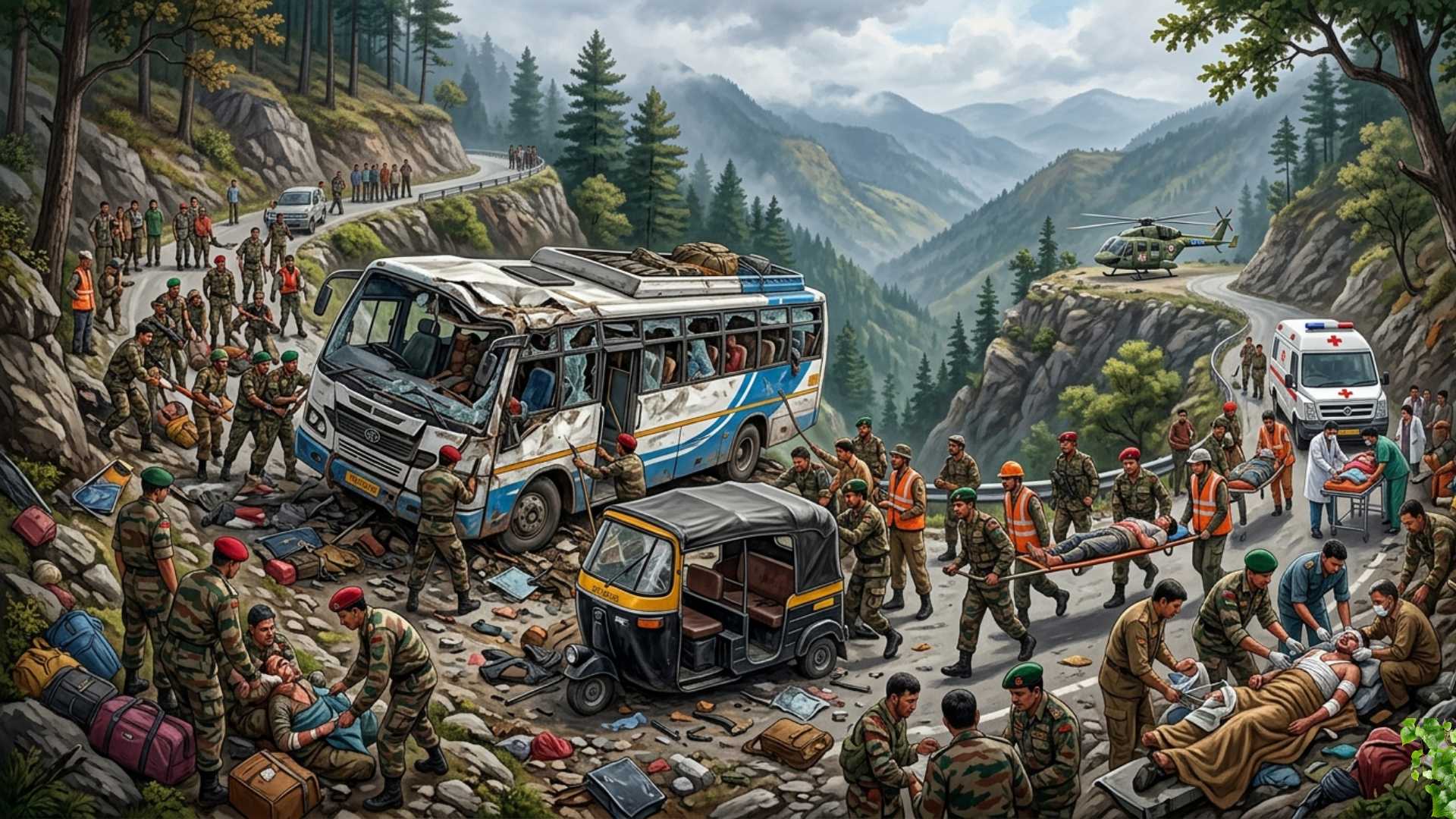
Tragic Bus Accident in Udhampur Claims 21 Lives and Injures Over 61

Introduction
On April 20, 2026, an overcrowded passenger bus plunged 60–70 feet into a gorge in Kagort village, Udhampur district, Jammu & Kashmir — killing 21 people and injuring 61 others. The bus, en route from Ramnagar to Udhampur, lost control at a sharp turn, also crushing an autorickshaw. India records over 1.5 lakh road accident deaths annually — the highest in the world — with hill road accidents in J&K, Himachal Pradesh, and Uttarakhand forming a disproportionate share of fatalities.
| Detail | Figure |
|---|---|
| Deaths | 21 |
| Injured | 61+ |
| Plunge depth | 60–70 feet |
| PM ex gratia (per deceased) | ₹2 lakh (PMNRF) |
| J&K Govt ex gratia (deceased) | ₹2 lakh |
| J&K Govt ex gratia (seriously injured) | ₹1 lakh |
| J&K Govt ex gratia (minor injuries) | ₹25,000 |
| Army teams mobilised | 10 (DOGRA Regiment + Gorkha Rifles) |
Background & Context
Road accidents in mountainous terrains of India — particularly J&K, Himachal Pradesh, Uttarakhand, and the Northeast — follow a recurring pattern: overcrowded buses + sharp curves + inadequate road engineering + driver fatigue + absent crash barriers. Udhampur district sits on the Jammu–Srinagar National Highway corridor, one of India's most strategically and economically critical but physically challenging road networks.
The Army's first-responder role in this incident — with Gorkha Rifles troops reaching the site before civil authorities — highlights both the operational capability of defence forces in remote terrains and the gap in civilian disaster response infrastructure in hill districts.
Key Concepts
Overcrowding as Structural Risk The bus was explicitly described as overcrowded — a chronic violation on hill routes where demand exceeds transport supply, operators exceed passenger limits for revenue maximisation, and enforcement is absent.
Sharp Turn / Hairpin Bend Risk Mountain roads in J&K feature acute gradient changes and hairpin bends with limited sight distance. Driver error at such points — especially with overloaded vehicles — is the leading proximate cause of hill road accidents.
Ad-hoc Incident Control Centre Army established a field coordination centre under a Commanding Officer — a Civil-Military coordination model for disaster response that civilian SDRF frameworks should institutionalise more formally.
Ex Gratia vs. Structural Reform Both Centre (₹2 lakh via PMNRF) and J&K government announced ex gratia payments — the standard post-accident political response. Ex gratia addresses consequence, not cause — a governance pattern that repeats after every major road accident.
Disaster Response — What Worked, What Didn't
WHAT WORKED:
Gorkha Rifles troops (en route to training)
→ First responders before civil authorities ✓
→ 10 rescue teams mobilised rapidly ✓
→ IAF assets kept on standby for air evacuation ✓
→ Ad-hoc Incident Control Centre established ✓
→ Civil-Military coordination effective ✓

WHAT FAILED:
Overcrowded bus operating on hill route ✗
No crash barrier at sharp turn in Kagort village ✗
No real-time vehicle tracking/overload detection ✗
Civil SDRF not first on scene ✗
Post-accident response = condolences + ex gratia
(same pattern as every previous hill accident) ✗
Structural Causes of Hill Road Accidents in India
| Factor | Manifestation |
|---|---|
| Overcrowding | Revenue maximisation overrides safety; weak enforcement |
| Road engineering gaps | Absent crash barriers, guardrails on hill bends |
| Driver fatigue | Long routes, inadequate rest, no monitoring |
| Vehicle fitness | Overaged buses, poor brake maintenance on steep descents |
| Terrain challenges | Sharp gradients, hairpin bends, narrow carriageways |
| Weather factors | Rain, fog, landslides on J&K routes seasonally |
| Weak SDRF capacity | First response dependent on Army in remote areas |
Regulatory & Policy Framework
| Policy/Body | Role |
|---|---|
| Motor Vehicles Act, 1988 (amended 2019) | Overloading penalties, fitness certificates, licensing |
| National Road Safety Policy, 2010 | Framework for road safety governance |
| MV Amendment Act, 2019 | Increased penalties, vehicle recall, good samaritan protection |
| NHAI | National highway engineering standards including crash barriers |
| SDRF (State Disaster Response Force) | First civilian responder for accidents |
| Vahan & Sarathi Portals | Vehicle registration and driver licensing databases |
| BharatNCRAP | Vehicle safety rating system (nascent) |
Critical gap: MV Amendment Act 2019 increased penalties but did not mandate real-time vehicle tracking, overload sensors, or driver fatigue monitoring on hill routes — where these are most needed.
Civil-Military Coordination — A Governance Lesson
The Udhampur incident demonstrates a model worth institutionalising:
Army troops (first on scene)
        +
SDRF + Police + Health Dept
        +
IAF (air evacuation standby)
        +
Local civilians
        =
Effective multi-agency rescue
Policy recommendation: J&K, Himachal Pradesh, and Uttarakhand should establish formal pre-disaster Civil-Military coordination protocols for highway accident response — not leave it to chance proximity of training troops.
Conclusion
The Udhampur bus accident is not an isolated tragedy — it is the latest episode in India's chronic hill road safety crisis. When Army training troops become the most reliable first responders because civil infrastructure is absent, and when the government's primary post-accident tool is ex gratia rather than enforcement reform, the pattern will repeat. Meaningful change requires three simultaneous interventions: engineering safer hill roads (crash barriers, gradient management), enforcing vehicle fitness and overloading laws with technology (real-time tracking, weight sensors), and building civilian first-response capacity in hill districts that matches the Army's demonstrated effectiveness. Condolences are not a road safety policy.
Attribution
Original content sources and authors


Syllabus classification
How this article maps to GS papers
Main syllabus
GS3InfrastructureQuick Q&A
What are the key factors that contribute to road accidents in hilly terrains like Jammu and Kashmir?
Human and vehicular factors: Driver fatigue, over-speeding, and lack of specialized training for hill driving significantly increase accident risks. Overcrowding, as seen in this case, can also destabilize vehicles and reduce maneuverability. Mechanical failures, especially in braking systems, are particularly dangerous in mountainous areas where constant braking is required.
Systemic issues: Weak enforcement of traffic regulations, inadequate public transport infrastructure, and limited emergency response capabilities in remote areas contribute to higher fatality rates. Addressing these factors requires a combination of engineering, enforcement, and awareness measures.
Why is disaster preparedness and coordinated response crucial in minimizing casualties in such accidents?
Importance of coordination: Effective disaster response requires coordination among multiple agencies such as the Army, police, SDRF, health departments, and even the Indian Air Force. The establishment of an incident control centre in this case ensured streamlined decision-making and resource allocation, demonstrating the importance of institutional preparedness.
Policy implications: India’s disaster management framework, guided by the Disaster Management Act, 2005, emphasizes preparedness and capacity building. However, gaps remain in implementation, especially in remote regions. Strengthening local response systems and investing in infrastructure can improve outcomes in such emergencies.
How can road safety measures be improved to prevent such accidents in vulnerable regions?
Enforcement and regulation: Strict enforcement of traffic laws, including limits on passenger capacity and mandatory vehicle fitness checks, is essential. Regular audits of public transport operators and stringent penalties for violations can deter risky behavior.
Capacity building and awareness: Training drivers specifically for hill driving, conducting public awareness campaigns, and integrating road safety education into school curricula can create a culture of safety. Programs like the National Road Safety Policy and Motor Vehicles (Amendment) Act, 2019 provide a framework, but effective implementation is key.
What are the underlying reasons for the high fatality rates in bus accidents in India?
Inadequate infrastructure and emergency care: Poor road conditions, lack of trauma care facilities, and delayed emergency response contribute to higher fatalities. In remote areas, access to hospitals and specialized care is often limited, increasing the risk of death from otherwise survivable injuries.
Systemic governance issues: Weak enforcement of safety norms, भ्रष्टाचार in vehicle fitness certification, and lack of accountability among operators further compound the problem. Addressing these issues requires systemic reforms, better governance, and investment in infrastructure.
Can you cite examples of similar accidents in India and the lessons learned from them?
Lessons learned: These accidents have highlighted the need for better road infrastructure, stricter enforcement of safety norms, and improved emergency response systems. For instance, after repeated accidents in Himachal Pradesh, authorities initiated road widening and installation of crash barriers in vulnerable stretches.
Policy responses: Initiatives like the National Road Safety Strategy aim to reduce road fatalities by 50% by 2030. However, translating policy into action remains a challenge, requiring coordination between central and state governments.
Critically analyze the effectiveness of India’s current road safety and disaster response framework.
Limitations: Despite these frameworks, implementation remains inconsistent. Issues such as poor inter-agency coordination, lack of trained personnel at the grassroots level, and inadequate funding hinder effectiveness. Rural and hilly areas are particularly vulnerable due to logistical challenges.
Way forward: A more decentralized approach, leveraging technology for real-time monitoring, and strengthening local governance structures can improve outcomes. Public participation and accountability mechanisms are also essential to ensure sustained improvements in road safety.
As a district administrator in a hilly region, what measures would you implement to prevent and respond to such accidents?
Emergency preparedness: Establishing well-equipped emergency response teams, conducting mock drills, and setting up incident control centres in vulnerable areas would enhance preparedness. Collaboration with local communities and training volunteers can further strengthen response capacity.
Long-term strategies: Promoting public awareness campaigns, integrating technology for monitoring traffic, and coordinating with state and central agencies for funding and expertise would be crucial. A holistic approach combining prevention, preparedness, and response can significantly reduce the impact of such tragedies.
Practice questions
1 question for mains preparation