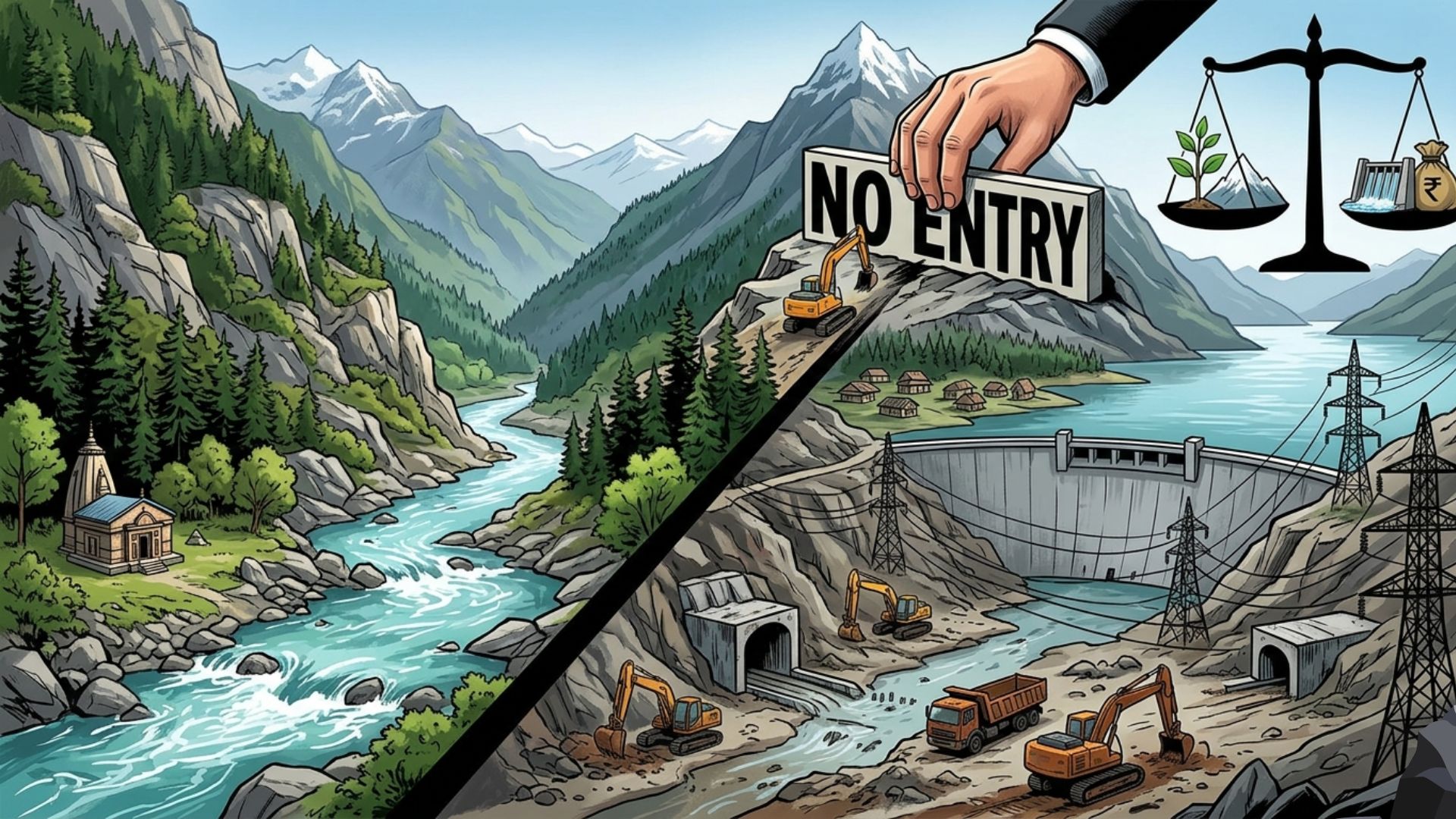
Centre Opposes New Hydel Projects in Upper Ganga
Government asserts no new hydroelectric projects will proceed in Uttarakhand's Alaknanda and Bhagirathi river basins.
4 mins read

The Trigger: 2013 Kedarnath Floods
- June 2013 Kedarnath floods killed at least 5,000 people
- Supreme Court halted hydroelectric development in Uttarakhand and ordered the Environment Ministry to examine whether these projects amplified the disaster
- This began a decade-long legal and expert battle
What Happened on May 19, 2025?
- Three ministries — Environment, Jal Shakti, and Power — filed a common affidavit in the Supreme Court
- Unified position: no new hydroelectric projects to be permitted in the Alaknanda and Bhagirathi river basins of Uttarakhand
- Notable because as recently as November 2024, the Power Ministry had argued for clearing eight new projects — a sharp reversal
The Seven Projects Allowed to Continue
Only projects already commissioned or near-complete were exempted. Combined capacity: ~2,150 MW
Project                  River          Capacity    Status
──────────────────────────────────────────────────────────
Tehri Pumped Storage     Bhagirathi     1,000 MW    Commissioned
Tapovan Vishnugad        Dhauliganga      520 MW    74–80% complete
Vishnugad Pipalkoti      Alaknanda        444 MW    74–80% complete
Singoli Bhatwari         Mandakini         99 MW    Commissioned
Phata Byung              Mandakini         76 MW    Commissioned
Madhmaheshwar            —               Small      Commissioned
Kailganga-II             —               Small      74–80% complete
Why these seven?
- None falls within the Bhagirathi Eco-Sensitive Zone
- None was flagged adversely by expert bodies
- Halting them would strand massive public and private investment with no real environmental gain
The Expert Committee Trail
- Expert Body-I — Ravi Chopra (2014): Examined 24 projects; found 23 would cause severe ecological damage
- Expert Body-II — B.P. Das (2020): More permissive; examined 70 projects; recommended 26 for implementation — Das had dissented from Body-I's findings
- Somanathan Committee (2024): Constituted by the Supreme Court; chaired by Cabinet Secretary T.V. Somanathan; narrowed field to 5 projects — Bowala Nandprayag, Devsari, Bhyundar Ganga, Jhalakoti, Urgam-II — saying benefits outweigh drawbacks
- Centre's final call: Rejected even these five
Why Did the Centre Reject Even the Five?
- "Bumper-to-bumper" dams: Projects in close succession amplify flood and ecological risk rather than spread it
- Seismic fragility: Upper Himalayan zone is among the world's most seismically active regions
- Accumulated disasters:
- 2013 Kedarnath cloudburst
- February 2021 Rishiganga flood — severely damaged the under-construction Tapovan Vishnugad project
- August 2025 Dharali flash flood
- Government concluded the foundational concerns of the 2013 Supreme Court judgment remain "fully subsisting"
"This is a wise and welcome step from the government that came out after more than a decade of wait and several expert recommendations." — Mallika Bhanot, environmental activist & member, Bhagirathi Eco-sensitive Zone monitoring committee
Key Tensions the Decision Navigates
- Uttarakhand's energy deficit: State spends over ₹1,000 crore annually purchasing electricity from outside; consistently backed Expert Body-II
- Activist pressure (opposite side): Groups like Matri Sadan argued even the seven cleared projects should be stopped — a warming Himalaya makes all such infrastructure dangerous
- Jal Shakti's own contradictions: Once opposed projects "whatever may be the status of construction" — before settling on permitting only the seven advanced ones
- Transparency gap: In 2020, the Centre accepted only 7 of Expert Body-II's 26 recommendations — the basis for excluding the other 19 was never formally explained
Way Forward
- Complete the seven permitted projects with updated seismic and hydrological assessments — sunk cost alone cannot be the justification
- Address Uttarakhand's energy gap through:
- Rooftop solar scaling
- Small run-of-river micro-hydel systems below ecologically sensitive thresholds
- Pumped-storage upgrades to existing reservoirs
- Government must place full reasoning on record before the Supreme Court — the transparency deficit from the Expert Body-II era must not repeat
- Supreme Court's continued oversight remains a critical institutional safeguard
Conclusion
- The 2013 Kedarnath disaster was not a freak event — it was a warning about cumulative ecological risk
- After a decade, three flood disasters, and multiple expert panels, India's three key ministries have finally aligned on an ecologically cautious position
- The challenge ahead: hold that line while solving the real energy needs of a power-deficient hill state caught between development and Himalayan fragility
Attribution
Original content sources and authors


Syllabus classification
How this article maps to GS papers
Main syllabus
GS3InfrastructureQuick Q&A
What is the significance of the Union government’s decision to oppose new hydroelectric projects in the upper reaches of the Ganga in Uttarakhand?
The Union government’s decision marks a major shift in India’s environmental governance and river management policy. For the first time, the Ministries of Environment, Jal Shakti, and Power have jointly taken a restrictive stand before the Supreme Court against permitting new hydroelectric projects in the Alaknanda and Bhagirathi basins. This is significant because hydroelectricity has traditionally been viewed as a clean and renewable source of energy essential for economic development and energy security.
The decision reflects growing recognition of the ecological fragility of the Himalayan region. The upper Ganga basin is highly vulnerable to seismic activity, glacial lake outburst floods, landslides, and cloudbursts. Disasters such as the 2013 Kedarnath floods and the 2025 Dharali flash flood demonstrated how extensive dam construction and infrastructure activity can intensify environmental risks. The government’s reference to “bumper-to-bumper” dams highlights concerns regarding cumulative ecological stress rather than isolated project impacts.
From a governance perspective, the decision also reflects the growing role of the judiciary in environmental policymaking. The Supreme Court’s intervention after the Kedarnath disaster led to multiple expert committees and forced the Centre to justify its developmental choices. The current position indicates a shift toward the precautionary principle and sustainable development approach.
At the same time, the government has allowed seven advanced projects to continue. This demonstrates an attempt to balance environmental concerns with economic realities such as sunk investments, electricity generation needs, and contractual obligations. Thus, the decision represents a nuanced middle path between absolute conservation and unrestricted development.
The decision reflects growing recognition of the ecological fragility of the Himalayan region. The upper Ganga basin is highly vulnerable to seismic activity, glacial lake outburst floods, landslides, and cloudbursts. Disasters such as the 2013 Kedarnath floods and the 2025 Dharali flash flood demonstrated how extensive dam construction and infrastructure activity can intensify environmental risks. The government’s reference to “bumper-to-bumper” dams highlights concerns regarding cumulative ecological stress rather than isolated project impacts.
From a governance perspective, the decision also reflects the growing role of the judiciary in environmental policymaking. The Supreme Court’s intervention after the Kedarnath disaster led to multiple expert committees and forced the Centre to justify its developmental choices. The current position indicates a shift toward the precautionary principle and sustainable development approach.
At the same time, the government has allowed seven advanced projects to continue. This demonstrates an attempt to balance environmental concerns with economic realities such as sunk investments, electricity generation needs, and contractual obligations. Thus, the decision represents a nuanced middle path between absolute conservation and unrestricted development.
Why are hydroelectric projects in the Himalayan region becoming increasingly controversial in India?
Hydroelectric projects in the Himalayas have become controversial because they lie at the intersection of development, ecology, disaster management, and climate change. While hydropower contributes to renewable energy goals and regional development, critics argue that excessive dam construction in fragile mountain ecosystems creates long-term environmental and social risks.
The Himalayan region is geologically young and highly unstable. Large-scale tunnelling, blasting, deforestation, and river diversion can destabilize slopes and increase the likelihood of landslides and flash floods. The Kedarnath tragedy of 2013, which caused thousands of deaths, intensified scrutiny over the role of hydropower projects in aggravating disasters by obstructing river flow and depositing debris into river channels.
Climate change has further amplified these concerns. Rising temperatures are accelerating glacier melt and increasing the frequency of extreme weather events. Projects such as Tapovan Vishnugad, which suffered repeated flood-related damage, are often cited as examples of infrastructure vulnerability in a warming Himalaya. Environmental groups argue that traditional environmental impact assessments underestimate cumulative and climate-induced risks.
There are also social and cultural dimensions to the controversy. The Ganga is not merely a river but holds immense spiritual and cultural significance in India. Many activists and religious groups believe excessive damming undermines the river’s ecological integrity and sacred character.
On the other hand, supporters of hydropower emphasize energy security and economic needs. Uttarakhand remains power-deficit and spends heavily on electricity purchases. Hydropower offers employment, revenue generation, and low-carbon energy. Therefore, the controversy reflects the broader challenge of balancing sustainable development with environmental protection in ecologically sensitive regions.
The Himalayan region is geologically young and highly unstable. Large-scale tunnelling, blasting, deforestation, and river diversion can destabilize slopes and increase the likelihood of landslides and flash floods. The Kedarnath tragedy of 2013, which caused thousands of deaths, intensified scrutiny over the role of hydropower projects in aggravating disasters by obstructing river flow and depositing debris into river channels.
Climate change has further amplified these concerns. Rising temperatures are accelerating glacier melt and increasing the frequency of extreme weather events. Projects such as Tapovan Vishnugad, which suffered repeated flood-related damage, are often cited as examples of infrastructure vulnerability in a warming Himalaya. Environmental groups argue that traditional environmental impact assessments underestimate cumulative and climate-induced risks.
There are also social and cultural dimensions to the controversy. The Ganga is not merely a river but holds immense spiritual and cultural significance in India. Many activists and religious groups believe excessive damming undermines the river’s ecological integrity and sacred character.
On the other hand, supporters of hydropower emphasize energy security and economic needs. Uttarakhand remains power-deficit and spends heavily on electricity purchases. Hydropower offers employment, revenue generation, and low-carbon energy. Therefore, the controversy reflects the broader challenge of balancing sustainable development with environmental protection in ecologically sensitive regions.
How does the concept of sustainable development apply to the hydroelectric project debate in Uttarakhand?
Sustainable development refers to meeting present developmental needs without compromising the ability of future generations to meet their own needs. The Uttarakhand hydropower debate is a classic example of the tension between economic growth and ecological sustainability.
Hydroelectric projects provide several developmental benefits. They generate renewable energy, reduce dependence on fossil fuels, support industrial growth, and improve regional infrastructure. For a power-deficit State like Uttarakhand, hydropower is viewed as a strategic resource capable of generating revenue and supporting local employment.
However, sustainable development requires environmental limits to be respected. The upper Ganga basin is ecologically fragile, seismically active, and highly prone to climate-related disasters. Excessive dam construction can alter river ecosystems, reduce biodiversity, obstruct sediment transport, and increase disaster vulnerability. Expert committees after the Kedarnath floods highlighted that cumulative impacts of multiple projects can severely damage riverine ecology.
The government’s current position attempts to operationalize sustainable development through a balanced approach. It has allowed seven substantially completed projects to continue while rejecting new projects in sensitive zones. This reflects the principle of balancing environmental conservation with economic considerations such as sunk costs and energy needs.
The debate also demonstrates the importance of the precautionary principle. Where scientific uncertainty exists regarding irreversible ecological damage, policymakers are expected to act cautiously. In the Himalayan context, climate change and increasing extreme weather events strengthen the case for precautionary policymaking.
Ultimately, sustainable development in such regions requires integrated river basin management, stronger environmental impact assessments, community participation, and climate-resilient infrastructure planning. The Uttarakhand case illustrates that development cannot be measured solely in economic terms but must incorporate ecological security and long-term resilience.
Hydroelectric projects provide several developmental benefits. They generate renewable energy, reduce dependence on fossil fuels, support industrial growth, and improve regional infrastructure. For a power-deficit State like Uttarakhand, hydropower is viewed as a strategic resource capable of generating revenue and supporting local employment.
However, sustainable development requires environmental limits to be respected. The upper Ganga basin is ecologically fragile, seismically active, and highly prone to climate-related disasters. Excessive dam construction can alter river ecosystems, reduce biodiversity, obstruct sediment transport, and increase disaster vulnerability. Expert committees after the Kedarnath floods highlighted that cumulative impacts of multiple projects can severely damage riverine ecology.
The government’s current position attempts to operationalize sustainable development through a balanced approach. It has allowed seven substantially completed projects to continue while rejecting new projects in sensitive zones. This reflects the principle of balancing environmental conservation with economic considerations such as sunk costs and energy needs.
The debate also demonstrates the importance of the precautionary principle. Where scientific uncertainty exists regarding irreversible ecological damage, policymakers are expected to act cautiously. In the Himalayan context, climate change and increasing extreme weather events strengthen the case for precautionary policymaking.
Ultimately, sustainable development in such regions requires integrated river basin management, stronger environmental impact assessments, community participation, and climate-resilient infrastructure planning. The Uttarakhand case illustrates that development cannot be measured solely in economic terms but must incorporate ecological security and long-term resilience.
Critically analyze the role of expert committees in shaping environmental decision-making in India with reference to the Uttarakhand hydropower case.
Expert committees play an important role in India’s environmental governance by providing scientific and technical inputs for policymaking. In the Uttarakhand hydropower case, multiple expert bodies were constituted after the 2013 Kedarnath disaster to assess the ecological impact of hydroelectric projects in the upper Ganga basin.
The Ravi Chopra Committee (Expert Body-I) adopted a precautionary approach. It concluded that most projects studied would severely affect the ecology of the Alaknanda and Bhagirathi basins. Similarly, the IIT-Kanpur panel under Vinod Tare recommended that several projects should not proceed in their existing form. These reports emphasized cumulative ecological impacts and disaster vulnerability.
However, Expert Body-II under B.P. Das took a more permissive view. After examining 70 projects, it recommended many for implementation with modifications. This divergence illustrates how scientific assessments can vary depending on methodology, assumptions, and institutional priorities. Such inconsistencies sometimes create policy ambiguity and reduce public trust.
The role of the judiciary has been crucial in this process. The Supreme Court repeatedly sought expert evaluation before allowing projects to proceed. Judicial oversight ensured that environmental concerns were not ignored in favour of short-term economic gains.
At the same time, the case highlights limitations of expert committees. Their recommendations are often advisory and can be selectively accepted by governments. The Centre accepted only seven projects despite Expert Body-II recommending 26, without fully explaining the rationale. This raises questions about transparency and accountability in environmental governance.
Therefore, while expert committees are essential for evidence-based policymaking, their effectiveness depends on institutional independence, transparency, public participation, and implementation mechanisms. The Uttarakhand case demonstrates that scientific expertise alone cannot resolve environmental conflicts unless integrated with democratic accountability and long-term sustainability considerations.
The Ravi Chopra Committee (Expert Body-I) adopted a precautionary approach. It concluded that most projects studied would severely affect the ecology of the Alaknanda and Bhagirathi basins. Similarly, the IIT-Kanpur panel under Vinod Tare recommended that several projects should not proceed in their existing form. These reports emphasized cumulative ecological impacts and disaster vulnerability.
However, Expert Body-II under B.P. Das took a more permissive view. After examining 70 projects, it recommended many for implementation with modifications. This divergence illustrates how scientific assessments can vary depending on methodology, assumptions, and institutional priorities. Such inconsistencies sometimes create policy ambiguity and reduce public trust.
The role of the judiciary has been crucial in this process. The Supreme Court repeatedly sought expert evaluation before allowing projects to proceed. Judicial oversight ensured that environmental concerns were not ignored in favour of short-term economic gains.
At the same time, the case highlights limitations of expert committees. Their recommendations are often advisory and can be selectively accepted by governments. The Centre accepted only seven projects despite Expert Body-II recommending 26, without fully explaining the rationale. This raises questions about transparency and accountability in environmental governance.
Therefore, while expert committees are essential for evidence-based policymaking, their effectiveness depends on institutional independence, transparency, public participation, and implementation mechanisms. The Uttarakhand case demonstrates that scientific expertise alone cannot resolve environmental conflicts unless integrated with democratic accountability and long-term sustainability considerations.
As a district administrator in a Himalayan State, how would you balance developmental needs with ecological protection while evaluating a new hydropower proposal?
As a district administrator, balancing development with ecological protection would require adopting a sustainable and participatory governance approach. Hydropower projects can contribute to energy security, employment, and regional infrastructure, but in fragile Himalayan ecosystems, ecological risks must be carefully assessed before approval.
The first step would be conducting a rigorous environmental and social impact assessment. Instead of evaluating the project in isolation, cumulative impacts on river systems, biodiversity, forests, and local settlements must be studied. Independent scientific institutions, climate experts, and disaster management authorities should be involved in the assessment process.
Second, community participation would be essential. Local residents, environmental groups, religious stakeholders, and indigenous communities should be consulted through transparent public hearings. In Himalayan regions, rivers often have cultural and spiritual significance, and ignoring community concerns can lead to social conflict and loss of legitimacy.
Third, disaster resilience and climate adaptation must guide decision-making. The project should comply with seismic safety norms, flood-resilient engineering standards, and early warning systems. Lessons from disasters such as the Kedarnath floods and the Tapovan Vishnugad damage should shape policy choices.
Fourth, alternative development models should be explored. Instead of relying solely on large dams, smaller run-of-the-river projects, decentralized renewable energy, and solar power could reduce ecological disruption while meeting energy needs.
Finally, any decision must align with constitutional and legal principles such as sustainable development, intergenerational equity, and the precautionary principle. Development should not compromise ecological security and human safety. A balanced approach would therefore prioritize long-term resilience over short-term economic gains.
The first step would be conducting a rigorous environmental and social impact assessment. Instead of evaluating the project in isolation, cumulative impacts on river systems, biodiversity, forests, and local settlements must be studied. Independent scientific institutions, climate experts, and disaster management authorities should be involved in the assessment process.
Second, community participation would be essential. Local residents, environmental groups, religious stakeholders, and indigenous communities should be consulted through transparent public hearings. In Himalayan regions, rivers often have cultural and spiritual significance, and ignoring community concerns can lead to social conflict and loss of legitimacy.
Third, disaster resilience and climate adaptation must guide decision-making. The project should comply with seismic safety norms, flood-resilient engineering standards, and early warning systems. Lessons from disasters such as the Kedarnath floods and the Tapovan Vishnugad damage should shape policy choices.
Fourth, alternative development models should be explored. Instead of relying solely on large dams, smaller run-of-the-river projects, decentralized renewable energy, and solar power could reduce ecological disruption while meeting energy needs.
Finally, any decision must align with constitutional and legal principles such as sustainable development, intergenerational equity, and the precautionary principle. Development should not compromise ecological security and human safety. A balanced approach would therefore prioritize long-term resilience over short-term economic gains.
What are the major reasons behind the increasing judicial intervention in environmental matters in India?
Judicial intervention in environmental matters has increased in India because environmental degradation directly affects constitutional rights, public health, and sustainable development. The judiciary, particularly the Supreme Court and High Courts, has often stepped in when executive agencies failed to adequately protect ecological resources.
One major reason is the expanding interpretation of Article 21 of the Constitution. The right to life has been interpreted to include the right to a clean and healthy environment. This constitutional evolution has empowered courts to intervene in matters involving pollution, deforestation, mining, and river conservation.
In the Uttarakhand hydropower case, judicial intervention emerged after the 2013 Kedarnath disaster. Concerns were raised that unchecked hydropower expansion may have aggravated the impact of floods and landslides. The Supreme Court consequently constituted expert committees and sought detailed scientific assessments before permitting further development.
Another reason is institutional and regulatory weakness. Environmental clearances are sometimes criticized for being procedural rather than substantive. Expert reports may be ignored, compliance monitoring remains weak, and economic priorities often dominate ecological concerns. Courts therefore act as accountability mechanisms.
Public Interest Litigation (PIL) has also strengthened judicial activism. Environmental groups, activists, and citizens can directly approach courts on matters of ecological concern. In the Ganga basin case, activists such as Matri Sadan and Bharat Jhunjhunwala played an important role in sustaining public scrutiny.
However, judicial intervention also raises concerns regarding separation of powers. Critics argue that courts may sometimes enter domains requiring technical expertise or policy discretion. Nevertheless, in environmentally sensitive matters where irreversible damage is possible, judicial oversight has often served as an important safeguard for ecological justice and intergenerational equity.
One major reason is the expanding interpretation of Article 21 of the Constitution. The right to life has been interpreted to include the right to a clean and healthy environment. This constitutional evolution has empowered courts to intervene in matters involving pollution, deforestation, mining, and river conservation.
In the Uttarakhand hydropower case, judicial intervention emerged after the 2013 Kedarnath disaster. Concerns were raised that unchecked hydropower expansion may have aggravated the impact of floods and landslides. The Supreme Court consequently constituted expert committees and sought detailed scientific assessments before permitting further development.
Another reason is institutional and regulatory weakness. Environmental clearances are sometimes criticized for being procedural rather than substantive. Expert reports may be ignored, compliance monitoring remains weak, and economic priorities often dominate ecological concerns. Courts therefore act as accountability mechanisms.
Public Interest Litigation (PIL) has also strengthened judicial activism. Environmental groups, activists, and citizens can directly approach courts on matters of ecological concern. In the Ganga basin case, activists such as Matri Sadan and Bharat Jhunjhunwala played an important role in sustaining public scrutiny.
However, judicial intervention also raises concerns regarding separation of powers. Critics argue that courts may sometimes enter domains requiring technical expertise or policy discretion. Nevertheless, in environmentally sensitive matters where irreversible damage is possible, judicial oversight has often served as an important safeguard for ecological justice and intergenerational equity.
Practice questions
1 question for mains preparation