Petroleum Pricing, Energy Security & Fiscal Policy

Introduction
India imports over 85% of its crude oil, making fuel pricing a direct casualty of global geopolitics.
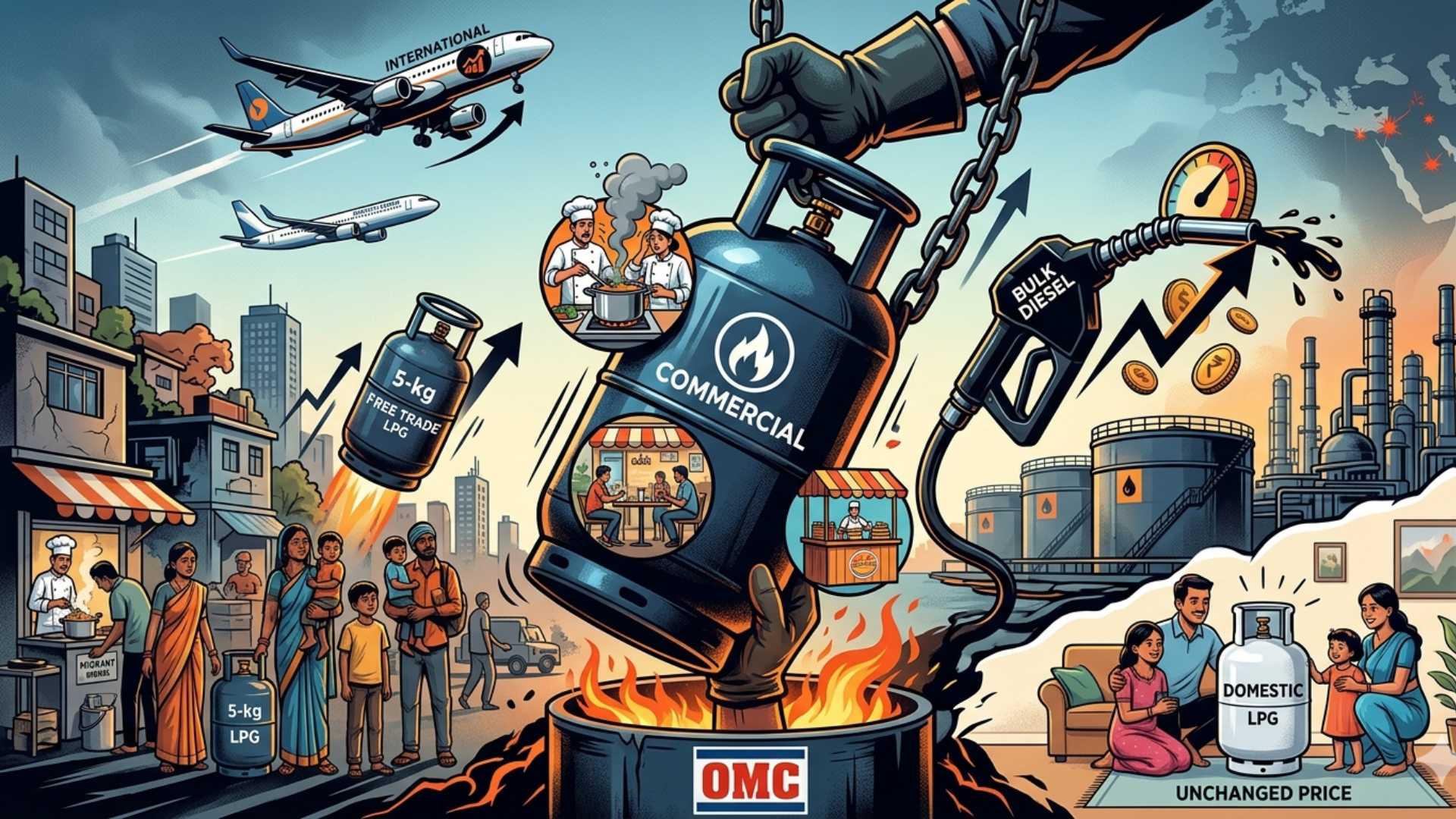
- The May 2026 revision — sharp hikes in commercial LPG, bulk diesel, and international ATF — reflects West Asia conflict spillovers and OMC balance sheet stress, while simultaneously protecting households and domestic aviation from the full market shock.
Key Price Changes (May 1, 2026)
| Fuel | Change |
|---|---|
| Commercial LPG | +₹993/cylinder |
| 5-kg Free Trade LPG | +₹261/cylinder |
| Bulk Diesel | +₹12/litre (now ₹149/litre) |
| ATF (international) | +$76.55/kilolitre |
| Domestic LPG, retail petrol/diesel, ATF (domestic carriers) | Unchanged |
Excise Duty on Exports revised downward:
| Product | Old Duty | New Duty |
|---|---|---|
| Diesel export | ₹55.5/litre | ₹23/litre |
| ATF export | ₹42/litre | ₹33/litre |
Background
Why now? The Iran-Israel war elevated crude benchmarks and disrupted West Asian supply. Commercial LPG already saw a ₹195.5 hike on April 1 — May's ₹993 hike is cumulative pass-through of a month-long geopolitical premium building on OMC balance sheets.
Why export duties were cut? High export duties were earlier imposed to retain fuel domestically during the supply crunch. The reduction signals domestic supply has stabilised — a direct policy reversal from April 11's stance.
Key Concepts
Under-Recovery: When OMCs sell below cost, they absorb the difference — eroding financials and requiring government bailouts via budgetary support or oil bonds.
Administered vs Market-Linked Pricing:
- Domestic LPG → administered (protected)
- Retail petrol/diesel → theoretically market-linked, but frozen during politically sensitive periods
- Commercial LPG, bulk diesel, ATF → market-linked, revised frequently
SAED (Windfall Tax): Excise duty on petroleum exports, imposed when refinery margins spike. Currently nil on petrol; reduced on diesel and ATF.
Petroleum outside GST: Keeps these products under Centre's unilateral excise control — enabling flexible duty adjustments without GST Council consensus.
Aviation Sector — Administered Relief
-
Despite ATF being market-linked, the government held domestic carrier prices unchanged in May — a deliberate intervention after Air India, IndiGo, and SpiceJet formally flagged operational viability concerns.
-
April 1's 9%+ hike was already framed by the Petroleum Ministry as only a "partial and staggered increase of 25% (only ₹15/litre)" — making May's freeze a direct policy response to sector distress, not routine pricing inaction.
Who Bears the Burden?
| Segment | Impact |
|---|---|
| Restaurants & hotels | Commercial LPG hike → food price inflation |
| Migrant/urban poor | 5-kg cylinder hike — no address proof for regular connection |
| Logistics/trucking | Bulk diesel hike → freight costs → supply chain inflation |
| International aviation | ATF hike → costlier international tickets |
| Domestic aviation | Relief — ATF unchanged; airlines had flagged operational viability |
| Households | Protected — domestic LPG and retail fuel unchanged |
5-kg LPG — Social Equity Concern Over 22.54 lakh kg sold in April. Serves urban migrants without address proof — the most administratively excluded urban poor. A ₹261 hike here is regressive — falling hardest on those least able to absorb it.
Structural Challenges
- 85%+ crude import dependence — West Asian conflicts directly translate into domestic inflation
- No GST on petroleum — no input tax credit for industries; cascading cost effect across sectors
- OMC boom-bust cycle — prolonged price freezes followed by sharp catch-up hikes damage long-term investment planning
- Regressive burden — commercial and 5-kg hikes disproportionately hurt small businesses and urban poor
Way Forward
- Include petroleum in GST — eliminates cascading costs, enables ITC
- LPG stabilisation fund — smooth price volatility instead of periodic shock hikes
- DBT for 5-kg cylinder users — Aadhaar-linked identification bypassing address-proof barrier
- Accelerate renewables — only structural solution to geopolitical price vulnerability
- Transparent OMC pricing — publish under-recovery data to depoliticise fuel pricing
Conclusion
-
India's May 2026 fuel pricing reveals a structural dilemma: protect consumers, maintain OMC health, manage revenues, and shield strategic sectors — all while absorbing geopolitical shocks beyond India's control.
-
The asymmetric approach — protecting households while passing costs to commercial users and migrants — exposes both the political economy of fuel pricing and its distributional consequences. Real energy security lies not in managing these trade-offs better, but in reducing the import dependence that makes them unavoidable.
Attribution
Original content sources and authors


Syllabus classification
How this article maps to GS papers
Main syllabus
GS3InfrastructureQuick Q&A
What are the recent changes in fuel pricing and excise duties in India, and what do they indicate about government policy?
On the taxation front, the government reduced excise duties on export of diesel and ATF, signaling a shift from its earlier stance of discouraging exports to ensure domestic availability. This suggests that supply conditions may have improved, or that the government is now prioritizing export competitiveness and foreign exchange earnings.
Overall, these changes indicate a nuanced policy approach where the government seeks to:
- Protect households from inflationary shocks
- Allow market-linked pricing for commercial users
- Adjust export policies based on supply-demand dynamics
Why has the government chosen not to increase domestic LPG and retail fuel prices despite rising global uncertainties?
From a policy perspective, the government often uses price controls or subsidies in essential commodities to ensure energy affordability and social welfare. Maintaining stable prices for petrol and diesel also helps in controlling transportation costs, which have a cascading effect on food and commodity prices.
Additionally, this approach reflects a balancing act between market forces and welfare objectives. While commercial users are exposed to price fluctuations, households are shielded to maintain economic stability. For example, during previous global oil shocks, India has similarly absorbed price increases through fiscal measures to prevent widespread inflation.
Thus, the decision underscores the importance of inclusive policy-making, where economic reforms are tempered with social protection mechanisms.
How do increases in commercial LPG and bulk diesel prices impact businesses and the broader economy?
The immediate impact includes:
- Rising operational costs: Businesses face higher input costs, particularly restaurants, hotels, and transport operators.
- Cost pass-through: These increased costs are often transferred to consumers in the form of higher prices.
- ضغط on small enterprises: Small and medium enterprises (SMEs) may face reduced profit margins.
In the broader economic context, such price hikes can contribute to cost-push inflation, where increased production costs lead to higher prices across sectors. For instance, higher diesel prices can increase freight costs, affecting the prices of essential goods.
However, market-linked pricing also promotes efficiency and reduces fiscal burden on the government. Thus, while short-term impacts may be inflationary, long-term benefits include better resource allocation and reduced subsidy dependence.
What are the reasons behind the differential pricing of aviation turbine fuel (ATF) for domestic and international carriers?
Key reasons include:
- Support to domestic aviation sector: Indian airlines have been under financial stress and have sought relief from rising fuel costs.
- Competitiveness: Keeping ATF prices stable helps domestic carriers remain competitive in a price-sensitive market.
- Revenue considerations: Higher prices for international carriers can generate additional revenue without directly impacting domestic consumers.
For example, airlines like IndiGo and Air India had flagged concerns about operational viability due to rising fuel costs. The government's decision to maintain domestic ATF prices reflects responsiveness to industry needs.
Thus, the policy reflects a targeted intervention strategy aimed at balancing industry sustainability with revenue generation, while also considering the strategic importance of aviation in economic growth.
Critically analyze the implications of fuel price hikes on vulnerable populations, particularly users of 5-kg free trade LPG cylinders.
Negative implications include:
- Increased cost of living: Higher LPG prices directly impact daily expenses of low-income households.
- Energy insecurity: Users may shift to cheaper but polluting alternatives like firewood or kerosene.
- Social inequality: The burden disproportionately affects those already economically marginalized.
However, from a policy standpoint, free trade LPG operates outside the subsidized regime, making it more responsive to market conditions. The government’s decision to double allocation of these cylinders suggests an attempt to improve accessibility despite price hikes.
Critically, this situation highlights a gap in welfare delivery mechanisms. A potential solution could involve:
- Expanding subsidy coverage to include migrant populations
- Improving portability of LPG connections under schemes like Ujjwala
Thus, while market efficiency is important, ensuring equitable access to clean energy remains a key policy challenge.
Using the recent fuel price revisions as a case study, how should India balance energy security, inflation control, and fiscal sustainability?
Key lessons include:
- Targeted subsidies: Protecting vulnerable groups while reducing universal subsidies helps manage fiscal burden.
- Dynamic taxation: Adjusting excise duties based on market conditions allows flexibility in policy response.
- Supply management: Export duties can be used strategically to ensure domestic availability during shortages.
For instance, the earlier increase in export duties aimed to secure domestic supply, while the recent reduction indicates improved supply conditions. Similarly, maintaining stable domestic LPG prices helps control inflation.
Going forward, India must invest in energy diversification (such as renewables) and improve efficiency to reduce dependence on volatile global markets. This case underscores that effective energy policy requires a fine balance between economic efficiency and social equity.
Practice questions
1 question for mains preparation