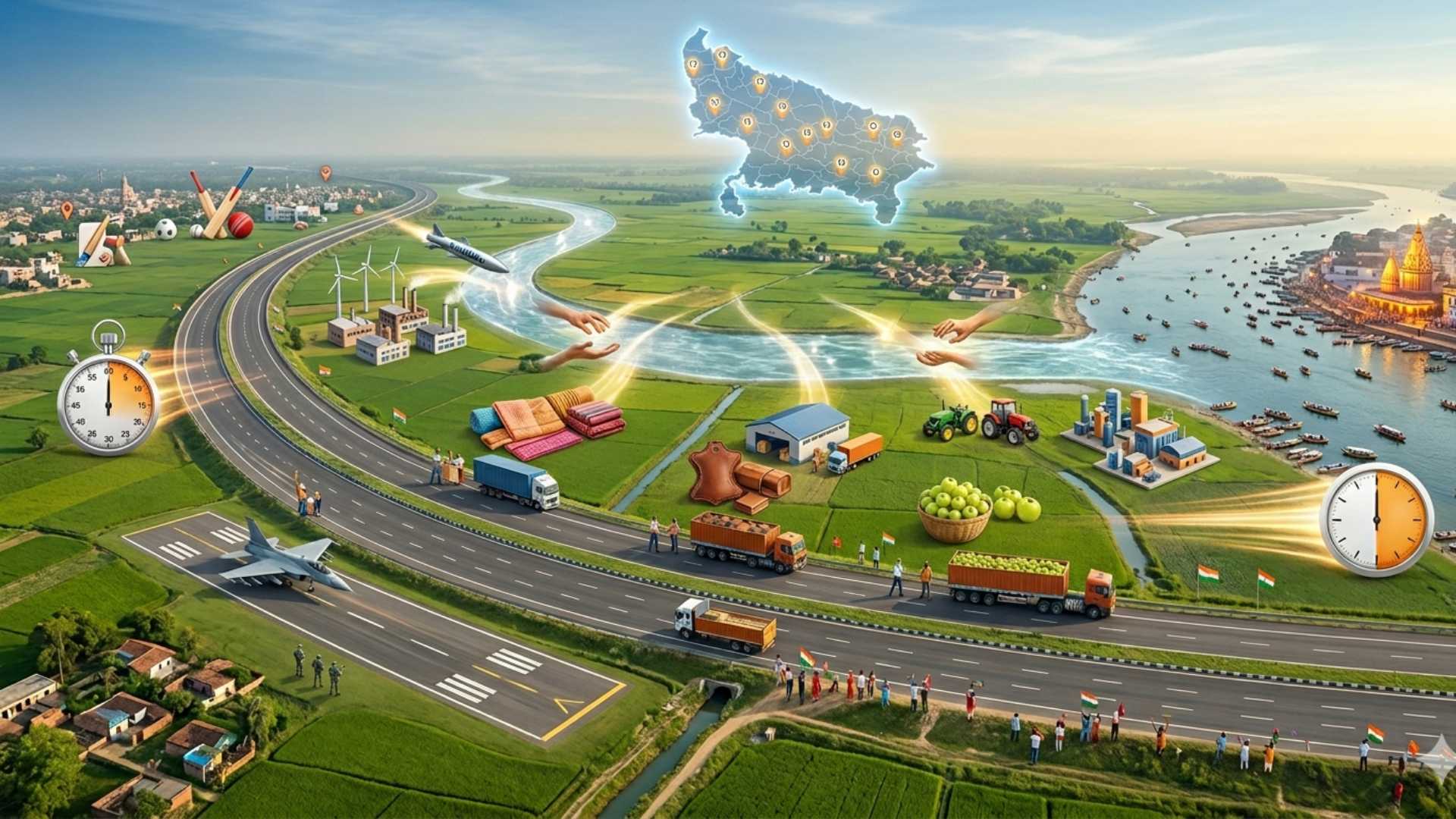
PM Modi Launches Transformative Ganga Expressway in Uttar Pradesh

"Infrastructure is the foundation upon which economic transformation is built."
The inauguration of the 594-km Ganga Expressway (April 29, 2026) — connecting Meerut to Prayagraj across 12 districts at a cost of ₹36,230 crore — represents India's largest state-level expressway project and a case study in infrastructure-driven regional economic transformation.
| Parameter | Detail |
|---|---|
| Length | 594 km |
| Cost | ₹36,230 crore |
| Type | Six-lane, access-controlled |
| Route | Meerut → Hapur → Bulandshahr → Amroha → Sambhal → Badaun → Shahjahanpur → Hardoi → Unnao → Raebareli → Pratapgarh → Prayagraj |
| Districts covered | 12 |
| Industrial clusters along route | 27 locations |
| Travel time (Meerut–Prayagraj) | ~6 hours |
Background & Context
Uttar Pradesh, India's most populous state (~240 million), has historically struggled with the infrastructure deficit–poverty trap: poor connectivity suppressed market access, depressed agricultural incomes, and drove out-migration. The expressway is part of a broader UP infrastructure push that includes multiple expressways, airports, and industrial corridors — oriented toward UP's stated goal of becoming a USD 1 trillion economy.
Key Concepts
Agglomeration Economics: Clustering 27 integrated industrial and logistics hubs along the expressway corridor creates economies of scale, reduces transaction costs, and attracts investment — a textbook application of agglomeration theory.
Last-Mile Connectivity: The expressway directly addresses agricultural market access — sports goods (Meerut), handloom (Hardoi), leather (Unnao), amla (Pratapgarh) — converting local comparative advantage into market-linked income.
Land Acquisition & Farmer Participation: Over 1 lakh farmers from 12 districts contributed land — a significant governance achievement given India's historically contentious land acquisition record under the LARR Act, 2013.
Economic Implications
| Sector | Expected Impact |
|---|---|
| Agriculture | Faster market access → reduced post-harvest losses → higher farmer income |
| MSMEs | District-level products gain regional and national market reach |
| Logistics | Lower freight costs, reduced transit time |
| Employment | Industrial clusters generate direct and indirect jobs along corridor |
| Investment | Improved connectivity raises investor confidence in UP |
| Religious Tourism | Prayagraj (Sangam) and Varanasi (Kashi) more accessible → tourism economy boost |
Challenges & Critical Dimensions
- Land acquisition displacement: Large-scale farmer land contribution raises questions about rehabilitation, compensation adequacy, and long-term livelihood security
- Industrial cluster actualisation: Announcing 27 clusters is different from operationalising them — execution risk remains high
- Environmental concerns: Expressways cutting across river plains (Ganga basin) carry ecological sensitivity around groundwater, flood plains, and biodiversity corridors
- Maintenance financing: Long-term upkeep of access-controlled expressways requires sustainable toll revenue models or PPP arrangements
- Regional equity: Benefits tend to concentrate near expressway nodes; districts away from the corridor risk being left behind
Governance Dimension: Double Engine Government Model
The UP–Centre alignment is presented as a model of cooperative federalism in infrastructure delivery — where state and central government priorities converge to accelerate project completion. This raises a broader UPSC-relevant question about whether infrastructure delivery speed correlates with political alignment between state and centre, and its implications for federal balance.
Comparison: UP Expressway Network
| Expressway | Length | Key Corridor |
|---|---|---|
| Yamuna Expressway | 165 km | Greater Noida–Agra |
| Agra–Lucknow Expressway | 302 km | Agra–Lucknow |
| Purvanchal Expressway | 341 km | Lucknow–Ghazipur |
| Bundelkhand Expressway | 296 km | Chitrakoot–Etawah |
| Ganga Expressway | 594 km | Meerut–Prayagraj |
Conclusion
The Ganga Expressway is more than a road — it is a spatial economic intervention connecting lagging districts to growth corridors. Its real test lies beyond the ribbon-cutting: whether industrial clusters materialise, whether farmer incomes actually rise, and whether the expressway reduces UP's out-migration or merely accelerates the movement of goods while people still leave. Infrastructure is necessary but not sufficient — human capital, governance quality, and institutional capacity must scale alongside concrete and asphalt.
Attribution
Original content sources and authors


Syllabus classification
How this article maps to GS papers
Main syllabus
GS3InfrastructureQuick Q&A
What are the key features of the Ganga Expressway, and how does it represent a transformative infrastructure project?
The expressway is equipped with modern infrastructure such as Intelligent Traffic Management Systems (ITMS), CCTV surveillance, emergency call boxes, and ambulance services, ensuring safety and efficiency. Additionally, 27 integrated industrial clusters and logistics hubs are planned along the corridor, making it not just a transport project but a catalyst for economic growth.
Transformational significance: The project exemplifies next-generation infrastructure that integrates connectivity, defence preparedness, and economic development. Similar to the Yamuna Expressway, which spurred industrial growth near Noida, the Ganga Expressway is expected to reshape regional development patterns and enhance Uttar Pradesh’s role in India’s economic landscape.
Why is the Ganga Expressway considered crucial for the economic and social development of Uttar Pradesh?
From an economic perspective, the expressway will boost agriculture, MSMEs, and local industries. Products such as sports goods from Meerut, handloom from Hardoi, leather from Unnao, and amla from Pratapgarh will gain improved market access. Faster transport reduces spoilage of perishable goods, thereby increasing farmers’ incomes. This aligns with the broader goal of doubling farmers' income and strengthening rural economies.
Social implications: Improved connectivity enhances access to education, healthcare, and employment opportunities. It also promotes religious tourism by connecting key sites like Prayagraj and Varanasi. Similar infrastructure projects, such as the Golden Quadrilateral, have demonstrated how highways can drive inclusive growth. Thus, the Ganga Expressway is a critical enabler of Uttar Pradesh’s aspiration to become a trillion-dollar economy.
How do expressways like the Ganga Expressway contribute to regional industrialization and investment growth?
Improved connectivity reduces travel time and transportation costs, making supply chains more efficient. Industries such as manufacturing, warehousing, and food processing benefit significantly. For instance, the Delhi-Mumbai Industrial Corridor (DMIC) has shown how infrastructure can attract large-scale investments and create employment opportunities.
Multiplier effect: The expressway generates jobs not only during construction but also in allied sectors like logistics, retail, and services. It also enhances urbanization by creating new growth centers along the route. By integrating infrastructure with industrial policy, Uttar Pradesh is positioning itself as an attractive investment destination, reinforcing its emergence as a key economic hub in India.
Critically analyze the role of large-scale infrastructure projects like the Ganga Expressway in achieving balanced regional development.
Advantages include:
- Enhanced market access for rural and backward regions
- Development of industrial corridors and logistics hubs
- Improved social infrastructure through better connectivity
However, there are challenges and concerns. Land acquisition can lead to displacement and social tensions. Environmental impacts, such as deforestation and habitat disruption, must also be addressed. Additionally, benefits may be unevenly distributed, with more developed regions gaining disproportionately.
A balanced approach requires integrating infrastructure with inclusive policies, such as skill development and environmental safeguards. For example, the Eastern Peripheral Expressway helped decongest Delhi but also raised concerns about ecological impact. Thus, while the Ganga Expressway has immense potential, its success depends on ensuring sustainable and equitable development.
What are some real-world examples of how improved connectivity can transform local economies, and how is this relevant to the Ganga Expressway?
Another example is the Yamuna Expressway, which led to rapid urbanization and industrial development in regions like Greater Noida. Similarly, the Konkan Railway improved connectivity in coastal regions, boosting tourism and trade. These examples highlight how infrastructure acts as a catalyst for economic transformation.
Relevance to the Ganga Expressway: The expressway is expected to replicate these successes by connecting diverse regions of Uttar Pradesh. It will enable farmers and small businesses to access larger markets, attract investment, and create employment opportunities. By leveraging lessons from past projects, the Ganga Expressway can serve as a model for integrated and sustainable regional development.
Examine the Ganga Expressway as a case study in linking infrastructure development with political and economic narratives.
From a political perspective, such projects are used to showcase governance efficiency and attract voter support. The emphasis on ‘double engine government’ reflects coordination between central and state authorities. Criticism of previous administrations highlights how infrastructure is often framed as a marker of political performance.
Economically, the expressway aligns with the vision of making Uttar Pradesh a trillion-dollar economy. It integrates connectivity with industrial growth, investment promotion, and employment generation. Similar narratives have been seen in projects like the Statue of Unity or Bharatmala परियोजना, where infrastructure is linked with national pride and economic progress.
Conclusion: The Ganga Expressway illustrates how infrastructure development is not just a technical or economic activity but also a strategic tool shaping public perception, regional identity, and long-term growth trajectories.
Practice questions
2 questions for mains preparation