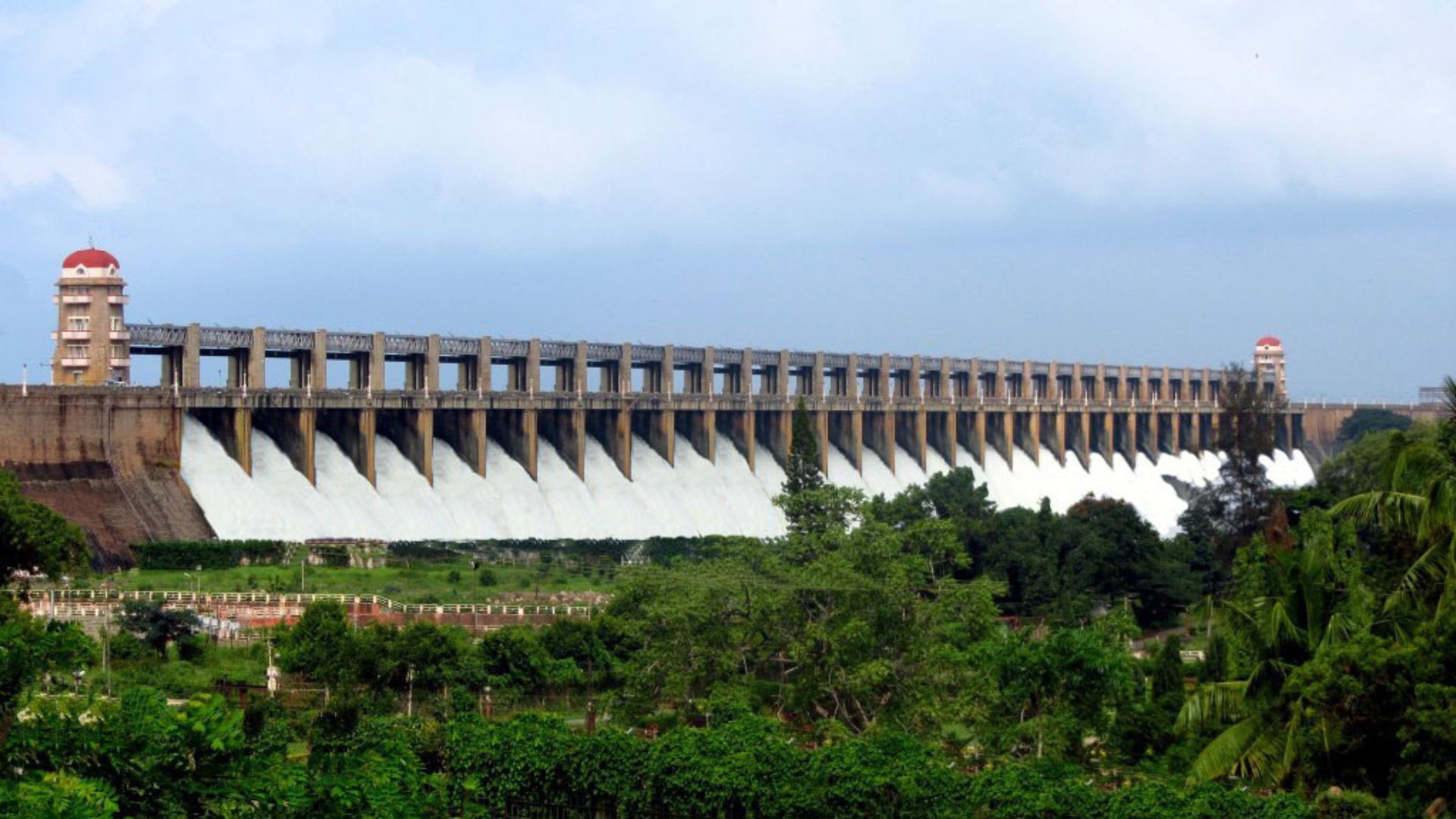
Tungabhadra's Broken Gate: What a Dam Crisis Reveals About India's Infrastructure Deficit

The Illusion of Permanence
Nehru called large dams the "temples of modern India." But temples, too, need upkeep. The Tungabhadra Dam's Gate No. 19 collapse on August 10, 2024 was not a sudden shock — it was the predictable outcome of seven decades of deferred maintenance.
Why this dam matters:
- Lifeline of north Karnataka, Andhra Pradesh, and Telangana
- Sustains agrarian economies of Koppal, Raichur, and Ballari
- Reservoir was at Full Reservoir Level — 105.788 tmcft — when the gate failed
- Within minutes, 35,000 cusecs of water gushed uncontrollably through the damaged bay
This was not just a hydraulic emergency. It was a food security crisis in the making for lakhs of farmers who depend on this reservoir for irrigation.
Deferred Maintenance: The Real Culprit
The gate mechanism — chains, gearboxes, motors, counterweights — had run for nearly 70 years without major overhaul. Post-failure inspection found all 33 gates warranted replacement. This was not a surprise. It was the consequence of a deeply embedded institutional pattern:
- Political cycles reward ribbon-cutting, not maintenance budgets
- Infrastructure receives attention at inauguration — and again only at failure
- The decades in between are institutional silence
- Inter-State complexity (dam serves three States) further delays routine decisions — what should be a technical call gets caught in political negotiation
The chain that snapped was not an outlier. It was the weakest link in a system that had been quietly deteriorating across all 33 bays.
Engineering Under Pressure: Seven Days to Stability
What followed the failure was a masterclass in crisis engineering — and a frustrating demonstration of what focused effort can achieve when urgency finally forces action.
The challenge was severe:
- Reservoir at full level — no option to de-water
- Teams had to work amid live currents and fluctuating discharge
- A temporary barrier had to be designed, fabricated, and installed under active flow conditions
How the team responded:
- Experts mobilised from Hyderabad, Chennai, and Bengaluru
- JSW Steel engineers and local fabrication teams joined simultaneously
- Hydro-mechanical expert N. Kannaiah Naidu designed the stop-log arrangement under field conditions
Stop-Log Gate — Emergency Solution:

Design   → 5 massive interlocking steel elements
Function → Temporary barrier inserted against live current
Result   → Uncontrolled discharge halted
Time     → 7 days from failure to installation (Aug 10–17, 2024)
Seven days is remarkable. It also raises an uncomfortable question: if this mobilisation was possible in a crisis, why does routine maintenance consistently fail to happen?
The Full Rehabilitation: 123 Days, 33 Gates
With the temporary fix buying time, a permanent rehabilitation was planned and executed at scale:
What was replaced:
- All 33 spillway gates — dismantled and newly erected
- 68 lifting chains — replaced as precaution despite being structurally sound
- 100 bevel gear units — replaced
How it was done:
- Work window: December 24, 2025 to April 25, 2026 — 123 days
- Contractor: Ahmedabad-based Hardware Tools & Machinery Projects Pvt. Ltd.
- Third-party quality inspection agencies from Hyderabad monitored throughout
- Trial runs successfully completed; finishing works in final stages
The cost: ₹51 crore — to rehabilitate infrastructure serving three States for 70 years. That is not extravagance. It is a measure of how cheaply catastrophe can be averted when the institutional will exists to act.
Engineers now estimate the overhaul has extended the dam's life by 50 years.
Way Forward
The Tungabhadra crisis makes the case for structural reforms in how India manages ageing water infrastructure:
- Dam Safety Act, 2021 must move from legislation to enforcement — statutory inspection cycles, not voluntary compliance
- Dedicated rehabilitation budgets must be embedded into dam management from the start, not treated as emergency expenditure after failure
- Multi-State bodies like the Tungabhadra Board need empowered technical wings that can act on engineering recommendations without waiting for political consensus
- Real-time structural monitoring — sensors on gates, chains, and spillway components — to enable predictive rather than reactive maintenance
- Early warning systems for downstream communities must be institutionalised, because dam safety is ultimately agrarian security
Conclusion
A gate failing after 70 years of neglect is not a story about metal fatigue — it is a story about institutional culture. India builds with ambition and maintains with indifference. The engineers who stabilised Tungabhadra in seven days and restored it in 123 deserve full credit. But heroism is what you need when systems fail. What prevents failure is something far less dramatic: consistent, funded, unglamorous maintenance — year after year, gate after gate.
Attribution
Original content sources and authors


Syllabus classification
How this article maps to GS papers
Main syllabus
GS3InfrastructureQuick Q&A
What is the strategic significance of the Tungabhadra Dam for southern India, and why is its restoration considered nationally important?
The incident in August 2024, when Crest Gate No. 19 was washed away, highlighted the vulnerability of aging water infrastructure. With the reservoir at Full Reservoir Level and nearly 35,000 cusecs of water escaping, there was immediate concern over crop loss, water scarcity, and downstream flooding. Such a failure could have had cascading impacts on food security and interstate water management.
Its restoration is nationally important because:
- It secures irrigation for large command areas dependent on canal systems.
- It prevents interstate disputes over water sharing.
- It strengthens resilience against climate variability and erratic monsoons.
- It demonstrates India’s capability in restoring legacy infrastructure under emergency conditions.
The successful rehabilitation symbolizes how strategic public assets can be renewed to support agricultural sustainability and rural livelihoods.
Why do aging dams pose a governance and infrastructure challenge in India, as seen in the Tungabhadra case?
Governance challenges arise because dam maintenance often suffers from delayed inspections, fragmented institutional responsibilities, and budget constraints. In the Tungabhadra case, the gates had operated for nearly seven decades without comprehensive replacement. This exposed a gap between periodic maintenance and long-term modernization planning.
Key challenges include:
- High rehabilitation costs for old dams.
- Interstate coordination issues in shared river basins.
- Need for specialized technical expertise.
- Balancing water storage during repairs without disrupting irrigation.
The case underlines the need for India’s Dam Safety Act, 2021 to be implemented effectively, with regular structural audits and preventive replacement of aging components before disasters occur.
How was the Tungabhadra Dam emergency managed technically after the crest gate failure in 2024?
A temporary stop-log gate system was designed by hydro-mechanical expert N. Kannaiah Naidu. It consisted of five heavy steel elements fitted under highly risky conditions amid strong currents and fluctuating discharge. Installation was completed within seven days, preventing further loss of water and stabilizing the structure.
This response shows key features of disaster engineering:
- Rapid technical assessment.
- Use of indigenous fabrication and local industries.
- Interdisciplinary collaboration between state agencies and private experts.
- Emergency risk reduction while maintaining irrigation needs.
The event is a strong case study in how engineering preparedness and decentralized expertise can prevent escalation of infrastructure disasters.
Critically analyze whether reactive restoration after infrastructure failure is sufficient, or whether proactive modernization should be prioritized.
Proactive modernization involves periodic audits, predictive maintenance, and replacement of vulnerable components before breakdown. In this case, experts later recommended replacement of all 33 gates, chains, and gear units. Had this been done earlier, the emergency may have been avoided.
Advantages of proactive modernization:
- Lower disaster risk.
- Reduced long-term repair costs.
- Improved water security.
- Greater public trust in governance.
Limitations include:
- High upfront expenditure.
- Political reluctance due to invisible benefits.
- Operational shutdown constraints.
Therefore, while reactive restoration demonstrates resilience, sustainable infrastructure governance requires shifting toward proactive modernization, especially for strategic irrigation assets.
What lessons does the Tungabhadra Dam rehabilitation provide for India’s broader water infrastructure management?
The case also highlights the importance of precautionary decision-making. Although detailed inspections found some chains structurally sound, authorities replaced all 68 chains and 100 bevel gear units to ensure future safety. Third-party inspections further improved transparency and accountability.
Lessons for India include:
- Institutionalize preventive audits for old dams.
- Create specialized hydro-mechanical response teams.
- Ensure interstate coordination for shared reservoirs.
- Promote third-party technical certification.
This example can guide rehabilitation of other aging dams such as Hirakud, Bhakra, and Nagarjuna Sagar, where modernization is essential to maintain agricultural and water security.
As a district administrator in a command area dependent on Tungabhadra, how would you respond if a similar dam failure threatened irrigation security?
Second, contingency plans such as alternate groundwater use, rationed canal distribution, and emergency support for affected farmers would be activated. Crop advisories promoting less water-intensive cultivation may also be introduced temporarily. Disaster management teams would monitor downstream flood risks.
Administrative strategy would include:
- Real-time communication with stakeholders.
- Agricultural contingency planning.
- Financial compensation for crop loss.
- Monitoring infrastructure restoration progress.
The Tungabhadra case shows that infrastructure failure is not merely an engineering issue; it directly affects governance, livelihoods, and rural stability. An administrator must combine technical coordination with human-centered crisis management.
Practice questions
2 questions for mains preparation