GS3 Internal Security

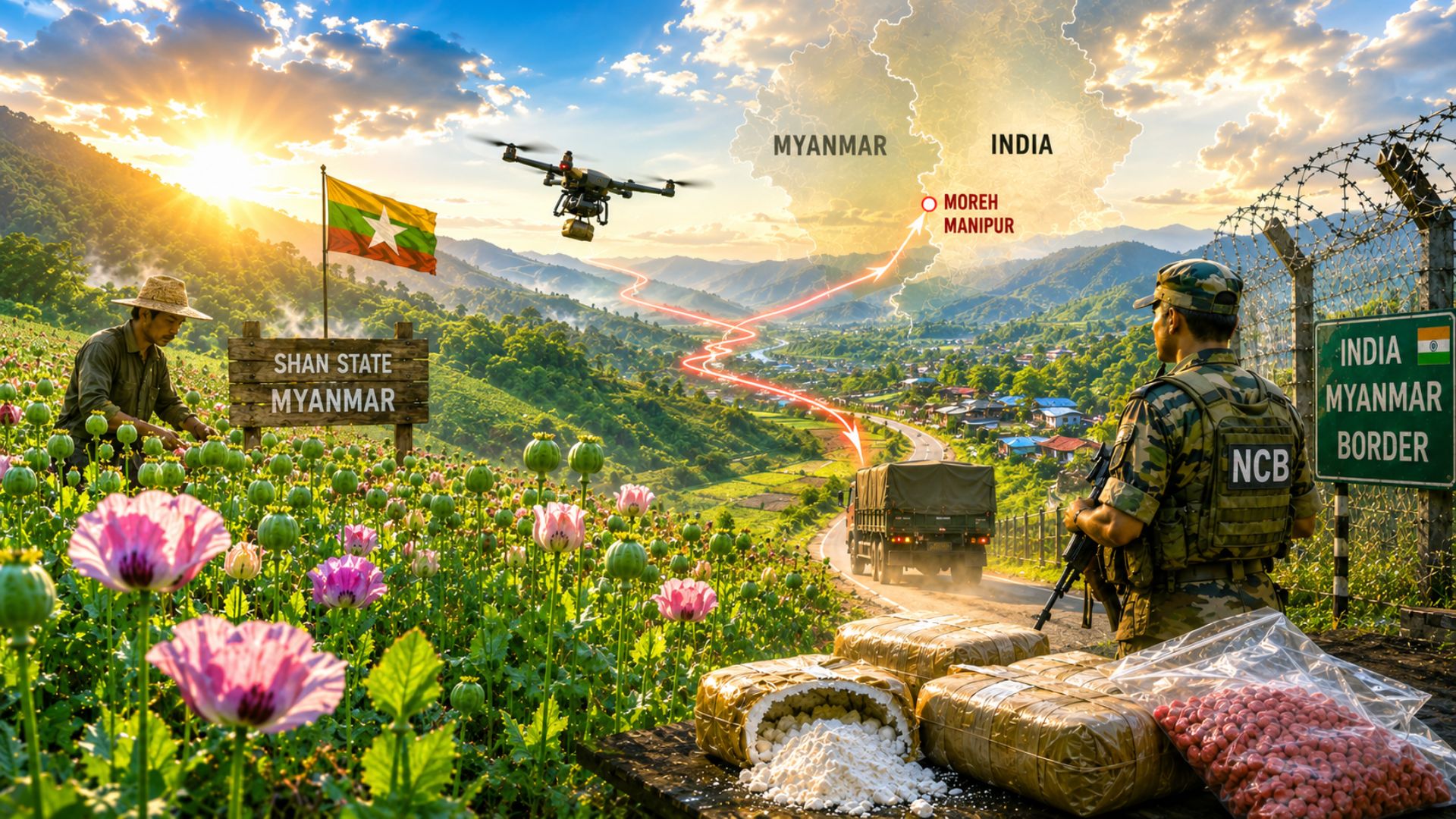
Myanmar Emerges as New Opium Hub, Threatening India's Eastern Borders

How are Shifting Global Drug Trafficking Routes Reshaping India's Internal Security?

The rise of Myanmar's opiate production poses significant challenges for India, particularly in Manipur, Mizoram, and Nagaland due to increased drug trafficking.
Gopi Gopi
4 mins read

The 2026 Annual Report of the Narcotics Control Bureau (NCB) highlights a major shift in global narcotics supply chains. Following the Taliban's 2022 ban on drugs in Afghanistan, Myanmar has emerged as an alternative source of global opium, exposing India's eastern borders to increased trafficking. Simultaneously, western trafficking routes continue to operate using pre-existing Afghan stockpiles and new technologies such as drones.


Why has Myanmar become more significant?

After the Taliban imposed a ban on opium cultivation in 2022, Afghanistan's production declined sharply.

However:

  • Myanmar has expanded illicit opium cultivation.
  • Drug production now includes both opiates and synthetic drugs.
  • India's northeastern border has become the most vulnerable entry point.
IndicatorStatus
Afghanistan's opium productionReduced by 93% after the 2022 Taliban crackdown
Myanmar's opium cultivationIncreased by 56% (2021–2023)
Area under poppy cultivation45,200 hectares

Why is India's Northeast particularly vulnerable?

The NCB identifies Manipur, Mizoram and Nagaland as the States facing the greatest exposure.

Contributing factors include:

  • Porous and largely unfenced borders
  • Free Movement Regime (FMR) along the India–Myanmar border
  • Proximity to Myanmar's narcotics production centres
  • Well-connected road networks into mainland India

"These States have transitioned from peripheral transit zones to active staging grounds for distribution of narcotics into the Indian hinterland."


Major trafficking corridors

1. Manipur Corridor

The principal land route originates from Myanmar's Golden Triangle, especially Shan State, where areas controlled by ethnic armed groups have become hubs of poly-drug production.

Drugs entering through this corridor include:

  • Heroin
  • Methamphetamine (Yaba tablets)

The route primarily uses National Highway 102.


2. Mizoram Corridor

A second important route enters through Champhai, bordering Myanmar's Chin State.

Myanmar (Chin State)
        ↓
Champhai (Mizoram)
        ↓
Aizawl
        ↓
Silchar (Assam)
        ↓
Indian Hinterland

The NCB notes that traffickers exploit unfenced and porous border stretches before routing narcotics through Assam's Barak Valley.


Amphetamine-type stimulants (2025)

StateQuantity Seized
Mizoram1,477 kg
Manipur535 kg
Delhi454 kg
Gujarat308 kg
Karnataka164 kg
India Total3,485 kg

Mizoram alone accounted for nearly 42% of nationwide seizures.


Western border remains active

Although Afghan opium production has fallen sharply, approximately 13,200 tonnes of pre-ban narcotics continue to sustain trafficking networks.

The principal route remains:

Afghanistan
      ↓
Pakistan
      ↓
Punjab / Rajasthan
      ↓
India

Additionally, maritime trafficking through the Gujarat and Maharashtra coastlines is increasing, with smugglers using fishing vessels and small coastal craft that often evade conventional maritime surveillance.

The Afghanistan–Pakistan–Iran corridor continues to be the world's primary opiate trafficking complex.


Rise of drone-based trafficking

The NCB reports a dramatic increase in the use of Unmanned Aerial Vehicles (UAVs) for cross-border smuggling from Pakistan.

YearIncidentsQuantity Seized
2021310 kg
202235148 kg
202328103 kg
2024178236 kg
2025305468 kg

Key observations:

  • Nearly 100-fold increase in incidents over five years.
  • Punjab accounted for 298 of 305 incidents.
  • Punjab seized 461 kg of narcotics, including 449.751 kg heroin and 9.018 kg methamphetamine.
  • Overall, Punjab accounted for 2,086 kg, representing 58% of India's total narcotics seizures (3,567 kg).
  • Additional drone incidents have also been reported in Rajasthan and Jammu & Kashmir.

According to the NCB, this reflects the growing operational sophistication of trafficking networks using drones to bypass traditional border security.


Broader security implications

The changing trafficking routes highlight:

  • Convergence of traditional opiates and synthetic drugs
  • Increased vulnerability of India's eastern and western borders
  • Use of advanced technologies such as drones
  • Linkages between transnational organised crime and border security
  • Need for integrated land, maritime and aerial surveillance

Way Forward

  • Strengthen border management through smart surveillance, drones and integrated checkpoints.
  • Enhance intelligence sharing with neighbouring countries and international agencies.
  • Review border management mechanisms, including the Free Movement Regime, based on security considerations.
  • Expand coastal and maritime surveillance using advanced technologies.
  • Strengthen anti-drug operations in vulnerable northeastern States through coordinated Centre-State action.
  • Improve financial investigations to dismantle organised trafficking networks.

Conclusion

The NCB report demonstrates that while global drug production patterns are changing, the threat to India has merely shifted geographically rather than diminished. Addressing this evolving challenge requires a comprehensive strategy integrating border security, technology, regional cooperation and coordinated law enforcement to safeguard national security and public health.

Attribution

Original content sources and authors

Vijaita Singh Author Vijaita Singh The Hindu Source The Hindu

Syllabus classification

How this article maps to GS papers

Main syllabus

GS3Internal Security

Quick Q&A

What explains the changing geography of global narcotics trafficking after the Taliban's 2022 drug ban, and why is it strategically significant for India's border security?
The global narcotics trade has undergone a significant geographical shift following the Taliban's 2022 ban on opium cultivation in Afghanistan. According to international estimates cited in the Narcotics Control Bureau (NCB) report, Afghan opium production declined by nearly 93% from its earlier peak. However, this did not eliminate the global narcotics market. Instead, production shifted toward Myanmar, particularly the Golden Triangle region comprising Myanmar, Laos, and Thailand. Between 2021 and 2023, Myanmar's illicit poppy cultivation expanded by approximately 56%, reaching around 45,200 hectares. Simultaneously, the region has emerged as a major producer of methamphetamine, creating a diversified poly-drug economy controlled by ethnic armed groups in Shan State. For India, this transformation has direct strategic implications. The porous India-Myanmar border, particularly through Manipur and Mizoram, has become a major entry point for heroin and synthetic drugs into the country. The challenge is compounded by difficult terrain, historical cross-border ethnic linkages, and the Free Movement Regime (FMR), which permits regulated movement of border communities. From a UPSC perspective, this issue intersects GS Paper III topics such as Internal Security, Border Management, Organized Crime, and External Security. It also connects with governance, federal coordination, public health, and international diplomacy. The evolving narcotics landscape demonstrates that changes in one country's domestic policy can reshape regional security dynamics. Therefore, India's response must integrate border infrastructure, intelligence sharing, international cooperation, technology-enabled surveillance, and socio-economic development in vulnerable border regions to effectively address this multidimensional security challenge.
Why have Manipur, Mizoram, and Nagaland become particularly vulnerable to cross-border drug trafficking, and what are the broader national security implications?
The northeastern states of Manipur, Mizoram, and Nagaland have emerged as India's frontline against narcotics trafficking primarily because of their geographical proximity to Myanmar and the unique characteristics of the India-Myanmar border. Large stretches of the border remain unfenced and pass through dense forests and mountainous terrain, making surveillance difficult. The Free Movement Regime (FMR), intended to facilitate traditional social and cultural ties among border communities, has also been exploited by organized criminal networks. According to the NCB's 2026 report, the Manipur corridor linked through National Highway 102 serves as a principal land route for heroin and methamphetamine entering India, while Champhai in Mizoram functions as another critical trafficking corridor. In 2025, Mizoram alone accounted for 1,477 kg of amphetamine-type stimulant seizures out of the national total of 3,485 kg, illustrating the magnitude of the challenge. The implications extend far beyond law enforcement. Drug trafficking finances organized crime and insurgent groups, promotes corruption, fuels addiction among youth, undermines governance, and threatens social stability. It also places enormous pressure on state police forces and border management agencies. For UPSC aspirants, the issue connects GS Paper III themes such as Internal Security, Border Management, Disaster and Security Governance, and Centre-State coordination. Policy debates revolve around balancing humanitarian concerns, tribal mobility, and national security. Long-term solutions require modern border infrastructure, community participation, intelligence-led policing, international cooperation with Myanmar, stronger financial investigations to dismantle trafficking networks, and development initiatives that provide legitimate economic opportunities to vulnerable border populations.
How has the emergence of drone-based narcotics trafficking along India's western border transformed traditional border security challenges and enforcement strategies?
Drone-based narcotics trafficking represents one of the most significant technological adaptations by transnational criminal organizations operating along India's western frontier. Traditionally, narcotics entered through physical smuggling routes using couriers, vehicles, tunnels, or maritime vessels. However, the increasing deployment of unmanned aerial vehicles (UAVs) has enabled traffickers to bypass conventional border fencing and patrol mechanisms. The NCB's 2026 report highlights the rapid escalation of this threat. Incidents increased from only 3 cases involving about 10 kg of narcotics in 2021 to 305 cases involving 468 kg in 2025, representing an almost hundred-fold increase in incident count over five years. Punjab accounted for 298 of these cases and approximately 461 kg of seizures, primarily consisting of heroin and methamphetamine. This trend illustrates the growing sophistication and operational maturity of criminal networks. Drones enable precise delivery, minimize human risk, reduce chances of interception, and exploit technological gaps in surveillance. From a national security perspective, the same technology can potentially facilitate movement of weapons, counterfeit currency, communication devices, and other contraband, thereby strengthening criminal and terrorist networks. UPSC candidates should recognize that this issue falls under GS Paper III topics relating to Internal Security, Science and Technology, and Border Management. Effective countermeasures require anti-drone technologies, artificial intelligence-enabled surveillance, radar integration, inter-agency intelligence sharing, stronger coastal and border monitoring, cyber capabilities, and legal frameworks regulating drone operations. India's response must evolve from traditional manpower-intensive border policing toward technology-driven, intelligence-led, and integrated security architecture capable of addressing emerging non-traditional threats.
Critically analyze whether border fencing alone can effectively address cross-border narcotics trafficking in India amid evolving regional security dynamics.
Border fencing is an important component of national security but cannot serve as a comprehensive solution to the complex challenge of cross-border narcotics trafficking. India's international borders vary widely in terrain, demography, and geopolitical context. While fencing may reduce unauthorized physical crossings in certain sectors, extensive mountainous terrain, dense forests, rivers, and long coastlines limit its effectiveness in regions such as the India-Myanmar border. Furthermore, traffickers increasingly rely on drones, maritime routes, hidden compartments in legitimate trade, and sophisticated financial networks that bypass physical barriers. The NCB report demonstrates this evolving threat through rising drone-based trafficking from Pakistan and expanding trafficking corridors from Myanmar. At the same time, complete fencing may disrupt traditional livelihoods and cultural interactions among border communities, especially where arrangements such as the Free Movement Regime exist. Critics argue that excessive securitization without community engagement could alienate local populations whose cooperation is vital for intelligence gathering. Supporters, however, emphasize that selective fencing, modern surveillance systems, and improved infrastructure can significantly reduce illegal movement. Therefore, the debate is not about fencing versus non-fencing but about adopting a layered security approach. Such an approach should combine physical barriers where feasible, smart surveillance technologies, satellite imagery, anti-drone systems, biometric monitoring, financial intelligence, international cooperation, and community policing. For UPSC GS Paper III, this discussion illustrates the importance of balancing security, development, and human considerations. Ultimately, sustainable border management requires institutional coordination among central and state agencies, diplomatic engagement with neighboring countries, socio-economic development in border districts, and continuous technological modernization rather than dependence on any single security measure.
What lessons can policymakers draw from the contrasting narcotics trafficking patterns along India's eastern and western borders as a case study in integrated border management?
India's eastern and western borders present two distinct but interconnected models of narcotics trafficking, offering valuable lessons for integrated border management. Along the eastern frontier, the primary challenge arises from Myanmar's expanding narcotics production, particularly heroin and methamphetamine originating in the Golden Triangle. Trafficking exploits porous land borders, difficult terrain, ethnic linkages, and transport corridors through Manipur and Mizoram. In contrast, the western border is influenced by the Afghanistan-Pakistan-Iran trafficking network, where residual Afghan opium stocks continue to sustain illegal trade despite the Taliban's production ban. Here, traffickers increasingly employ drones, maritime routes along Gujarat and Maharashtra, and sophisticated logistics networks. The NCB's 2026 report illustrates these differences through substantial seizures in northeastern states and Punjab, alongside the sharp increase in drone-related smuggling incidents. The central lesson is that border management cannot adopt a uniform strategy. Instead, security responses must be tailored to region-specific threats while remaining integrated under a national framework. Land borders require improved infrastructure, road connectivity, intelligence sharing, community participation, and coordinated policing. Western sectors demand advanced anti-drone capabilities, coastal surveillance, and maritime domain awareness. Financial investigations must complement physical interdiction by disrupting money laundering and organized crime networks. Diplomatic engagement with neighboring countries and multilateral cooperation against transnational crime are equally essential. For UPSC aspirants, this case study integrates GS Paper III themes relating to Internal Security, Border Management, Organized Crime, Technology, and Governance. It also demonstrates the need for adaptive policymaking that combines hard security measures with development, institutional capacity building, and regional diplomacy to address evolving security challenges.

Practice questions

1 question for mains preparation

Examine how evolving transnational drug trafficking networks pose multidimensional challenges to India's internal security. Discuss the role of border management, technology and regional cooperation in addressing these threats.

10 marks · 150 words · 8 mins
