Eliminating Left-Wing Extremism: India's Anti-Maoist Strategy and the Bastar Success

Introduction
"Poverty is the parent of revolution and crime." — Aristotle
At its 2005 peak, Maoist insurgency gripped 230 districts across 9 states — India's gravest internal security threat. By March 2026, it has been reduced to just 2 districts in a single state.
| Metric | 2005 | 2026 |
|---|---|---|
| Districts affected | 230 | 2 |
| States affected | 9 | 1 |
The Bastar transformation is a masterclass in blending security strategy with development-led governance.
Decline of the Red Corridor: Data at a Glance
| Indicator | 2005 | 2014 | 2026 |
|---|---|---|---|
| Districts affected by LWE | ~230 | 126 | 2 |
| Police stations with Maoist incidents | 460 | 350 | 60 |
| States with active LWE presence | 9 | 9 | 1 (Chhattisgarh) |
| Security camps in Bastar (cumulative) | — | 168 | 432 |
| Attacks on economic infrastructure | — | 1,141 (2010–14) | 613 (2015–25) |
Background and Context
The Maoist insurgency in India, rooted in the Naxalbari uprising of 1967, evolved over decades into a structured armed movement — the Communist Party of India (Maoist) — drawing support from tribal and marginalised communities in resource-rich but governance-poor regions.
The Bastar division of Chhattisgarh (42,000 sq. km) became the operational and ideological core of the movement, with dense forests providing cover and weak state presence creating a vacuum that the CPI (Maoist) exploited through parallel governance and coercion.
Strategic Pillars of the Anti-LWE Campaign
1. Security Grid Expansion
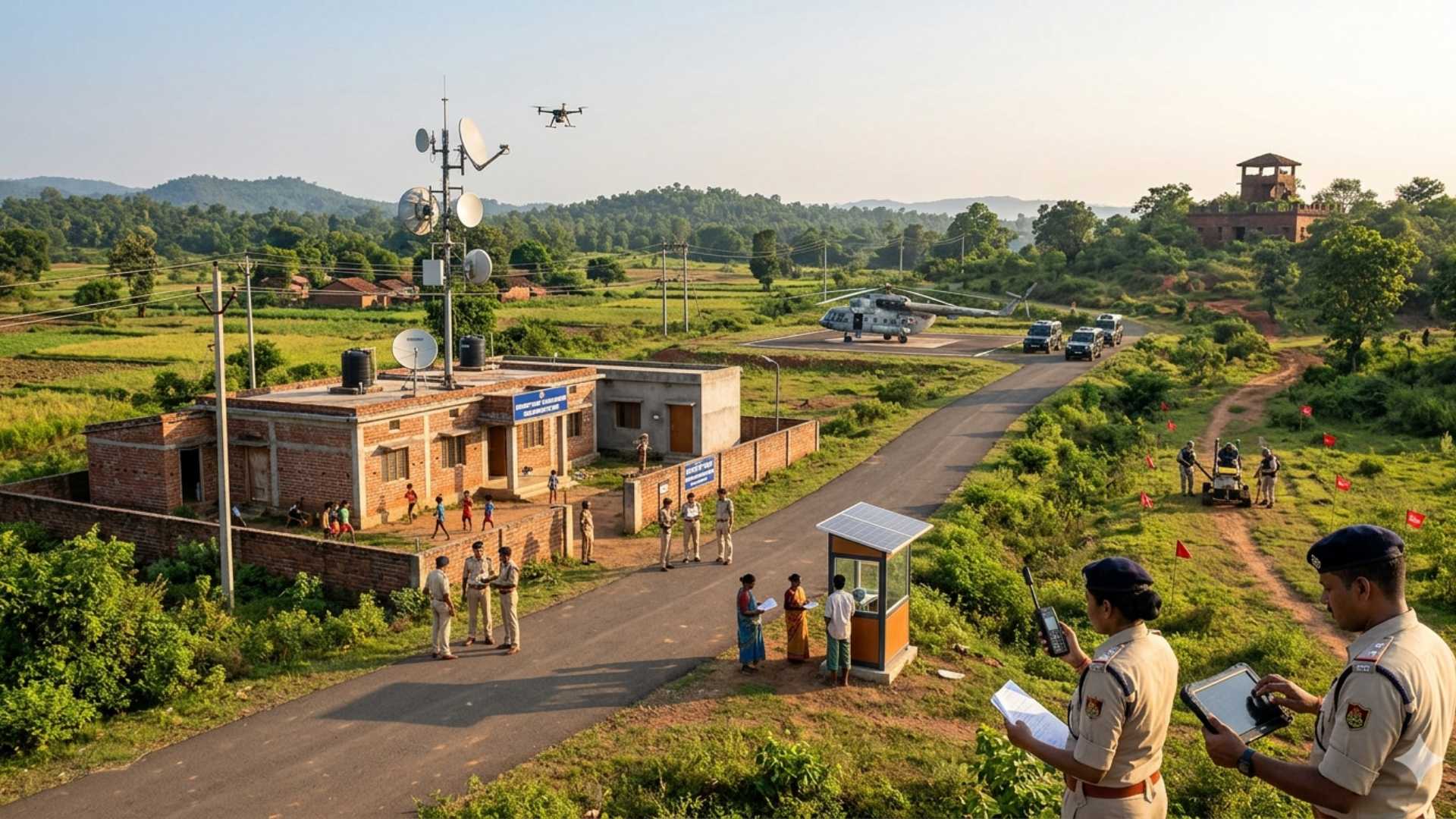
Between 2015 and 2026, 264 new security camps were established in Bastar alone — far outpacing the 168 set up in the previous 14 years. Nationally, 406 new CAPF camps and 68 night-landing helipads were constructed. Bijapur and Sukma — the last two active districts — account for 50% of all existing camps, reflecting a targeted saturation strategy.
2. Technology-Enabled Operations
"The movement of each patrol team was tracked through GPS devices. To tide over connectivity issues in the interior, satellite phones were used. If a team came under fire, reinforcements were sent from the nearest camp." — Sundarraj P., Inspector-General of Police, Bastar Range
This shift — from multi-day blind patrols to GPS-tracked, satellite-connected, camp-linked operations — fundamentally reduced both operational risk and casualties.
3. Integrated Development Centres
Security camps have been repositioned as Integrated Development Centres, extending welfare schemes, essential services, and governance outreach to previously inaccessible villages. This reflects a doctrinal shift: from pure counter-insurgency to WHAM (Winning Hearts and Minds).
4. Infrastructure and Mobility
- 400 bullet-proof and blast-proof vehicles deployed for ground operations.
- Road and telecom connectivity expanded in formerly Maoist-controlled zones.
- Mobile tower damage incidents fell to just 2 in 2025, down from peak levels.
Residual Challenges
Despite the near-complete territorial clearance, significant challenges remain:
IED Threat: The most immediate operational challenge. Maoists planted IEDs extensively before abandoning camps or surrendering. De-mining operations are ongoing and will take time before areas can be formally declared safe.
Socio-Economic Vacuum: The withdrawal of Maoists does not automatically mean the arrival of effective governance. Tribal communities in Bastar have long-standing grievances around land rights, forest rights (under FRA 2006), and displacement — issues that, if unaddressed, can fuel re-radicalisation.
Cadre Dispersal: With only 7–8 active cadres reportedly remaining in Bastar, the risk of dispersal to other states or regrouping in newer geographies cannot be ruled out.
Attacks on Infrastructure: Over 1,754 attacks on roads, telecom networks, and schools were recorded since 2010 — a legacy of deliberate isolation that will require sustained investment to reverse.
Conclusion
The near-elimination of Left-Wing Extremism from India's map is a milestone that reflects the cumulative effect of coordinated security strategy, technological modernisation, and a gradual pivot toward development-as-security. However, declaring victory prematurely would be a strategic error. The roots of the Maoist movement — tribal alienation, forest rights disputes, and governance deficits — remain partially unresolved. Sustaining this success demands that the state presence established through security camps be followed swiftly and credibly by schools, health centres, and legal empowerment under frameworks like the Forest Rights Act, 2006 and PESA, 1996. The Bastar story is not yet complete — it is at its most critical inflection point.
Attribution
Original content sources and authors


Syllabus classification
How this article maps to GS papers
Main syllabus
GS3Internal SecurityQuick Q&A
What factors explain the significant decline of Left-Wing Extremism (LWE) in India, particularly in regions like Bastar?
Key contributing factors include:
- Enhanced security presence: Establishment of over 400 CAPF camps and increased troop deployment ensured territorial dominance.
- Use of technology: GPS tracking, satellite phones, and real-time communication improved operational efficiency and reduced casualties.
- Infrastructure development: Construction of roads, telecom networks, and helipads facilitated faster mobility and governance outreach.
- Integrated Development Centres: Security camps doubled as welfare hubs, extending state services to remote areas.
Additionally, the government’s focus on cutting off Maoist supply chains and weakening their ideological base played a crucial role. Reduced attacks on economic infrastructure—from over 1,100 (2010–14) to about 600 (2015–25)—reflect declining insurgent capability.
Conclusion: The decline is not merely due to force but reflects a shift toward state penetration, governance delivery, and trust-building in previously alienated regions.
Why is the integration of development initiatives with security operations critical in addressing insurgency like Maoism?
Importance of integrated approach:
- Winning hearts and minds: Development initiatives such as healthcare, education, and welfare schemes reduce local support for insurgents.
- Restoring state legitimacy: Presence of governance institutions builds trust among marginalized communities.
- Economic inclusion: Infrastructure development creates livelihoods and reduces recruitment into extremist groups.
The Bastar example demonstrates this clearly. Security camps functioning as Integrated Development Centres helped bring essential services to remote villages, reducing dependence on Maoist networks.
Broader implications: This approach aligns with India’s internal security doctrine that emphasizes ‘clear, hold, and develop’. Without development, security gains are fragile; without security, development cannot reach conflict zones.
Conclusion: Sustainable peace requires a holistic strategy where security operations create space for development, and development consolidates peace.
How has the use of technology transformed counter-insurgency operations in Left-Wing Extremism-affected areas?
Key technological interventions include:
- GPS-enabled tracking: Monitoring patrol movements in real time improved coordination and reduced vulnerability.
- Satellite communication: Satellite phones addressed connectivity gaps in dense forests and remote terrains.
- Improved logistics: Night landing helipads and better surveillance ensured rapid response to attacks.
Earlier, patrol teams operated in isolation for days, leading to high casualties. Now, with real-time tracking and communication, reinforcements can be deployed quickly, enhancing troop safety.
Impact: These advancements have reduced casualties, improved intelligence gathering, and disrupted Maoist operations. For instance, quicker response times have made ambushes less effective.
Challenges: Despite progress, threats like Improvised Explosive Devices (IEDs) persist, highlighting the need for continued technological innovation such as drone surveillance and mine detection systems.
Conclusion: Technology acts as a force multiplier, enabling smarter, safer, and more efficient counter-insurgency operations.
What are the reasons behind the decline in attacks on economic infrastructure in Maoist-affected regions?
Key reasons include:
- Increased security presence: Expansion of camps and patrol networks deterred Maoist sabotage activities.
- Improved connectivity: Better roads and communication reduced isolation, weakening Maoist control over local populations.
- Loss of local support: Development initiatives reduced the willingness of communities to assist insurgents.
Earlier, Maoists targeted infrastructure to isolate regions and prevent state penetration. Between 2010–14, over 1,100 such attacks occurred. This dropped significantly to around 600 between 2015–25, with minimal incidents in recent years.
Case example: In 2025, only two incidents of damage to mobile towers were reported, indicating near-collapse of Maoist operational capacity in this domain.
Conclusion: The decline reflects a shift in the balance of power, where the state has regained control over critical infrastructure and connectivity.
Critically analyze whether India can be declared fully 'Maoist-free' despite the recent successes in counter-insurgency operations.
Achievements:
- Reduction in affected districts to just two (Bijapur and Sukma).
- Sharp decline in violence and infrastructure attacks.
- Expansion of governance and development in remote areas.
Persistent challenges:
- IED threats: Residual explosives continue to pose risks to civilians and security forces.
- Residual cadres: Even a small number of insurgents can regroup if conditions allow.
- Socio-economic vulnerabilities: Issues like tribal marginalization and land rights remain unresolved in some areas.
Historically, insurgencies have shown the ability to re-emerge if root causes are not addressed. For example, earlier gains in some regions were reversed due to governance gaps.
Conclusion: While India is close to eliminating LWE as a major security threat, sustained vigilance, development, and institutional reforms are essential to prevent resurgence.
Using Bastar as a case study, evaluate the effectiveness of the 'security-led development' model in conflict resolution.
Key interventions:
- Massive security deployment: Over 250 new camps established post-2015 ensured territorial control.
- Technological integration: GPS tracking and satellite communication improved operational outcomes.
- Development outreach: Camps acted as centres for healthcare, education, and welfare delivery.
Outcomes:
- Sharp decline in Maoist presence and violence.
- Improved access to government schemes in remote villages.
- Restoration of public confidence in state institutions.
However, challenges remain, such as IED clearance and ensuring long-term socio-economic development. Critics argue that excessive militarization may alienate communities if not balanced with participatory governance.
Conclusion: The Bastar experience shows that security-led development can be effective, but its success depends on sustained efforts in governance, inclusion, and addressing local grievances.
India's Red Corridor has shrunk from 230 districts across 9 states to just 2 districts in one — but the Bastar story reveals that eliminating Maoist presence is the easier half of the challenge; the harder half is filling the governance vacuum left behind with genuine tribal rights, forest justice, and development delivery before alienation finds a new ideological home.
Practice questions
1 question for mains preparation