Revisiting the Pahalgam Massacre and Its Impact on Security Forces

"Terrorism thrives in ungoverned spaces — the answer is not just force but persistent presence, technological superiority, and intelligence dominance." — Vivekananda International Foundation, Report on J&K Security Architecture, 2024
The April 22, 2025 Pahalgam attack — 26 civilians killed at Baisaran meadow — was the deadliest tourist-targeted attack in Kashmir in nearly a decade, triggering a complete overhaul of J&K's security grid. With ~65 foreign terrorists currently active in J&K and only 5 local recruits remaining, the conflict has structurally transformed from a local insurgency into a Pakistan-sponsored foreign terrorist operation — demanding a fundamentally different counter-strategy.
Background / Context
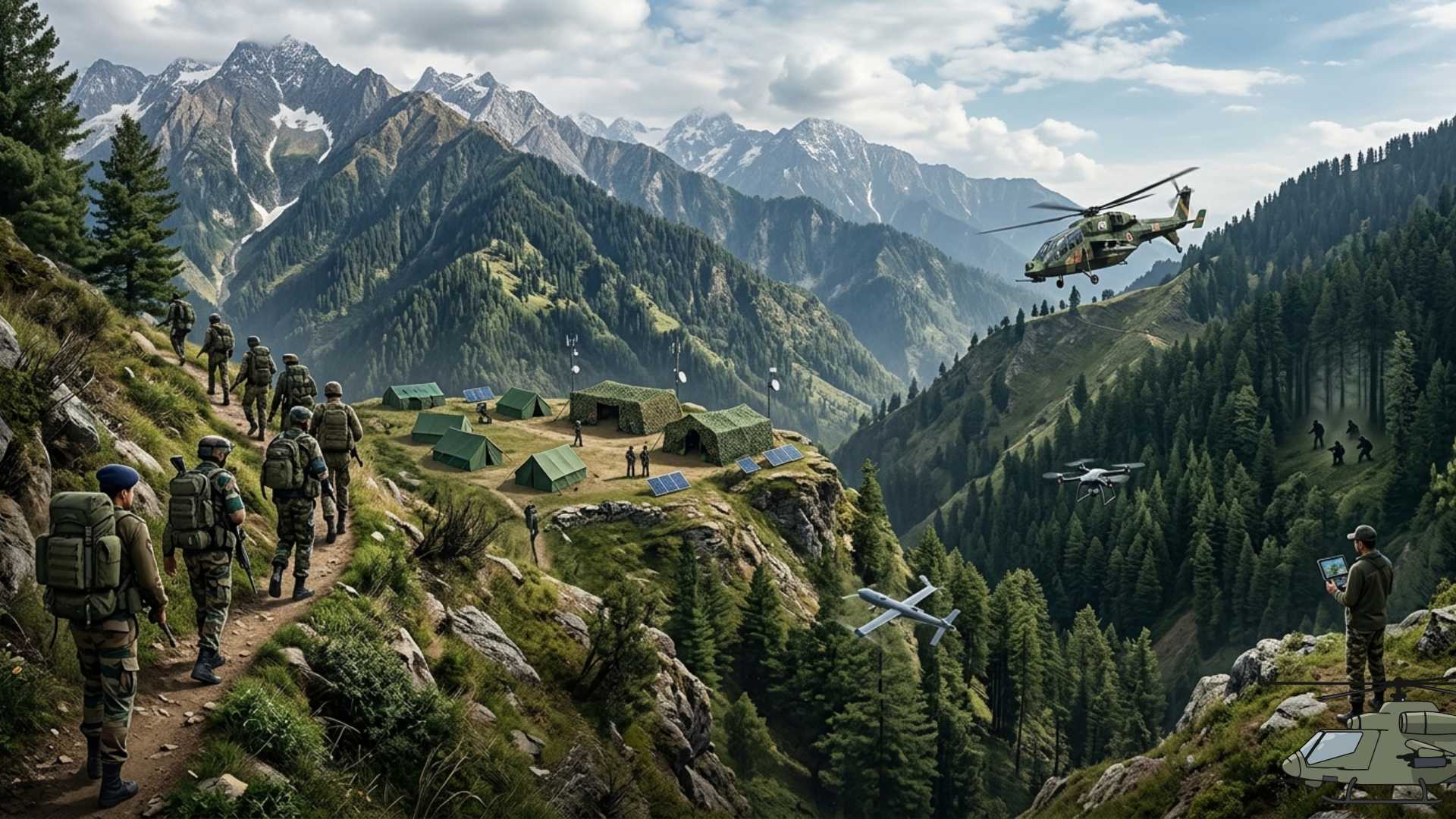
Since mid-2021, the epicentre of terror activity has shifted from urban Kashmir Valley to forested, high-altitude zones — particularly the Chenab Valley (Doda, Kishtwar, Ramban) and Pir Panjal region (Rajouri, Poonch). Around 150 security personnel have been killed in ambushes since 2021, signalling a deliberate tactical shift by terrorist groups toward jungle-based guerrilla warfare.
The Pahalgam attack forced a strategic rethink — from reactive urban counter-terror to proactive jungle warfare and technology-driven operations.
Key Concepts / Definitions
Special Operations Group (SOG) Elite wing of J&K Police specialising in counter-insurgency. Re-energised post-Pahalgam with younger officers, cross-training with Greyhounds and Army Para SF.
Greyhounds Elite anti-Maoist force of Andhra Pradesh Police. Pioneers of jungle counter-insurgency in India. Now training J&K SOG — a significant doctrinal cross-pollination between Left Wing Extremism and terror theatre tactics.
Loitering Munitions / Kamikaze Drones Unmanned aerial systems that loiter over target areas and self-detonate on contact. Highly effective in dense forest terrain where ground access is limited.
Network-Centric Warfare Military doctrine integrating sensors, communication systems, and weapons platforms into a unified battlefield network — improving real-time situational awareness and response speed.
Temporary Operating Bases (TOBs) Forward military posts established in forest areas at altitudes up to 7,000 feet. Enable sustained jungle presence ≠ periodic patrol model.
Security Grid Overhaul — Key Changes
| Domain | Pre-Pahalgam | Post-Pahalgam |
|---|---|---|
| Theatre focus | Urban areas, Valley | Forests, high-altitude zones |
| SOG composition | Senior-heavy teams | Younger officers inducted |
| Training model | Standard CT training | Greyhounds + Para SF cross-training |
| Operating bases | Limited forward presence | 40+ TOBs in forest areas |
| Technology | Conventional surveillance | Drones, loitering munitions, air defence |
| Patrol model | Periodic | Long-range, sustained, frequent |
| Intelligence focus | Urban human intelligence | Forest terrain scanning (300 sq km on foot) |
Operation Mahadev — Case Study
The elimination of the three LeT terrorists responsible for Pahalgam (Suleman/Faizal Jatt, Hamza Afghani, Zibran) illustrates both the new doctrine and its challenges:
OPERATION MAHADEV — TIMELINE
━━━━━━━━━━━━━━━━━━━━━━━━━━━━━━━━━━━━━━━

Pahalgam Attack → April 22, 2025
       ↓
300 sq km Dachigam forest → foot scanning begins
       ↓
60+ days of continuous jungle patrolling
       ↓
Multiple sightings → terrorists evaded each time
       ↓
Refined cordon + technology assist
       ↓
Neutralised → July 28, 2025 (~20 km from Srinagar)
       ↓
LESSON: Jungle CT = persistence + technology
        ≠ quick surgical strike model
Analysis / Significance
STRATEGIC
Local recruitment ↓ (5 locals only) = insurgency losing indigenous base ✓
But 65 foreign terrorists = Pakistan's direct operational involvement ↑
→ Shifts responsibility to diplomatic + military deterrence ≠ internal CT alone

TACTICAL
Terrorist shift → forests = deliberate exploitation of security blind spots
Greyhounds cross-training = LWE counter-insurgency lessons → terror theatre
→ Doctrinal innovation ✓

TECHNOLOGICAL
Drone warfare + loitering munitions = force multiplier ✓
→ Effective where infantry movement = slow + predictable
Counter-drone systems = critical (terrorists also using drones ↑)

INTELLIGENCE
60-day foot scan of 300 sq km = intelligence-led persistence model ✓
Multiple sighting → escape cycles = terrorists have counter-surveillance capability
→ Demands real-time drone ISR integration ↑
Challenges / Issues
Dense Forest Terrain
→ Vehicle/helicopter access ↓ + ground teams exposed to ambush
≠ Conventional CT tactics effective

High-Altitude Operations
→ TOBs at 7,000 feet = logistics + weather + acclimatisation challenges
≠ Sustained presence easy

Drone Airspace Congestion
→ Rapid drone expansion = deconfliction challenges + friendly fire risk
≠ Centralised control viable in complex terrain

Counter-Surveillance by Terrorists
→ Multiple escapes in Op Mahadev = forest movement discipline ↑
+ Possibly local informer network active

Cross-LoC Infiltration
→ 65 foreign terrorists = active infiltration pipelines ↑
≠ Solved by internal CT alone → border management = critical

Decapitation Incidents
→ Past SF decapitation = psychological warfare dimension ↑
→ Demands morale + tactical counter-response
Government / Institutional Measures
| Measure | Detail |
|---|---|
| SOG Re-energisation | Younger officers + Greyhounds/Para SF cross-training |
| 40+ TOBs | Permanent forest presence at high altitude |
| Drone Induction | ISR drones + loitering munitions + counter-drone systems |
| Attack Helicopters | Modernisation for precision forest operations |
| Network-Centric Systems | Secure battlefield communication upgrade |
| Security Grid Review | Complete overhaul of UT-level security architecture post-Pahalgam |
| Indigenous Defence Production | Drones + air defence systems under Atmanirbhar Bharat |
Way Forward
IMMEDIATE   → Sustain TOB presence + long-range patrol tempo
              ≠ post-operation drawdown = terrorist re-infiltration risk

SHORT-TERM  → Real-time drone ISR integration with ground teams
              = Close sighting-to-elimination gap (Op Mahadev lesson)
              + Informer network disruption in forest belt

MEDIUM-TERM → Expand Greyhounds cross-training model nationally
              = LWE + J&K CT doctrine convergence
              + Indigenous loitering munition production ↑ under DRDO

LONG-TERM   → Diplomatic + financial pressure on Pakistan
              = Cut foreign terrorist pipeline at source ≠ only eliminate inside J&K
              + Rehabilitation + development in Chenab Valley + Pir Panjal
              = Prevent future local recruitment ↑

STRUCTURAL  → Network-centric battlefield → real-time data from TOBs + drones
              + Air defence grid around civilian + military assets in Valley
India's J&K security doctrine is undergoing its most significant structural transformation since the 1990s insurgency — from reactive, urban-focused CT to proactive, forest-based, technology-driven operations. The near-elimination of local recruitment is a strategic success; the persistence of 65 foreign terrorists signals that durable peace requires both operational excellence inside J&K and diplomatic resolution of Pakistan's proxy war infrastructure.
Attribution
Original content sources and authors


Syllabus classification
How this article maps to GS papers
Main syllabus
GS3Internal SecurityQuick Q&A
What changes have been made in the counter-terrorism strategy in Jammu & Kashmir after the Pahalgam attack?
Key strategic changes include:
- Jungle warfare orientation: Security forces have returned to forested terrains, establishing over 40 temporary operating bases in upper reaches.
- Long-range patrols: Sustained and deep patrols are conducted in difficult terrains to track terrorist movements.
- Re-energising Special Operations Group (SOG): Younger officers have been inducted and trained with elite forces like Greyhounds and Para SF.
Additionally, the approach has become more proactive rather than reactive, with forces actively pursuing terrorists in their hideouts instead of waiting for attacks. The Dachigam operation, involving scanning of a 300 sq. km forest area for over 60 days, exemplifies this persistence.
In conclusion, the strategy reflects adaptability and learning from past incidents, focusing on terrain-specific warfare, better training, and intelligence-driven operations to counter evolving terrorist tactics.
Why has there been a shift of terrorist activities from urban areas to forested and high-altitude regions in J&K?
Several factors explain this transition:
- Reduced local support: The decline in local recruitment (only a handful of locals remain active) has limited safe havens in populated areas.
- Strategic advantage of terrain: Dense forests and mountainous regions offer natural cover, making detection and tracking difficult.
- Foreign terrorist presence: A higher proportion of foreign militants, unfamiliar with local communities, prefer isolated regions for operations.
Moreover, forests like those in Pir Panjal and Chenab Valley provide logistical advantages such as escape routes and concealment from aerial surveillance. This also allows terrorists to launch ambushes on security forces, as seen in the deaths of around 150 personnel since 2021.
Thus, the shift reflects both the success of urban counter-terrorism measures and the adaptability of terrorist groups. It underscores the need for terrain-specific strategies and continuous evolution in security responses.
How is technology transforming counter-insurgency operations in regions like Jammu & Kashmir?
Key technological interventions include:
- Drones and loitering munitions: These enable real-time surveillance and precision strikes in inaccessible areas.
- Network-centric communication systems: Secure and coordinated communication improves decision-making and reduces response time.
- Air defence systems: These neutralise aerial threats, including hostile drones.
For instance, the use of drones in forested regions helps overcome visibility challenges and reduces risks to personnel. Similarly, indigenous development of defence technologies aligns with India’s Atmanirbhar Bharat initiative, reducing dependency on imports.
However, challenges remain, such as congested airspace due to increased drone usage and the need for decentralised control systems. Dense forests still limit the effectiveness of certain technologies, necessitating a hybrid approach combining human intelligence and technological tools.
In conclusion, technology has significantly enhanced counter-insurgency capabilities, but its optimal use requires continuous innovation, training, and integration with traditional methods.
What are the reasons behind the decline in local recruitment into terrorist groups in J&K?
Key reasons include:
- Effective counter-radicalisation measures: Government initiatives, community engagement, and monitoring of online propaganda have reduced radicalisation.
- Improved governance and development: Increased focus on infrastructure, employment, and welfare schemes has provided alternatives to youth.
- Strong security presence: Enhanced surveillance and intelligence networks deter individuals from joining militant groups.
Additionally, the decline in local support networks makes it difficult for terrorist groups to sustain operations in populated areas. This has led to a greater reliance on foreign आतंकists, who operate in isolated regions.
However, it is important to note that this trend does not imply complete normalcy. Sporadic incidents and targeted attacks still occur, indicating the persistence of underlying issues.
Thus, while the decline in local recruitment is a positive indicator, sustained efforts in governance, security, and community engagement are essential to consolidate these gains.
Critically analyse the effectiveness of India’s evolving counter-terrorism strategy in J&K.
Strengths of the strategy include:
- Adaptability: Security forces have realigned tactics in response to terrorists shifting to forested areas.
- Technological integration: Use of drones, precision weapons, and communication systems enhances operational efficiency.
- Decline in local recruitment: Indicates success in counter-radicalisation efforts.
However, limitations persist:
- Challenging terrain: Dense forests and high-altitude areas complicate operations and prolong engagements.
- Foreign आतंकists: Continued infiltration from across borders sustains militancy.
- Human cost: Significant casualties among security personnel highlight operational risks.
The Dachigam operation, which took over 60 days to neutralise terrorists, illustrates both the persistence and challenges of such operations.
In conclusion, while the strategy has yielded positive outcomes, it must be complemented by diplomatic efforts, border management, and socio-economic development to achieve long-term peace and stability.
As a security advisor, how would you design a comprehensive counter-terrorism response following an attack like the Pahalgam incident?
Immediate response measures:
- Area sanitisation: Launch intensive search operations in surrounding regions using ground forces and aerial surveillance.
- Intelligence activation: Strengthen human and technical intelligence to identify networks and collaborators.
- Public safety: Secure tourist areas and restore confidence through visible security presence.
Medium-term strategies:
- Establish temporary operating bases in vulnerable regions
- Enhance training in jungle and mountain warfare
- Deploy advanced technologies like drones and surveillance systems
Long-term measures:
- Counter-radicalisation: Engage communities and counter extremist narratives
- Border management: Strengthen anti-infiltration mechanisms
- Development initiatives: Address socio-economic grievances to reduce recruitment
Effective coordination between the Army, police, intelligence agencies, and civil administration is crucial. Transparent communication with the public is also essential to prevent panic.
In conclusion, a balanced approach combining security, development, and community engagement is key to ensuring sustainable peace and preventing recurrence of such attacks.
Practice questions
1 question for mains preparation