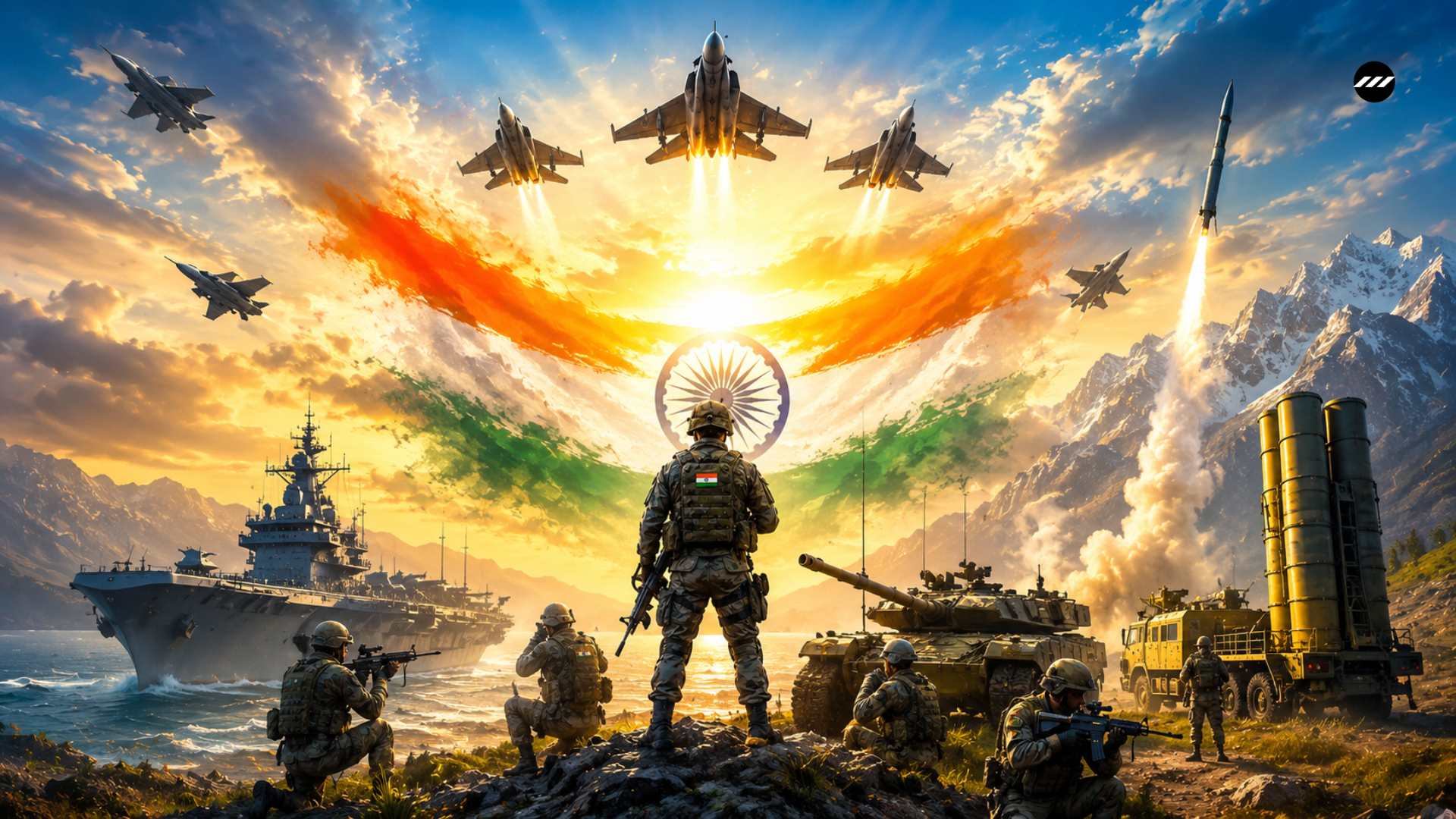
A Watershed Moment in India’s Defence Posture

At 1:05 a.m. on May 7, 2025, India launched Operation Sindoor — a surgical, high-intensity strike on selected terrorist infrastructure in Pakistan. What followed over 88 hours was not merely a military operation but a fundamental rewriting of India's national security doctrine.
The Doctrinal Shift: From Reactive Restraint to Zero Tolerance
India's historical posture of "reactive restraint" had a predictable architecture:
Terrorist attack occurs
        ↓
India compiles evidence → "Dossier approach"
        ↓
Military inaction framed as "extraordinary restraint"
        ↓
West encourages and lauds restraint
        ↓
"What if" nuclear escalation loops paralyse decision-makers
        ↓
No military response
Operation Sindoor broke this cycle decisively. Post-operation, Prime Minister Modi's "zero tolerance" policy established a new red line — any act of cross-border terrorism would henceforth be treated as an act of war. This reflects a leadership that refused to submit to nuclear blackmail or external pressure, drawing permanent new boundaries in India's strategic calculus.
The Operation: Scale, Integration, and Precision
The strikes targeted nine terrorist targets — including Bahawalpur and Muridke inside Pakistan, choices described as previously "unthinkable." The operation achieved total success despite Pakistan being fully alert.
The three-phase escalation ladder:
Phase 1 — May 7 (1:05 a.m.): Surgical strikes on nine terrorist infrastructure targets across Pakistan — seamlessly integrated across the Indian Army, Navy, and Air Force.
Phase 2 — May 9–10: When the Pakistan Air Force attempted to strike Indian high-value assets, the IAF countered in near real time — hitting 11 Pakistani bases including Nur Khan, Sargodha, Murid, and Bholari with precise, devastating effect.
Phase 3 — Naval and Ground Pressure:
- Indian Navy deployments left Karachi nervously monitoring the Arabian Sea
- Aggressive Army operations along the Line of Control and International Border rendered Pakistani drone attacks unviable
- India's networked air-defence system including the S-400 denied airspace not just over Indian territory but deep inside Pakistan
"After 88 hours of Operation Sindoor, by noon on May 10, Pakistan was reeling from massive destruction at 11 bases. Pakistan had no choice but to rush and request a ceasefire."
The global defence analytical community has acknowledged this as "one of the most defining and concise actions against a nuclear-armed nation."
Civil-Military Synergy: The Real Achievement
The operation demonstrated seamless integration between India's civil and military institutions:
- Political directive came in unambiguous, decisive form — stronger than the services had anticipated
- Services were given a free hand to execute
- The Chief of Defence Staff and Service Chiefs are credited with the "ferocious targeting on May 10" and the "brilliant seizing of the escalation opportunity" to coerce ceasefire on India's terms
- Termination was timed after all objectives were achieved — not under external pressure
The ceasefire announcement, though sudden for the public, was strategically sound. As the author notes — one cannot view these developments with emotion when all military objectives have been met.
Strategic Signals Beyond the Battlefield
Operation Sindoor's ongoing status carries layered strategic messaging:
- To terrorists — remain in hiding; no sanctuary is safe
- To Pakistan's military establishment — reckless adventurism carries catastrophic costs
- To Pakistani citizenry — in the age of digital transparency, the truth of a military regime camouflaged by political facade cannot be suppressed indefinitely
- To the world — India will not be deterred by nuclear overhang from protecting its sovereign interests
The Atmanirbharta Imperative
The stellar performance of indigenous systems during Operation Sindoor has direct implications for India's defence industrial ecosystem:
- Invigorated India's innovation and startup ecosystem
- DRDO laboratories, Defence PSUs, and large industry players must now urgently integrate the entire private sector — including MSMEs and startups — into an indigenous ecosystem
- The mandate: "Innovate, Design, and Manufacture" at scale
- Government reforms across defence, aerospace, space, cyber, and AI domains must now translate into real Atmanirbharta — not delayed further
The unpredictable geopolitical environment makes this not optional but urgent.
Way Forward & Conclusion
Operation Sindoor is not a closed chapter — it is a permanently altered baseline. The "Modi redlines" on cross-border terrorism are irreversible and will define India's strategic mindset for the foreseeable future. Three imperatives follow:
- Sustained readiness — the armed forces must maintain high operational tempo; expectations after the opening round are high
- Defence industrialisation — the golden period of governance reforms must be capitalised on through a whole-of-nation approach to indigenous defence manufacturing
- Doctrinal institutionalisation — the shift from reactive restraint to proactive deterrence must be embedded in formal doctrine, training, and procurement priorities
India demonstrated that strategic resolve, military precision, and civil-military synergy — when aligned — can redefine the rules of engagement even under a nuclear overhang. That is the enduring lesson of Operation Sindoor.
Attribution
Original content sources and authors

Syllabus classification
How this article maps to GS papers
Main syllabus
GS3Internal SecurityQuick Q&A
What does Operation Sindoor signify in the evolution of India’s national security doctrine?
The operation was launched in response to the Pahalgam terror attack of April 2025 and involved coordinated strikes on terrorist infrastructure across Pakistan. According to the article, the political leadership declared that future acts of cross-border terrorism would be treated as “acts of war.” This reflects the emergence of a doctrine based on zero tolerance, calibrated escalation, and rapid military retaliation.
Key features of this doctrinal shift include:
- Proactive deterrence: India demonstrated willingness to strike deep into adversary territory.
- Refusal to accept nuclear blackmail: Strategic restraint no longer implies military inaction.
- Integrated warfare capability: Coordination among the Army, Navy, and Air Force became central.
- Political-military synergy: The armed forces reportedly received a clear operational mandate.
The targeting of locations such as Bahawalpur and Muridke signaled a willingness to hit strategically sensitive terror hubs. This resembles the gradual evolution of India’s doctrine after earlier operations such as the 2016 Uri surgical strikes and the 2019 Balakot airstrike, but at a much larger operational scale.
Strategically, Operation Sindoor indicates that India seeks to establish new deterrence thresholds against state-sponsored terrorism. However, such a doctrine also increases the importance of escalation control, diplomatic preparedness, and military readiness in a nuclearized regional environment.
Why is Operation Sindoor being described as a paradigm shift in India-Pakistan strategic dynamics?
The operation reportedly involved integrated strikes on multiple terrorist and military-linked targets despite Pakistan being fully alert. India also responded rapidly to subsequent Pakistani actions by targeting several air bases, demonstrating high operational preparedness and escalation dominance. Such actions conveyed that India was willing to impose significant military costs while still managing escalation within controllable limits.
The paradigm shift can be understood through the following dimensions:
- Expanded response spectrum: India moved beyond symbolic retaliation to sustained integrated operations.
- Escalation control: Military force was calibrated rather than indiscriminate.
- Strategic signaling: The operation established new red lines regarding cross-border terrorism.
- Psychological impact: It altered adversarial perceptions regarding India’s willingness to act.
The article also notes the role of advanced systems such as the S-400 air defence network and integrated tri-service coordination. This demonstrated India’s growing capability to combine conventional superiority with technological preparedness. Comparisons may be drawn with earlier doctrines such as Cold Start, which emphasized swift and limited conventional retaliation under a nuclear overhang.
However, the strategic consequences are complex. While stronger deterrence may reduce future provocations, repeated military escalations also raise risks of miscalculation between nuclear powers. Therefore, alongside military preparedness, diplomatic engagement and crisis communication mechanisms remain essential for long-term regional stability.
How did Operation Sindoor demonstrate the importance of integrated theatre operations and civil-military synergy?
The Indian Air Force reportedly carried out precision strikes on terrorist infrastructure and Pakistani air bases, while the Indian Navy maintained strategic pressure through deployments near Karachi. Simultaneously, the Indian Army conducted aggressive operations along the Line of Control and International Border, reducing the effectiveness of Pakistani drone activity. This multidimensional response reflected synchronized planning and execution across services.
The operation highlighted several aspects of integrated warfare:
- Unified command and planning: Political leadership provided clear operational objectives.
- Real-time coordination: Rapid responses were enabled through networked military systems.
- Air defence integration: Systems such as the S-400 strengthened aerial dominance.
- Escalation management: Operations were calibrated to achieve objectives without uncontrolled conflict expansion.
The operation also underscored the importance of civil-military synergy. The article emphasizes that the political leadership trusted the armed forces with operational freedom, while the military effectively translated strategic intent into battlefield outcomes. This alignment between political objectives and military execution is considered essential in modern conflict management.
From a broader strategic perspective, Operation Sindoor supports India’s ongoing defence reforms aimed at theatre command integration and jointness. However, achieving sustained integration requires institutional restructuring, interoperable technologies, common doctrines, and continuous joint training. Thus, the operation may serve as both a demonstration of capability and a catalyst for deeper defence reforms.
Critically analyze the opportunities and risks associated with India’s emerging doctrine of proactive military retaliation against cross-border terrorism.
The doctrine offers several strategic opportunities:
- Enhanced deterrence: Demonstrates that terrorist attacks will invite substantial retaliation.
- Psychological advantage: Alters adversary perceptions regarding India’s resolve.
- Domestic confidence: Strengthens public trust in national security institutions.
- Operational preparedness: Encourages modernization and jointness among armed forces.
Operation Sindoor, according to the article, reflected these advantages through rapid, integrated, and high-impact operations. It also showcased indigenous defence systems and India’s evolving military capabilities. Such operations may discourage future attacks by increasing strategic uncertainty for hostile actors.
However, significant risks and challenges remain:
- Nuclear escalation: Military confrontation between nuclear powers carries inherent risks.
- Miscalculation: Rapid escalation cycles may reduce diplomatic maneuvering space.
- International pressure: Prolonged conflicts may invite external intervention.
- Economic consequences: Sustained tensions can affect investment and regional stability.
Critics may argue that military responses alone cannot permanently eliminate terrorism without addressing underlying geopolitical and ideological factors. Furthermore, repeated retaliatory doctrines may create escalation expectations among domestic audiences, reducing flexibility during crises.
Therefore, while proactive retaliation may strengthen deterrence, it must be integrated within a broader national security strategy that includes diplomacy, intelligence coordination, border management, and international cooperation against terrorism. Sustainable security requires balancing military assertiveness with strategic restraint and crisis management mechanisms.
Why does Operation Sindoor highlight the importance of Atmanirbharata and indigenous defence manufacturing for India?
India’s defence modernization goals increasingly emphasize domestic production in areas such as missiles, drones, aerospace systems, cyber capabilities, and artificial intelligence. Indigenous manufacturing enhances strategic autonomy by reducing dependence on external powers for critical military equipment. It also allows faster adaptation to operational requirements specific to India’s security environment.
The importance of indigenous defence production can be understood through several dimensions:
- Strategic autonomy: Reduces vulnerability to foreign sanctions or supply disruptions.
- Operational readiness: Enables quicker maintenance and replenishment.
- Economic growth: Defence manufacturing supports employment and industrial development.
- Innovation ecosystem: Encourages startups, MSMEs, and research institutions.
The article specifically emphasizes the need for Defence Research and Development Organisation (DRDO), Defence Public Sector Undertakings (DPSUs), and large industries to integrate MSMEs and startups into a “whole-of-nation” ecosystem. Similar models are visible in countries such as the United States, Israel, and China, where private-sector innovation plays a central role in defence capability development.
However, achieving true Atmanirbharata requires more than slogans. India must improve research funding, procurement efficiency, technology transfer, and public-private collaboration. Long-term success will depend on building globally competitive defence manufacturing ecosystems rather than relying solely on import substitution. Operation Sindoor thus serves as both a demonstration of capability and a reminder of the urgent need for sustained defence industrial reform.
Suppose you are part of India’s National Security Advisory framework after Operation Sindoor. What measures would you recommend to sustain deterrence while preventing uncontrolled escalation?
The following measures would be important:
- Strengthening intelligence integration: Improve coordination among intelligence agencies for early threat detection.
- Enhancing tri-service preparedness: Continue reforms related to theatre commands and joint operations.
- Investing in indigenous technologies: Expand domestic capabilities in drones, cyber warfare, AI, and missile defence.
- Maintaining diplomatic channels: Keep backchannel communication mechanisms operational to prevent misunderstandings.
- Strategic communication: Clearly communicate red lines and objectives to both domestic and international audiences.
India should also deepen cooperation with global partners on counterterrorism financing, intelligence sharing, and cybersecurity. Simultaneously, civil defence preparedness and resilience against hybrid warfare, including drone and cyber threats, should be strengthened.
From a diplomatic perspective, India must ensure that military operations remain accompanied by strong international outreach to maintain legitimacy and avoid external misperceptions. Escalation dominance should not be confused with unlimited escalation. Historical examples such as the Kargil conflict and Cold War crisis management demonstrate the importance of maintaining strategic signaling alongside military preparedness.
Ultimately, deterrence is sustainable only when military capability is supported by political clarity, economic resilience, technological strength, and diplomatic credibility. Operation Sindoor may have established new strategic red lines, but preserving long-term stability will require a balanced combination of strength, restraint, and institutional coordination.
Practice questions
1 question for mains preparation