Has the Weakening of Unionisation Hurt Indian Workers?

Introduction
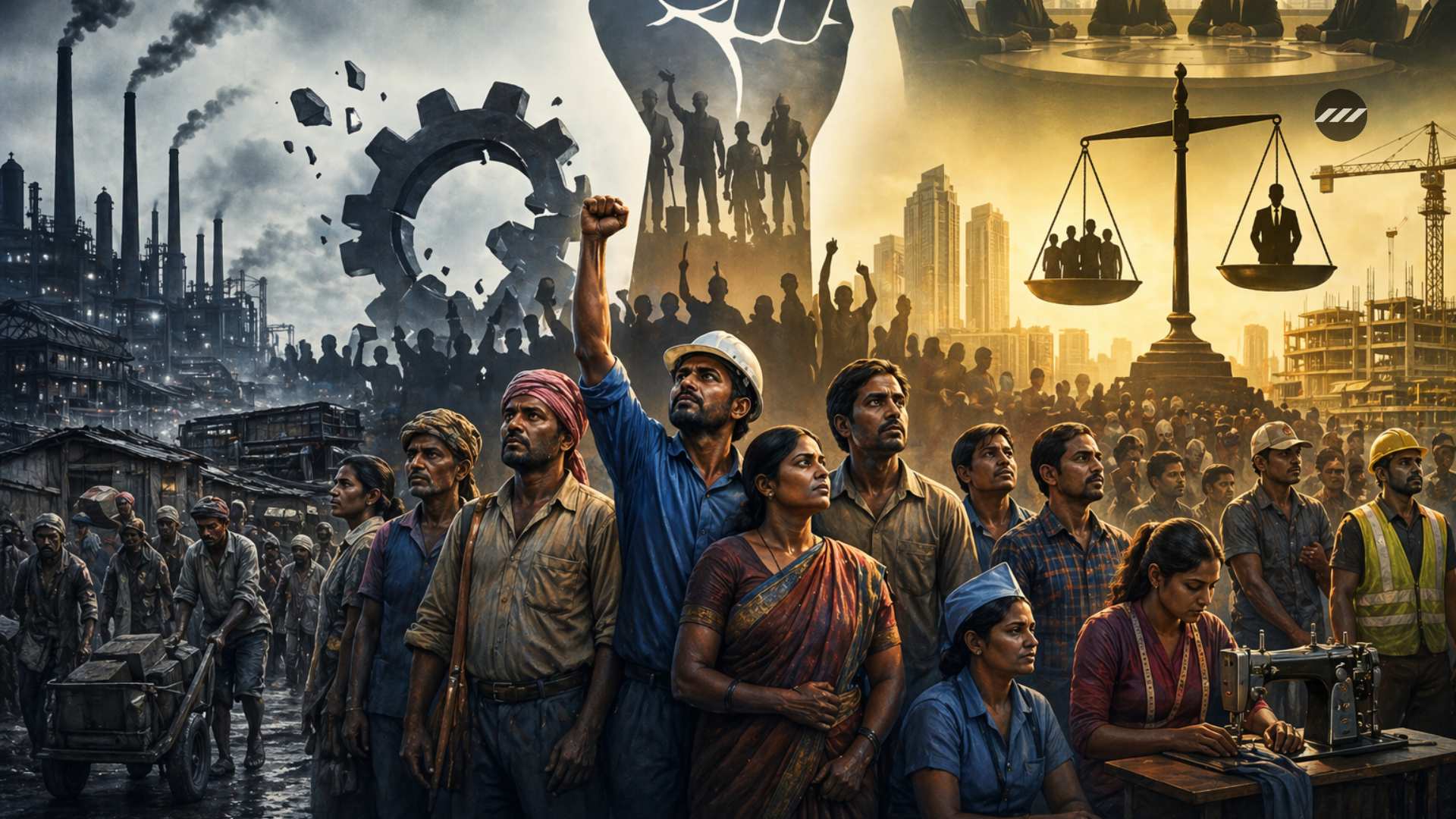
India's labour movement, once a cornerstone of its democratic and anti-colonial struggle, has undergone a structural erosion over four decades of liberalisation. With unionisation at a mere 6.3% of the workforce (1.8% private sector; 11.8% public sector), and the four Labour Codes threatening to further curtail collective bargaining rights, the March–April 2026 worker agitations in the NCR — demanding minimum wage revision amid soaring living costs — signal a deepening crisis at the intersection of labour rights, informalisation, and democratic governance.
"Rather than formalising the informal, our labour force has become more informal over the years in spite of a protective labour law framework being there." — Kingshuk Sarkar, Labour Economist
| Indicator | Data |
|---|---|
| Overall unionisation rate | 6.3% of workforce |
| Private sector unionisation | 1.8% |
| Public sector unionisation | 11.8% |
| Public sector employment (1991) | 19.6 million |
| Public sector employment (2008) | 17.5 million |
| Agriculture: % of national income | 14% |
| Agriculture: % of employment | 45%+ |
Background & Context
- Pre-1991: Trade unions had relatively stronger bargaining power,
  primarily in the public sector; labour laws were actively enforced.

- Post-1991 (LPG era): Liberalisation, Privatisation, Globalisation
  → labour market became predominantly informal
  → public sector downsized (19.6M → 17.5M jobs, 1991–2008)
  → contract labour proliferated; outsourcing became structural norm

- Trigger for current crisis (March–April 2026):
  → Worker agitations in NCR and manufacturing sector
  → Demands: minimum wage revision, social security expansion,
    end to contractualisation of jobs
  → Context: soaring living costs, stagnant minimum wages

- Four Labour Codes: Passed by Parliament, implementation pending
  → Consolidate 44 central labour laws into 4 codes
  → Contested on grounds of weakening worker protections
Key Concepts
DEUNIONISATION — CAUSES (Structural, not merely behavioural)
──────────────────────────────────────────────────────────────────────
  1. Informalisation of labour market
     → Workers lack employment contracts or social security access
     → Trade unions historically focused on formal/permanent workforce
     → Contract workers remain largely outside union structures

  2. Fragmentation & outsourcing
     → Workers employed by intermediaries, not directly by firms
     → No direct employer-employee relationship → hard to organise

  3. Ideological fragmentation of unions
     → Political affiliations of mainstream unions → worker distrust
     → Multiple competing unions weaken collective bargaining

  4. Privatisation & public sector shrinkage
     → Unionised public sector workforce trimmed significantly
     → Private sector resistant to unionisation

  5. Younger workforce alienation
     → Negative perception of trade unions among youth
     → Gig economy, platform work outside traditional union models

  6. Regulatory retreat
     → Global competition → weakening of labour standards
     → Flexible work arrangements replacing secure employment


CONTRACTUALISATION
──────────────────────────────────────────────────────────────────────
  Definition: Replacing permanent employees with contract workers
  to reduce labour costs and avoid statutory obligations.

  Impact:
    → Contract workers earn less, lack social security
    → Harder to unionise (no direct employer relationship)
    → Creates two-tier workforce within same factory/firm
    → Legally ambiguous employer liability

  Regional variation: Kerala, Tamil Nadu — contract workers unionised
  as separate entities; participate in general strikes.
  Most states: Contract workers outside union ambit entirely.


MINIMUM WAGE DETERMINATION — TRIPARTITE STRUCTURE
──────────────────────────────────────────────────────────────────────
  Minimum Wage Advisory Board:
    → 1/3 Trade Union representatives
    → 1/3 Employer representatives
    → 1/3 Government representatives
  Decision: State governments fix minimum wages based on board input.
  Problem: Trade unions weakened → worker voice diluted in tripartite
  structure → wages remain below subsistence level.
The Labour Codes — Key Changes & Concerns
| Parameter | Pre-Labour Codes | Under Four Labour Codes |
|---|---|---|
| Trade union formation threshold | 8 workers can form a union | Minimum 10% of workforce required |
| Labour Department oversight | Statutory supervision present | No statutory supervision mandated |
| Employment type | Permanent + contract | "Fixed Term Employment" introduced |
| Minimum wage coverage | Scheduled employments only | Extended to all employments (progressive) |
| Strike notice period | 14 days (factories) | 60 days (public utilities) — extended |
| Overall tilt | Relatively balanced | Critics: tilts toward employers |
KEY CONCERN — TRADE UNION FORMATION THRESHOLD
──────────────────────────────────────────────────────────────────────
  Old law: 8 workers → can form a registered trade union
  New code: 10% of workforce required → in large factories with
  thousands of workers and multiple unions, no single union may
  qualify → effectively bars formal union registration

  Impact: Catastrophic for small establishments and contract workers
  where worker density or cohesion is low.

FIXED TERM EMPLOYMENT (FTE)
──────────────────────────────────────────────────────────────────────
  FTE = Employment for a fixed period with same benefits as permanent
  workers — but no obligation to retain after contract ends.
  Critics argue: Formalises precarity; replaces permanence with
  renewable short-term contracts → eliminates job security entirely.
Structural Labour Market Paradox
AGRICULTURE SURPLUS LABOUR — THE CORE PROBLEM
──────────────────────────────────────────────────────────────────────
  Agriculture contributes: 14% of national income (GDP)
  Agriculture employs:     45%+ of workforce

  → Massive surplus labour trapped in low-productivity agriculture
  → This labour needs absorption into industry and services
  → Without this absorption, surplus labour depresses industrial wages
    (workers accept below-subsistence wages to avoid unemployment)
  → Trade unions cannot sustain wage floors when labour supply is
    structurally unlimited from agricultural sector
──────────────────────────────────────────────────────────────────────
  This is why minimum wage agitations recur — the market wage for
  unskilled labour in India is structurally below subsistence.
Implications & Challenges
For Workers
- Minimum wage has become the ceiling, not the floor — workers fight for it as survival, not as a baseline above which collective bargaining operates.
- Social security (PF, ESI, gratuity) inaccessible to ~90% of workforce in informal arrangements.
- Defensive strikes (general, symbolic) have replaced aggressive sector-level indefinite strikes — reflecting weakened bargaining position.
For Democracy & Governance
- Deunionisation = de-democratisation: trade unions are not just economic institutions — they are vehicles of political voice for the working class.
- Arrest of trade union leaders without parliamentary or media scrutiny signals shrinking democratic space for labour.
- Tripartite wage-setting structures become hollow when one party (labour) is structurally weakened.
For Industry & Growth
- Wage suppression reduces domestic consumption demand — a structural constraint on India's consumer market growth.
- Contractualisation reduces firm-level productivity investment (firms invest less in training contract workers).
- Industrial unrest (NCR agitations, 2026) disrupts manufacturing output — ironically, deunionisation creates more volatile, not less, labour relations.
Way Forward
- Implement existing laws first: Decades of protective labour legislation remain unimplemented — enforcement, not new legislation, is the priority.
- Extend union rights to informal workers: Amend Labour Codes to lower union formation threshold; extend collective bargaining rights to gig, platform, and contract workers.
- Strengthen tripartite machinery: Make Minimum Wage Advisory Board recommendations binding; increase revision frequency to match inflation.
- Social security universalisation: Delink social security from employment type — extend PF, ESI, and gratuity to all workers regardless of contract status.
- Address agricultural surplus labour: Accelerate labour absorption into manufacturing and services through skilling, industrial corridors, and MSME growth — the structural root cause of wage depression.
- Revise Labour Code thresholds: Restore 8-worker union formation threshold; reinstate statutory Labour Department supervision.
Conclusion
India's labour crisis is not a law-and-order problem — it is a structural governance failure. The progressive informalisation of the workforce since 1991, combined with the weakening of collective bargaining institutions and the regulatory retreat embodied in the Labour Codes, has created a workforce that is simultaneously more productive (India's manufacturing output is rising) and more precarious (wages stagnant, job security absent). Trade unions, when functional, serve as institutional shock absorbers — converting worker grievances into negotiated outcomes rather than street agitations. Their erosion has not produced industrial peace; it has produced periodic explosions. Rebuilding labour institutions is not anti-growth — it is the foundation of sustainable, consumption-driven, inclusive growth that India's development model urgently requires.
Attribution
Original content sources and authors


Syllabus classification
How this article maps to GS papers
Main syllabus
GS3Jobs & Inclusive GrowthQuick Q&A
What is deunionisation and how has it evolved in the Indian labour market since 1991?
Post-1991, the labour market underwent a structural transformation characterized by informalisation, contractualisation, and flexible employment arrangements. A growing share of workers began operating outside formal contracts and social security frameworks, making it difficult for unions to organise them. As a result, unionisation rates have dropped significantly to about 6.3% overall, with only 1.8% in the private sector.
Additionally, fragmentation of trade unions along ideological and political lines weakened collective bargaining. Younger workers also tend to perceive unions as less relevant in a gig-based and flexible job economy. This shift reflects a broader transition from a state-supported industrial relations system to a market-driven labour regime.
Thus, deunionisation in India is not merely a decline in membership but represents a systemic shift in labour-capital relations, with implications for wage security, working conditions, and social protection.
Why has the decline of trade unions raised concerns about workers’ rights and social security in India?
One major issue is the erosion of bargaining power. For example, the article highlights that a large proportion of workers are now employed under non-standard arrangements such as contract labour, part-time jobs, or self-employment. These workers often lack access to benefits like health insurance, pensions, or job security. Without strong unions, it becomes difficult to advocate for improvements in these areas.
Additionally, the decline of unions has implications for democratic participation. Trade unions have historically played a role in broader social and political movements, including India’s freedom struggle. Their weakening reflects a trend of de-democratisation, where worker concerns receive less attention in public discourse and policymaking.
Furthermore, issues like inadequate minimum wages and rising inflation remain unresolved partly due to weak collective representation. Thus, the decline of trade unions threatens not only economic justice but also the broader goal of inclusive and equitable development.
How have structural changes such as informalisation and contractualisation affected the functioning of trade unions in India?
These trends have made it difficult for unions to identify, mobilise, and organise workers. For instance, contract workers often do not have a direct employer-employee relationship, which complicates union engagement. Moreover, such workers may fear job loss if they participate in union activities, further reducing union penetration.
Another impact is the fragmentation of the workforce. With workers spread across multiple small units, gig platforms, or subcontracting chains, collective bargaining becomes less effective. Trade unions, which traditionally focused on permanent workers in organised sectors, have struggled to adapt to this new reality.
For example, even in manufacturing hubs, protests over minimum wages and working conditions highlight the inability of unions to fully represent contract labour. While some regions like Kerala and Tamil Nadu have experimented with separate unions for contract workers, these efforts remain limited.
Thus, these structural changes have weakened the traditional model of trade unionism, necessitating innovative approaches to labour organisation.
What are the key reasons behind the declining bargaining power of trade unions in India?
Politically, the affiliation of trade unions with political parties has sometimes reduced their credibility among workers, who may view them as extensions of political ideologies rather than independent representatives. This has led to fragmentation and weakened collective action.
Institutionally, changes in labour laws and policies have also played a role. For instance, the introduction of Labour Codes requiring a minimum of 10% workforce representation to form a union makes unionisation more difficult, especially in small and fragmented workplaces. Additionally, the lack of effective enforcement of existing labour laws has further eroded union influence.
Another important factor is the surplus labour supply, particularly from agriculture, where over 45% of the workforce contributes only 14% to national income. This creates a situation where workers are easily replaceable, reducing their bargaining power.
Together, these factors have created a labour market where trade unions struggle to assert their role, leading to weaker protections for workers.
Can you provide examples from recent labour unrest that highlight the challenges faced by trade unions in addressing workers’ issues?
One example is the unrest in the National Capital Region (NCR), where workers demanded higher minimum wages. Despite the presence of a tripartite mechanism involving the government, employers, and trade unions, the wages were found insufficient for subsistence. This highlights the limited influence of unions in ensuring fair wage revisions.
Another example is the issue of contract labour. Workers employed through contractors often lack direct representation and are excluded from traditional union structures. Even when unions exist, their ability to negotiate on behalf of such workers is constrained.
Additionally, the absence of strong public and political support for labour movements—such as lack of media coverage or legislative debate when union leaders are detained—illustrates the marginalisation of trade unions in contemporary discourse.
These examples underscore the need for revitalising trade union strategies and strengthening institutional frameworks to better address worker concerns.
Critically analyze the impact of the Labour Codes on trade unions and workers’ rights in India.
However, there are significant concerns regarding their impact on trade unions and workers’ rights. One major issue is the requirement that at least 10% of the workforce must be part of a union for it to be registered. This raises barriers to union formation, particularly in small and fragmented workplaces. Additionally, critics argue that the codes tilt in favour of employers by allowing greater flexibility in hiring practices, including fixed-term employment.
Another limitation is the lack of effective enforcement mechanisms. As highlighted in the article, even existing labour laws have not been properly implemented over the past decades. Without strong institutional oversight, the benefits of the new codes may not reach workers.
Moreover, the codes do not adequately address the challenges of informal and gig workers, who constitute a large portion of the workforce. This limits their effectiveness in tackling the root causes of labour insecurity.
In conclusion, while the Labour Codes represent an important step towards legal reform, their success depends on balanced implementation, stronger enforcement, and inclusion of diverse worker categories.
As a policymaker, how would you address the challenges of deunionisation and ensure better protection for workers in India?
Secondly, there is a need to enhance social security coverage. This could involve expanding schemes like the Employees’ State Insurance (ESI) and Provident Fund to include gig and informal workers. Digital platforms can be leveraged to register and track workers, ensuring portability of benefits.
Another key intervention would be strengthening tripartite mechanisms involving government, employers, and trade unions. These bodies should play an active role in revising minimum wages, resolving disputes, and ensuring compliance with labour laws. For example, state-level wage boards can be made more responsive to inflation and cost-of-living changes.
Additionally, capacity-building initiatives for trade unions are essential to help them adapt to changing labour dynamics. This includes training in digital organising, legal advocacy, and negotiation skills.
Finally, ensuring effective enforcement of labour laws is critical. Without accountability mechanisms, even well-designed policies may fail. By combining these measures, policymakers can create a more balanced labour ecosystem that protects workers while supporting economic growth.
Practice questions
1 question for mains preparation