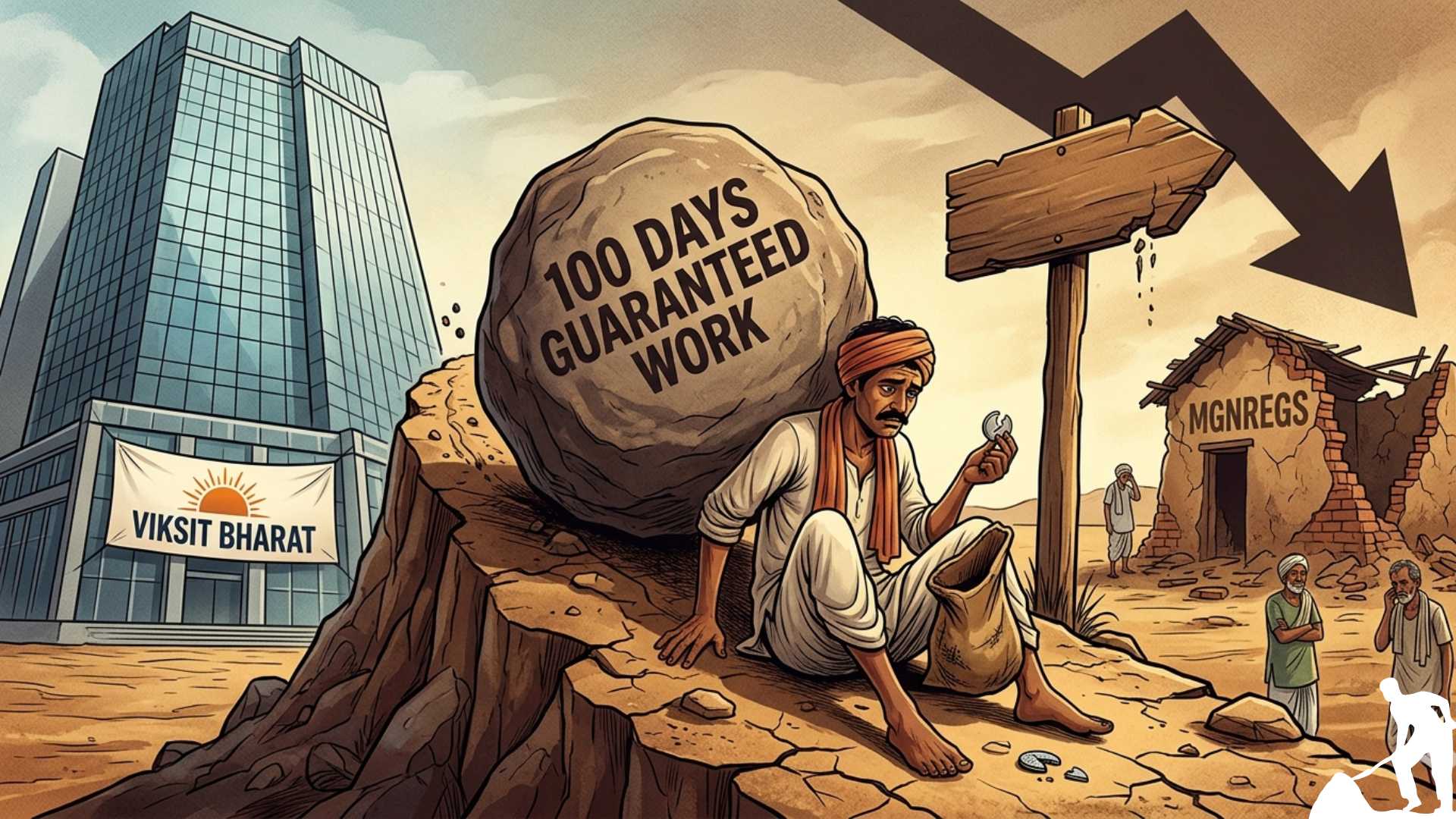
MGNREGS: A Sharp Decline in Coverage and Employment in 2025-26

MGNREGS — the flagship rural employment guarantee of the UPA era — is ending not with a transition but with a contraction. The final operational year of the scheme (2025–26) recorded a sharp decline across every key metric, even as the government prepares to replace it with a new law passed without public consultation.
The Paradox: More Registered, Less Employed
The headline number looks positive — registered households rose from 14.98 crore to 15.46 crore (a 3.2% increase). But that is where the good news ends.
Registered households       ↑ 3.2%   (15.46 crore)
Households actually employed ↓ 8.2%   (44 lakh fewer)
Workers actually employed    ↓ 9.1%   (67 lakh fewer)
Total persondays generated   ↓ 21.5%  (210.73 crore vs 268.44 crore)
Avg persondays/household     ↓ 14.5%  (42.92 vs 50.18)
Households completing 100 days ↓ 40.5% (0.22 crore vs 0.37 crore)
Registration expanded on paper while actual delivery collapsed on the ground — a textbook case of coverage-delivery mismatch.
The Income Blow
- Average daily wage actually increased from ₹252.7 to ₹267
- Yet wage expenditure fell by ₹11,570 crore — from ₹67,835 crore to ₹56,265 crore
- Because the collapse in workdays overwhelmed the wage hike
LibTech estimates: had persondays remained at 2024–25 levels, workers could have earned an additional ₹15,409 crore.
- Average household income fell from ₹12,681 to ₹11,460
- Potential income had workdays held steady: ₹13,398 — implying an effective loss of ₹1,938 per household
- Conservative estimate of actual loss: ₹1,221 per household
Geographic Spread of Decline
The contraction was not localised — it was nationwide:
- 15 out of 20 states recorded a fall in persondays
- West Bengal generated zero persondays in both 2024–25 and 2025–26 — excluded from analysis entirely
Steepest declines:
- Tamil Nadu — 42.8%
- Haryana — 41.7%
- Himachal Pradesh — 41%
- Telangana — 40.2%
States that bucked the trend:
- Jharkhand — +12.9%
- Jammu & Kashmir — +7.3%
- Odisha — +6.7%
- Madhya Pradesh — +0.5%
The Transition Problem
MGNREGS is being replaced by the Viksit Bharat – Guarantee for Rozgar and Ajeevika Mission (Gramin) Act 2025, passed in Parliament in December 2025. Key concerns:
- Only ₹30,000 crore allocated for the transitional period — a sharp reduction given the scale of the outgoing scheme
- The new law was brought in with no public consultation
- Civil society groups have flagged that restructuring an employment guarantee without stakeholder input undermines its foundational purpose
"The employment guarantee programmes play a critical role in rural livelihood security and any major restructuring of such programmes must involve meaningful consultation." — NREGA Sangharsh Morcha
Activists have urged the government to ensure unhindered employment continuity during the transition, warning against any gap in coverage that leaves rural households exposed.
Conclusion
The core tension this article presents: a welfare scheme designed as a demand-driven right is being wound down in a year of peak contraction, replaced by legislation designed without grassroots input.
Attribution
Original content sources and authors


Syllabus classification
How this article maps to GS papers
Main syllabus
GS3Jobs & Inclusive GrowthQuick Q&A
What is the significance of MGNREGS in India’s rural development framework, and how does the reported contraction in 2025–26 affect rural livelihoods?
Impact of the contraction: The reported decline in 2025–26 is significant because it reflects a reduction in actual employment opportunities despite a rise in registered households. The fall in persondays from 268.44 crore to 210.73 crore indicates weakening rural demand support at a time when many rural regions continue to face agrarian distress, climate uncertainties, and limited non-farm employment opportunities. The sharp decline in households completing 100 days of work suggests that the statutory guarantee itself is becoming less effective in practice.
Economic and social implications: According to LibTech estimates, the contraction caused an average income loss of ₹1,221 per household. Such losses disproportionately affect marginal farmers, landless labourers, Scheduled Castes, Scheduled Tribes, and women workers. In states like Tamil Nadu and Telangana, where dependence on MGNREGS has historically been high, the reduction could aggravate rural indebtedness and migration. The programme also acts as an automatic stabiliser during economic crises, as seen during the COVID-19 pandemic. Therefore, weakening MGNREGS may reduce the resilience of rural households against future shocks.
Broader governance perspective: The contraction also raises concerns regarding the future of rights-based welfare in India. Since MGNREGS is demand-driven by design, a decline in employment despite increasing registrations may indicate administrative restrictions, delayed fund releases, or policy-level shifts in welfare priorities.
Why is the transition from MGNREGS to the Viksit Bharat - Guarantee for Rozgar and Ajeevika Mission (Gramin) Act 2025 being viewed with concern by activists and researchers?
Importance of consultation in welfare policy: Welfare schemes like MGNREGS are not merely budgetary instruments but social contracts between the State and citizens. The NREGA Sangharsh Morcha argues that major reforms must involve meaningful stakeholder engagement including Panchayats, labour unions, women’s self-help groups, and civil society organisations. Without consultation, policy design may ignore local realities such as seasonal unemployment, drought vulnerability, and caste-based exclusion.
Budgetary and implementation concerns: The allocation of only ₹30,000 crore during the transition phase has raised apprehensions regarding reduced scale and effectiveness. Since wage employment demand remains high in many regions, inadequate allocations may lead to delayed payments, work rationing, and denial of legal entitlements. The decline in wage expenditure despite higher daily wages indicates that fewer work opportunities are being generated.
Case-study perspective: During the COVID-19 crisis, MGNREGS emerged as a lifeline for returning migrant workers. States such as Rajasthan and Chhattisgarh effectively used the scheme to absorb labour distress. If the new scheme lacks a legally enforceable employment guarantee or decentralised implementation structure, rural households may lose an important safety net. Therefore, the debate is not merely administrative but relates to the broader issue of balancing fiscal priorities with social justice and inclusive development.
What factors could explain the paradoxical trend of increasing registrations under MGNREGS but declining employment generation in 2025–26?
Administrative and fiscal factors: One major reason could be inadequate budgetary allocation and delayed fund release mechanisms. Since MGNREGS is legally demand-driven, insufficient funds can lead to work rationing at the local level. Panchayats may avoid opening new works due to uncertainty regarding wage payments. Delays in wage disbursement also discourage participation. In addition, technological requirements such as Aadhaar-based attendance systems and digital payment mechanisms may unintentionally exclude vulnerable workers lacking digital access.
Policy transition uncertainty: The transition towards the new employment legislation may also have contributed to administrative confusion. Officials may become hesitant to initiate long-term projects during institutional restructuring. This can reduce the number of sanctioned works and persondays generated. The decline across multiple states suggests that the issue is systemic rather than region-specific.
Socio-economic implications: The paradox indicates that rural distress remains high even as public employment support weakens. For example, Tamil Nadu recorded one of the steepest declines despite historically strong implementation of MGNREGS. Such trends can increase seasonal migration, reduce consumption expenditure, and weaken rural economies. Economically, lower wage payments reduce purchasing power, affecting local markets and rural demand. Therefore, the data highlights the importance of viewing employment guarantee schemes not only as welfare expenditure but also as instruments of macroeconomic stabilisation and inclusive growth.
Critically analyse the effectiveness of MGNREGS as a rural employment and social protection programme.
Role in social justice and empowerment: The scheme has empowered marginalised communities by creating a legally enforceable right to work. It reduced dependence on exploitative labour arrangements and improved bargaining power for rural workers. During crises such as droughts and the COVID-19 pandemic, MGNREGS acted as a social safety net that prevented extreme poverty and distress migration.
Limitations and criticisms: Despite these achievements, the programme faces several operational challenges.
- Delayed wage payments reduce worker confidence.
- Insufficient budget allocations constrain implementation.
- Corruption and ghost beneficiaries remain concerns in some regions.
- Digital attendance and payment systems sometimes exclude vulnerable populations.
- The guaranteed 100 days are rarely fully provided to all eligible households.
Balanced evaluation: While there are implementation shortcomings, most experts agree that the solution lies in reform rather than rollback. Strengthening transparency, decentralised planning, timely fund release, and social audits can improve outcomes. The sharp contraction in 2025–26 demonstrates that reducing employment opportunities under MGNREGS can have immediate consequences for rural income security. Therefore, from a governance perspective, MGNREGS remains an essential pillar of inclusive development and social protection in India.
How do inter-state variations in MGNREGS performance reflect broader issues of governance and rural development in India?
Governance and institutional factors: States with stronger Panchayati Raj institutions, active civil society participation, and better administrative coordination often implement MGNREGS more effectively. For example, states like Rajasthan and Kerala historically demonstrated strong social audit systems and proactive work generation. On the other hand, delays in fund utilisation, weak planning mechanisms, or inadequate staffing can reduce employment opportunities.
Socio-economic and geographical dimensions: Variations also reflect differing socio-economic realities. States with high rural poverty, tribal populations, or drought-prone regions often rely more heavily on MGNREGS. Jharkhand’s increase in persondays may indicate continued dependence on public employment due to limited industrial opportunities. Conversely, declines in economically dynamic states may partly reflect administrative policy choices or shifting labour patterns.
Policy implications: These disparities underline the need for flexible and decentralised policy implementation. A uniform national approach may not adequately address local needs. Stronger monitoring, transparent data systems, and greater financial autonomy for local bodies can improve performance. Inter-state comparisons also demonstrate that welfare outcomes are closely linked to governance quality. Therefore, MGNREGS serves not only as an employment programme but also as a test of cooperative federalism and administrative accountability in India.
Suppose you are a district collector in a rural district witnessing a sharp fall in MGNREGS persondays. What administrative and policy measures would you adopt to protect rural livelihoods during the transition period?
Strengthening implementation mechanisms: Several operational reforms can be introduced:
- Ensure timely wage payments through close coordination with banks and implementing agencies.
- Increase awareness campaigns so workers understand their legal entitlements.
- Strengthen social audits and grievance redressal systems.
- Use digital systems carefully while ensuring inclusion of workers lacking technological access.
- Coordinate with Panchayats for proactive work generation instead of waiting for distress situations.
Convergence and long-term planning: MGNREGS works can be integrated with schemes related to watershed management, agriculture, and rural infrastructure. For example, creating farm ponds and check dams can improve agricultural productivity while generating employment. Collaboration with self-help groups and farmer producer organisations can create sustainable livelihood opportunities beyond wage employment.
Human-centric governance approach: During policy transitions, maintaining public trust is essential. The administration must ensure transparency regarding the shift towards the new employment framework and avoid sudden disruptions. District-level monitoring of vulnerable groups such as women-headed households, SC/ST communities, and migrant families should be prioritised. Ultimately, the role of the district administration is not merely to implement schemes mechanically but to uphold livelihood security, social justice, and inclusive rural development.
Practice questions
1 question for mains preparation