Labour Informality and Industrial Unrest in India

"Minimum wages are meant to ensure subsistence and are not linked to firms' profitability." — Sudip Dutta, President, Centre of Indian Trade Unions (CITU)
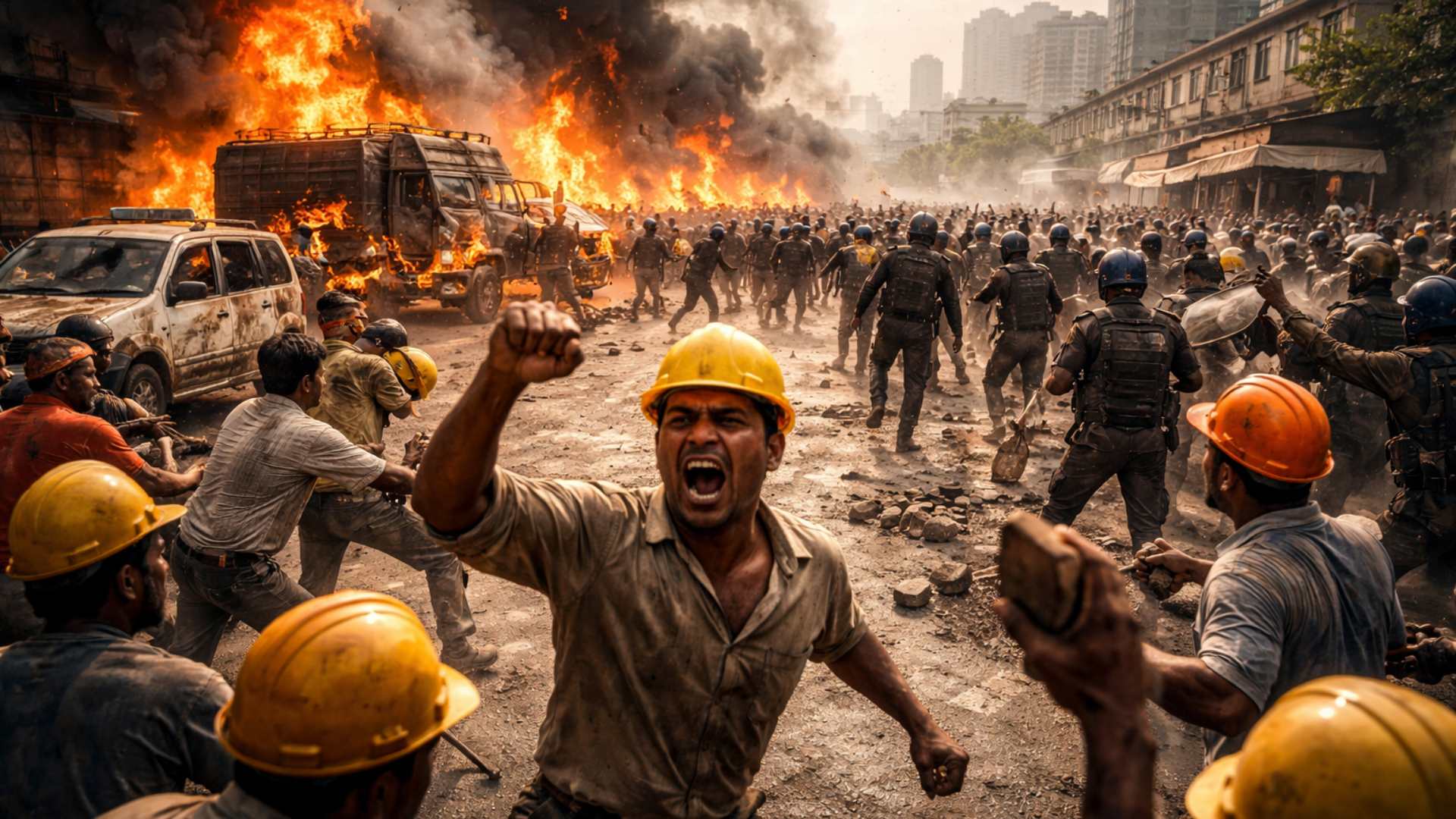
The April 2025 Noida industrial belt protests — involving stone-pelting, vehicle arson, and police lathicharges — exposed a structural paradox at the heart of India's labour market: workers employed inside formal factories lacking the most basic formal protections.
| Indicator | India (Non-Agri Regular Workers, 2025) | Uttar Pradesh |
|---|---|---|
| No written job contract | 58.2% | 67.8% |
| No social security benefits | 51.7% | 59.2% |
| No paid leave | 47.3% | 62.4% |
| All three deprivations combined | — | 46.3% |
| Contract workers in formal manufacturing | 42% (2023–24) vs 35% (2014–15) | — |
Background & Context
What triggered the protests? When Haryana revised minimum wages by ~35% following unrest in Faridabad, Gurugram, and Manesar, workers in Noida recognised their wages were comparatively lower. Compounding this, a sharp rise in LPG and food costs had already eroded real purchasing power.
UP Government's response: An interim wage hike of ~21% for unskilled workers in Noida and Ghaziabad — raising wages from ₹11,313 to ₹13,690/month — fell short of union demands of ₹18,000–₹25,000/month.
Key Concepts
1. The Formal-Informal Paradox
India's labour market has a peculiar structural feature: formal sector establishments co-exist with informally employed workers within them. Workers hired through contractors — who now constitute 42% of industrial workers — typically lack written contracts, paid leave, and ESI access. This is called contractualisation of formal employment.
2. Real Wages vs. Nominal Wages
Nominal wage increases appear large but are eroded by inflation. Consumer Price Index (CPI) for industrial workers in the Delhi-NCR belt has risen 45–52% since 2016, while wage revisions in UP rose only ~59% over the same period — a marginal real gain that shrinks further after accounting for higher food and fuel costs.
| State | Nominal Wage Increase (2016–2025/26) | CPI-IW Inflation (~2016–2025) | Real Gain |
|---|---|---|---|
| Delhi | 92.9% | ~43.7% | Moderate |
| Haryana | ~88.6% (post-revision) | ~50%+ | Marginal |
| Uttar Pradesh | ~59% (incl. 2026 interim hike) | ~50–51% | Very Low |
3. New Labour Codes and Their Impact
The four Labour Codes enforced from late 2025 consolidated 29 central labour laws. However, critics point to key structural concerns:
- 12-hour workday permitted — allows employers to extract more labour at or near minimum wage
- Wage floors set centrally but actual wages left to states — creating inter-state disparities and a race to the bottom
- Restrictions on worker strikes — weakens collective bargaining
- Encourages contract labour rather than incentivising permanent employment
- Tripartite consultation bypassed — Indian Labour Conference has not met since 2015
Structural Drivers of Labour Vulnerability
1. Contractualisation: Share of contract workers in formal manufacturing at its highest since 1997–98. Contractors act as intermediaries, insulating firms from labour law compliance.
2. Migration and Desperation: Many Noida workers are inter-state migrants with limited bargaining power and no fallback employment. Cost of living pressures are immediate — cooking fuel costs alone reportedly rose ₹3,000–4,000 in a single month.
3. External Economic Shocks: US tariff pressure and Strait of Hormuz supply disruptions raised input costs for industries. Trade unions argue these costs were disproportionately transferred to labour rather than absorbed by capital.
4. Weak Enforcement Machinery: Even where laws exist, inspection regimes are thin. Yogi Adityanath government initially labelled protests a "conspiracy" before announcing the interim hike.
Comparative Case Studies
| Event | Location | Core Demands | Outcome |
|---|---|---|---|
| Noida Factory Protests (Apr 2025) | Gautam Buddha Nagar, UP | ₹18–25K wages, fixed hours, overtime pay | 21% interim hike — demands unmet |
| Samsung Workers' Strike (2024) | Sriperumbudur, Tamil Nadu | Wage revision, unpaid overtime, union recognition | Partial settlement |
| IOCL Panipat Strike | Haryana | 8-hr workday, better wages, safety | Ongoing |
| NTPC Patratu / Adani Raikheda | Jharkhand / Chhattisgarh | Wages, working conditions | Ongoing |
A common thread runs through all: the Labour Codes regime has not strengthened worker protections in practice.
Implications & Challenges
For Industrial Policy: Persistent informality within formal manufacturing undermines the "Make in India" vision. Investor confidence is not just about ease of doing business — it also depends on social stability.
For Social Justice: Domestic workers who joined protests were barred from residential societies using their photographs — a civil rights violation that went unaddressed by both state and central governments.
For Federalism: Minimum wages are a concurrent subject; inter-state wage disparities create migration pressures and competitive informality between states.
For Governance: The Labour Codes were passed without convening the Indian Labour Conference (last held 2015), bypassing the tripartite consultation mechanism — undermining the legitimacy of the reforms themselves.
Way Forward
- Enforce written contracts universally in all registered establishments as a basic compliance benchmark
- Index minimum wages to CPI-IW to prevent real wage erosion between revision cycles
- Revive the Indian Labour Conference for genuine tripartite dialogue before further code amendments
- Limit contract labour in core production activities; restrict it to genuinely ancillary work
- Strengthen labour inspection with digitised, risk-based monitoring rather than discretionary inspections
- Address civil liberties of protesting workers — blacklisting and photographing workers in residential spaces must be legally challenged
Conclusion
The Noida protests are not an isolated wage dispute — they are symptomatic of a structural deficiency in India's industrial labour regime, where formal employment and informal conditions coexist. The Labour Codes, in their current form, have tilted the balance toward capital without delivering commensurate protections to workers. Sustainable industrial growth requires that workers in formal establishments enjoy formal protections in practice, not merely on paper. A state that ignores this contradiction risks recurring unrest across its industrial corridors — undermining both social equity and economic productivity.
Attribution
Original content sources and authors


Syllabus classification
How this article maps to GS papers
Main syllabus
GS3Jobs & Inclusive GrowthQuick Q&A
What does the Noida labour unrest reveal about the nature of employment in India’s formal sector?
Data from the Periodic Labour Force Survey (PLFS) underscores this issue. Even among regular salaried workers in non-agricultural sectors, over 58% lack written contracts and more than half are not eligible for social security. In Uttar Pradesh, the situation is more severe, with nearly half the workforce lacking all three: contracts, leave, and social protection.
This phenomenon is often termed “informalisation within formalisation.” It implies that economic growth and industrial expansion have not translated into secure and dignified employment.
Key implications include:
- Worker vulnerability: Increased risk of arbitrary dismissal and exploitation.
- Weak labour rights enforcement: Laws exist but are poorly implemented.
- Social inequality: Lack of benefits perpetuates economic insecurity.
The Noida protests, therefore, are not isolated incidents but symptomatic of deeper structural issues in India’s labour market.
Why does the rise of contract labour contribute to labour unrest in industrial regions?
Contract labour arrangements typically involve intermediaries, which creates a disconnect between workers and principal employers. This often results in:
- Lack of formal agreements: Workers rarely have written contracts.
- Limited access to benefits: Social security schemes like ESI are often unavailable.
- Job insecurity: Workers can be dismissed easily without due process.
For example, in the Noida industrial belt, many workers involved in protests were contract workers who lacked basic protections despite working in formal factories.
From an economic perspective, firms prefer contract labour to reduce costs and increase flexibility. However, this comes at the expense of worker welfare and long-term productivity.
The resulting imbalance creates tensions: workers face exploitation, while employers prioritise cost efficiency. This structural mismatch often culminates in protests and industrial unrest.
Thus, the rise of contract labour is not merely a labour market trend but a central factor undermining industrial harmony.
How do wage trends and inflation interact to shape workers’ real income and discontent?
For instance:
- In Uttar Pradesh, wages for unskilled workers rose from ₹7,107 (2016) to ₹13,690 (2026).
- However, inflation in industrial centres increased by nearly 45%-52% during the same period.
This implies that real wages (adjusted for inflation) have not improved substantially, leading to persistent financial stress for workers.
Additional factors intensifying the issue include:
- Rising cost of essentials: Fuel and LPG prices have surged significantly.
- Irregular wage payments: Delays exacerbate financial insecurity.
- Household expenditure pressure: A large share of income is spent on basic needs.
For example, workers reporting that one-sixth of their income is spent on cooking fuel indicates severe cost-of-living stress.
This mismatch between wages and living costs creates dissatisfaction, even when nominal wage increases appear significant.
Thus, labour unrest is not merely about wage levels but about declining purchasing power and economic insecurity.
Critically analyse the impact of the new Labour Codes on workers’ rights and industrial relations.
Potential advantages include:
- Ease of doing business: Simplified regulations reduce compliance burden.
- Uniformity: Consolidation of multiple laws into four codes.
- Flexibility: Allows firms to adapt to market conditions.
However, significant concerns have emerged:
- Extended working hours: Provision for 12-hour workdays may increase exploitation.
- Weak enforcement: Labour rights remain largely on paper.
- Restrictions on strikes: Limits workers’ ability to protest.
- Encouragement of contract labour: Reduces incentives for permanent employment.
For example, the Noida protests and similar strikes in Sriperumbudur (Samsung) and Panipat (IOCL) suggest that workers feel inadequately protected under the new regime.
From a policy perspective, the challenge lies in balancing flexibility for employers with security for workers.
Thus, while the Labour Codes represent an important reform, their success depends on effective implementation, stakeholder consultation, and safeguards to protect workers’ rights.
Using recent industrial protests in India as a case study, examine the recurring causes of labour unrest.
Recurring causes include:
- Low wages: Workers demand wages aligned with rising living costs.
- Poor working conditions: Long hours and unsafe environments.
- Lack of job security: Prevalence of contract labour.
- Absence of union recognition: Limits collective bargaining.
For example, the Samsung strike in Tamil Nadu involved demands for union recognition and fair wages, while the Noida protests focused on wage disparities and lack of basic protections.
These cases highlight structural issues rather than isolated घटनाएँ:
- Weak enforcement of labour laws.
- Delayed wage revisions.
- Inadequate institutional dialogue, such as the absence of the Indian Labour Conference since 2015.
The broader implication is a systemic failure in labour governance. Without addressing these root causes, such protests are likely to recur.
Thus, India’s recent labour unrest underscores the need for comprehensive reforms that ensure both economic efficiency and social justice.
What policy measures can address the structural issues highlighted by the Noida labour protests?
Key policy measures include:
- Strengthening enforcement: Ensure compliance with labour laws, including contracts and social security.
- Rational wage setting: Align minimum wages with inflation and cost of living.
- Regulating contract labour: Limit excessive reliance and ensure equal benefits.
- Reviving tripartite dialogue: Reconstitute forums like the Indian Labour Conference.
For example, successful implementation of Direct Benefit Transfers (DBT) in welfare schemes shows that targeted and transparent systems can improve outcomes. A similar approach can be adopted for labour welfare.
Additionally, improving working conditions is crucial:
- Enforcing reasonable working hours.
- Ensuring workplace safety.
- Providing grievance redressal mechanisms.
From a long-term perspective, policies must aim to formalise employment rather than merely formalise enterprises.
Thus, the solution lies not in ad hoc wage hikes but in systemic reforms that guarantee dignity, security, and fairness for workers.
Practice questions
1 question for mains preparation